Prologue in the form of a duel
In his Dictionnaire entry dedicated to Les Vampires by Louis Feuillade, Jacques Lourcelles challenges Julien Gracq to a duel. The latter, an eminent reader, generous and not inclined to general ideas, got himself caught in the flagrant act of schematism by approaching cinema from above (having been adapted not once, but twice, and notably by the great André Delvaux, might have led him to this hubris of the ‘original author’ for whom cinema is a degradation of the Text):
This portion of neutral filler, inactive and insignificant (like the quantum satis of distilled water in pharmaceutical preparations), which as a rule is worthless in a painting, a poem or even a novel, reaches its maximum in cinema. Even in the most rigorously composed and purged image, the most purely significant one, the camera welcomes within its rectangular frame a jumble of objects: the bric-à-brac of the decorator, landscaping details, the gleam of the water, the shadows cast, the clouds, the movements of leaves — which are too much, which are just there, captured in a state of total non-participation by sensitive film [...]. Color and the rather recent taste for natural setting considerably increase in a film this lion’s share taken by pure contingency [...]. There isn’t a single element of his art, visual, aural, or even rhythmic, of which the filmmaker is the master in the first degree, as the writer is of his words. [1]
After enduring blanks without batting an eyelid, Lourcelles takes his shot at the winner of the 1951 Goncourt Prize. He pulls the trigger:
If it is ‘relatively’ easy to be personal with a material of which they are masters in the first degree, as it is for writers, painters and musicians, then it becomes a new challenge for any work to be so with the photographic reflexes of a reality belonging to all. And the genius of great filmmakers is measured precisely by their handling of a material that could not from the start belong to them in particular. Feuillade’s handling of the setting — of the up close and far away spaces of the action he shows — was total, disturbing, and almost inexplicable. [2]
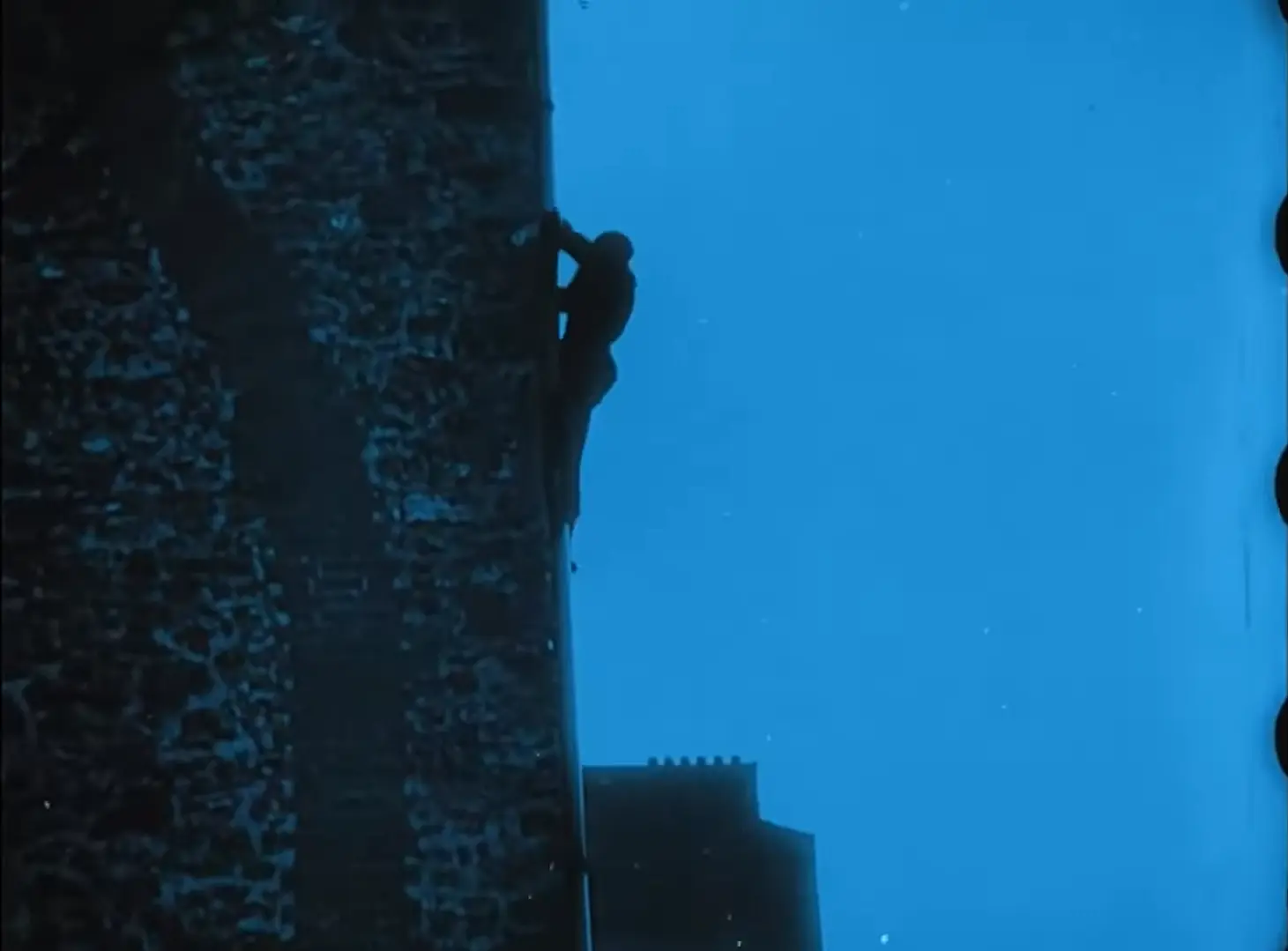
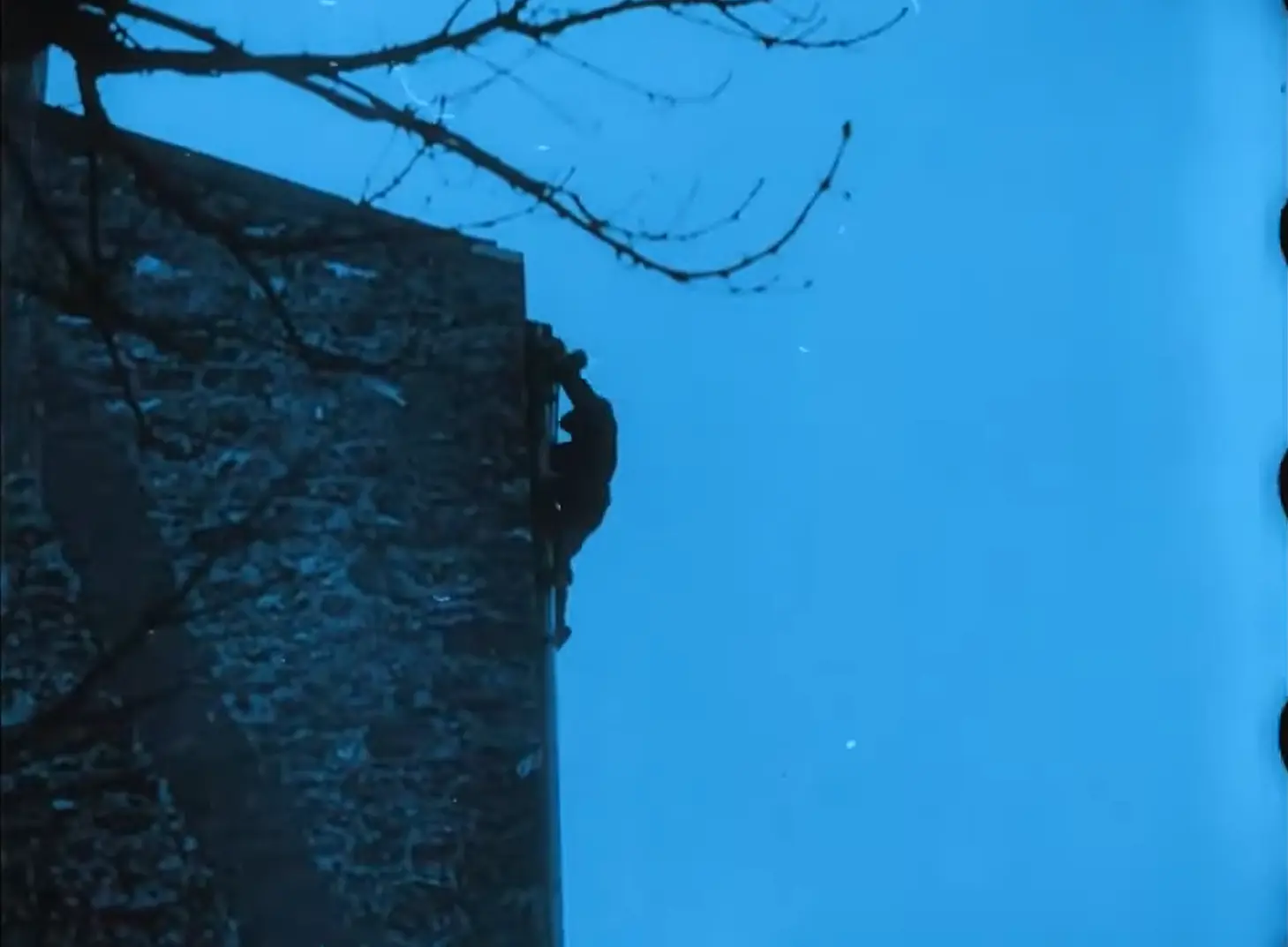
Les Vampires (Louis Feuillade, 1915–1916), episode 9: L’Homme des poisons
‘To be personal’ with materials ‘belonging to all’ (at least in the form of a common denominator: appearances and their apparent passivity) would therefore suggest a heroic gesture, that of the metteur en scène who exerts his control whatever the cost may be, beyond the harshness of contingency particular to his art, turning chance into a new necessity: the material that could not belong to him in particular ultimately does belong to him, in its very impurity within the work. I’d like to find a verb other than ‘belong’ that can make the filmmaker (and the artist in general) sound less like a poacher, but that would open up a parenthesis I’m too lazy to close. What’s important is to agree with Lourcelles that it matters little, in the end, that the artist be the master of his materials in the ‘first’ or ‘second’ degree; it matters only that he be this, at one moment or another and to different degrees. The metteur en scène has the luxury of a control that takes on the casual airs of the observer of the real. The literary man or the painter, if they wish to adorn themselves with the feathers of objectivity, must prolong themselves indefinitely in commentaries and justifications, in forewords and explanatory prefaces, while the filmmaker can, in a way, let his work dress itself in the thousand fires of evidence. But if Gracq is wrong in placing cinema below literature and other arts, under the pretext of a presumed passivity of the materials with which the filmmaker works, we wouldn’t go so far as to do the opposite: to place cinema above literature precisely because of this apparent passivity of the author more or less constrained by contingency. [3] To those who, taking the opposite stance of Gracq’s assessment (but on the same basis as his), would establish this superiority of the filmmaker on the possibility of erasing himself completely behind his work, we respond that it is precisely because he can feign neutrality and ‘erase his tracks’ — as we are accustomed to saying — that the filmmaker is a demiurge of an even more cunning kind than the transparent narrator who creates his worlds out of words without being able to wholly conceal himself within them, as the former has the leisure to do.
I would even go a little further than Lourcelles (and his prudent ‘relatively’) by posing the following question: at the end of the day, and momentarily setting aside notions of ‘first’ and ‘second’ degrees, do the words writers use belong that much more to them than the Paris of the belle époque belonged to Louis Feuillade? It seems to me that it is only in the particular context of their own work that the writer as well as the filmmaker can, in the span of a shot or a sequence, a metaphor or a sentence, take hold of these materials which, in their original forms, always remain available to others outside of this given context (I could very well visit the real sites where Vampires was shot after Louis Feuillade, or use the words ‘longtemps’ and ‘de bonne heure’ after Proust; this would not, however, lead me to appear in the film of the former or rewrite the novel of the latter). By what right can Mr. Gracq legislate on what does — or does not — take part in or go against the shot? Everything that is in the frame, image or sound, chosen or not by the filmmaker, is all the same a matter of choice: it no longer matters, to the spectator at least, that a tree leaf was chosen by the filmmaker, added by the editor, suggested by the producer, or left there inadvertently; it matters only that the whole, that all the elements of the mise en scène take part in that which is visible and audible. The filmmaker has a particular relationship with contingency (he may fight against it or make it a powerful ally, but he can’t simply ignore it), but this does not imply either the superiority or the inferiority of cinema in relation to other arts.
Imaginary city and real city
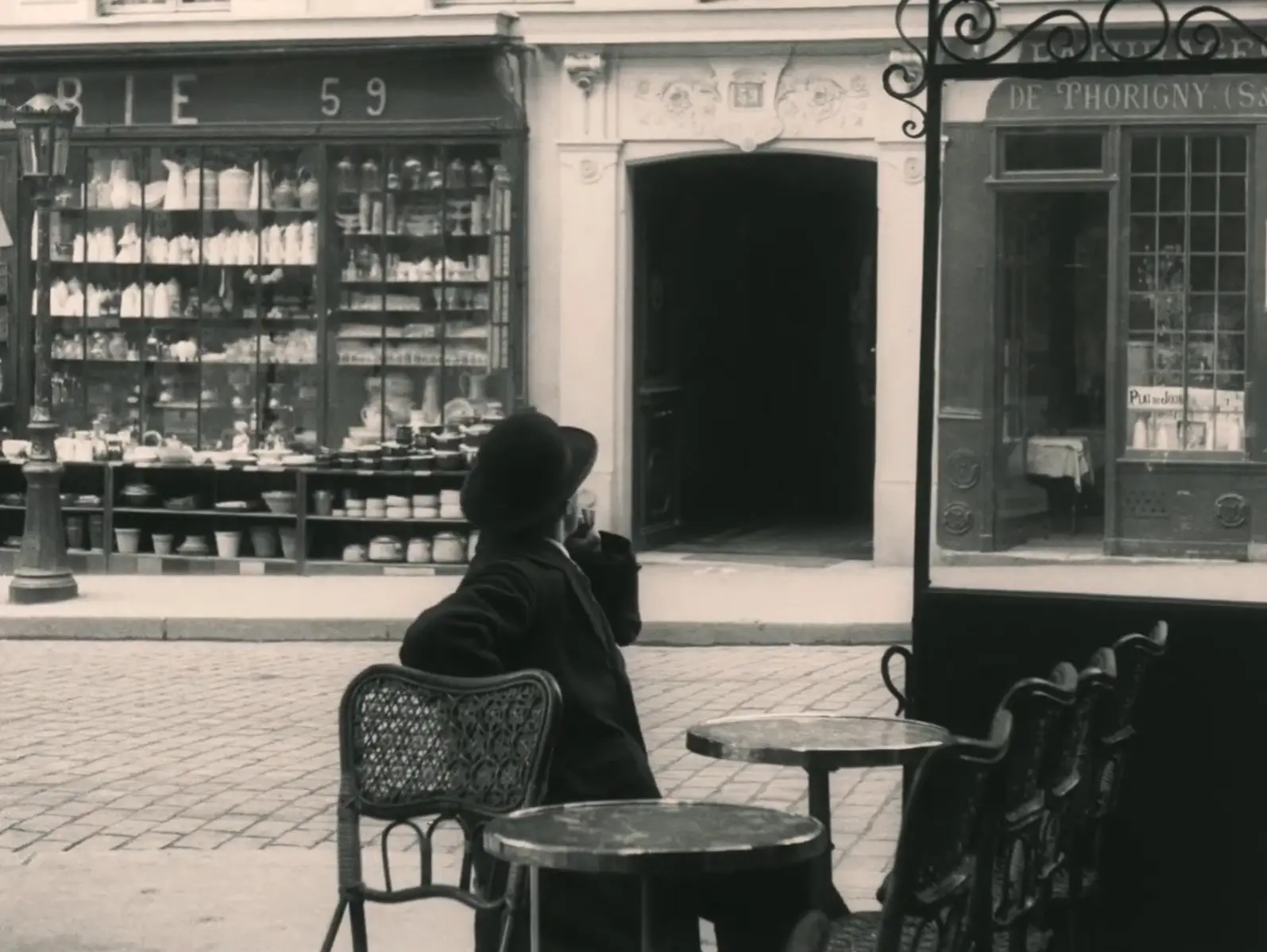
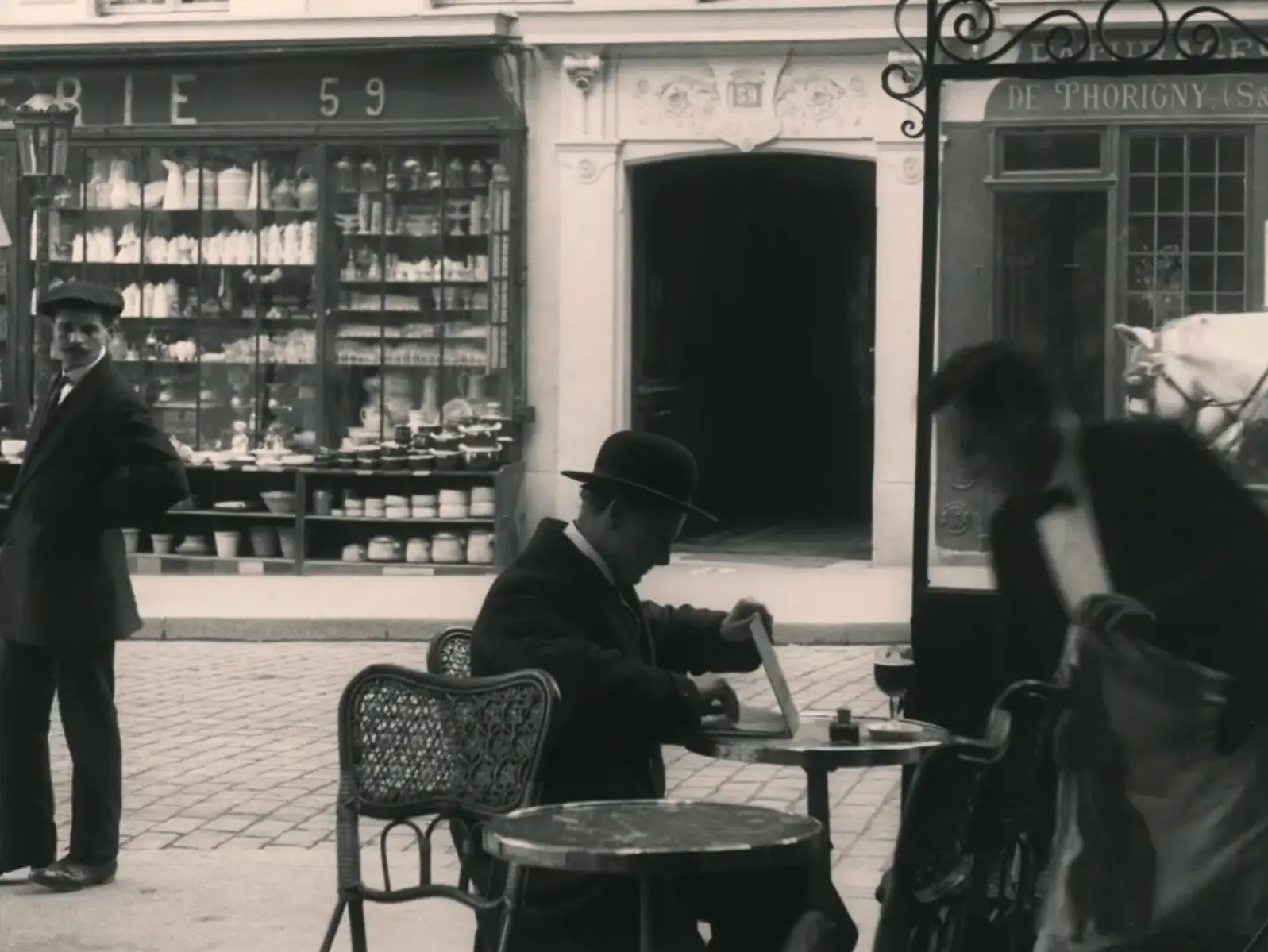
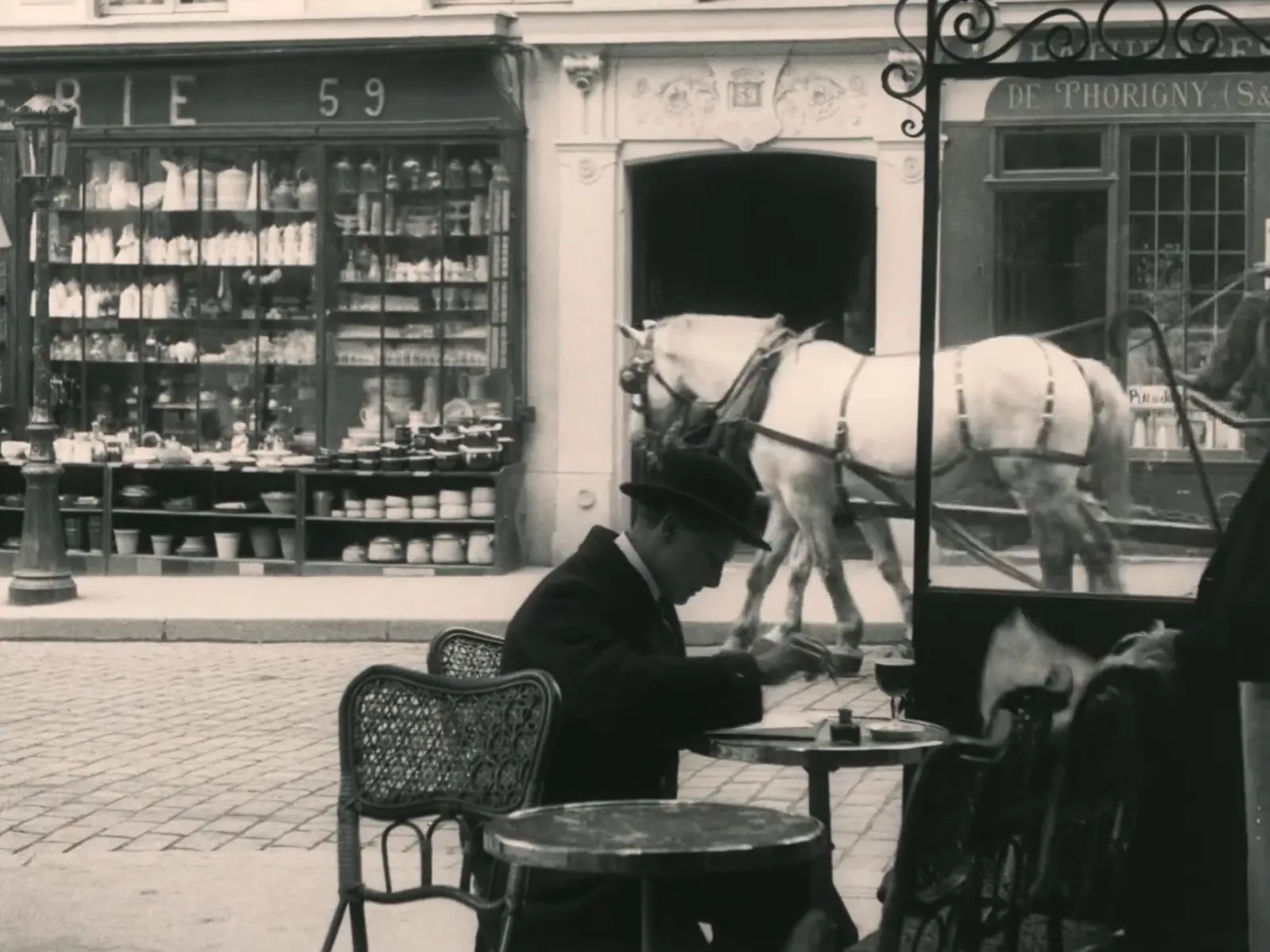
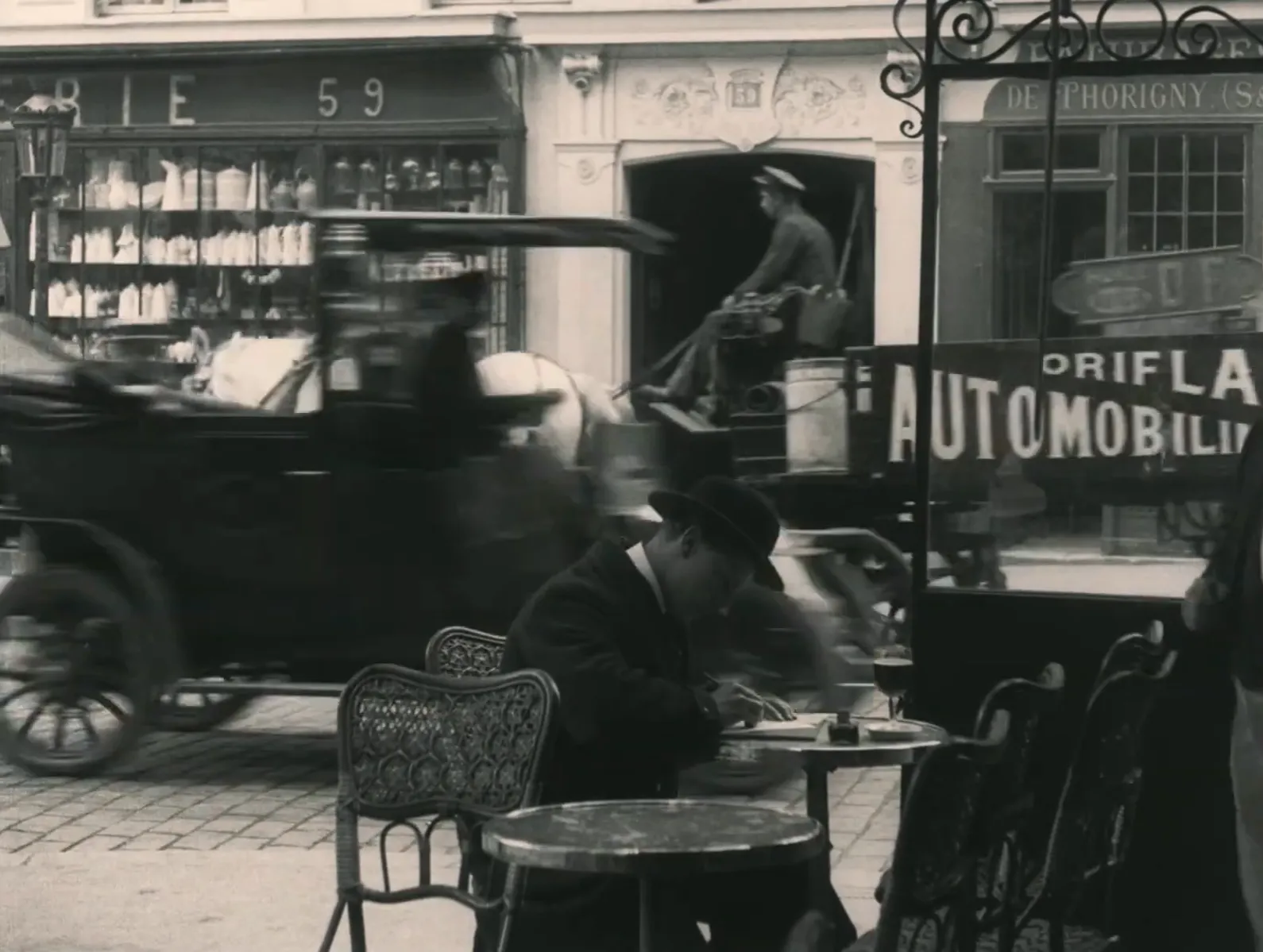
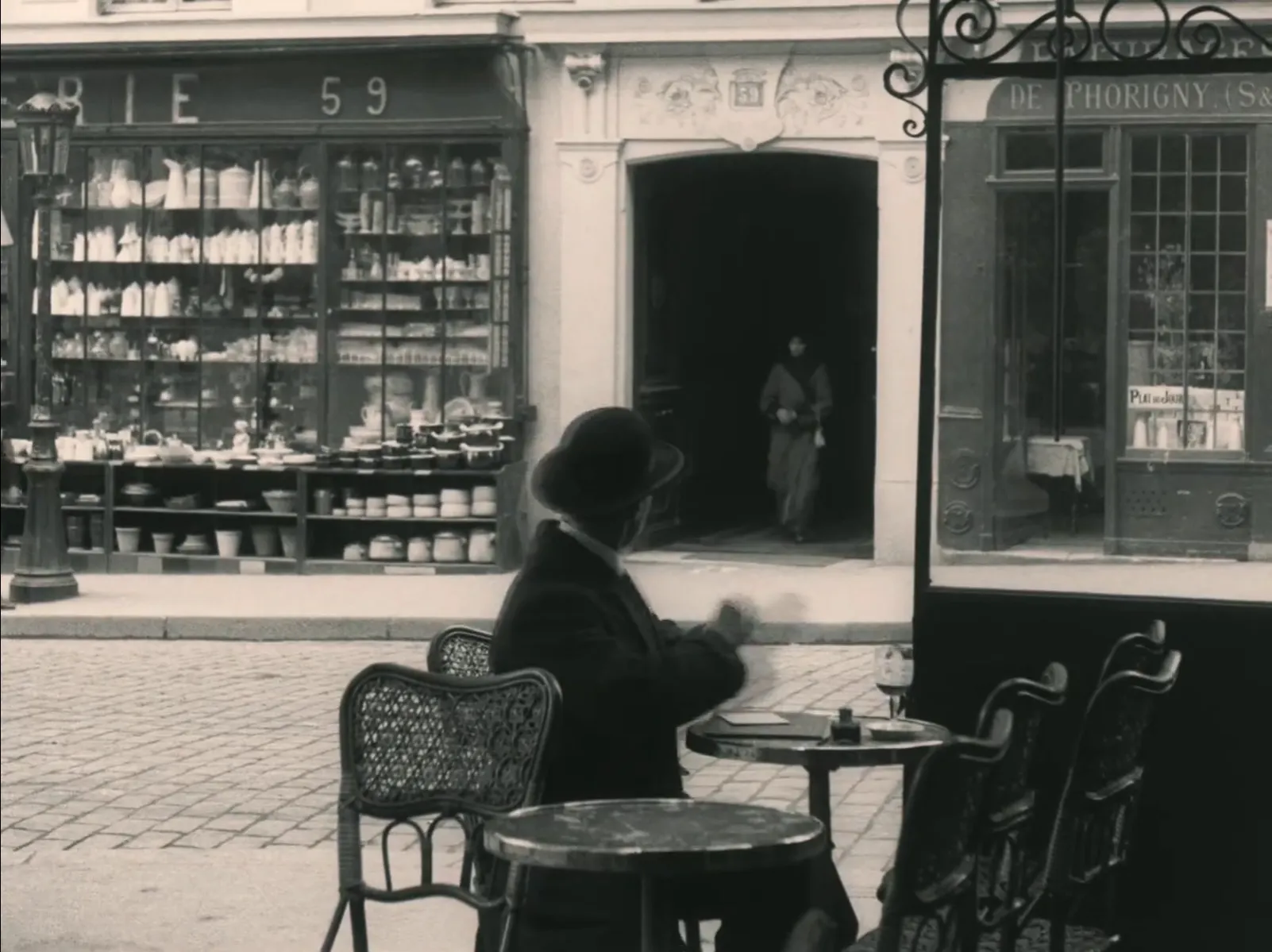
Fantômas (Louis Feuillade, 1913–1914), episode 2: Juve contre Fantômas
The London of Dickens and of Thomas Burke’s Limehouse Nights, the Paris of Balzac and Eugène Sue, before being cities on paper transfigured by our authors, are very real cities shared by their fellow countrymen of flesh and bone: the industrial and populous city, this ‘amazing assemblage of movements, machines and thoughts’, [4] cannot become imaginary except on the condition of being able to impose itself upon the imagination of novelists by way of its social, cultural, and finally mythological excess. Similarly, when Feuillade samples ‘photographic reflexes’ of Paris, it is simultaneously the real city and the imaginary one that was nourished by the serial novel and the popular tradition he records on film. Let us not be mistaken: Feuillade is a filmmaker of the nineteenth century. The ‘rehabilitation’ as well as ‘new reading’ [5] of his work in the postwar years (by the likes of Franju, Lacassin, Resnais, Rivette, Fieschi) could convince us of two things: that the nineteenth century haunts ours, and that Feuillade had one foot before his time, [6] in the chimeric 1800s, and the other ahead of his time, in a land of labile and ludic fictions that a certain French cinema will explore in a somewhat facetious (even vaguely intellectualizing) manner. We can easily take Jacques Rivette as the spearhead of this tacit ‘return to Feuillade’, [7] a distant lineage illustrated by filmmakers such as Eduardo de Gregorio, Hugo Santiago and Pierre Zucca. This handful of attempts by this French cinema of the sixties and seventies to renew their bonds with a form of fancy, investing in literary registers considered ‘minor’ until then (at least in France) — roman populaire, science fiction, fairy tales, comics — would deserve an in-depth study of its own. I am content to simply stress that this handful of works, which I conveniently place under the patronage of a Feuillade resuscitated for the circumstances, does not exactly renew their bonds with ‘popular cinema’ as it could have existed in the first decades of cinema. Rather, for such an ‘auteur’ cinema eager for experimentation and more or less informed by the critical discourse of the time, it was about exploring narrative modes that then appeared rich in cinematographic possibilities. To find a less self-conscious, and therefore more ‘innocent’ heir to the director of Fantômas and Vampires, we would have to cross the Atlantic and leave the confines of the post-Nouvelle Vague to face a more openly popular and ‘commercial’ cinema: that of a certain Larry Cohen.
Thanks to this helpful shortcut, we may quit Paris to now find ourselves in New York. An industrial and cosmopolitan city, violent and vibrant, New York becomes, in the Western imaginary of the twentieth century, what Paris (or London) could have been in that of the nineteenth century. A real city, the city of maps, records and statistics, it is thanks to its pure force of fascination that New York could in turn be so represented by the authors, artists and filmmakers that found in it the effervescence of one thousand and one modern marvels, one thousand and one urban nightmares. And if the Paris of the roman populaire, destined to disappear and on its way to disappearing, finds in Feuillade its ultimate elegist, the city of New York, very much alive, finds some fifty years later in Larry Cohen a particularly inspired poet who, like his illustrious French ancestor, does not limit himself to the observation and description of life in his new Babylon, but sets out to beat it in its own game: that of fabulation.
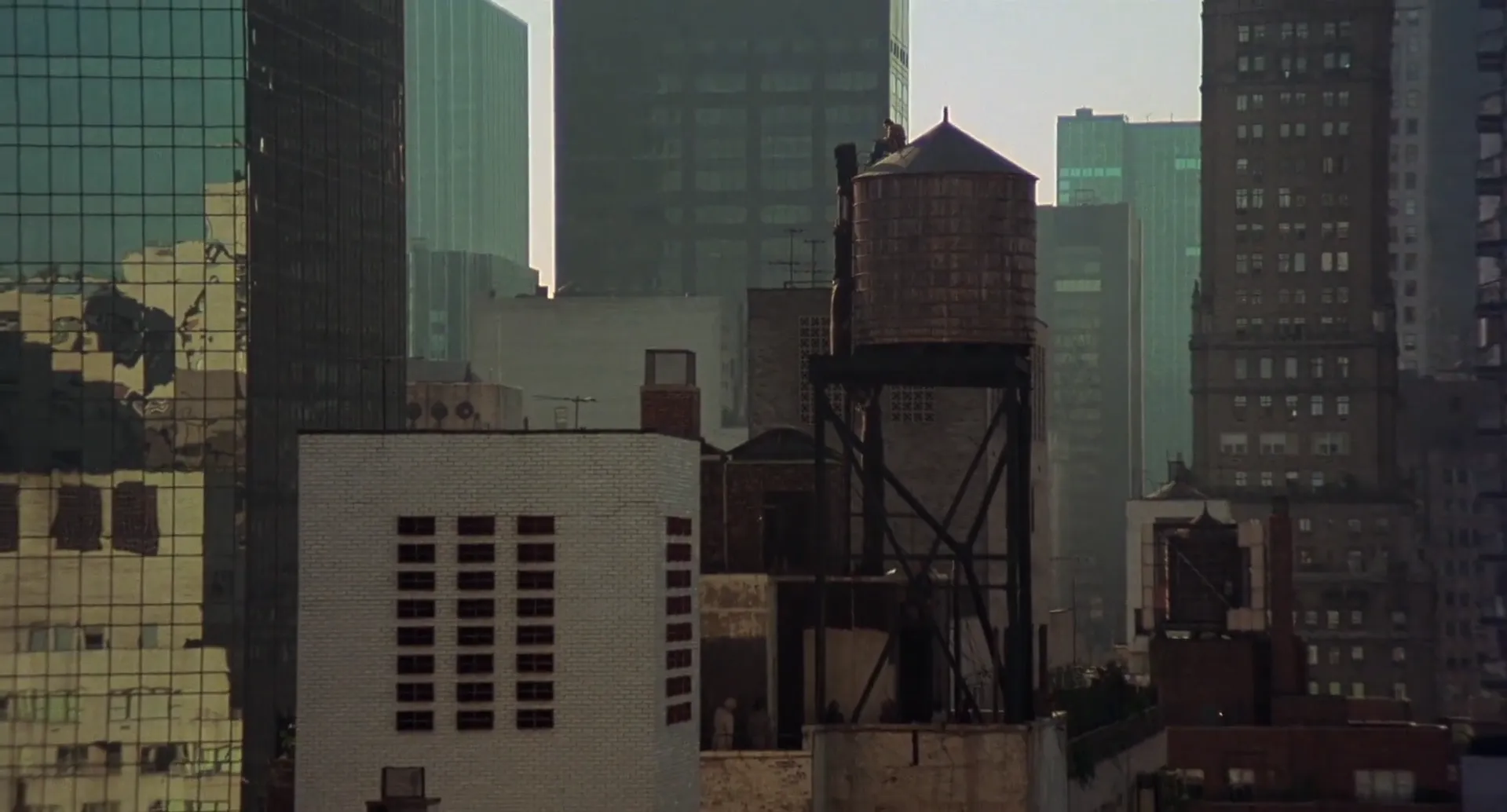
God Told Me To (Larry Cohen, 1976)
Feuillade’s way
This gesture of placing Cohen alongside the adoptive father of Fantômas is first of all to bypass the Méliès–Lumière quarrel: ‘The Méliès–Lumière quarrel no longer keeps us up at night.’ [9] It’s to silence in us the need for a reassuring classification, the schismatic reflex that, instead of thinking about their convergences — what of Méliès there is in Lumière, and what of Lumière in Méliès — would rather create a ‘third way’ to distinguish itself. We may be eternally grateful to Alain Resnais for having wanted to place Feuillade side by side with these two great primitives, [10] but, the way I see it, Feuillade isn’t the officiant of a marriage of convenience between two distinct currents of the nascent art of the cinematograph: he simply offers less grip to the somewhat simplistic (although sometimes fruitful) reading that wished to separate the pioneers of the Old Continent into two distinct traditions almost hermetically separated from each other. Feuillade does not forge by some hidden operation an alloy of realism and fantasy: he instinctively knows that the fantastical does more than ‘accommodate itself’ to a real setting and that sometimes it may require this everyday background in order to strike the modern man with all its force. The fantastical does not limit itself either to the setting or to props, but to an approach that, like the path of Novalis, ‘goes towards the interior’. [11] The fantastical in cinema is as much in the eyes as it is in what’s in front of them.
What can be surprising, then, about the fact that a man of the nineteenth century, a city dweller (and at a time when cities were still only partially banalized by the demonic breed of urbanists), may instinctively know that the uncanny is easily born out of a contrast with the everyday, that strangeness nestles in the ordinary, and that the fantastical is therefore better nourished by these customary appearances, since they give themselves to him without being asked? ‘Appearances are at last shown for what they are, deceptive for sure, but naturally so*.*’ [12] A fantastical approach to reality may require that we take its appearances for granted — and what is more granted than the places where we live, and about which we too often forget that they have their own genius, even their own demons?
What is more shocking, on the other hand, is that a filmmaker from the seventies, a specialist in quick shoots on the sly in the middle of the city — for whom the idea of a filming permit was the height of crudeness — is not content to settle for the bare minimum in regard to the real setting, that he does not ask the city of New York simply to appear in frame in order to give his works a little supplement of ‘life the way it is’. [13] What is most shocking is that Larry Cohen, to name the man, was first of all a storyteller whose verve was not satisfied with merely offering some banally lively background in the form of New York City to his fictions, but that he knew how to listen to the chimeras of his hometown and to give definitive forms to some of them. A paradoxical submission to the spirit of the place, which dictates that one must go beyond appearances and become a seer of the real underlying effervescence, of which faits divers and happenings are nothing but the foam left on the surface by a groundswell that translates even better — such is my hypothesis — into the chimeric terrain of fiction. Through him, the city wanted to be more than a background. The filmmaker humbly yielded to the will of his modern Shanghai, where ‘anything can happen at any moment’ [14] — where everything wants to happen at every moment.
Here now, to illustrate my proposition, are some suitably far-fetched remarks concerning two exemplary episodes of the great unfinished serial by Larry Cohen. For the serial, by its very nature, can only be unfinished… [15]
'God Told Me To': Legenda aurea
It is not a useless pun to say that God Told Me To is a most singular object: a UFO. At once a crime thriller, a metaphysical horror film and a work of psychologizing science fiction, we are dealing with one of the most curious ‘genre’ objects in all of the American cinema of its time, even more so if we consider that there is in this film no genre ‘blending’, but the creation of an entirely new, mutant genre, albeit one difficult to grasp. A psychotic mystery, but a mystery nonetheless. It becomes rather futile to want to dissect such an object by trying to find ‘elements’ of such and such genre: it is wiser to see a larger whole in the sum of its parts, even if it does not let itself be completely grasped by thought. Here still, we find a facet of the hyperurban ‘phenomenon’ that New York represents, insofar as we cannot reduce the city to an agglomeration of individuals and buildings, nor even to its history or the ‘facts’ that contribute to the image we may have of it. We do not describe New York, we experience it: we endure its formless turbulence. This is equally true of every particularly dense city, but New York — at least at that time — represented for the majority of Westerners (at least the North Americans…) the Citiest City there is. We do not observe New York, we are shaken by its possibilities. If Cohen describes or observes New York, it is to the extent that he anticipates those possibilities to the point of impossibility.
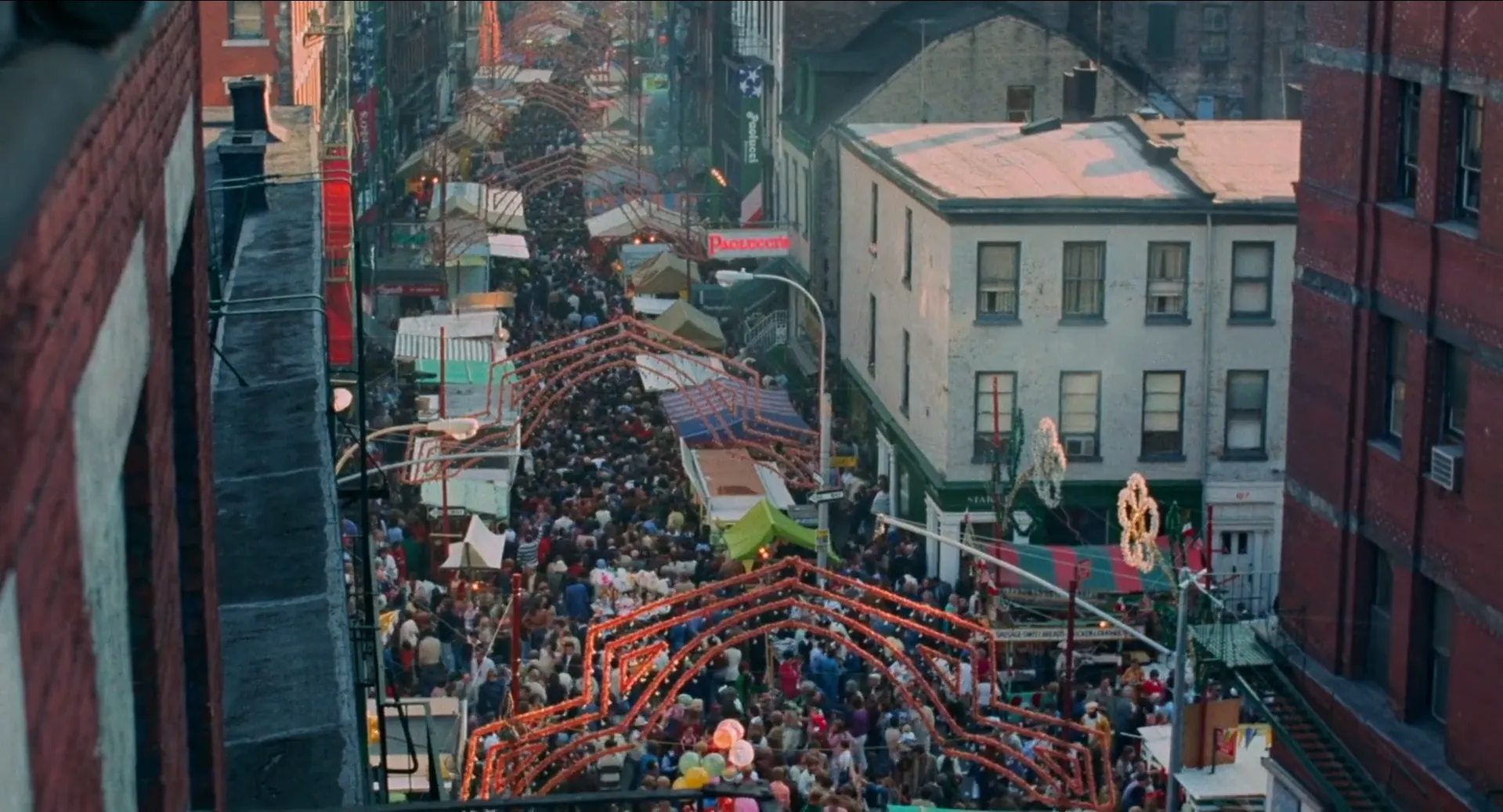
Perhaps it would be good to reverse, if only for an instant, the ordinary perspective that wants the place — before being a source of fiction — to give birth to a proliferation of ‘documents’ (individuals, events, sociological facts) to be subsequently leveraged or illustrated by fiction. A city as alive as New York is surely a fertile ground for harvesting ‘documents’ worthy of interest, yet it seems to me that through its presence always sustained by ambient phenomena (the feeling that all around, at every moment, visible or invisible, known or ignored, something is happening…), through the perpetual becoming of those phenomena and the infinity of beams they project around themselves, New York refuses to submit to its role of passive setting. We could thus venture that a documentary on New York is always an embryonic fiction — a pruned fiction — and it is not enough to ‘document’ a city that also exists as a swarming nest of potential fictions. A ‘city symphony’ of New York could not be anything but an amassing of fictions gaining in potency, unless it only shows the buildings (without any ambient sound, without any honking horn already betraying the dramatic stakes of frustrated citizens) — and, even then, it is very possible that the simple horizon line of this city is in itself heavy with dramaturgy (especially after 2001).
In God Told Me To, the city’s heterogeneity contributes to the film’s heterogeneity — not ‘as such’, since we could very well want to offer a more homogenous portrait of New York (and a number of filmmakers did and continue to do so) without however ‘distorting’ it — but because Cohen knows how to weave a drama as dissipated and opaque as that of the film into an image of the city that is equally so. The protagonist’s religious journey — his drama in the shape of an investigation — is anything but rectilinear, and consequently the presence of the city as support for this journey cannot be either. We are far from Abel Ferrara’s Bad Lieutenant, another ingenious New York ‘golden legend’, in which the slums represent the successive stations lining up on a way of the cross towards abjection, within which the particular textures of scenes (whether they are more or less naturalistic, like the scene of Zoë Lund’s injection, or almost spectacular, like the parti-colored rape of the nun) join forces and together work to bring our little Saint safely to port. No matter where Lieutenant Keitel’s steps lead him, we know that he will find his own moral dereliction there — the flip side of his redemption to come. The same does not apply to Cohen’s Lieutenant Lo Bianco, whose torturous path across streets and buildings is erratic and confusing. Shifting from police inquest to metaphysical investigation, the mystery only intensifies at every breakthrough into a new location. Behind every door, a new source of bewilderment. The only common ground (in both senses) between these films by Cohen and Ferrara is the staircase, which become in both the antechamber of the possible (like the trapdoors through which Fantômas or Juve slip), the cloakroom of vice, an alley between four walls where everything can happen (especially the worst!): the ground of the reversibility between law and crime (Keitel’s ‘Police activity!’ as he takes a drag from a crack pipe) as well as a pressing metaphysical interrogation (Lo Bianco’s gun-in-hand ‘Do you believe in God?’). Except that the ‘possible’ in God Told Me To is as distanced from Bad Lieutenant as its gnostic, ufological, libidinal and delirious implications can be from a slightly sulfurous, yet never heterodox, Catholicism.
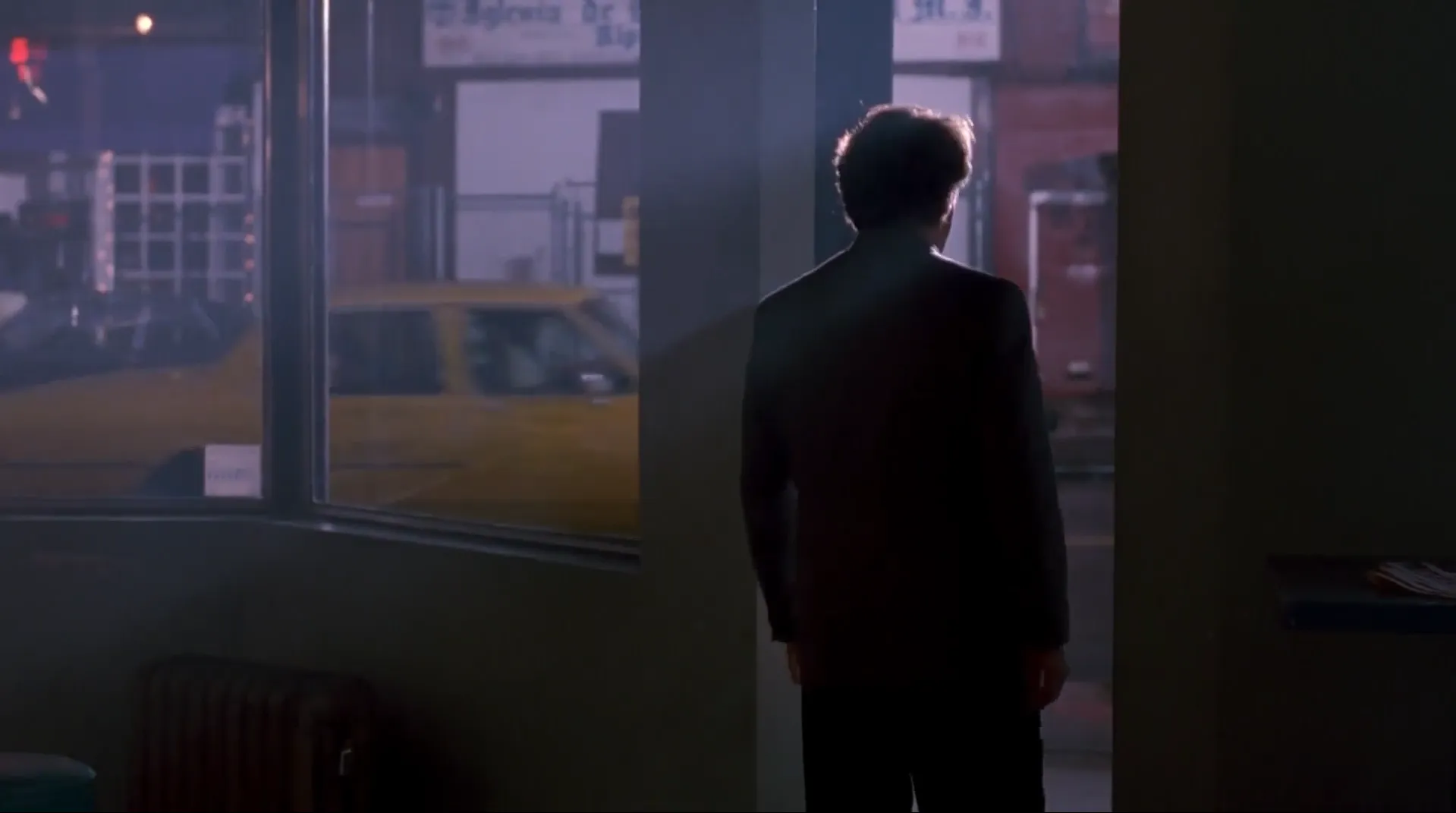
Bad Lieutenant (Abel Ferrara, 1992)
Contrary to Ferrara, who offers a profound meditation on the simplest notions — Redemption and Sacrifice, the spiritual and moral torment of a man of flesh — Cohen evokes religious motifs to unsettle, perhaps to dispute, but above all to maintain in us the vertiginous sensation of the impossible. The profusion of myths, folklore and cosmic speculation are what attach his film to a religious imaginary, rather than a ‘message’ of a moral or spiritual sort. Even the mystical revelation acquires the status of an overabundant peripeteia, a sally among sallies, which introduces a final vertigo within this affair that is already convoluted enough on a procedural level. The mise en scène and the calculated deployment of the narrative give their unity to the whole — it is possible that we have the impression of linearity only because cinema, in good hands, can allow that which is pure narrative extravagance to come to life as linear and consecutive: the film’s duration gives the smooth surface of a uniform flow to the outlandishness of the narrative and the delirious logic of the ‘always new’ which seems to preside over it.
Where the New York of Bad Lieutenant ends in Gethsemane in spite of its obscene labyrinth, that of God Told Me To ends elsewhere, in something other than itself, in something other than everything. The two films share a kind of urban eschatology, a vision of New York as a spiritual desert; in both cases, the end of times is the beginning of another time whose nature, however, could not be more radically opposed: Last Judgement and Grace, where we expect them, for Ferrara’s abject policeman — and for the detective of God Told Me To? Hard to see, hard to say… Most of Cohen’s films end in the possibility of a sequel. We can see in this the mercenary flair of the producer, yet let us also allow ourselves to see Cohen’s faith in the infinite virtualities of fiction, of every fiction.
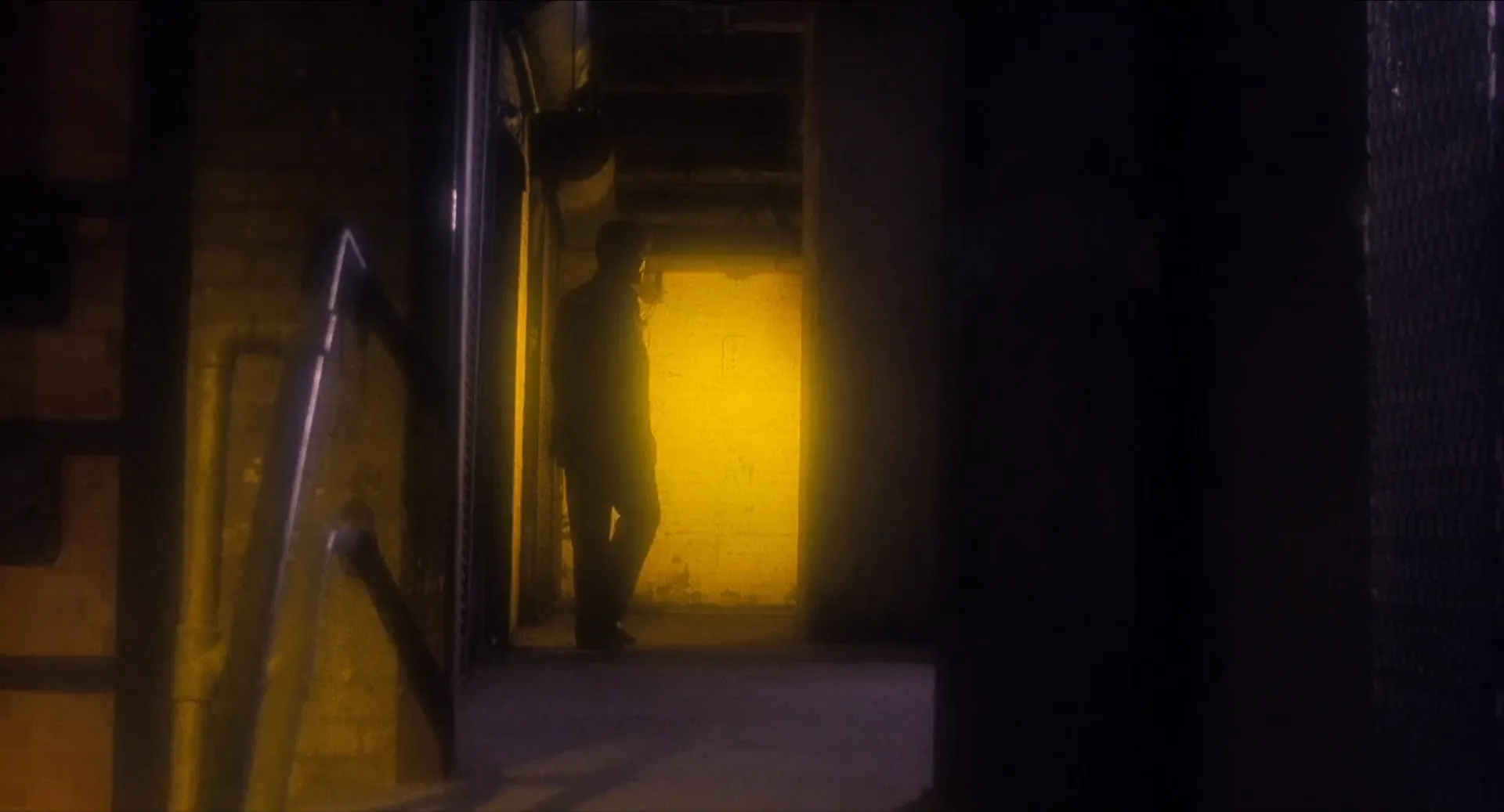
Concerning the film’s form, it seems that all that should — if we trust the dry historiographies of cinema — anchor God Told Me To in the seventies actually sets it further away. The most striking example is the status of the handheld camera, which doesn’t introduce a particular rhythm, but blends in with the rest, and may even seem to be the most concerted, firmly set and definitive element of the découpage and the arrangement of shots. We could advance the idea that the recurrence of the technique in the film induces this stability — whereas elsewhere, the handheld camera is less frequent and therefore more salient and destabilizing. Cohen and his operator resort to it for the majority of shots which constitute the film’s sequences, and the trembling motion (sometimes light, sometimes pronounced) becomes thus its principal plastic mode, in such a way that the rare shots which are more stable (shot on a tripod or a temporarily unmoving shoulder) in return come to be charged with a new expressiveness (momentarily granting more plastic force to the sole movements of the characters within the fixed frame or giving the immobility of the bodies the means to assert itself — in both cases, the ‘suspense’ of the camera’s trembling does not induce the formal appeasement we could reasonably expect). This thoughtful use of the handheld camera allows Cohen to make it a means and not an end (we should, in my humble opinion, avoid speaking of ‘style’ in regards to its usage): in a delicate balance between submitting to the characters’ movements and anticipating them, the camera spontaneously harmonizes itself with the general concern of the mise en scène and could almost make us forget that it trembles. This peculiarity has nothing striking in it, once we admit that there exists no definitive grammar of the formal procedures in cinema, the values of shots and other things, and that the functions of such procedures can vary greatly. That does not prevent it from being the case that it is quite rare to witness such a defined ‘inversion’ of the functions shared for the most part between the fixed camera and the mobile camera, and moreover in American cinema during those years. The kineticism and gonzo immediacy of the handheld camera in certain works of the new cinemas at the time do not share much in common with Cohen’s film, and convince us that the same formal procedure coupled with the same setting does not, however, produce the same effect. Unlike Friedkin, who in The French Connection ‘uses’ this ‘handheld New York’ as an exponentially kinetic factor, multiplying the agitation of the real setting by that of the camera to unnerve his mise en scène with an excess of movement to which the frame can only ever adapt itself in extremis, Cohen embraces the movement of New York because he anticipates it on the terrain of fiction, much more so than on that of formal decisions.
'Q: The Winged Serpent’: A murder is a place
Let us now leave the horizontal labyrinths to venture into the verticality of Q. We witness in the film’s opening sequences a sort of grand-scale slasher, with subjective point-of-view shots of the ‘murderer’ making their way across the skyscrapers as across the corridors of a Victorian manor. If it weren’t for the poster (and the title) of the film, it would be quite difficult to know that these shots are subjective, which, in hindsight, makes us put into question the convention of the subjective shots ‘from the point of view of the murderer’. These ‘bird’s-eye view’ shots make us realize that in the slasher, the murderer, before being a being, is frequently a place which is explored behind the backs of the poor characters of eventual victims. We recognize those ‘point-of-view’ shots only as those of a threat personified by the force of convention and the formal procedures constituting such convention, which are the use of offscreen sounds (heavy breaths), a floating/trembling camera and sequence shots which reproduce the movements of a prowler; yet, when read in the first degree, in a voluntarily literal way, these shots are above all those of places elaborated for us without a personified presence, a space patiently explored within the frame by its own volition. (Mutatis mutandis, and the opening sequence of L’Année Dernière à Marienbad only lacks the heavy breathing in off to resemble a slasher.) A place explored and possessed without the victim’s knowledge, the space creating suspense — complementing, through its spatial aspect, the (literary) definition by Thomas Narcejac: ‘Suspense is time that bleeds’ [16] — this is what tosses off the body count of this film genre, far more than the psychopathology and the individual will of the murderer. If the slasher belongs to the fantastical, this is because it may be capable of suggesting that the knife-wielding maniac is the incarnation of an invisible force, that the psychological is the fact of metaphysics: by reversing the causal relation which unites the place and the murderer, we could see in the latter the human pretext for a space which is emptying itself of all human presence. The carnage over, the space depopulated, the murderer can disappear, dissolve himself in a larger space (that of a world outside the site of carnage). In the slasher, murder is a place. This is precisely what makes all the difference between our dreamlike carnages and their maniacs walking at a slow pace, silently observing us before taking action (and reserving for each their individual little death) and those contemporary mass murders (with GoPro and assault rifles) which are massacres without a place, where the corpses who pile up become the place (like how the bodies piling up in Guyana became Jonestown). Several simultaneous or consecutive murders in the same place make a massacre; several murders separated in space and time along an itinerary make a story (a drama).
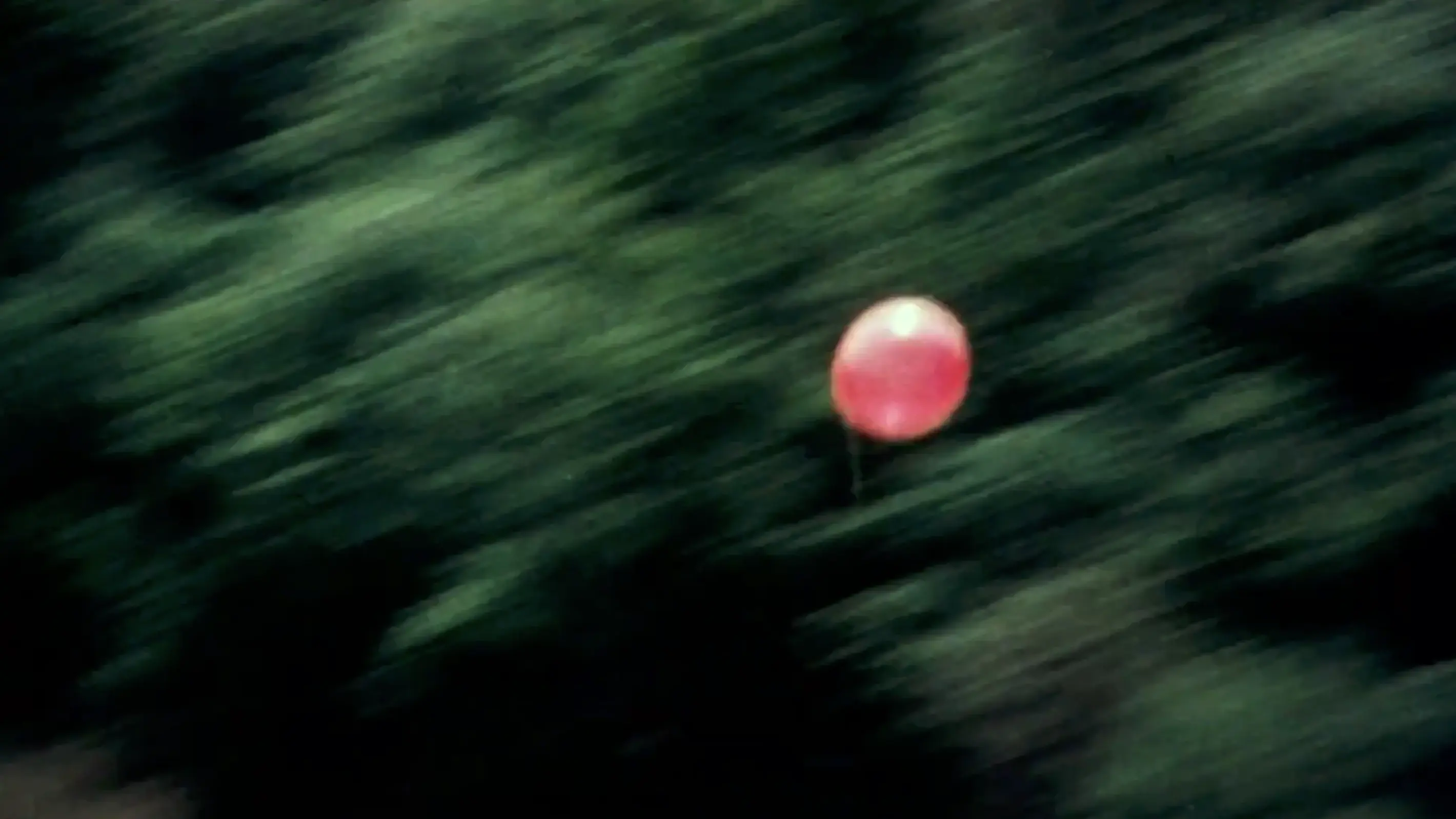
Q (Larry Cohen, 1982)
In Q, this story is that of a highly improbable place and the murders that originate from there. It’s the aerial flyby, the film’s opening, which situates the threat on a citywide scale, all while setting it in a beyond somehow ‘inaccessible’ to ordinary citizens (they can only be attacked from above yet cannot defend themselves). At first, the threat blends in with the sky; it’s the sky which comes down to seize those who have ventured there scot-free, for mundane reasons (the lecherous window washer, the frivolous sunbathers, the routine construction worker). The film does not open on just any murder, but on the most bizarre death possible: a death in the form of a gag. Most of the murders in this film will have this almost farcical quality, perhaps to downplay the victims’ deaths, thereby highlighting the gulf that separates the killer and the victims, the height of the crime scene and the baseness of those who dare to casually go there. It’s these high-altitude deaths that alarm the authorities and the population on the ground (out of reach, but powerless for this very reason); to the extent that they take place in this privileged space of the clouds where skyscrapers coexist with the extraordinary, the uncommon nature of these murders (attacking precisely the commonplace) will ultimately allow the policeman (the one played by David Carradine at least) to conceive of an equally extraordinary source of the events — a divine, supernatural origin: the dragonsnake god Quetzalcoatl. The particularly relaxed nature of his investigation, initially conducted with little enthusiasm and urgency, might cause us to wonder whether crime in New York is not so rampant on the ground (literally on hind legs) [17] that it becomes difficult for the cops to conceive of it as being anywhere but at ground level, that is, practically impossible in the open sky. At a vertiginous altitude, the rooftops of New York, like those of Feuillade’s Paris before them, offer the murderer a hideout in broad daylight. Passersby only notice the dragon’s presence through blood dripping on their clothes from above, the creature having enlisted a towering ally: the Sun and its blinding rays. But Sun and Sky can also easily blend in with the geography of the film, and the place as the origin of the drama naturally makes an accomplice, acting as a handy deus ex machina with nefarious intentions.
When the authorities finally begin to take a more serious interest in this series of unusual deaths that are terrorizing the city (or so we are told), it will only be after our true protagonist, the crook Quinn, ex-convict and ex-junkie played with a genuine touch of madness by Michael Moriarty, has found himself thrown right into the middle of the affair. Quinn is not a commoner: he’s outside and ‘below’ the class of ordinary citizens with his status as a criminal, a drug addict, an outcast — he’s sidelined even within his small gang of bandits, an outcast among outcasts. By the film’s logic, it is this specific social status which allows him to come into direct and privileged contact with evil taking up residence at the heights of the Chrysler Building. It’s thanks to one of those orchestrated accidents characteristic of the outlandish [18] that Quinn, having reached a nadir and desiring to hide (to go underground), climbs to the top of the tower and discovers the monstrous marvel which looms over the city. Going from the lowest point to the highest in a matter of minutes, his ascent to the dragon’s perch equally represents a reverse descent into hell, an ascendant horror, a paradoxically providential discovery: this sinister place where he finds the emaciated corpse of a young woman will later help him eliminate accomplices who (wrongly) accuse him of having kept stolen jewels for himself (they actually ended up under the wheels of a truck) and threaten him with death. Quinn’s discovery will further secure him a real stranglehold on the city and its authorities: his megalomania at being the only one capable of putting an end to these aerial killings, the lure of reward, but above all the vindicating pleasure of repaying American justice in its own coin. When we say of a place high above that it ‘looms over’ the city, we have rarely ever meant this so literally as when referring to Quinn discovering the creature’s chosen lair atop the Chrysler Building, which gives him the power of life or death over his fellow citizens and enables him to observe, stricto sensu, the reversal of his relationship to the city: him at the top, howling with laughter, New York at his feet, which, as his whim dictates, ‘must continue to tremble!’
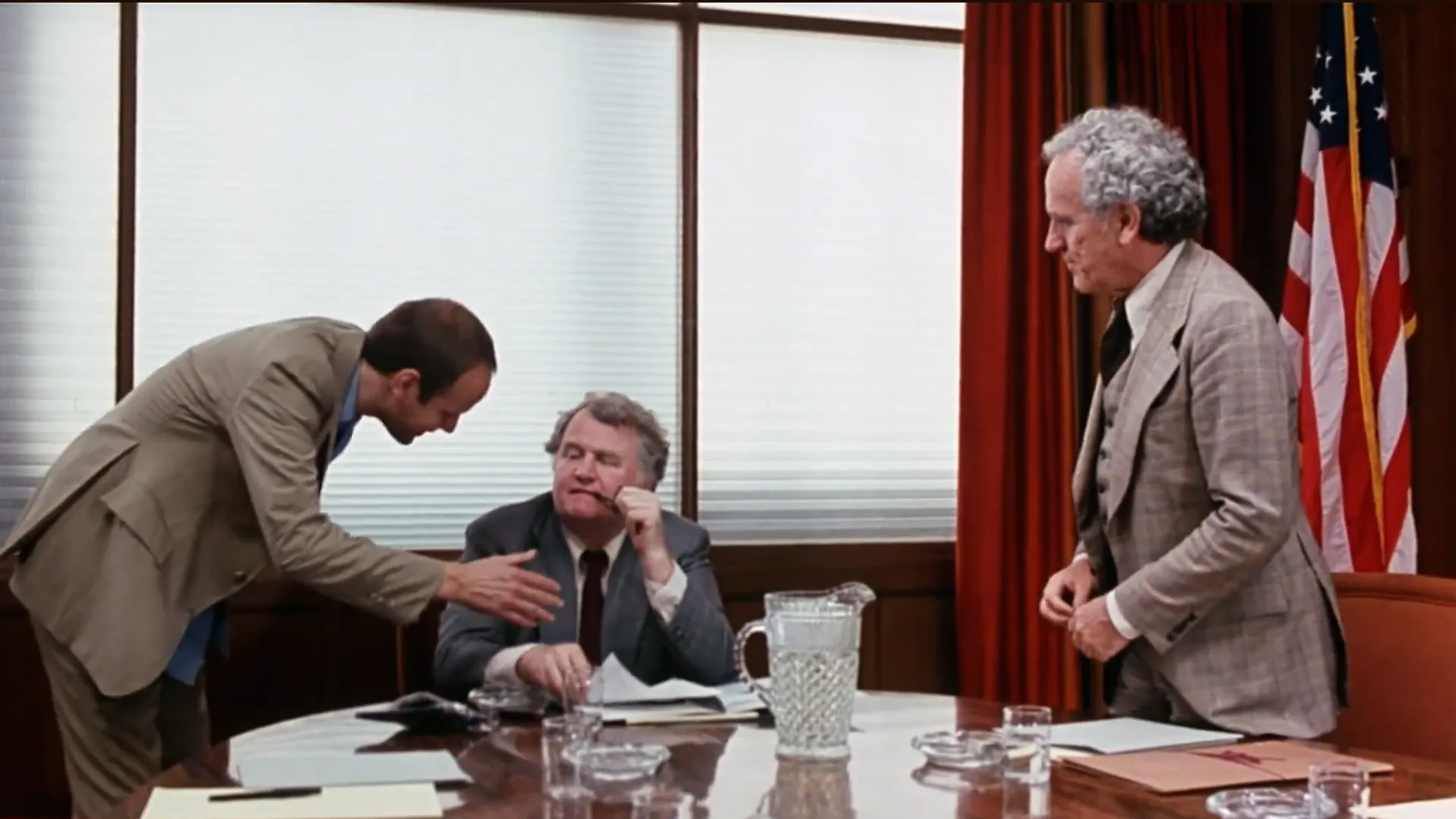
After a few dry moral deliberations, Quinn will abdicate his throne and things will be able to ‘fall back into place’: our unlikely hero will find modest salvation in the Justice that has cheated him, offering him only the dull satisfaction of having ‘done the right thing…’; the winged god and his zealous sacrificial priest will be eliminated — unless… (There is always in Cohen’s films the possibility, as amusing as it is disturbing, that evil is dormant rather than eradicated for good.) But the place — this space that had been a threat before an ethnological explanation provided us with another representative in the form of a feathered serpent — remains, a nefarious omnipotence that hovers overhead like the sword of Damocles, ready to seize the opportunity to once again be incarnated.
That a reject like Quinn ultimately could only be helped by finding himself a circumstantial ally in a bloodthirsty Mesoamerican god tells us a lot about Mr. Cohen’s ideas of American justice and the powers that claim to uphold it. This biting social critique is still more admirable for being inseparable from the complimentary joy of telling a story without getting bogged down in preaching; there is in Cohen’s work a quite rare alliance between the outlandish and social charge. Quite rare, in any case, ever since the disappearance of the entire tradition of the popular novel as practiced by Eugène Sue, Paul Féval, Ponson du Terrail, extending to Souvestre and Allain, the biological fathers of Fantômas. The popular novel relied on the most basic characterization, reducing most of the ills of contemporary society to a series of dramatis personae: the orphan, the thief, the policeman, the greedy bourgeois, the priest, the fallen woman, the ex-convict — so many fixed archetypes, but oh so manipulable by the storyteller! It was this surface-level work, this most basic melodramatic angelism that enabled the popular novelist in those days to channel such dramatic force into his works. A quick pacing allowed its (social or other) charge to hit the mark with more clarity, even if its range of attack could perhaps have been less well-defined. The social critique in the popular novel was no less powerful for that, however; it simply wasted less time: it was a critique that agreed to momentarily settle — in harmony with ‘popular common sense’ — in order to give dramatic weight to the story (by withdrawing another kind of weight, that of ‘theses’, which risked encumbering its course): what the characters lose in psychology or social acuity, what the ‘message’ loses in complexity, the whole work gains by stretching the strings of the dramatic instrument to the limit, just to make its few one-notes resonate with the utmost violence. In his own way, Larry Cohen is heir to this mode of narration that has been obsolete for at least a century, in that the polemical force of his work depends on this same confidence in the tenfold force of social critique when it is embedded in a story that does not merely provide opportunities for that critique to be heard at greater length and ‘at the top of its lungs’. The improbable and the implausible are not antithetical to reflection, but can instead become its privileged vehicle. In Q, by showing us the haphazard revenge of a ‘nobody’ against those who have trampled on him, the vertical reversal of the power dynamic between Police and Thief, that Cohen creates a work of social critique, touching lightly on the motif of the intoxication of power and the paradoxical reconciliation within man of conflicting desires for murder and justice.
Quick epilogue
While it is commonly said of certain films [19] that their city setting takes on the status of character, in order to distinguish Cohen’s films from these, it must be said that he never makes New York a ‘character’, since he expects much more from his native soil: that the City be the primary matrix which spews out characters and peripeteias like so many offerings for those who know how to seize them on the fly. Ultimately, we could say what Francis Lacassin says of the City in the popular novel: it is a silent character who does not act, but accompanies, like the chorus in the ancient epic. [20] The fantastical in cities like those of Feuillade and Cohen is not a means of escaping them, but of keeping them alive on a plane other than that of statistics and cold information; it’s not about sublimating these modern cities, much less about escaping them, but about enduring them by immersing oneself in what they suggest to the imagination. The New York of Larry Cohen is not just any city; it is, strictly speaking, not itself either: it is the city which nourishes fiction and which fiction saturates, mother and child, chicken and egg, the serpent which eats its own fabulist tail — and this serpent is always ready to fly.
Notes
Jacques Lourcelles, Dictionnaire du cinéma (Robert Laffont, 1992), 1538–41 (p. 1540). [This quote by Gracq, cited by Lourcelles, is from the chapter ‘Littérature et cinéma’, En lisant en écrivant (José Corti, 1980), 124–130 (p. 124). The first ellipsis is by Lourcelles, the second by the author of this text — Trans.]
Ibid.
As Luc Moullet does in his own way in ‘Confession impudique d’un vieux cinéphile’, Cahiers du cinéma, 497, December 1995, pp. 66–67. A translation is published in the first issue of Narrow Margin.
Honoré de Balzac, Ferragus, Histoire des Treize (Éditions Garnier, 1966), p. 41.
It is worth recalling that this renewed interest is thanks to the efforts of Henri Langlois, who organized a major retrospective in 1964, thus allowing for the (re)discovery of Feuillade’s oeuvre, which by that point had become virtually invisible for several decades.
Didn’t a contemporary like Louis Delluc criticize him for precisely this anachronism of his ‘serial-esque abominations’, judging it in the light of a certain avant-garde cinema (Gance, Dulac) which Delluc defended?
Even if Resnais may be the real instigator, especially considering that his great phantom film, Harry Dickson, a Jean Ray adaptation, began in the late fifties before being abandoned in 1967, following several drafts of the screenplay.
Translator’s note: After Du côté de chez Swann, or Swann’s Way as it is best known in English*.*
Michel Mardore, Pour une critique-fiction (Éditions du Cerf, 1973), p. 67.
‘It is said that in cinema there exist a Méliès tradition and a Lumière tradition; I believe there exists also a Feuillade current, which makes wonderful use of the fantastical in Méliès and the realism of Lumière.’ In Francis Lacassin, Louis Feuillade (Éditions Seghers, 1964), p. 153.
‘Pollen’, Novalis: Pollen and Fragments, trans. by Arthur Versluis (Phanes Press, 1989), 25–40 (p. 26). The ninth fragment: ‘Toward the Interior goes the arcane way.’ [The citation of the French translation has been replaced. — Trans.]
Frédéric Vitoux, ‘Le Revers des apparences’ (on Preminger’s Bunny Lake is Missing), Midi-Minuit Fantastique, 14, June 1966, 109–110 (p. 109).
Also the title of Papa Feuillade’s naturalistic escapade, a seventeen-episode series produced between 1911 and 1913.
So says Gene Tierney’s character in Shanghai Gesture by Josef von Sternberg, a filmmaker who could very well be related to Cohen in his use of setting (non-natural in the Viennese artist’s case, but this distinction ultimately matters little), especially when we consider this line in Claude Ollier’s magnificent text: ‘The arbitrariness of the situations is justified by that of the setting, and vice versa.’ ‘Une aventure de la lumière’, Cahiers du cinéma, 168, July 1965, 28–38 (p. 32).
The word ‘THE END’ that concludes the last episode of a series is often a mere stopgap, a narrative convenience, as though this ‘THE END’ were at most a slightly authoritarian variation of the usual ‘To be continued…’ We need only to think of the hasty conclusion of the last episode of Fantômas (Le Faux magistrat, 1914) to be convinced that the muse of the serial creator (like the author of the roman-feuilleton before him) is always Sheherazade. On the possible links between the serial format and the princess of One Thousand and One Nights, see the three-part study by Fereydoun Hoveyda, ‘Grandeur et décadence du sérial’, Cahiers du cinéma, 58–60, April–June 1956, pp. 10–20, 8–18, 4–12.
Cited in Lacassin, Sur les chemins qui marchent (Éditions du Rocher, 2006), p. 36.
Translator’s note: another meaning of ‘rampant’.
Translator’s note: rocambolesque, which comes from the title of Ponson du Terrail’s series Les Exploits de Rocambole (1858–1859).
To name a few: Metropolis and M, The Third Man, Escape from New York and its wonderful sequel Escape from LA, Fellini’s Roma, Midnight in the Garden of Good and Evil.
Lacassin, Mythologie du roman policier (10/18, 1974), p. 15.