God Told Me To (Larry Cohen, 1976)
Purity and candor, rather than joy or strength, are what propel the upright life of police officer Peter J. Nicholas against the false idols and the rest of the political detritus of mid-1970s American society. A New York stripped of glamor — vulgar, ugly, and poorly dressed, the promised land of degenerates. This could well have been called a ‘dirty idea’ a few years earlier, and yet, unfortunately, it proved to be an appropriate point of departure for confused times… as all those that followed would be.
God Told Me To, Larry Cohen’s fifth film, was born at a moment when American cinema had already blown up every remaining bridge to its glorious past, leaving behind, for anyone wishing to return, an unrecognizable landscape, like the aftermath of a smoldering battlefield. Cohen sought to document an act of expiation, a collective apology articulated through the sacrifice of a good man overwhelmed by a mission he neither understands nor truly claims as his own; to employ such an undertaking ‘from another era’, he was driven to employ an arsenal of decidedly unclassical weapons. The old balances, the noble trials overcome despite adversity, the charismatic antagonists, the tacit recognitions no longer belonged to the terrain walked by heroes or antiheroes. Cohen, a young filmmaker determined to overturn every convention of the horror, adventure, and science-fiction films that had shaped his cinephilia, found himself compelled to frame and stage his scenes in strange positions, buffeted by the crowd, unafraid to appear naïve as he took by the hand the only character who still carries an internalized sense of order, however misguided it may be. He embarked on the project without even glancing at what another director with a far more illustrious future, Martin Scorsese, was doing as he raised his most emblematic film, Taxi Driver, a work which, despite appearances, ended up sharing almost nothing with God Told Me To. Yet neither Bernard Herrmann — nor Miklós Rózsa as an alternative — agreed to compose the score for Cohen’s film (as Herrmann had done for It’s Alive). Nor did Cohen enlist a ‘symbolist’ like Paul Schrader to write the script; as a result, he assumed nearly all the remaining tasks, most notably this one: becoming the sole representative of his work once it was finished. This can be seen as a necessary clarification of responsibilities and yet another abrupt break with the forms of earlier times.
In this new world, concealed beneath layers upon layers of makeup, Cohen returns to the beginning, to the raw material of adventure cinema, and adopts an initiatory, Hawksian point of view. He films Tommy Lo Bianco (the aforementioned inspector Nicholas) as a young man still clinging to the skirts of his girlfriend and his ex-wife — in a very strange equilateral love triangle — darting after every clue as if he were the last man alive to whom the truth still mattered. Compassionate as his faith demands, ignorant of vengeance, incapable even of imagining one of his own. Thus, he moves ever farther from solving the mystery and becomes increasingly alienated from what is happening around him, as this fanatical delirium exacts an ever greater toll on him... until, in the manner of an old Joseph H. Lewis film, So Dark the Night (1946) — one of the most mysterious works of film noir — he realizes that he himself may be the killer: a double killer, both of the people who are dying and of the very values he believed to be foundational. Cohen watches him with the curiosity of someone who does not know the fate of his ‘modern saint’, hoping to glean some understanding from everything he records.
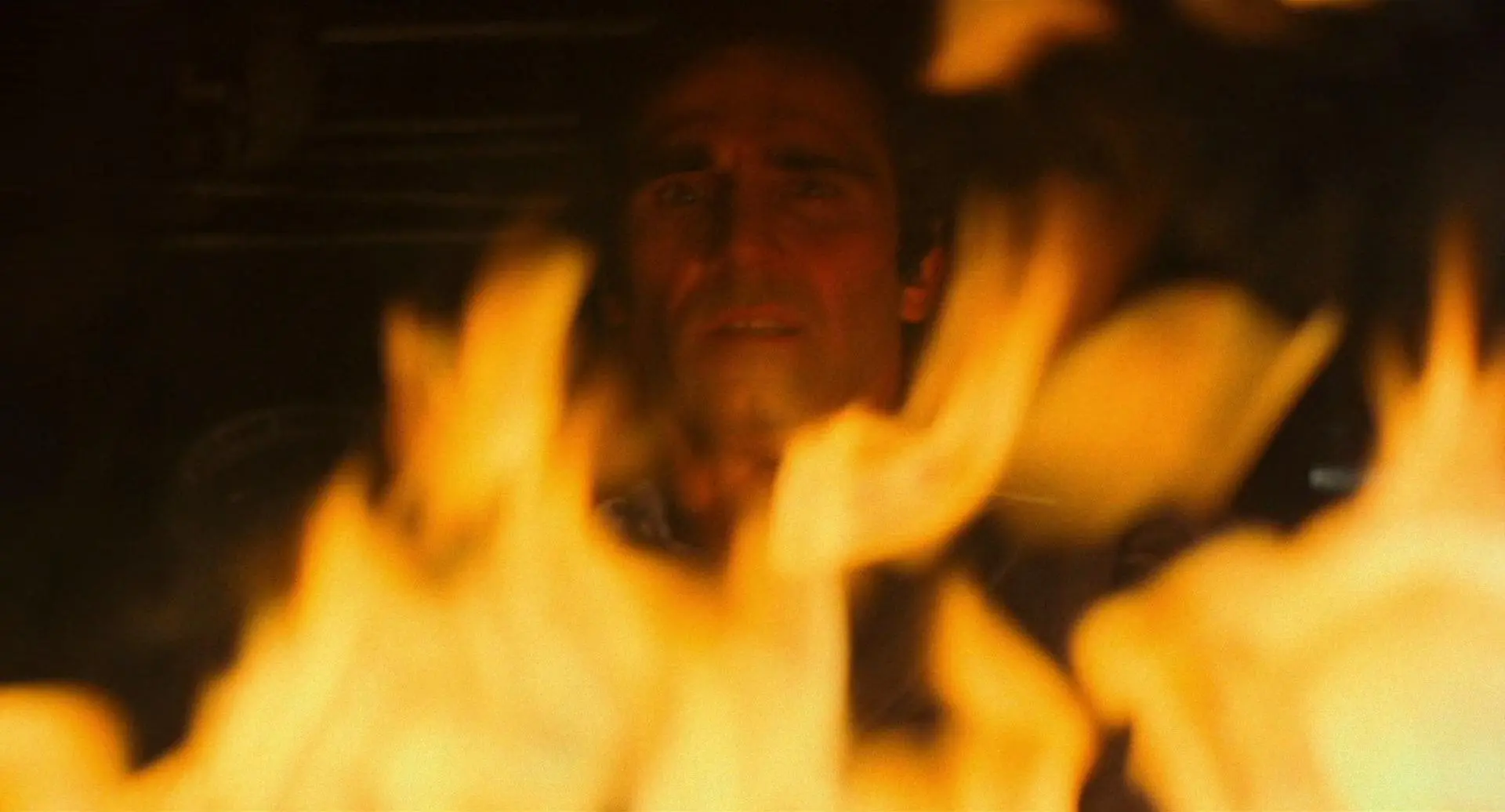
Two problems loom over the film. The first concerns the treatment of the supernatural which forms its underlying substrate: that nebulous past involving the intervention of an otherworldly intelligence and its present-day product, embodied in a malevolent being who plays at being a fallen angel or perhaps nothing more than hallucinations; history is full of such examples. This element, fundamental as it is, should have been integrated into the mise en scène without effects, in a surreal manner, on the same aesthetic level as the rest of the film, avoiding emphasis. This is therefore one of the film’s weak points, conceptually speaking, regardless of the budgetary constraints so often invoked as an excuse for gratuitous liberties that exploit the scant or nonexistent verisimilitude of such elements. To his credit, Cohen confines them to some flashbacks and a couple of encounters which, while they break the film’s unity and slightly trivialize it, do not fully derail it, perhaps because they involuntarily rhyme with the path followed by the protagonist toward his sudden final involution. That old lesson of Jacques Tourneur’s cinema — always suggest, never show — must be counted among the teachings to be demolished and rebuilt by the new revisionists. A decade later (Special Effects and Perfect Strangers, 1984), Cohen would have largely refined this tendency, and by 1990, with The Ambulance — perhaps his most acclaimed film — he had fully mastered and given personal form to everything he filmed, doing so with a greater sense of humor.
And that, precisely, is the other component that Cohen had yet to develop in God Told Me To: the ability to lighten the gravity of his narrative, not to blunt the events, but to give them greater cinematic breadth. Not even the cinephilic references scattered throughout the film manage to mitigate its heaviness by a single degree. The homages — verbal or visual — to the cinema of Alfred Hitchcock or Richard Fleischer, and of course the lessons borrowed from the first major Italian figures of ‘giallo’ films (Riccardo Freda, Dario Argento, Giulio Questi, Mario Bava, Lucio Fulci, Umberto Lenzi, Sergio Martino…), effective in their modest or limited scope, are integrated more with attention to detail than with sheer pleasure, as if Cohen were trying to demonstrate that he knew how to film such scenes rather than that they were part of his apprenticeship. In a sense, he succeeded, earning the admiration of Claude Chabrol for his technical resources. The French filmmaker has always shown interest and curiosity in Cohen from the moment he encountered the latter’s work.
Where the film truly shines is in scenes of great tension, such as the one in which a calm family man tells a stunned and fascinated Nicholas how he ended the life of each of his children by ‘divine command’, and in the analogy between his words and the testimonies of ministers and congregants whom Nicholas hears every day at mass, an analogy Cohen skillfully delivers through voiceover. In this way, he avoids the crude parallel editing that the tone of the speech already suggests without further comment, and elevates the figure of this Antichrist above that of the absent God whom Nicholas has longed to see and hear his entire life. Or, consider the brief conversation with the old sensationalist editor who asserts that ‘out of chaos comes reason; out of reason, science’, speaking of God coming to Earth as something that would annihilate belief rather than sublimate it.
From here emerge the two aspects of the film that interest me most.
The first is its rhythm. Which is to say, its style. Action and adventure films were once episodic, rising and falling, balancing tension with romance or comedy, with familiar refrains, often infallible, enduring, eagerly anticipated by audiences. Thus were built what may be the most pleasurable of genres. This era, coming after film noir and the new waves, introduces another key element: films like this one, without interludes, with their strongest fragments pressed tightly together, and few, rapid transitions. From a clue to a gesture, from a word to an image. Scientists repeat that nature abhors a vacuum, that something is always happening — even if we do not perceive it — that realism lies in the perpetual vibration of things, in chaos rather than rest or order. Cohen films in accordance with that evolution and, to a large extent, with that refinement, as if there were no other possible way to capture on screen either the world he inhabits or the questions he addresses, at the speed of ‘those who think little’, which is to say, nearly all spectators, with few exceptions. If the mise en scène feels brutal and ‘wrenched from reality’, it is because it is structured and elliptical; that seems to be his creed.
The other issue, to conclude, could be nothing other than evil. How a filmmaker approaches it reveals much about him, not necessarily in order for us to elevate him or deprecate him, but to understand him. Cohen is one of those who ask how, not why or who, which are questions he considers impossible to answer. Evil is simply there, and not seeing it or sensing its proximity at any moment is an absurd and dangerous denial. Man is not good by nature, nor can he be, Cohen seems to think. Like Terence Fisher, whom he neither matches nor seeks to match in elegance, yet with whom I often associate him, he accepts turbulence and deviation as part of the natural order; he has no interest in explanations; he regards fate with laconic detachment and turns endlessly over the question of form, where and when evil will emerge, and above all the most disturbing possibility of all: whether that gift, that source from which so many have sought to drink — in this case, religion — may in fact be the most polluted spring of all.
Translated from Spanish by Jesús Cortés.