But with the other, is not this disjuncture, this dis-adjustment of the ‘it’s going badly’ necessary for the good, or at least the just, to be announced? Is not disjuncture the very possibility of the other? How to distinguish between two disadjustments, between the disjuncture of the unjust and the one that opens up the infinite asymmetry of the relation to the other, that is to say, the place for justice? [1]
—Jacques Derrida, Specters of Marx
Bone (Larry Cohen, 1972)
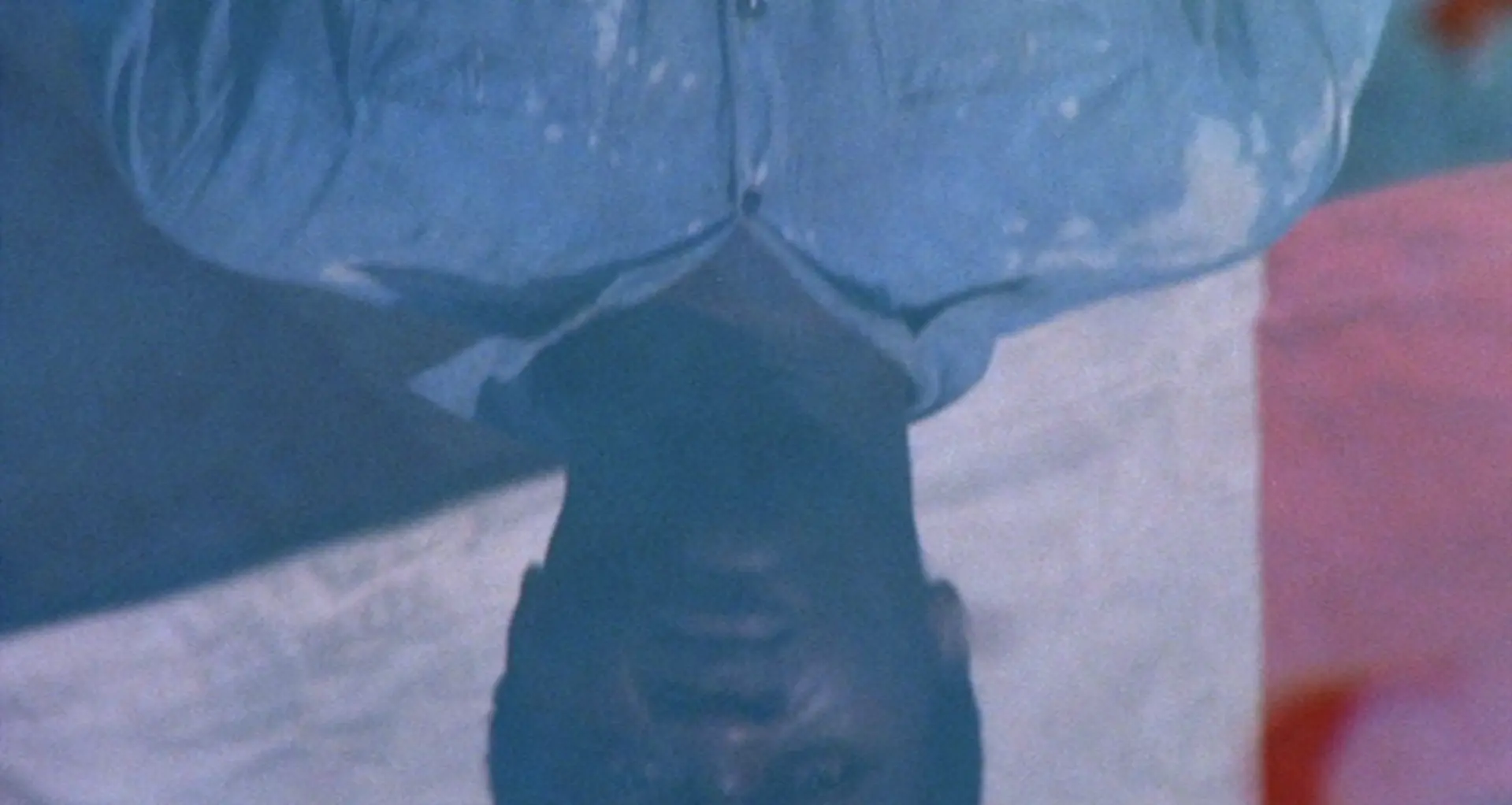
Larry Cohen imbues Bone with a ghostly quality before the audience is even able to register the fact that we’re watching a haunting. Before our eyes ever meet the titular character played by Yaphet Kotto, they meet his reflection. In the quickest pan up from the rat-tainted pool that conjures our protagonist, Bone seemingly materializes atop the water. The next shot is a slower pan from the edge of the pool, up the length of Bone’s body, stopping at his waist. We abruptly cut to the top half of Bernadette’s face, which she obscures with a pair of sunglasses. Back to Bone now, a close-up zoom on his eyes, meeting Bernadette’s gaze across the pool. When we finally get to take in the totality of this specter, he dons ratty cotton work clothes that are juxtaposed with those of the homeowners, not only in quality and style, but also in contemporaneity — as Jacques Derrida states in an appropriation of Hamlet, ‘the time is out of joint’ for our three central protagonists. These quickly successive cuts emotionally triangulate these characters and foreshadow an unfurling of desire that will later become the undoing of their psyches as determined by a psychosexual racialization that Bone’s conjuring undoes. Our meeting of Bone could have very simply situated him at the edge of the pool as a figure in spatial opposition to Bill and Bernadette, but Cohen decides to use this moment to establish the racialized sexual hierarchy that marks the first crack of many throughout the film, becoming the fissure through which truth emerges for Cohen’s characters. That Bone’s reflection in the pool is the first thing we see of him establishes his spectrality, but once he is physically placed in the space, the camera, stopping at his groin, moving to Bernadette’s gaze, to Bone’s gaze, and finally to Bill’s gaze, hints at the role his magnetism will later play in his establishment as both a mythological figure in the white American cultural imaginary and the omen whose apparition signals the deconstruction of the very systems which conjure him.
As the interaction quickly develops into a hostage situation, Bone leads the couple through the backyard and into the home, where the disembodied voices of Bill and Bernadette narrate the history and design of the spaces in the frame: ‘This house was built in 1925, by the family of William Randolph Hearst…’ ‘We get to the breakfast room, which you see is orange and yellow… and uh, we used kind of sunlight as a motif.’ These details are not shared with Bone but are reserved only for the audience. There is a humor in this disjunction as Cohen begins an interrogation of white upper middle class social performance. In a moment of terror for our protagonists, their primary concern, or what Cohen would have us believe is their primary concern, is reinforcing their ability to do whiteness. During this narration, our perspective shifts to Bone as we follow his gaze across the spaces and objects being described, as though he were any other guest in their home. Kotto’s expression as we watch him look upon the space is wistful and full of intrigue, as though he can hear the pleasantries the audience is hearing. Cohen’s editing here is itself out of joint, a characteristic of his directorial choices throughout this film, which conjure breaks in a normative understanding of time from which the past may return to pose a threat to the persistence of injustice, as Bone does for Bill and Bernadette. The dis-jointed dialogue syncs back up with the image when the group moves into Bill’s office, giving the impression of a spectral voice returned to its owner. The audience is only aware of this return to the present moment when Bone is given the opportunity to speak back, making a comment on Bill’s home office being a business write-off. This interruption of idyllic narration marks an end for Bill and Bernadette’s attempts at saving face and begins the fracturing of their participation in the act of polite whiteness. Aptly, this sequence ends with the introduction of another spectral character, the couple’s son, trapped in a picture frame on Bill’s desk and abrasively cut into shots where we see him huddled on the floor in what we later find out is a prison cell. Cohen has, at this point, established a misalignment, or rather a dis-jointure, between Bill, Bernadette, and the truth. A dis-jointure that is integral to their continued participation in white society.
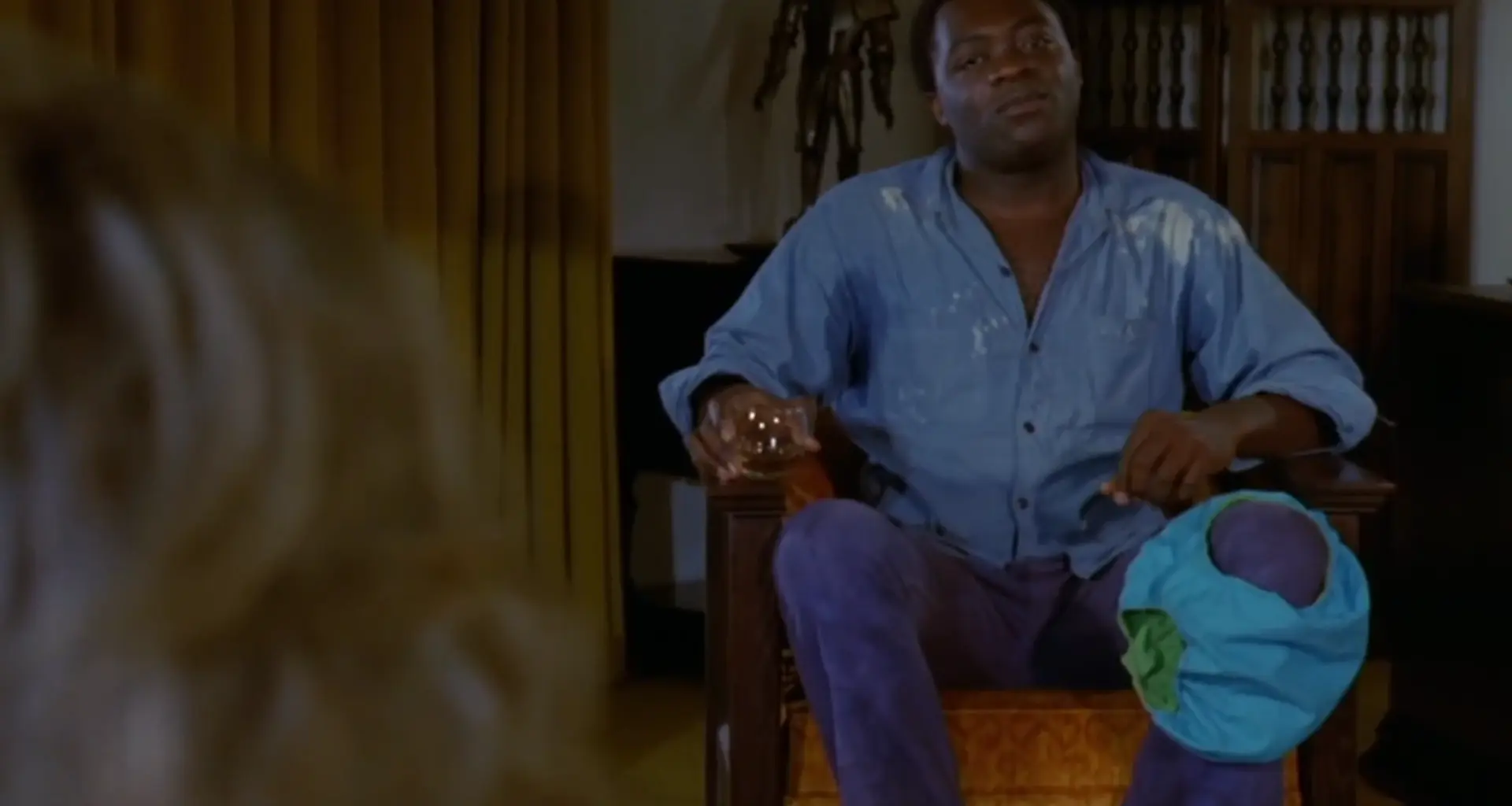
Later in the film, with the rules of the game established and a barrage of truths illuminated, Bernadette and Bone share a vulnerable exchange after she interrogates him about his inability to pursue his assault on her. Bone at this point self-identifies as a rapist, and monologues on the specifics of how he derives his pleasure in these racialized assaults. Bone and Bernadette are shot at medium distance, sitting opposite one another in the living room, her bathing suit bottoms slung lackadaisically across his knee. What was initially an imbalance of power is now equalized by the camera. Bone abruptly rises from his seated position and delivers a return on the sexualization established by Bernadette’s gaze at the beginning of the film, a thesis that Cohen discusses in an interview decades later, as cutting ‘to the heart of racial prejudice’ where the ‘white man has a fear of the black man’s sexuality’. [2] As Bone explains his misplacement in a post-Jim Crow America, he laments that, in an unspecified previous point in history, he embodied a ‘nigger mystique’ that was largely centered around his perceived capacity for sexual violence and the mystery provided by the roles afforded to him in a cultural lexicon that denied him his humanity and, in fact, required him to be inhumane. But, ‘now they’re treating us like people, you can see what kind of position that puts a rapist like me in’. As Kotto shrinks back down into his seat, this humanness that he has up to this point worked so hard to repress bursts through. We zoom in on Bone’s face, his expression softens, and his gaze turns away from Bernadette and towards a memory off in the distance: ‘I was holding onto the past, because change is scary.’ The dialogue here, and Kotto’s performance of Bone as a man adrift in the face of a lost future, convey his status as a figure out of his own time, but also in a state of mourning for a past that never existed. Black audiences, who, according to Cohen, responded better to Bone at the time of its release, see and understand ‘the unidentified negro’ as a model. It is a character in a myth that helps maintain the structure of white hegemony in America. Bone’s agency, when he is afforded the ability to wield it, shatters these illusory performances and disrupts the maintenance of white subjecthood. As the cracks in this performance multiply, the threat of the specter becomes greater. In Bone’s rejection of participation in this myth, a myth that is predicated on the unsubstantiated threat of physical violence and theft, the threat he poses in reality is one that shakes the very foundations of the American cultural imaginary, by nature of its insistence on the truth.
Bone’s spectrality awakens a sexual anxiety in both Bill and Bernadette that becomes manifest in parallel fashion. While Bone expounds on his forced assimilation into a world that now suddenly sees him as human, Bill, who has already been confronted with his own inadequacy as a husband and father, becomes a specter himself for Jeannie Berlin’s character, referred to as ‘The Girl’. In her own devastating recounting of her past, she accuses Bill of being the man who molested her as a child, and in a bid to soothe his bruised ego, allows The Girl to make him this man in her story. Their sexual encounter becomes a dual fight for agency, her reversing the roles in her molestation and him using her hypersexuality to make himself feel like a man again. Back in the couple’s home, Bernadette makes her own bid to reclaim her sense of desirability, and after successfully seducing Bone, the image turns misty in the haze of realized desire. We assume Bone’s looking onto Bernadette as she moans, ‘Oh, Bone, you’re just as I imagined you’d be.’ This admission reasserts the role Bone, as the ‘unidentified negro’, manifests in her fantasies. Bernadette speaks to the other side of the coin that Bone illustrated in his earlier monologue. The construction of a white American cultural identity needs ‘the rapist’ just as badly as it needs him tamed, and thus primed to be the object of desire for a particularly dissatisfied white housewife. Bernadette needs Bone to self-identify as a rapist prior to this moment because it reinforces her image of Blackness and allows her to engage with her own fantasy. In order to tame the beast, she must make one.
Twenty years prior to the publishing of Specters of Marx, we find Cohen using a cinematic language concerned with dis-jointure. Time folds against itself, eliciting the tension that, for Derrida, is the space from which an opportunity for justice emerges. As the past becomes history, it runs the risk of being neutralized as the future continues to approach, but it is in these instances of confrontation with the past that the time becomes out of joint, and a haunting threatens to demand attention to justice. The retroactive mapping of a hauntological approach to Cohen’s work challenges us as viewers to reckon with how the apparent threat of Blackness has echoed since the film’s release and how, as the ‘unidentified negro’ becomes a figure of the past, its threat is at risk of being neutralized by its historical significance. To Cohen — and to us, several decades after the film's release — Bone’s apparition continues to threaten the institutional performance of whiteness, forcing our protagonists to come to grips with truth as they fail to piece their act back together. At the end of the film, after Bernadette has killed Bill, she tries and fails to again conjure the ‘unidentified negro’. Bone’s declaration of selfhood prevents him from being used as a tool for her self-soothing. The figure she attempts to conjure after Bone’s disappearance echoes in our nation’s mythology, haunting the psyches of white men and women, planting seeds of fear that the Black man is going to rape your wife and steal your fortune. Larry Cohen dares to conjure this figure and then ask: What if you lied about your fortune and your wife left you for the rapist? A looming figure in the shadow of history that threatens to re-apparate and deliver the righting of time as determined by the future from which it is returning. In the way that Bone mourns a past where he was ‘just a rapist’, he comes from a future where his humanness forces Bill and Bernadette to live so truthfully, for such a brief moment, that they get exactly what they deserve. The threat of deliverance of justice that his materialization produces remains not only intact, but is amplified by Bernadette calling upon the model of Blackness that she recognizes, that is familiar to her. She attempts to invoke a past in which the future had yet to catch up to her and Bill, and history was still neutral. Bone threatens Bill and Bernadette’s social capital and white subjecthood, and Blackness threatens the pervasiveness of American racial capitalism in a similar fashion. Something greater is always aware that the time is out of joint, and nothing but the past is capable of materializing in such a way to catalyze the righting of time and the deliverance of justice. The specter of Blackness continues to loom across America, and will continue so long as the time remains out of joint.

Notes
In ‘Injunctions of Marx’, Specters of Marx, trans. by Peggy Kamuf (Routledge, 1994), 1–60 (p. 26).
Roel Haanen, ‘Do The Picture My Way: Larry Cohen’, The Flashback Files, 2018, <https://www.flashbackfiles.com/larry-cohen-interview>.