If Bone had been appreciated artistically within the circles I hoped it would, I think I may have gotten a chance to make a more esoteric type of film.
—Larry Cohen: The Stuff of Gods and Monsters
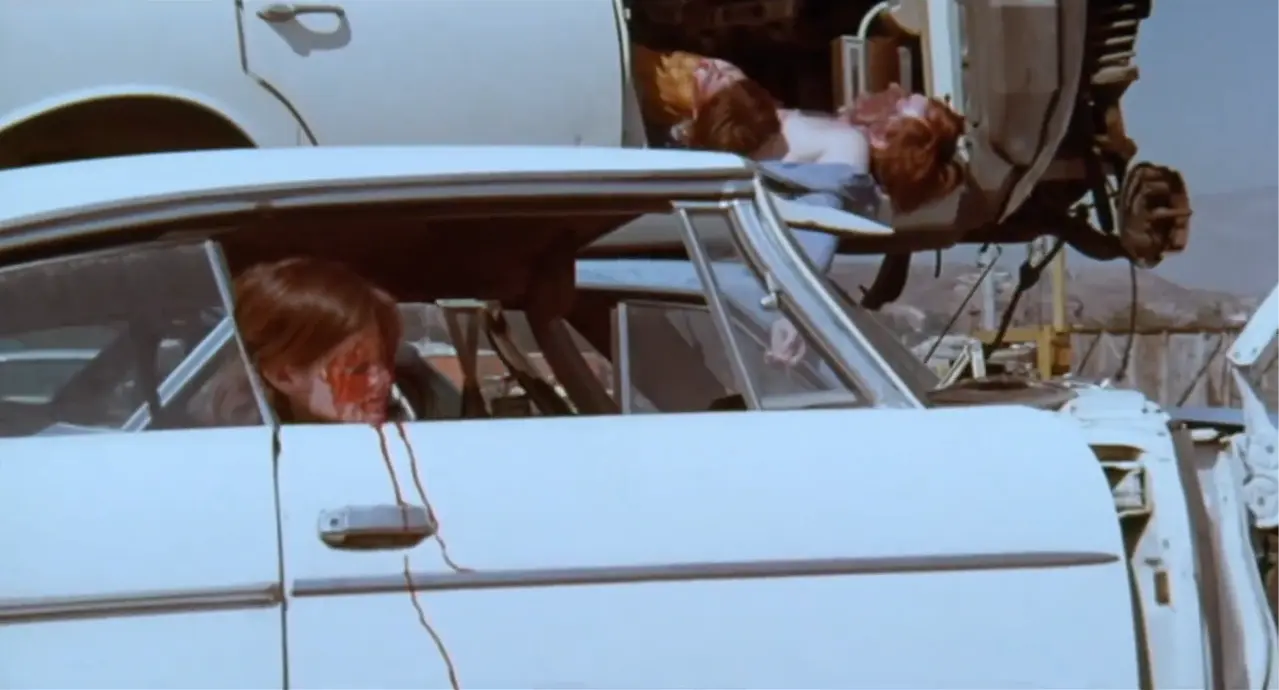
Bone (Larry Cohen, 1972)
The career of one of the great political poets of cinema — the polis in the background so that progressive utilitarianism does not put the cart before the horses of cinema, the street shot without official authorization in the foreground so that the eye may wander — begins with a caption in white letters over black that reads like a pop guerrilla graffiti: ‘The year is 1970. The most powerful nation on earth wages war against one of the poorest countries — which it finds impossible to defeat. And in this great and affluent nation exists its smallest richest city... And it is called Beverly Hills.’ May the last one to leave turn off the lights and lock everything up because Larry Cohen has hit first gear. Immediately after the title card, some R&B and a small bulb lights up as the credits pass by. From the black sun of soul to the dark Wasp smile of a car salesman (Andrew Duggan is the Girotti of this Teorema exploitation), through a zoom in/zoom out raccord which initially prevents us from knowing whether he’s a TV salesman, a journalist or a politician. Anyhow, it’s a whitey who, with a mic in hand and standing in the middle of a junkyard, with his even whiter American smile, is promising to his audience the best family automobile when he begins to see white and blonde corpses over each and every one of the piled-up cars. The noise of a radio whose location is unknown, since it infiltrates the film in close-up, leads us to a house with a lawn (built by William Randolph Hearst, as the characters will tell us in a fabulously displaced off, as if we were listening to a real estate broker in the middle of Guernica amid the acoustic sharpness of a showroom), a bikini-clad woman by the pool and the same whitey, with his Yankee salesman chlorinated smile, removing dead leaves from the water. When Cohen turns on the light, he is lighting up the (American) nightmare, and in the golden Sunday vigil of the rich, there’s room for the trash that piles up in a corner of the street and also for an insistent telephone call with the Castillan, immigrant and tanned voice of a man who asks to speak with the maid who throws out the white trash of the street-master.
Five minutes haven’t passed by and the hydrochloric owner of the manor screams the same words which gave birth to The Bride of Frankenstein, and which a few years later would be Cohen’s guerrilla-cry: ‘It’s alive.’ The first living thing in Bone (1972), besides its mise en scène, is a rat the whitey felt brushing against him while swimming, just after plunging into the pool, while we hear a loud bang — which is impossible because there’s no gun anywhere, and may have been the exhaust pipe of the truck where the servant has just loaded a pair of suitcases destined to be thrown out, but actually isn’t anything other than cinema being liberated from having to justify each and everyone of its interventions by way of verisimilitude. The white woman in the green bikini by the pool, the protagonist’s wife of many years and mistress of the house, doubts there is a rat because, just like us, she hasn’t seen it, but she doesn’t know, like we do, that cinema is the place where invisible bangs exist (like the one that ends the life of Liberty Valance, to name just one example). What we’re all certain of is that what has shown up, not exactly in the pool but standing still over its edge, precisely over the drain where the white owner said the rat was, is a Black man. And not any Black man, but Yaphet Kotto (Across 110th Street). But what is even more important is that this Black man — who has just been gifted a slow pan that goes from his feet to his head and from his face to an extreme close-up facing the eyes of the white lady in the green bikini, who puts on her glasses to take a better look at him — isn’t just a Black man because he is all dressed in blue. A day laborer, a convict? It’s the same thing, but not in the same way for Us as it is for Them. During the seventies, even in Hollywood, the revolution was not an eternal dream.
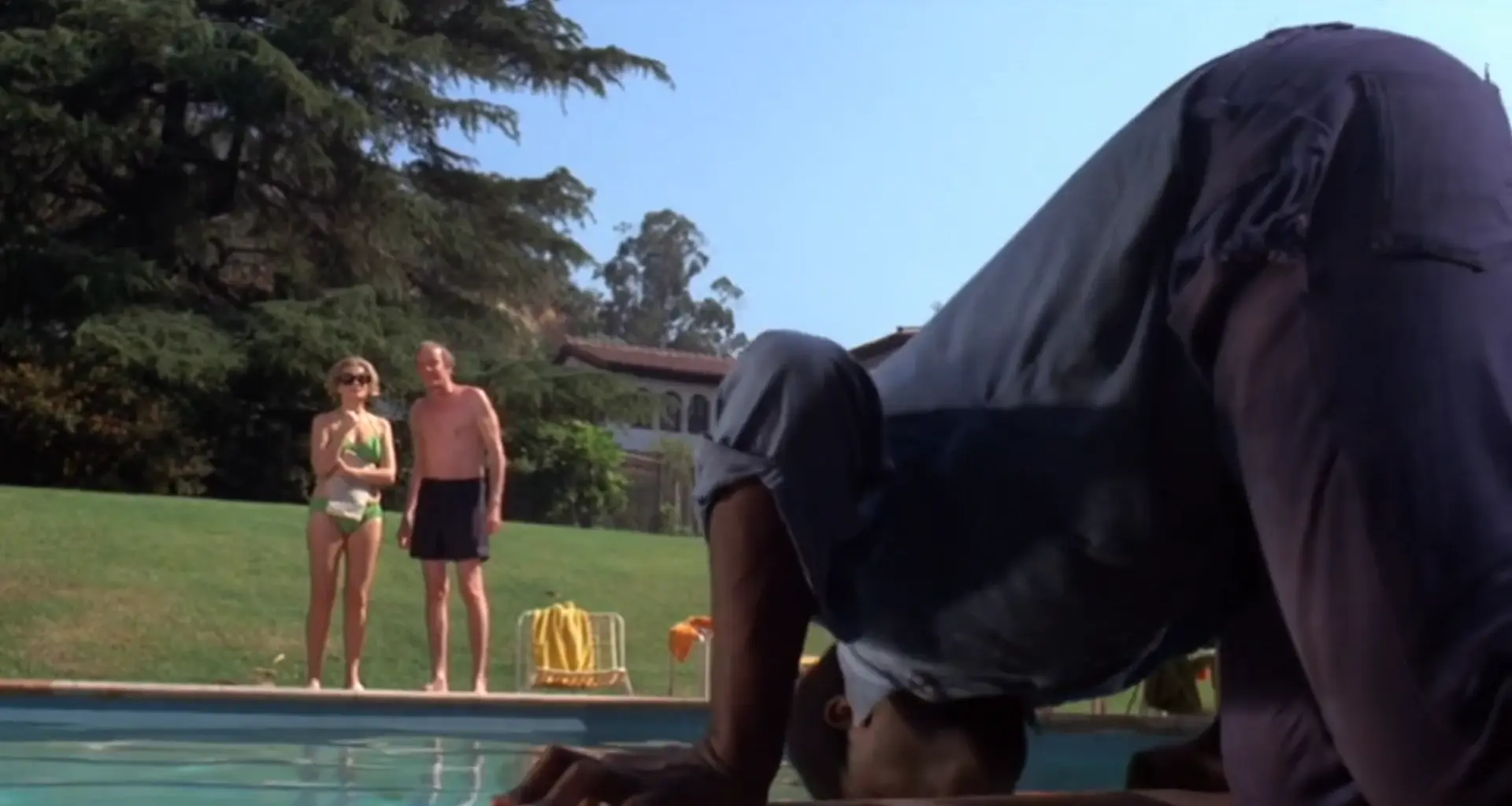
Where did this Black man who isn’t just a Black man come from? A shot from the white couple’s point of view suggests a southern swamp, because it takes a few seconds too much to open up and include, besides the wall of bushes, the carefully cut lawn of the estate. The Black man who isn’t just a Black man puts his hands in the Black hole of the drain of the whites’ pool, pokes around decisively and a few seconds later takes out a dead rat. ‘You’re from the exterminator’, say the whities, ‘what a coincidence!’ The Black man who isn’t just a Black man and may very well be the exterminating angel starts talking, rat in hand, to the white gentlefolks, bouncing on the diving board to the sound of soul, activated by his moving exclusively to himself and us, while the owners don’t know what to reply when the Black man who isn’t just a Black man asks them what to do with the dead rat he has in his hand. That you throw it as far away as possible, they ask him, which implies that it will end up in some neighbor’s lawn. The Black man who isn’t just a Black man obeys, not without first brushing against the owner’s robe with the rat’s wet cadaver as he throws his hand back to gain momentum. Having done this, he offers it for the handshake that no longer seals any gentleman’s agreement. The question isn’t whether the whitey will give his hand to the Black man who just had a dead rat in his, not even whether the whitey will give it to the man he just told he has no job to offer other than this one without having been asked: [1] the question is whether the white owner will give it to the Black day laborer who has just removed this slimy glob of spit from the clear water for him.
Once inside the house — when it becomes clear that the Black man isn’t just a Black man, nor is he there because some extermination company sent him, but rather because he wants money — the film lets itself be led by his chaos-triggering presence, the same chaos George Romero established for cinema in Night of the Living Dead, where the single survivor was a Black man inside a Beverly Hills house with a lawn. Cohen’s chaos is potentially allegorical, like that of The Plumber by Peter Weir — the director of beautiful films where, nevertheless, his characters never fully break free from the symbolic matrix they embody — but precise, concrete and swift. The Black man who isn’t just a Black man because he’s dressed like a blue-collar worker wants money, but he doesn’t find it because we already know that the dough that really matters — and that isn’t the Black man’s nor ours, who as spectators are the proud Black masses of Cohen’s cinema — isn’t in banknotes but in bank accounts, offshore if possible, until he says the magic word and there it is: already half-crazed, he starts cursing and his ‘ass’ is the open sesame for a small wooden box that ends up being Pandora’s, because it hides under the white man’s bed his dirty laundry. Which isn’t exactly the same as that of his wife, even though it’s of the same nature, which makes chaos break loose between them, causing the Black man who isn’t just a Black man to laugh. From the beginning, Cohen loves chaos. And nothing is better than comedy for his agitational cinema. The disjunctions of sound and image and the breaks in the linearity of the narrative through montage, be they spatio-temporal displacements or mental intrusions, stimulate physical shock and intellectual short-circuit — reincorporated into the narrative system not by way of the mainstream but through the glorious vein of B movies revived thanks to the exploitation — rather than the psychological anguish of the realist European auteur cinema of the time: the Black man who isn’t just a Black man says to the whities he’ll have to rape them if they don’t give him money, but the scene and the discussion between those under threat continues to unfold, not only without them being scared but without them even paying attention to the threat.
When run-of-the-mill critics say that a film is a celebration of life, you must be careful because they will feed us the same load of crap that the important critics shove down our throats with their alien and half-baked rhetoric. When the white landlord of the manor opens his mouth just because while driving his Rolls Royce, whereas the Black man who isn’t just a Black man is stuck at the house built by Hearst with the guy’s wife as hostage, and the soundtrack makes us listen to soul music that doesn’t come out of this mouth, nor from the radio, then we really are before a celebration of life. Except that Cohen knows the only thing worth singing in celebration of life is ‘Las cuarenta’ by Gorrindo and Grela. And with the cards of cinema. [2] Bone plays these cards like the one-handed Lavand, who in his turn didn’t have anything to envy Cervantes. [3] He does as he please with the cuts, for example: the camera leaves the house with its owner in the Rolls going after the ransom money, and a zoom in on the whitey’s face takes us back to the house where the Black man who isn’t just a Black man sits down to have a popsicle, next to the white lady in the green bikini and yellow robe. Then, after sucking on the red popsicle for a while, he offers it to the white lady with the yellow robe: never has cinema allowed us so clearly to see that the disgust of someone who refuses the glass or bottle offered by someone who just drank from it is an obscenity. When, finally, it’s time for the rape — because a low-budget film shot in the seventies with a title such as Bone cannot not have it, but also because it’s part of the counterculture of the time (it’s time to take stock and analyze the rapes that were filmed then, from Oshima to Bertolucci — Last Tango in Paris ends just like Bone — passing through Peckinpah and who knows how many others, which would allow us to see the differences not only between directors but also between decades, in addition to noticing the infinite range of nuances that rape had back then as a fictional situation, compared to the absence of these and even of rape itself in the progressive realism of today), we’ll find ourselves amidst plenty of ironies and cuts à la Makavejev, references to seminal — sorry, I could not resist — texts of the sexual revolution, reversals of gender roles, a dramaturgy that veers from action and genre conventions to Cassavetes’s fabulous behaviorism (and even to psychodrama), consensual sex between a Black man who isn’t just a Black man and a white woman who’s also mistress and Mrs., nonsense, absurdity and all the freedom in the world that isn’t guaranteed by any constitution. Even Vietnam is a joke in Bone, and sometimes the best one.
Calanda — Crítica de cine, November 23, 2020.
Notes
Translator’s note: The Black man does ask this in the film.
Translator’s note: A really layered wordplay: first, for ‘celebration of life’, it says ‘cantar’, or ‘a song of life’; second, ‘cuarenta’ in the title of Gorrindo and Grela’s tango means ‘the forty’, referring to a winning hand in the card game Tute. ‘Te voy a cantar las cuarenta’, or ‘I’ll sing the forty to you’, means ‘I’ll get forty points (and beat you)’, which in turn has become a common expression meaning ‘I’m going to show you the real hard truth whether you like it or not’. The author of this text means to say: the hard truths of life, which are the only things worth celebrating and which are indeed celebrated in the tango, will also be shown (sung) here, through the ‘cards’ of cinema.
Translator’s note: Lavand was a famous Argentinian magician who only had one hand; Cervantes, the author of Don Quixote, had notably lost mobility in his left hand after being wounded in battle.