This is a vampire story, as we know; and Larry Cohen’s life of J. Edgar Hoover — avatar of the modern surveillance state and central Machiavellian bachelor of his generation — is also the story of a debt: the measure of what film can exact from life in particular, a story be damned. This is not an ordinary life. For one thing, there is only so much of this particular man’s life that needs to be shown, especially in the case where digressions into local conditions are almost compulsory. The distance between the subject and these external factors is always the degree to which a particular life can be said to have been lived, rather than a certain span of time simply running out.
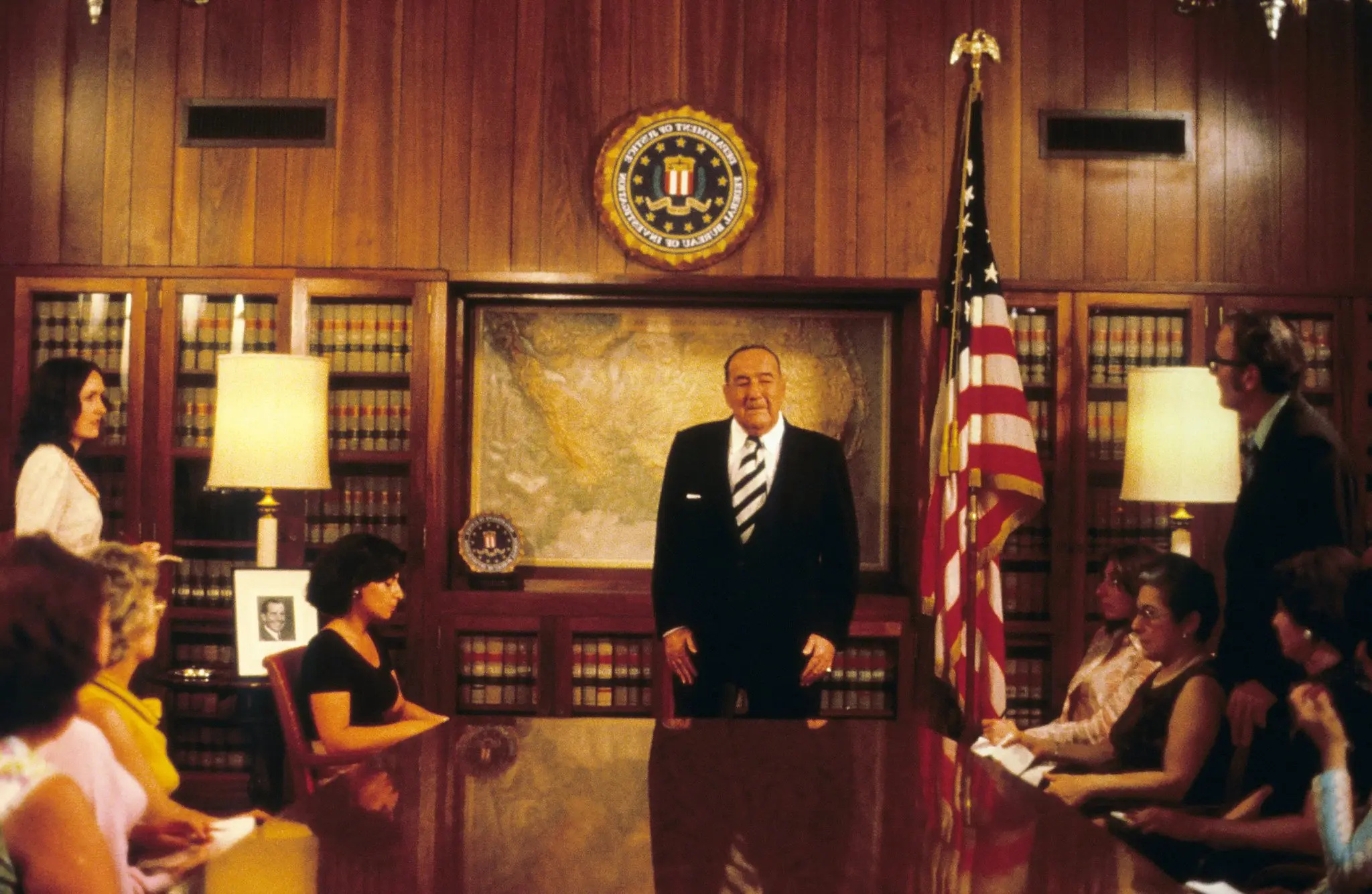
The Private Files of J. Edgar Hoover (Larry Cohen, 1977)
A biopic is certainly the most analytic of genres, a structure controlled by an outside mechanism that operates almost seamlessly, with a texture beyond dramatic irony. The subject is consumed by the facts, whatever they are; fate resolves every action, action resolves into new circumstances, every circumstance leads to another one. Unlike life, which tends to leave no trace of itself in the biopic, when properly done, the former is devoured by the latter. This is why biography is seemingly the most natural dimension of a narrative, if not the quintessence of plot; there can only be one intrinsic direction to go in. But what can be said about a film that spans an entire life except that this life is at the same time being consumed by the film?
‘Top cop. It has a nice ring to it’, so goes the innocuous line of dialogue that denotes the start of the FBI director’s infamous career. Perhaps this is exactly what happened: some wisecrack and the budding American police state had found its maestro. There is some serendipity in how glib words may well have determined the fate of millions. But Cohen’s biopic posits something far more radical than this: that the historical form in cinema, properly shown, is always given instantaneously; every point in a sequence reflects the form of the whole back onto the discrete events. In Cohen’s work, this never feels like compressions of scale into miniatures, but rather an intensive fullness that deliberately shows us only what must be shown and nothing more. The personhood of Hoover becomes a mechanism amongst many others, a piece of matter that breaks down like a complex fraction into the surrounding format. For Pocock, the virtú of the Machiavellian personality is constantly overtaken by the fortuna of irony. In Cohen’s film, willpower is instantaneously subject to events, as if it had no say in them. [1]
So one might expect Larry Cohen’s life of Hoover to be cut from the cloth of Procopius, the macabre tales of a consummate bloodsucker, a creature that lives by night. But The Private Files of J. Edgar Hoover is an almost unnaturally bright film. It’s almost as if, in keeping with the dinky sets and unauthorized filming locations, only the sunniest days were chosen for shooting, just so we can see everything clearly. In this sense it is certainly a film ‘made politically’, if only because we can see everything; Hoover is fully exposed to the light of the camera and what it is doing with broad daylight. The question is then what distinguishes his personality from the overriding personality of the state he serves; where he disappears, and how such a distinction, if it exists, faces the peculiar scrutiny that Cohen’s cinema performs. Adroit as he is at enhancing his own power, Hoover isn’t exactly a one-man cabal, and his ‘court’ is hardly the debauched one that surrounds Justinian in the The Secret History. In this sense there is no need for Cohen to resort to revisionist brass tactics, where the chronicle itself mutates into lurid set pieces, whose main purpose is to seize the means of production of historical memory. These darkened and secretive zones of power are nothing like what we see in Cohen’s film. For here, not unlike in Sade’s château de Silling, there is simply nowhere to hide: enough of this wretched career is merely a matter of public record.
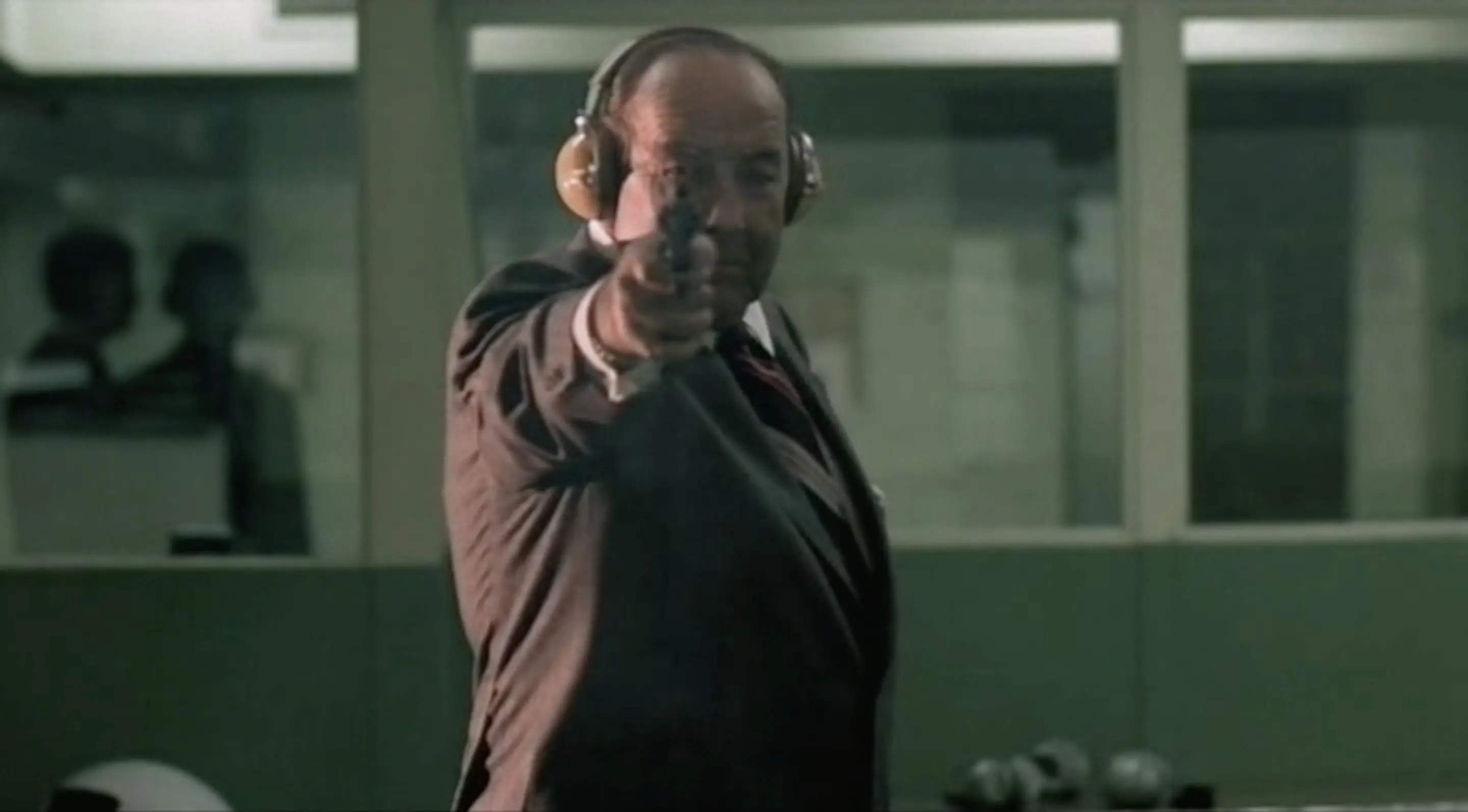
Moreover, Cohen’s film hardly even has sets worthy of the name, notwithstanding any with enough room for depravity. But the film has a camera that proves what it shows and not merely a text that says what it says, which only counts as hearsay. Cohen’s is a Tacitean camera, one that distills life into a series of events that elapse and contract through long periods of time, an objective eye that sees the decades as a meticulously assembled clutter, sketches made necessarily exact and proved by necessity. This is not like sketch comedy, but closer to it than seems appropriate for such a film devoid of heroes. The formula seems to work such that, precisely at the point where tensions are high — where the presence of history is felt — we cut to one of the many bleak interiors that constitute Cohen’s Bureau. Like John Clare suddenly letting up on a descriptive scene, there’s always a mechanism available in the shot for an ostensibly pivotal moment to stop short. This is how certain moments like Hoover’s strange comments on his employees’ shaving habits and attire are supposed to work. What life looks like as it is being spent is always historically associated; the furtive attempts to conceal oneself from a fated outcome — the end of a biopic — are far more exact than the material of history itself. What is systematic in this film is how nothing historical seems to happen of any real importance, except that fly in the room which lands on Hoover’s shoulder, which gives one of his hired help an excuse to swat him.
If the Bureau is the realization of a single man’s neurotic fantasies — Hoover’s anxiety, in particular, about being a ‘cop’ rather than, say, an efficient bureaucrat — then Cohen’s film is at pains to show the narcissism of these small differences. Gathering ‘intelligence’ and tradecraft require nothing of sophistication except a vocabulary, a somewhat serious frame of mind and a phone tap. How does such an unusual person make friends or even find common interlocutors? Cohen wants us to read Hoover like we would a roadcut, to observe the stratigraphy of Hoover, the precise transition from the younger, idealistic man to the one we know from history as well as the lack of conformity between them. There is in some sense a fantasy Hoover, depicted in the First Red Scare sequence near the beginning. He is very concerned with the lack of counsel for the jailed immigrants being rounded up by the anti-communist goon squads. This vaguely compassionate stance is a pretense that belies his avowed fixation on law and order, on expertise, on the information that might as well stand in for persons. Courts leave records and records provide a degree (always insufficient) of insight into a particular person, and most importantly, into how these data can suddenly become valuable if or when the proper moment — fortuna — arises. Of course Hoover is concerned these people are bereft of legal representation; if they had lawyers, they’d leave a paper trail!
From this point, Cohen cuts directly towards the scene of Hoover’s ascension into the purple of law enforcement supremacy. These abrupt movements forward in time show us exactly how fast the rewards of fortuna manifest for bad people in a depraved society. From the obscurity of the lone paranoiac to the pinnacle of American state power, it is a brief line from here to there. Also very brief is the interval at which we watch Hoover as he morphs from James Wainwright into the aged Broderick Crawford, happening almost instantaneously upon the death of his mother. Montage is not the only medium for this disposition. Take the scene at the Biograph theater — the scene of Hoover’s most important early milestone, the assassination of John Dillinger which Cohen découps into a series of close-ups: the camera is fixed far too close to see the whole picture. Most of the marquee text is cut off, but we can still read it in our heads as we have always known it from textbooks: Clark Gable, Manhattan Melodrama. There is nothing obvious in these shots; the raw material of history, via Cohen, demonstrates its own slapdash construction. A shot is set in the same fashion as the montage that cuts from a character speaking mid-sentence –– a Nixon cabinet member, conniving and contriving –– to an angle far away, the audio track changing, his voice becoming more distant. The matching, so to speak, of the short intervals in the montage — the speed with which they shuttle us, and the discreteness of the shots themselves — is precisely where the elegant synthesis of Cohen’s film takes shape.
There is some daylight, then, between the style of scrutiny that surveillance is and the film camera performs. Certainly, blackmail might not be as necessary for cinema as it is for the secret police. In death, Hoover’s methods were turned on the man himself, and rightly so. But vengeance always comes off unsatisfactory when it comes to blackmailing the dead and buried. In the finest scene of the film, we linger with Hoover asleep on his office couch, the super-spy lying in an unconscious state, presumably dreaming about wiretaps. But there are others in the room with him — with us — watching him sleep, people who, like us, dislike him and are afraid of him. These include his avowed enemy, the attorney general Robert F. Kennedy, who gazes at him and makes some nervous jokes. Everyone realizes the eye of the police state is shut and the watcher is finally being watched. His own devices are turned on him, and yet everybody is so nervous. Is he actually asleep? This sort of thing happens again in a later scene, following a botched liaison: we see Hoover sitting at a table listening to a recorded sexual exchange. He is aroused, obviously, but instead of masturbating, he takes out a bottle of whiskey and pours a glass, loosens his collar and starts sweating with great determination. In both of these scenes, it’s clear that the human being is depicted with incredible lucidity. There is something in this fleshly mechanism, Cohen says, that remains entirely subject to the changing of sensual states, that must yield to unconsciousness and to the basic sensations that seek to enrapture it.
Here, in miniature, is the central idea of biopics: the complete consumption of the subject by the film, residue and all. I would also add that a successful biopic must involve actual consumption taking place, not merely criticism of the person and their decisions; and to be successful, it must at least seem like a complete meal, with no leftovers. A life can not only be eaten by a movie, but it is also only that sort of life that goes down so easily, a life that’s arranged very properly, almost as if it were planned in advance. The Private Files of J. Edgar Hoover is that exact specimen which so precisely consumes its subject that there is nothing left over after we finish it; it is so delicious.
Notes
J. G. A. Pocock, The Machiavellian Moment: Florentine Political Thought and the Atlantic Republican Tradition (Princeton University Press, 1975).