Larry Cohen was the guest of honor at the 21st Fantasia Film Festival. In addition to the twenty films or so he’s made, he has also written over eighty scripts for television and cinema. A sort of missing link between Samuel Fuller’s anger-ridden films and the most critical B movies of the seventies, Cohen obeys no rules other than his own, defying the order established by politics and the industry in order to explore in all freedom the tenants of American paranoia. He is responsible for some scathing classics (Black Caesar, It’s Alive, Q, The Stuff) and films so angry they were more or less discarded from the histories of cinema (Bone, God Told Me To, The Private Files of J. Edgar Hoover). Cohen’s only fear? That of repeating himself, of retelling the same story… So he writes, tirelessly, making a name for himself in the sixties as one of the best creators of pilots for television, and later as a filmmaker of genius ideas but questionable execution. Critics, who surely have never adequately appraised his work, at least granted him his convictions. In order to build up a defense, we must therefore inquire on the basis of these convictions. What monster is Larry Cohen afraid of?
I saw The Stuff for the first time a few days ago and was left flabbergasted. Besides The Blob, you know what film it makes me think of? It reminds me of the couple dynamics in the pictures Frank Capra made in the 1930s, It Happened One Night, You Can’t Take It With You, Mr. Smith Goes to Washington...
Ah! Yeah, all these roles Jean Arthur played for Capra.
Exactly. The influence of classical Hollywood cinema in your films is evident.
Certainly, because when I was a kid I’d spend all my time watching these films, four or five of them a week, so they’re etched on my subconscious. On the other hand, it’s the first time someone has mentioned this analogy between Capra’s films and The Stuff, but I suppose it’s there; it seems logical to me: the quips, the temper of the man and of the woman, their witty exchanges, the way they go about their search, etc.
How did this young cinephile end up becoming a filmmaker? You had your start in television, but had you always wanted to make films?
I’ve always wanted to make films. I watched a ton of them as a kid and managed to put my hands on my father’s 8mm camera — you know, those cameras you had to crank and that’d give you more or less a minute of footage — and then we made a film near where we lived in Manhattan, near Fort Tryon Park, in Washington Heights, New York. It was an espionage film and I had to give some comic books to my friend to convince him to play the role…
So, it was an espionage film about a microfilm hidden in that park and a Russian secret agent on a mission while preparing to defect. Not wishing to be found nor for the microfilm to end up in the hands of other Soviet agents, he decided to hide it in the barrel of his revolver, so that in firing it (that is, if he ever had to fire it), he would also destroy it. I thought that was a good idea, very clever, and so we made this little film. What surprised me most afterwards was years later, when they arrested colonel Rudolf Abel, who was Russia’s no. 1 spy. It turned out he had arranged a meeting with his subordinates at Fort Tryon Park, and that they had hidden their microfilms there, just like in my little 8mm film! It was a really marvelous coincidence; how could I have known! So, that was my very first film, and, of course, it is now forever lost in the sands of time… All to say, I already wanted to make films back then. I knew what I wanted to do.
Why is it you’ve filmed so much in New York City? Is it just because you lived there?
I lived in New York, I was always in New York, so I didn’t have to travel. I knew the city very well and I loved it — even if I don’t love it so much nowadays. It was a place filled with interesting places which juxtaposed the old and the new with lots of character. It wasn’t very comfortable as a city but, in its uncomfortable nature, it was fascinating. It wasn’t beige, it was never boring, it never constrained you to any scenery that wasn’t interesting, all while giving you constant challenges: collapsing buildings, decrepit apartment blocks, infinite skyscrapers, this excessive wealth existing alongside extreme poverty. It definitely was a fascinating place to film.
And not as artificial as Los Angeles.
That’s it. You know, people were shooting at the back of studios all the time, and as long as you see the images, you can immediately tell that it isn’t reality you’re looking at. And you know what kind of film you’re dealing with.
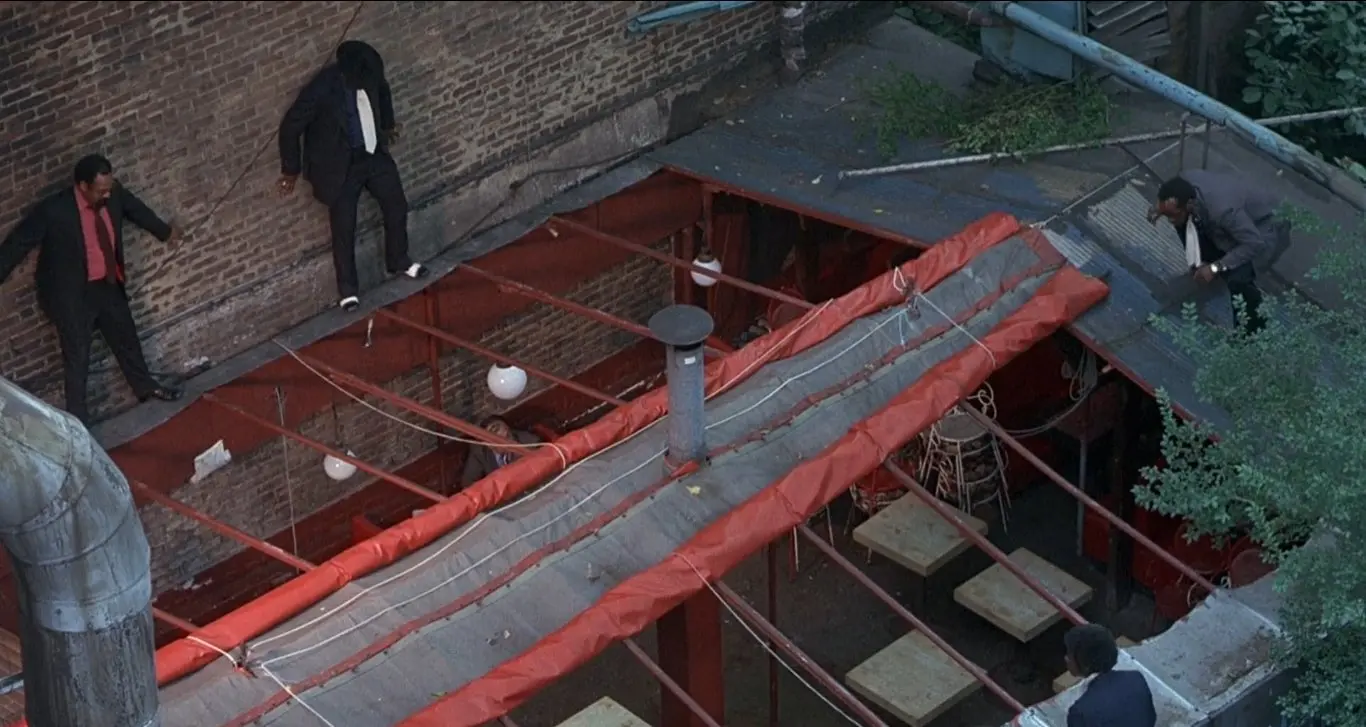
Black Caesar (Larry Cohen, 1973)
There’s always an ‘it’ in your films. In It’s Alive, God Told Me To or The Stuff, there’s something that can be more or less explained, that doesn’t have a well-defined origin. What is this recurring thing? Paranoia?
It’s something inexplicable. In so many films, they explain absolutely everything to you with such ease, with a semblance of credibility that seems so strange to me… So much so that I always ask myself, ‘How do they know? Why should they know?’ Me, I don’t even know why lamps turn on when I flip a switch upon entering the room. I don’t even know why the elevator goes up or down, or why, when I turn the left faucet, the water comes out hot. How does the faucet know? How does it know the water has to be hot? By that I mean that I don’t know the things I do know and, frankly, I don’t give a damn. The only thing I want to know is that when I flush the toilet, water goes out. I don’t know where this water ends up. I can’t even believe that when I flush from the 64th floor of a building, the water ends up sixty-four floors below. How’s that possible? The world seems to me like science fiction. I don’t understand the simplest things, let alone complicated ones…
How did you end up directing all those blaxploitation films at the beginning of your career?
That’s simple: in the first picture I made, Bone, an African-American actor, Yaphet Kotto, starred in it and delivered a wonderful performance. He was so good that some guys in Hollywood took note of the film and thought I was a great director of black actors. I tried to explain to them that Yaphet was an actor like any other actor, that ‘black actors’ didn’t exist. They replied: ‘Fine, but we want to make black pictures; do you have any ideas for us?’ I had just been hired by Sammy Davis Jr. to write a screenplay and he couldn’t pay me (he had some problems with the IRS). So, because I had a script ready and hadn’t received my fee, I offered it to them. The title was Black Caesar. That’s how the film was born.
Did you feel at ease as a white American writing and directing films about African-Americans?
I didn’t even think about it. In my mind, I was doing a crime film in the vein of those that Warner used to make with James Cagney, Edward G. Robinson, those films about the rise and fall of a crook, like Little Caesar. I never even thought about those racial tensions, neither while writing nor while shooting the films.
When would you say you started doubting official narratives? When did you first doubt the American government? Or, to put it another way, since when have you been interested in conspiracies?
I’m not that interested in conspiracies, but it’s true that I don’t believe very much in governments. What I believe in is that almost everything is corrupt.
And what was the breaking point for you?
I felt that, in observing and studying history, all I learned was that, on some level or another, some form of corruption was lurking, and we could never, ever take history for what it claimed to be. People don’t end up in politics for the good of their fellow citizens — they end up there first out of personal interest, to get something personal out of politics. Sometimes, it was a matter of power — sheer power — sometimes it was a matter of money, of asserting their influence even. The reasons that led politicians to politics don’t matter much; I never took them for heroes, be it the Kennedys or president Johnson… I have the feeling that Eisenhower was a well-meaning guy, but Truman was something of a crook, just like Roosevelt. Eisenhower was straight as a die. People thought he was stupid, but I don’t think so — he was a really good president. And I got lucky with him because he was running the country in the period when I could have been drafted, but Eisenhower’s presidency was the only time when we didn’t go to war, at least not to my recollection. As soon as he left… My God! We plunged into Vietnam.
I sometimes walk past military graveyards and contemplate all those crosses and, you know, it brings tears to my eyes every time… That all these poor guys had to die… In the name of what? For what reasons? Seeing it this way always leaves me without hope; it’s shameful that they had to give their lives, and that at least half of them did so without even knowing what they were fighting for… All that, before seeing all their hopes and dreams of peace betrayed by the next generation, which dragged us right back into war, before we could even have the time to comprehend the previous one.
These people always talk about some new demon, some new master of evil. Before, it was the Vietcongs — I had to endure all that bullshit about the Vietcongs for too long! — those evil Vietcongs with their traps, their tunnels, their tortures, their burned villages… And then, one day, the war was over. We escaped and rid ourselves of Vietnam, and what became of that? They even built Howard Johnsons and Hilton Hotels and Burger Kings so the Americans could go there and enjoy a good time. What were we fighting for? Why did all those people die? What was the point?
Of course, now the new enemy is ISIS, but I think that if we had stayed out of Middle Eastern affairs we wouldn’t even talk about it nowadays. Going down there, invading Iraq and occupying it triggered a chain reaction for which we now have to pay the price. We’re responsible for it. That responsibility is ours and nobody else’s. Now we pass our time saying more or less everywhere what an asshole Putin is, what a cheat the Russians are and that they meddled in our elections, but what do you think the Vietnam war was about? That war caught fire when we refused to accept the result of the Vietnamese elections. The Vietnamese had voted for Ho Chi Minh, but we couldn’t accept that, so we sent our troops down there to support a puppet government we put in place and that nobody wanted. We did that. We meddled with an election and killed a million people because an election result did not suit us. We pass our time worrying about what the Russians have done, but what have we done? Invaded Iraq because of weapons of mass destruction that did not exist… We did terrible things. We’ve stolen a great amount of land from the natives and the Mexicans. Some of the richest lands in our country were taken from the Mexicans for no reason. The Mexicans hadn’t done anything to deserve that. We simply decided that we could go there and take it from them because we didn’t consider them white — as if that excused our stealing their land! It’s terrible! The history of the United States is filled with outrageous events…
But here we are, so brave, so valiant, the Land of the Free! Land of the Free, but all the guys who wrote the Declaration of Independence owned slaves. It makes no sense and we need to look reality in the face. I know you’ll tell me after all that that I’m just a cynical old man, but I’m a realist. Everything I’ve told you is documented… Like when I made that controversial film, The Private Files of J. Edgar Hoover. I didn’t hold my punches either against the Democrats or the Republicans, so nobody liked the film because of that, because in the United States you have no choice other than be one or the other. If you aren’t a Democrat, then you must be a Republican; otherwise, you’re going to be attacked from all sides. Well, that’s me; what do you want me to do?
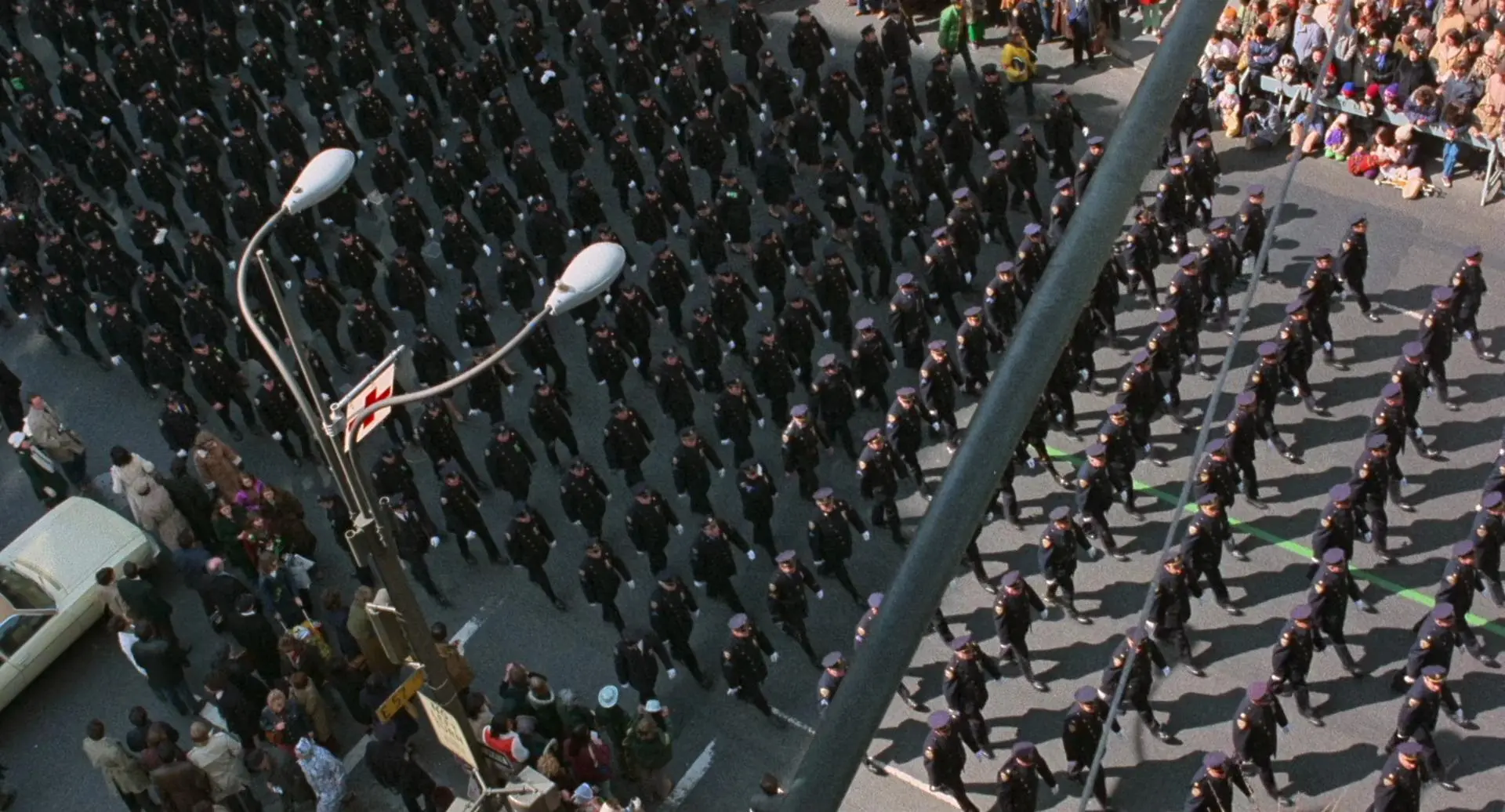
God Told me To (Larry Cohen, 1976)
Especially when, besides The Private Files of J. Edgar Hoover, many of your films evoke or criticize this corruption, in one way or another.
Yes, because I always try to observe these things in the most realistic way possible — as they appear to me, as they came to be, as they could be experienced or as they could allegorically embody unquestionably true situations… Unquestionably true, if it weren’t for the fact people don’t like looking at them, because, in general, we don’t want to have anything to do with stories like that. In fact, that’s precisely the subject that would still interest me. I’d still like to make a political film.
Would you say the assassination of Kennedy had an influence on you as an artist?
It was a major event; everybody saw it on television; everybody who was there lived through it, and that was a very painful experience, so yes, I imagine… Even if I don’t think he was a good president.
Most of your films were made under controversial presidencies. Has the Trump administration inspired you to return to the set?
All administrations have been embarrassing. Some have been able to get away with it, others haven’t. I mean… Everything Trump has done is idiotic, but there are other idiotic mistakes that were made by presidents before him. He hasn’t yet done anything that could equal the Bay of Pigs disaster or even the farce that was the Cuban missile crisis. We were on the losing side, even if everybody in the United States praised the incident as a victory for Kennedy, while it was obvious that Khrushchev would never have put missiles in the hands of the Cubans. You’d have to be ridiculous to believe that. If the Cubans had launched a single missile toward the United States, we would have razed Moscow to the ground. How stupid you’d have to be to believe the Russians would put themselves in such a position! They never wished to arm Castro like that. It was a huge bluff. And we fell for it.
In It’s Alive, you took the most innocent and adorable creature on planet earth — a baby — and turned it into a monster. You made it so the audience can feel its presence by means of a subjective camera, a mise en scène many consider a precursor to Jaws, which will make a similar use of it. Did you come to make this decision because of the budget or to stir greater fear in the spectator?
Two things. First, we didn’t want to show the baby too much because we wanted to focus just on his presence. So we showed that presence through the point of view of the baby himself. The second thing is that when they made Jaws, it’s because the robotic shark didn’t work that they decided to use a subjective camera, showing as little of the shark as possible. I’m not sure if it’s something he took from me or if it’s an homage, but I know Steven did see It’s Alive and told me at the time that it was an excellent film. What I also know is that the opening credits of It’s Alive, with the flashlights sweeping across the screen, were reused at the very beginning of E.T., when we see the blinding lights sweeping through the forest. In fact, if you think about it, E.T. is a reversal of It’s Alive: in It’s Alive you have an evil monster hidden in a house and protected by a member of the family, while in E.T. you have a good monster hidden in a house and protected by children. All things considered, they’re pretty similar films.
What made you return to It's Alive twice? Why that story and not the others?
The studio wanted sequels and, you know, when someone offers you the chance to make a film... Why not? Do it! I had other stories to tell from that same premise. I didn’t want to repeat myself (it’s what I fear the most), but I think both sequels take the story forward, towards other themes, especially the third one, which changes tone completely and is much more humorous than the first two.
What attracts you to a story? What makes you say, ‘Okay, I’ve got something here’? Is it a matter of theme or of character?
That’s a good one… I don’t know. It all comes and fits together. The story comes from a character. The character comes from that story. Screenwriting is an exercise in symbiosis: the situation people find themselves in changes them and, very often, surprises them, both because the situation itself may be surprising and because they may be surprised by what they’re capable of. Consciously, I do not separate these elements. Something comes to my mind, I write it down and, as I write, things develop. A good story writes itself, more or less.
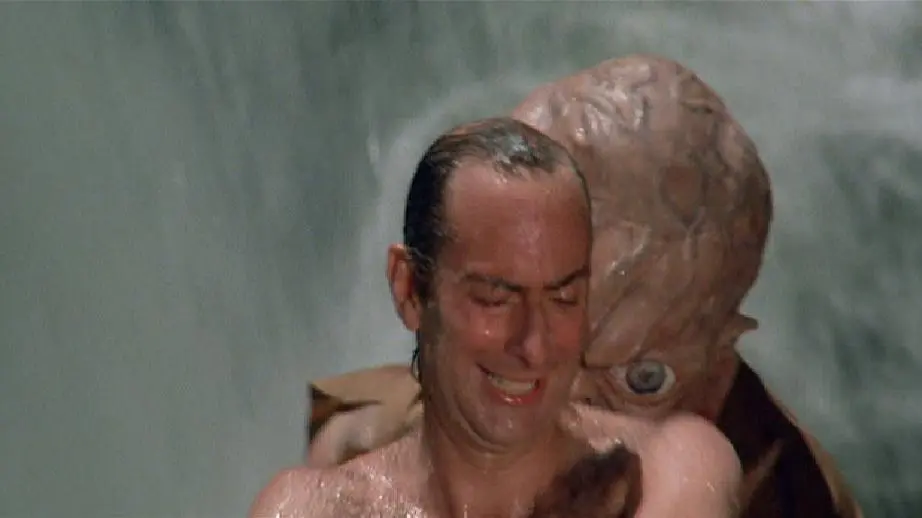
It's Alive III: Island of the Alive (Larry Cohen, 1987)
George Romero recently passed away. He predates your cinema by a few years, but you were both among the first American filmmakers to deliver these B films charged with a strong social critique. Would you say he influenced you?
George was a really great guy. We were friends... He was very nice, very kind and very imposing! He’s created something imperishable. Everybody seems to have made a fortune off George Romero’s ideas except George Romero himself, including The Walking Dead, which was a huge success and which does very little that George hadn’t already done in his very first film, released almost fifty years ago. He completely changed horror, fantasy, science-fiction cinema, and he made wonderful films. He didn’t make a lot of money with them; I think he sold the rights to Night of the Living Dead for peanuts... But he made other films and some of those were really, really good. He always had to battle for financing and get his projects off the ground (I know a thing or two about that). He was a deeply lovely person, through and through. Having said that, I don’t think he influenced me. I’d rather say he taught me to pay attention to the returns on my projects, to make sure no one would make money off them and leave me empty-handed. That was a good lesson to learn from him.
Special Effects is a curious — but curiously magnificent — film. What inspired you to tell this story about a blockbuster director in decline who leads a morbid double life in a dungeon where he shoots his own snuff films?
It’s funny that you mention Special Effects; it’s a film I like very much. You know, the script is also the very first script I wrote from the moment I knew I wanted to make movies… In the end, I didn’t make it at the time and instead made Bone (and, looking back, it was probably for the best). This script sat in my drawer for years; it was called The Cutting Room. Later, in the eighties, I had the opportunity to direct two films back to back for a company named Hemdale. The first one was Perfect Strangers and the second one was distributed under the title Special Effects. We shot these two films one after the other, with practically the same cast and crew. We finished shooting Perfect Strangers one day, and started shooting Special Effects the next. I was lucky to bump into Eric Bogosian and Zoë Tamerlis; it was wonderful to see them act. Of my films, it’s still one of my favorites.
As for the story… At the time, there were plenty of filmmakers who directed big-budget films and who, from one day to the next, because of one or two box-office bombs, could no longer find work in the industry. That’s what happened to Peter Bogdanovich, or Michael Cimino. It’s tough to have been a first-rate director, one of those Oscar-winners and then, because of a few mistakes, find oneself unemployed… So that was the basis for my character. Initially, I wanted to set the story in Los Angeles, but eventually I went for New York, mostly because many filmmakers had made the city their HQs. After that, there was nothing left to do but find that strange house where we shot it. I’m really proud of this film.
And did you hope to take this big leap at the time? To become ‘a first-rate director’ and work with those budgets? Is that style of production attractive to you?
Oh, I could never have done that! I could not work in a film where you have producers, then executive producers, then studio representatives and all their assistants who crawl around telling you what to do and what not to do. I could not work under these conditions. There’s no way I could have made my films the way I made them — that is, wholly independently, with control over all aspects from the opening to the end credits, supervising editing and working hand in hand with composers — if I had had to do it under their conditions. The only thing I could not control about my films was distribution, and that was always my biggest problem. Distribution as well as marketing gave me headaches, because those were the only domains of production over which I could not exert absolute control.
Has this refusal of working within the system led you to turn down any big projects?
Yes, sure, I’ve flirted with projects that were big money, but since I’ve never wanted to work on a committee, I always turned them down. I simply wanted to make films that were Larry Cohen films, from start to finish.
For The Ambulance, where did you get the idea of having the protagonist work in the comic book industry as an artist for Marvel, with Stan Lee playing his boss?
I had the feeling my character needs to have an unusual occupation, that he has to be a little eccentric so that the people to whom he tells his story about the renegade ambulance don’t believe him from the get-go. So I told myself he could be a comic book artist. I’d already met Stan Lee a few years before, because I’d been hired to write the script for a Doctor Strange feature in the early eighties. At the time, Stan had trouble adapting his characters to the big screen. I worked with him on that project; we got along well and we’ve remained good friends to this day. By that point, I’d already told him: ‘Stan, one day I’ll write you a role in a film, and it won’t be just to get you to be in front of the camera. I’m going to write you some lines, and you’ll have to act.’ Anyway, I did it, he came, he acted, and he allowed us to use the Marvel logos as well as the image of some characters. He also helped us recreate the mythical Marvel Bullpen, where the Marvel artists were supposed to work. Of course, all this was fiction; the Bullpen was more of a marketing trick.
When you were young, did you use to read the superhero comics Stan Lee created?
No. I used to read horror comics, like those by EC Comics.
Since you’re here at the Fantasia Festival to receive an honorary award, I guess I can’t help but ask which of your films is your favorite.
I love a bit of each. It’s like with children: I love them all, but I also have issues with them on some levels. I had a lot of fun making these films, so it’s difficult for me to choose just one…
Having said that, there wasn’t anything crazier than climbing to the top of the Chrysler Building for the filming of Q. Only a lunatic would have gone up there! If you’ve seen the film and the tight narrow ladders that Michael Moriarty climbs, then you’ve seen it all! That’s all it was, those tight ladders that allowed us to climb up the building to the inside of its spire. We had to haul everything up these small ladders — the equipment, the light, the camera, the props, the corpses, the pigeons and even the pigeon handlers, all of that — right into that tiny space that we couldn’t reach except through that ladder. Once we had arrived at the top, there were no railings, no glass in the windows; one misstep and you would fall through eighty-eight floors, with nothing to stop you. It wasn’t open to tourists — it wasn’t even open to filming. And there, the wind blows through the building, and you feel its steel structure sway gently as the entire city of New York spreads out before your eyes. It’s quite a sight to behold.
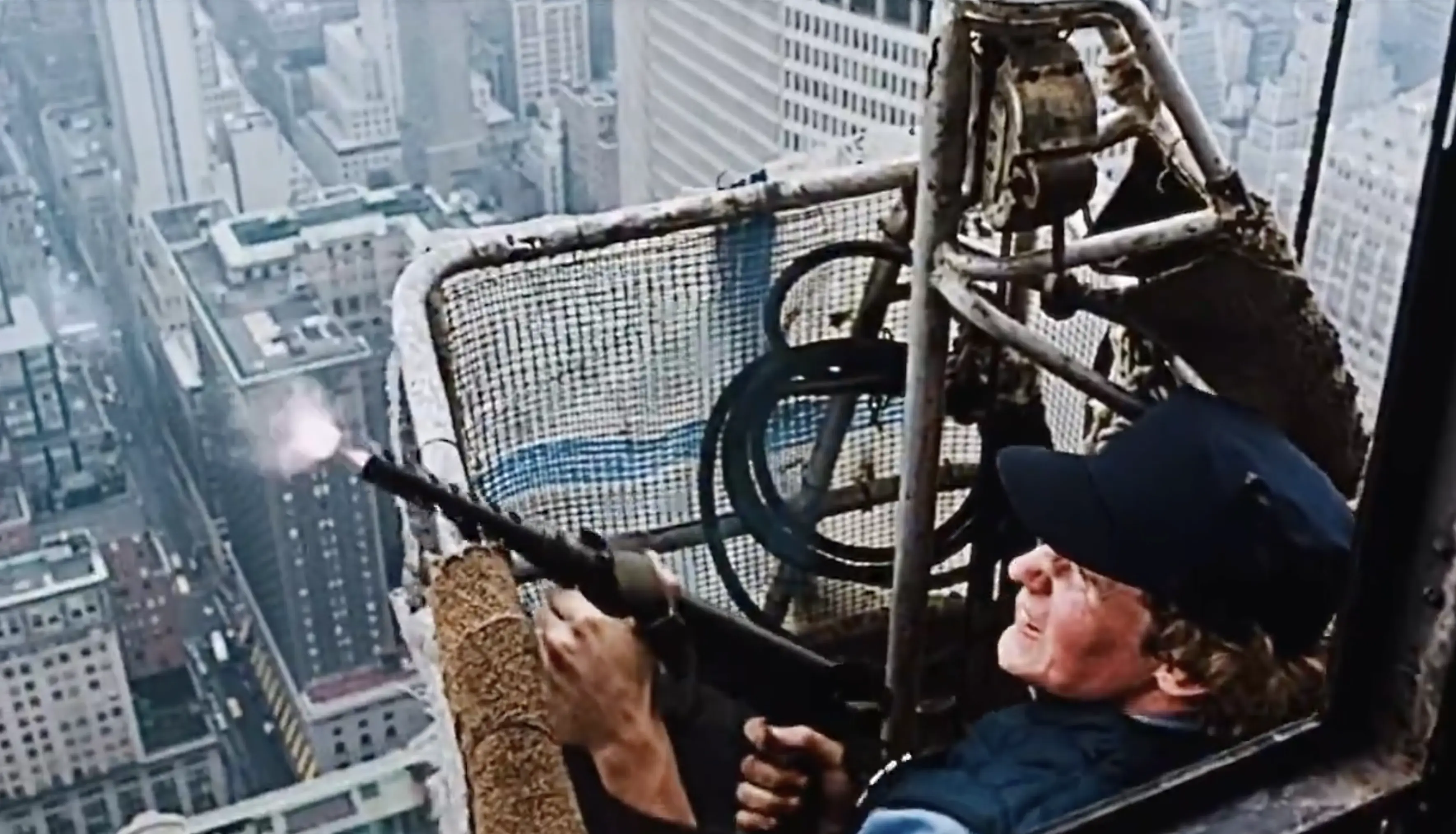
Q: The Winged Serpent (Larry Cohen, 1982)
Published on 5 August 2017 on Panorama-Cinéma.