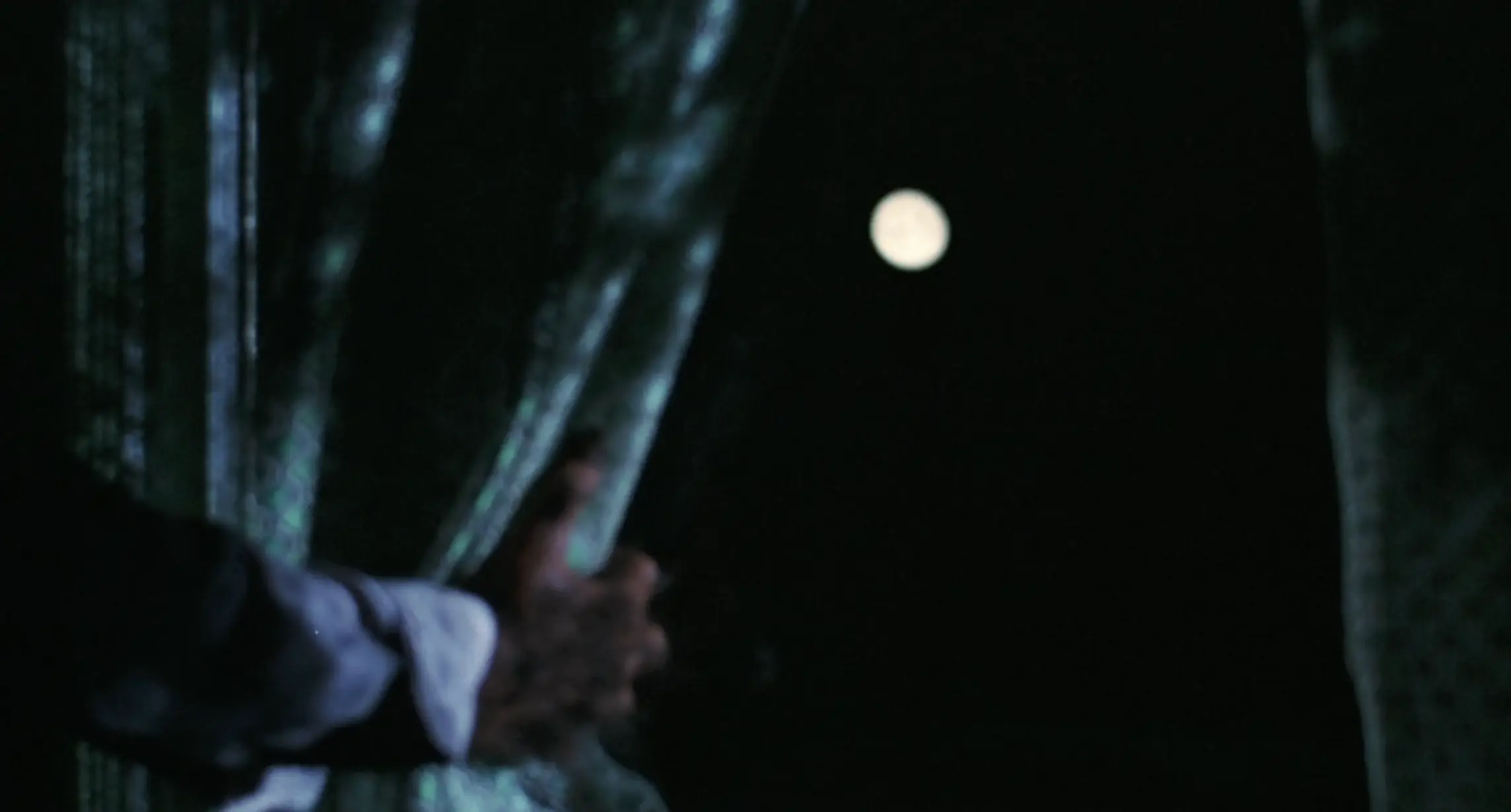
Full Moon High (Larry Cohen, 1981)
Yes; but the color of the heavy hemlocks
Came striding.
And I remembered the cry of the peacocks.
—‘Domination of Black’, Wallace Stevens
Why do some movies stick in our memories while others fade the second we leave the theatre? We might leave one movie proclaiming, ‘How great! How expressive!’, yet fail to recall a single moment. But another leaves us in a haze, mulling over bits and pieces — one never remembers perfectly — that we can’t get out of our heads. Some frames, always the unexpected ones, become permanent fixtures of our psyche, ever-present but never fully clear. There are certainly external factors — I remember the first R-rated movie I snuck into (The Descendants), or the time when a date stood me up (Jojo Rabbit) — but there is a peculiar element within certain movies that give them the capacity to lodge themselves in our brains. It is what I prize beyond all else in cinema — the element of strangeness.
Full Moon High is strange. Could the first readers of Genesis, the first viewers of Hamlet, have detected a similar strangeness, smoothed out only via centuries of canonization? All of these works function less as complete dramas within themselves than as conduits to conjure up an interlocutor, someone to compare our every decision against, a permanent stranger within our minds. What would Jacob do? How would Hamlet feel? Where could Tony, our teen werewolf, be tonight? If we return to the texts looking for answers to these questions, we find them vague in all the wrong places. That stranger eludes us again.
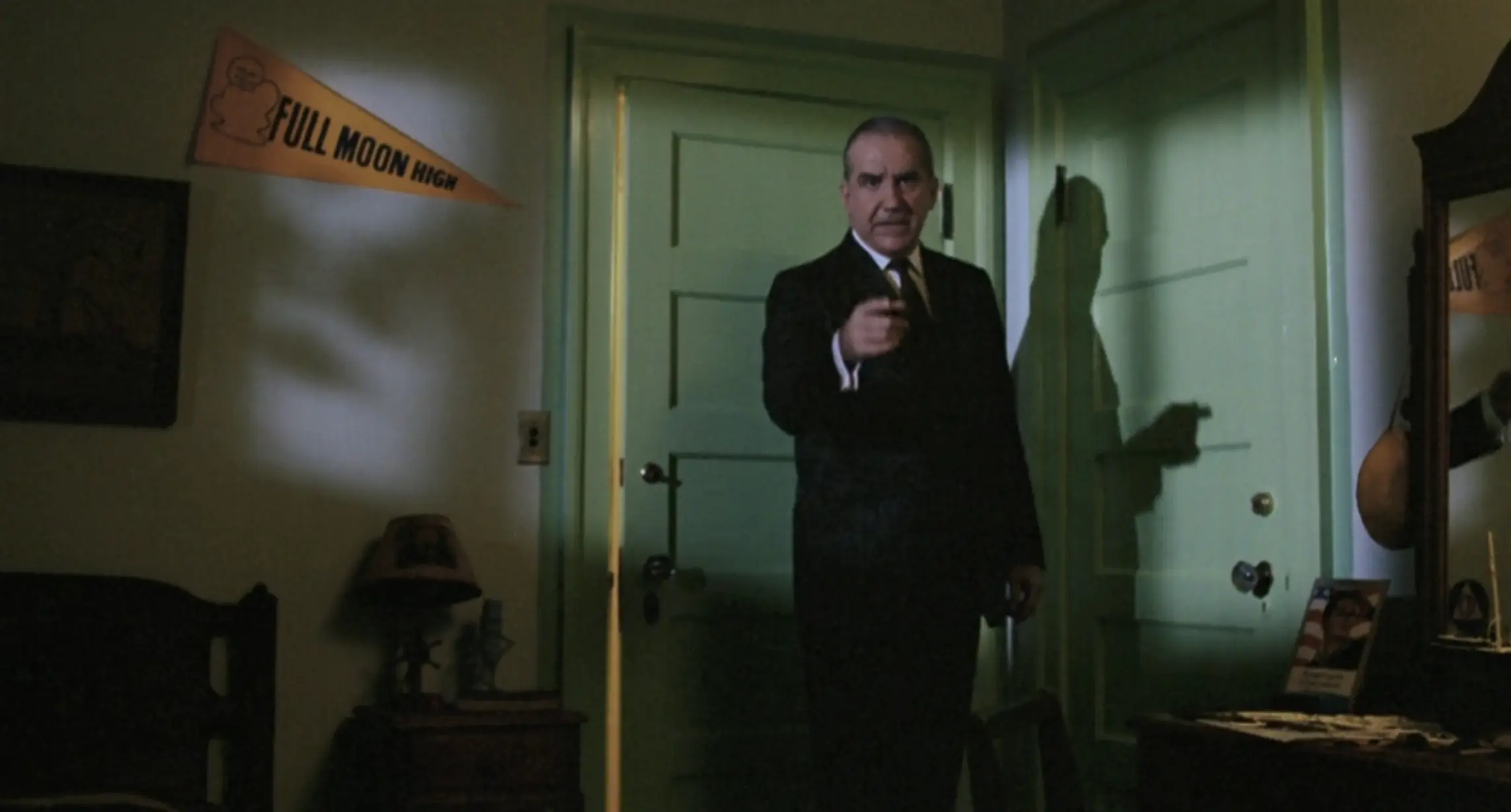
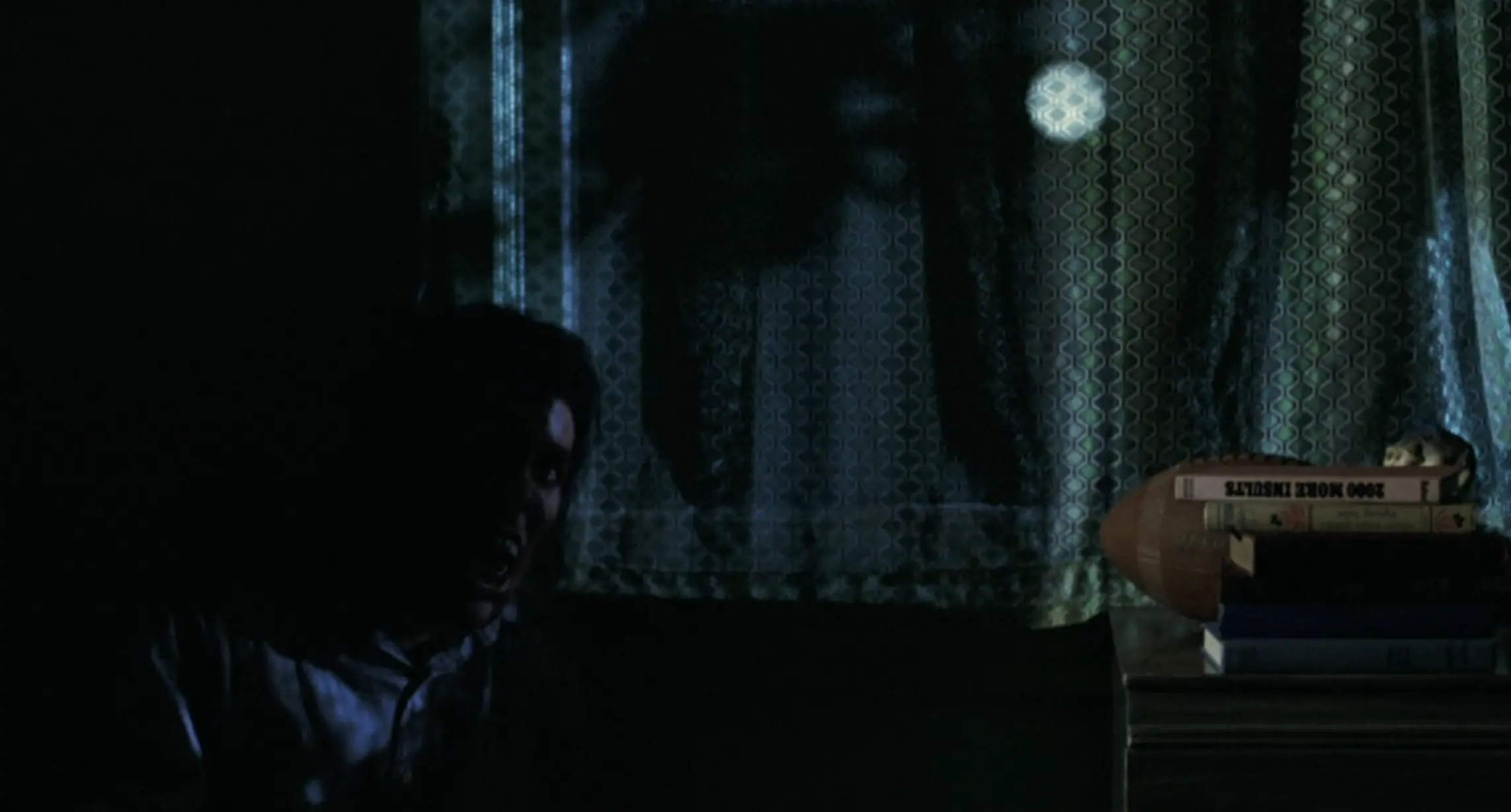
Two shots: Tony’s father berates him, Tony snarls back. These two shots play in my head when I can’t sleep. The cuts between them form a rhythm that mimics the human mind as it ponders a difficult problem: it fixates on one perspective, leaps to another in brief flashes, until that second one pushes us onto the next thought. Rhythmic, but irregular. There is a deliberate imbalance between the two shots: Tony’s father is seen from handheld point-of-view, eyes pointed at the barrel of the lens, whereas Tony is framed statically, just a few inches off from the father’s gaze. The shot of the father is bright, flanked by moonlight and a halo of artificial light peeking through a door frame. Tony is dominated by black, despite the bright full moon burning a hole in his curtain. Nothing lines up.
All this on its own would simply create incongruity; it is the red-hot feelings underlying the scene that make it strange. The scene’s simple, true emotions — father angry, son hateful — provide the trunk from which every frame branches: the father’s self-righteous halo, the son’s neglected darkness. But Cohen does not situate these visual motifs within any larger semantic system; light seems to mean something new with each scene. So the jarring lighting becomes an unexpectedly symbolic accident or — more strangely — the outpouring of his characters’ oversized willpowers. Who is in control, the filmmaker or his characters? The lines that Cohen gives the father — genuinely funny — seem like the filmmaker’s attempt at dulling the scene’s unwieldy power, but the emotions blow through the shackles — indeed, with these simple emotions, the son drives the father to his death. We expect that fiction will provide a safe playground for our emotions, as it does in even the great films of Ford and Mizoguchi, so we are shocked when they manifest as the same type of discordant symbols we see in our everyday lives.
These sorts of emotional magnifications figure into nearly every scene. Tony, the unhappy werewolf in a golden jacket, suffuses each space he passes through with melancholy, permanently suspended upon the threshold between life and death. In the memory, the particularities of the plot fade away, and the film seems to be just the procession of this golden jacket through empty spaces, lacking action but brimming with emotion, like the latent, uninhabited spaces that end Halloween. To any viewer of Full Moon High, I can list the names of its locations and conjure some image, and with it, some emotion: the bus, the airplane, the high school hallway, the football field, the bunker, the jail cell, the flower room, Romania.
Cohen’s construction of Romania, in particular, serves as the prime example of the strangeness of these spaces. The exteriors of this country, where Tony is first bitten by a werewolf, are rendered more via representative elements than via verisimilitude. Tony walks past peasants, a horse, bundles of hay, a barn, all perched in static tableau. A violin’s scroll steps into the foreground, sans player. We cut to a werewolf, walking from nowhere and to nowhere. It is precisely this failure to integrate the elements of the scene — a combination of lighting each figure separately, editing them into separate shots, and Tony’s gold jacket contrasted with the blue moonlight — that causes our memory to reorganize them, finding logical connections that the text disavows. We might place the werewolf peeking out of a corner in the wide shot — despite the lack of visual continuity — or the light coming solely from the full moon — despite each figure’s doubled shadows. The film is always stranger than our memory of it. All that is clear is the space itself, the shape of its structures and the color of its dirt, not the discord of its inhabitants.
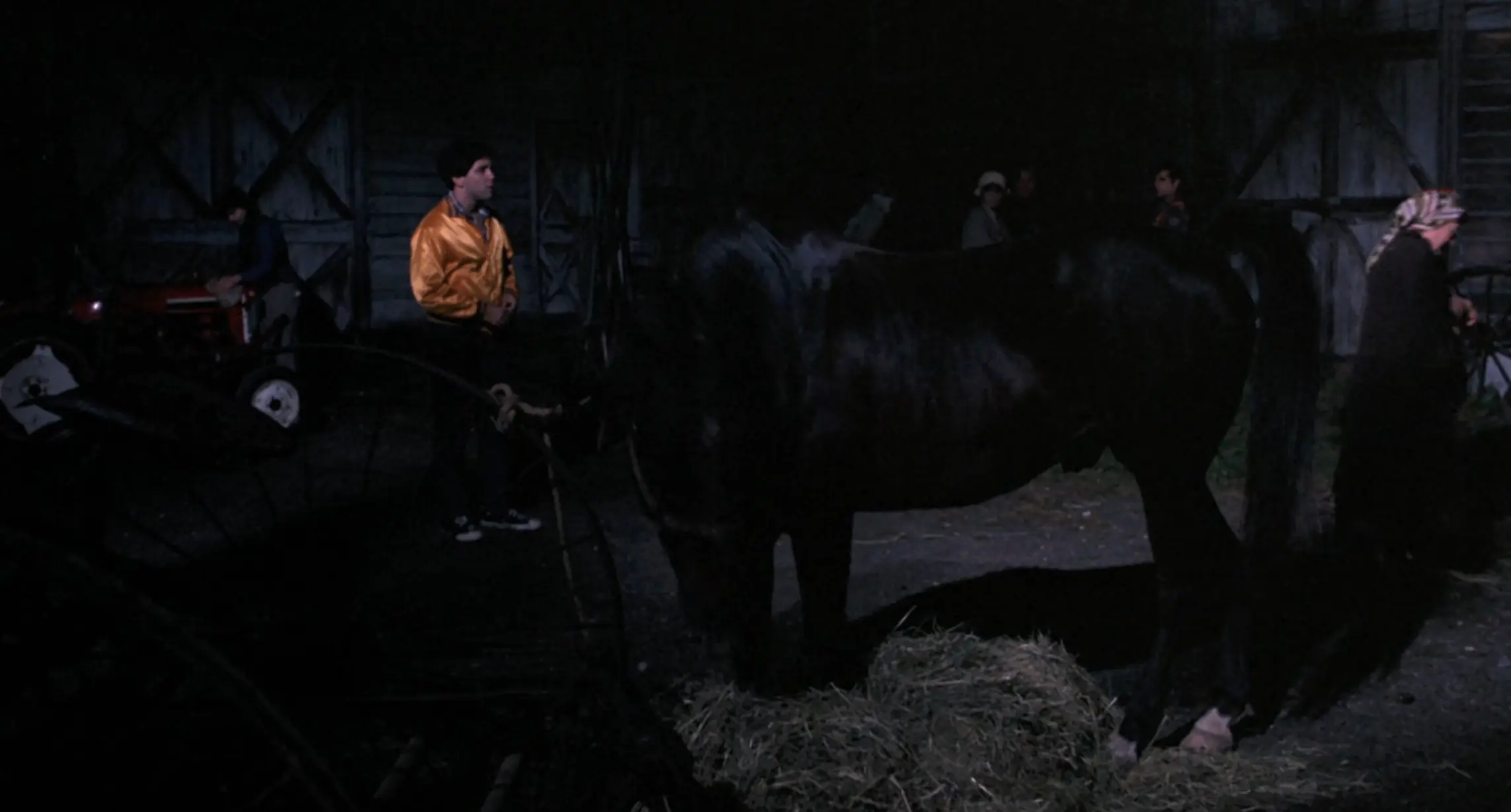
Truth be told, the disarray is laughable: the set looks fake, and Tony seems unperturbed by the danger, joking directly with the audience — ‘Pee on me, and let’s call it a night!’ But as with the confrontation between father and son, the emotions of the scene are entirely genuine, and it is that collision that turns this vision of ‘Romania’ into a site of tragedy. Tony’s father has abandoned him, no one speaks his language, and no one will acknowledge his existence. His dark surroundings seem to be the force of the emotions that Tony refuses to acknowledge. He tells us, ‘I’m a stranger… I’m lost and I need help.’ Recalling the scene years after viewing it, we get the sense that Tony is a stranger lost inside the darkness of our memories, screaming to get out.
The strangeness of Full Moon High cannot be created on purpose. Strangeness always results from a genuine attempt, and a failure to control the grandiosity you’ve created. Cohen’s brilliance as a filmmaker lies in always setting his sights just past his capabilities — past any filmmaker’s capabilities. Who could properly film a child driving his father to his death? The task is impossible. The result is strange. We remember it forever. I can’t ask for much more from a movie than for it to accompany me in all the hardships of life.