I
Q: The Winged Serpent (Larry Cohen, 1982)
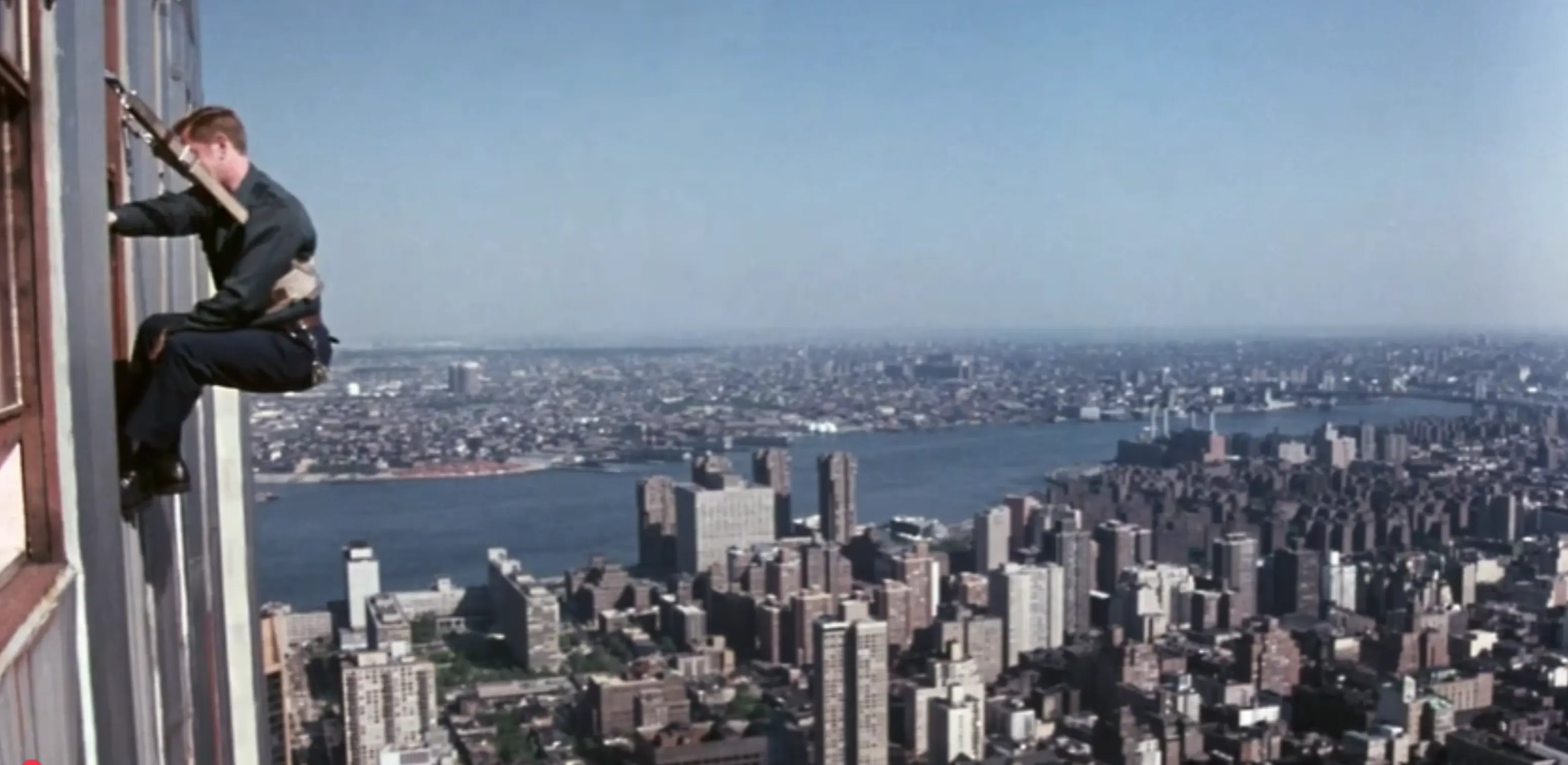
Q: The Winged Serpent opens with an aerial perspective shot from above New York City. We briefly observe the skyscrapers until the camera performs a pan and brings into the frame a worker cleaning the windows of a building. His image, occupying the left corner of the screen, functions both as a frame and as a scale for the contrast between the human figure, larger due to its proximity to the camera, and the city in the background, reduced to the point of offering us a sense of its amplitude and a mapping of its coordinates. The framing is not vertical, like a map seen from above, but oblique, introducing a strong sensation of vertigo based on the tension between the near plane, pressed against the façade, and the distant plane (the city in free fall). There is a perceptual abyss between figure and ground: the human body is large, sharp, lateral, while the urban background is vast, distant, compressed.
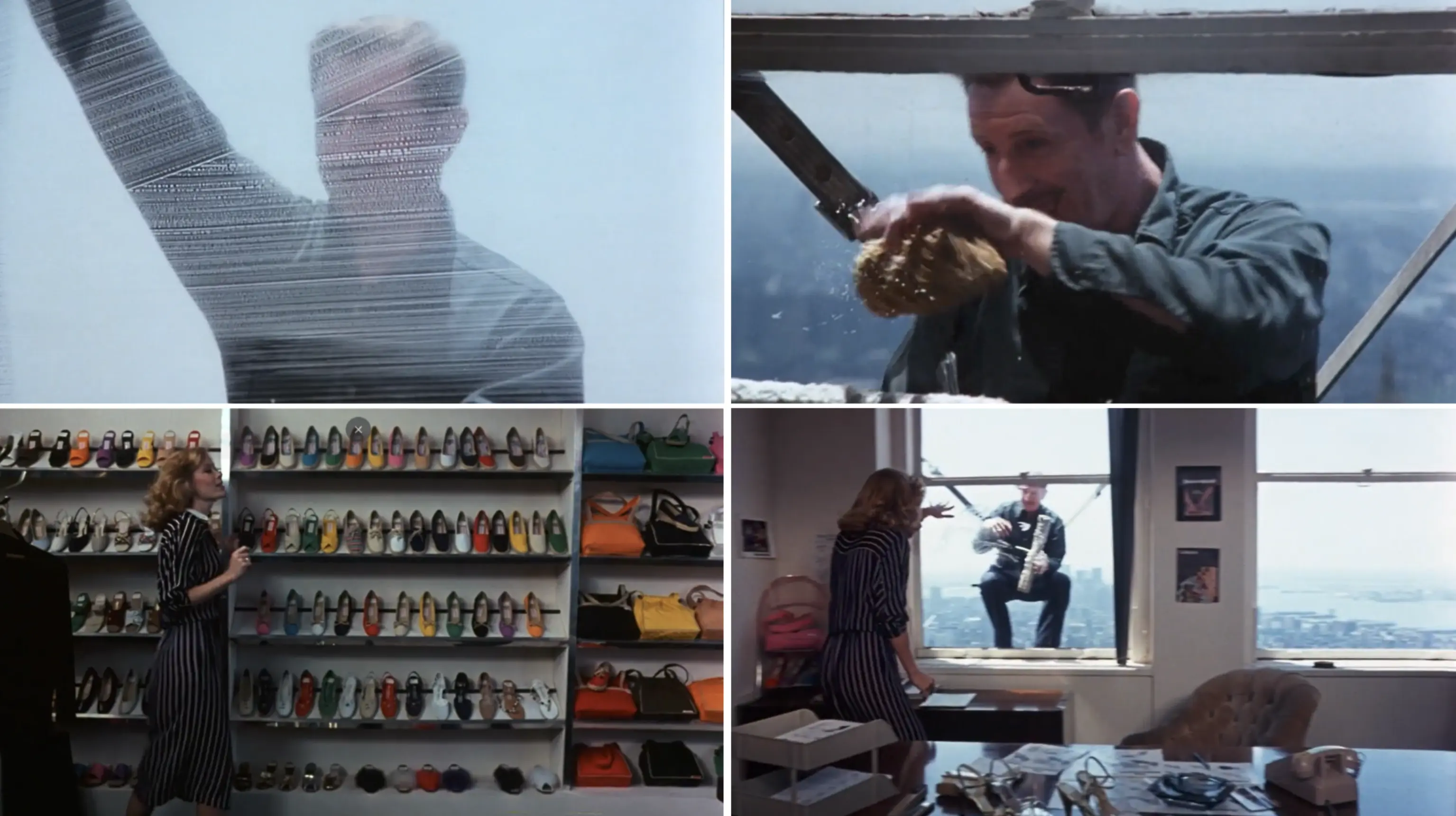
The following cut displaces us to the interior of the building. The worker reappears, now seen through cleaning products and glass surfaces. The image produces an immediate rupture: the human body seems dematerialized, crossed by lines, reflections, and optical interferences. The solidity of its contour is lost, and the figure begins to operate as a graphic field. The sky is the background, without horizon or supporting reference. Even before any narrative event, the film introduces an ontological instability, corroding the security of bodily perception in space.
A medium shot of the suspended man, now engaged in concrete action, produces a partial re-anchoring in reality. A horizontal beam crosses the frame like a line of precarious containment. Inside the building, we observe an orthogonal, ordered, and stable space. The modular repetition of shoes creates a visual grid. In shallow depth, everything is legible, symmetrical, and predictable, establishing a structural counterpoint to the exterior. The camera moves until we perceive a woman wandering inside the room. Two spatial regimes collide within the same image: on the left and in the foreground, the stable interior; in the background, framed by the window, the body suspended in the void.
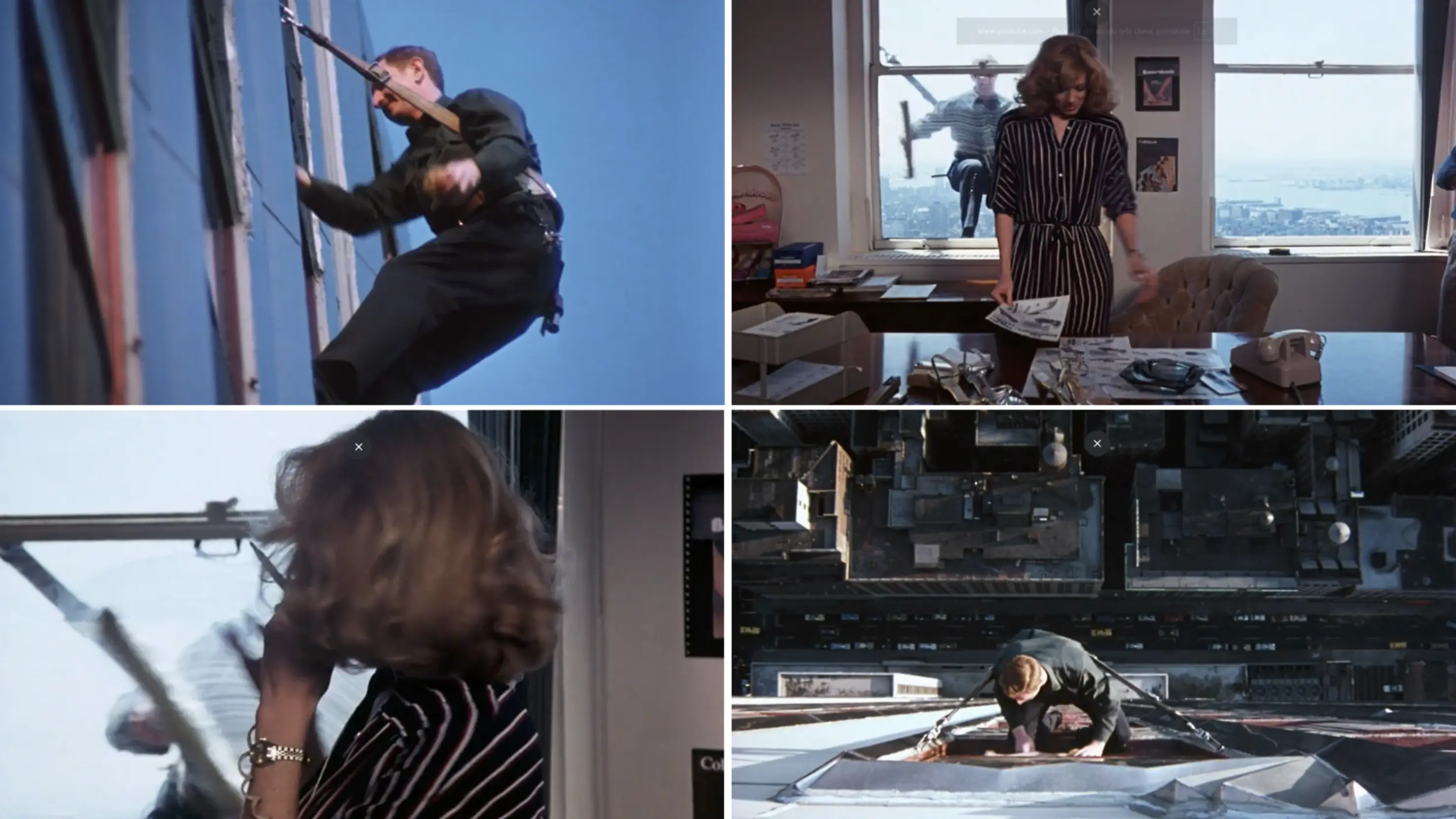
The worker exchanges gestures and playful signals with the woman, who responds from inside. His figure is held in an unstable composition, supported by cables that create tension in the visual field. Next, a top-down shot of the building radicalizes this instability. Seen from above, human presence is reduced to a minimum, while the city becomes a kind of model, an almost abstract field of geometric patterns and parallel lines. The diagonals create simultaneous visual forces of traction and containment, and transform the body into a graphic knot, trapped between opposing vectors.
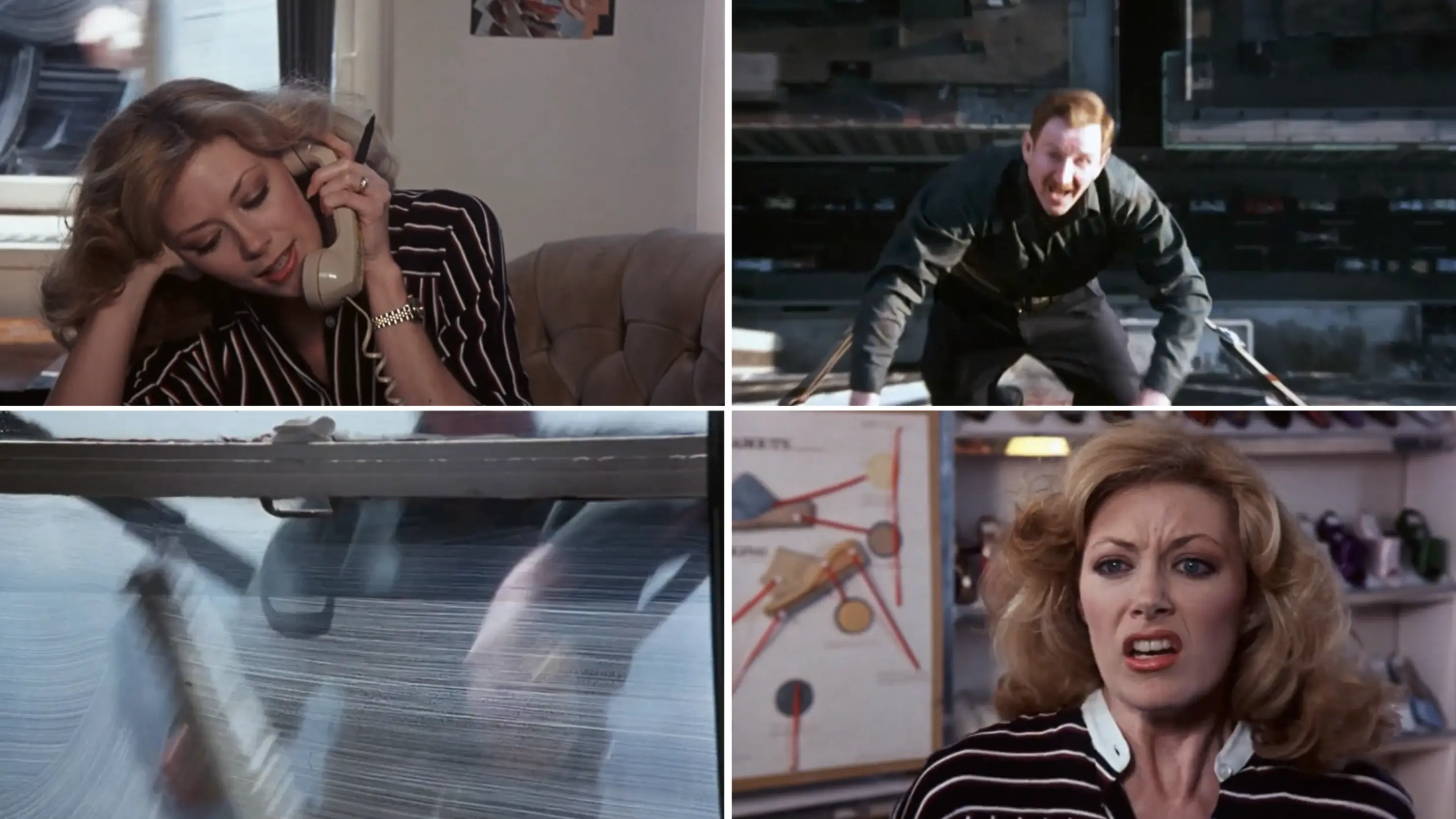
The scene returns to the woman on the phone. Danger is inscribed in the instability of the frame. When we return to the worker, the camera approaches his face, while the tension is increased by a bird’s sound in crescendo. His face becomes increasingly sharp, while the urban space progressively blurs and becomes abstract. In very rapid cuts, the film shifts to the interior apartment shot, in which the man’s body appears once again blurred behind cleaning products. The woman’s face is then framed, and we observe her reaction to the event: she becomes increasingly tense until she screams.
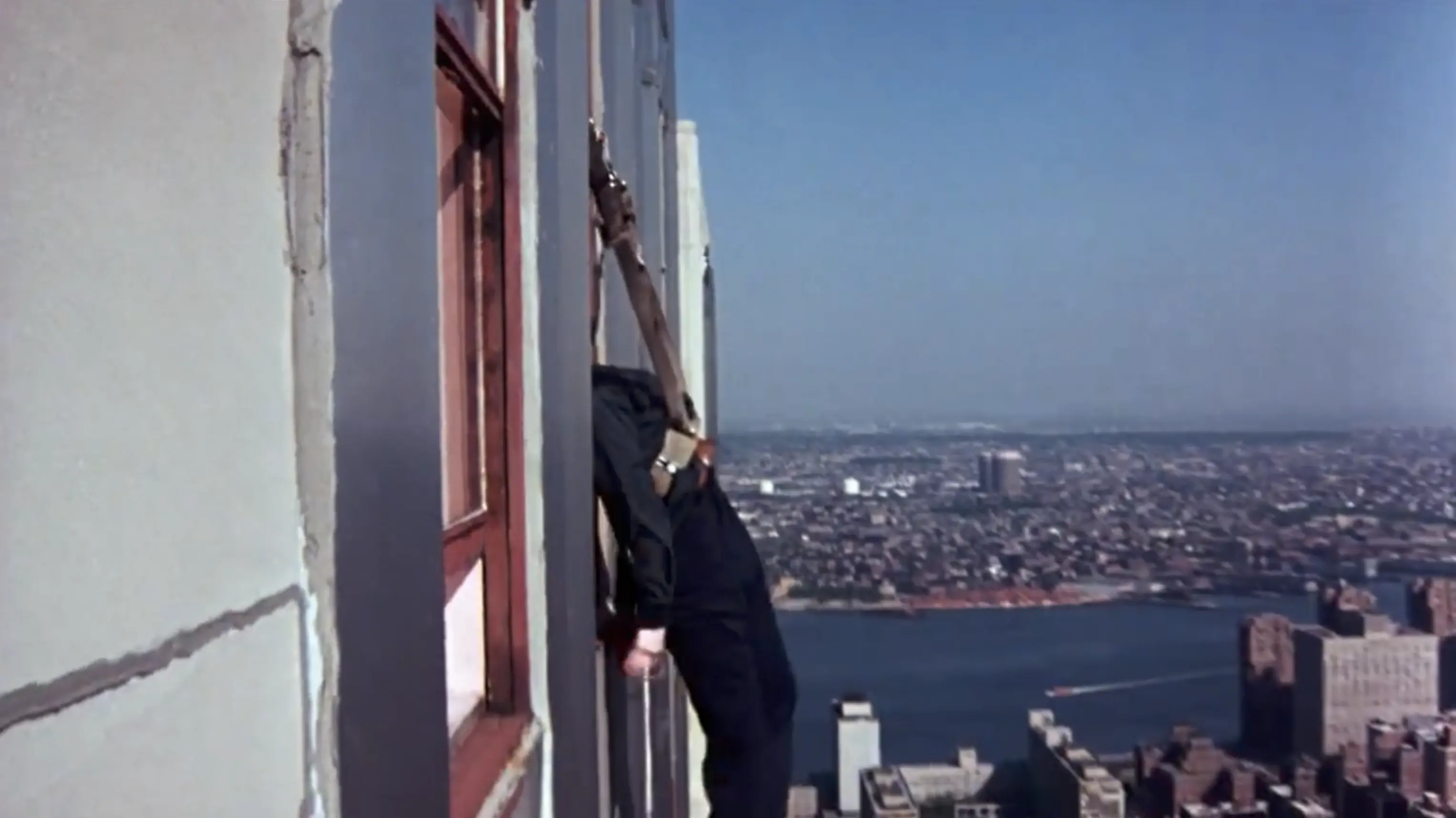
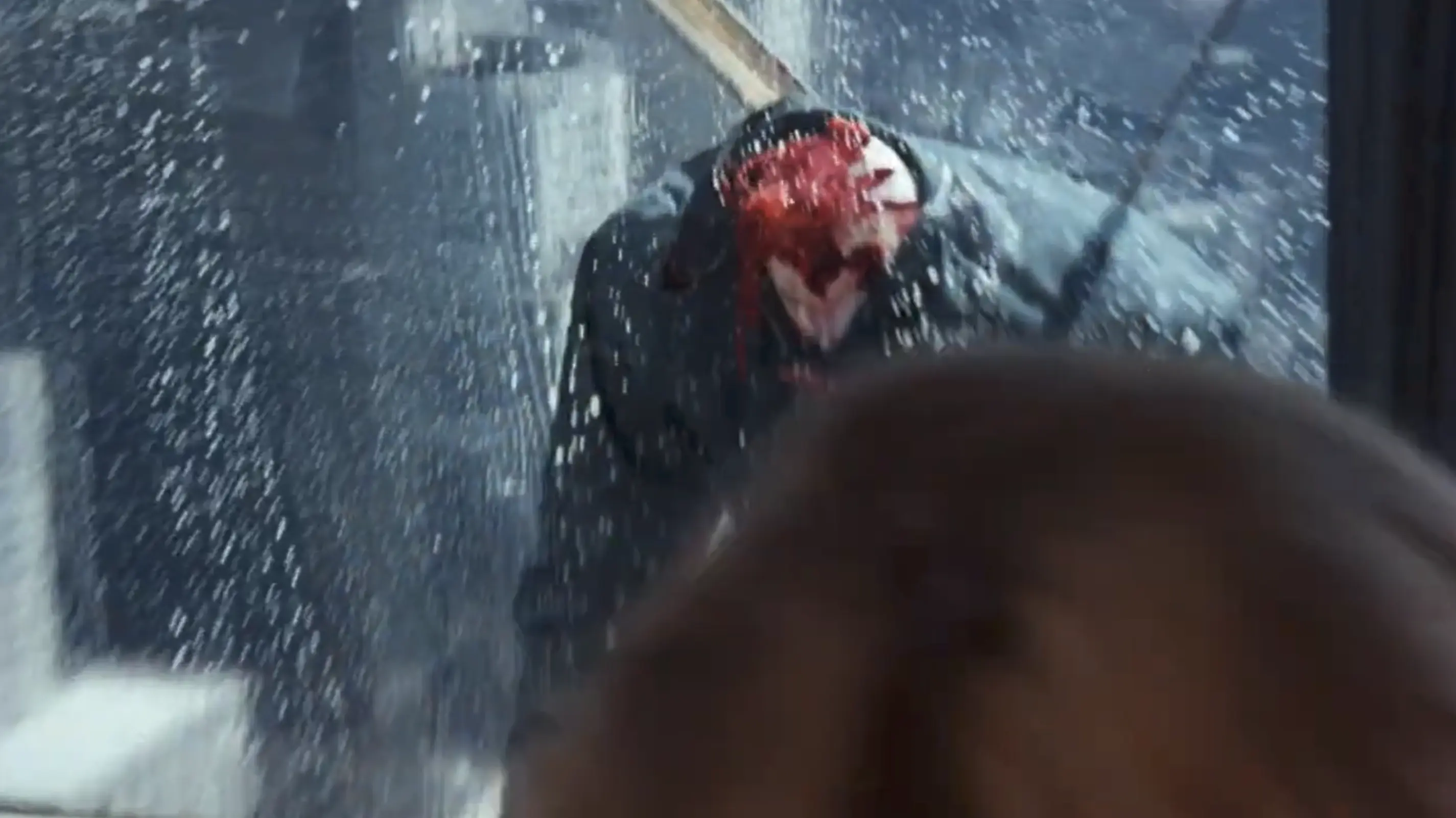
In a new abrupt cut, a framing similar to the initial one reappears, now in profile. The worker seems to be inserted from the torso up inside the building. In the scene’s conclusion, the woman screams while, in the background, the man’s body remains at the window. It becomes evident that his presence inside was illusory: his head has been severed. The aerial threat, never directly shown, is suggested by the sound montage, by the screams, and by the sudden absence of the intact body. We are aware that an aerial threat, probably a creature, was responsible for the decapitation, suggested by the screams and the sudden absence of the whole body.
II
The opening sequence of this film by Larry Cohen, released in 1982, hints at one of its main formal interests: an aerial montage constructed from the play between perspectives, articulated by a constant alternation between what remains inside the frame and what is kept outside it, between what is shown and what is withheld. The city is presented simultaneously as a legible space and as an abstract field, while the human body oscillates between being a recognizable figure and an unstable graphic element.
At ground level, an ambulance passes, bringing the body out of the building. David Carradine, who plays Detective Shepard, appears for the first time in a low-angle shot, set against the height of the building. We observe his face, but we still do not see the top of the construction. He looks upward. The city, at this moment, appears only partially. Meanwhile, the scale of human bodies renders them more distinct and concrete. From this point on, whenever the film situates itself at street level, the camera approaches its characters in a more direct manner, almost as in a journalistic or documentary register, evoking an observational cinema close to that of Cassavetes, in which attention falls on physical presence, gestures, and bodily interaction. The performances assume a naturalistic, sometimes rough tone, something that is most clearly perceived in the work of Michael Moriarty, who plays Jimmy Quinn.
At this human scale, when we follow characters walking on the city streets, there are no elaborate games of looking nor partial occlusions of space. This becomes evident in one of the first scenes involving a corpse, presented naked, with the skin removed, lying on a bed. The detectives observe the body with relative neutrality, and one of them even throws a pillow, a gesture that reinforces the contrast with the more abstract and distanced treatment of the aerial sequences.
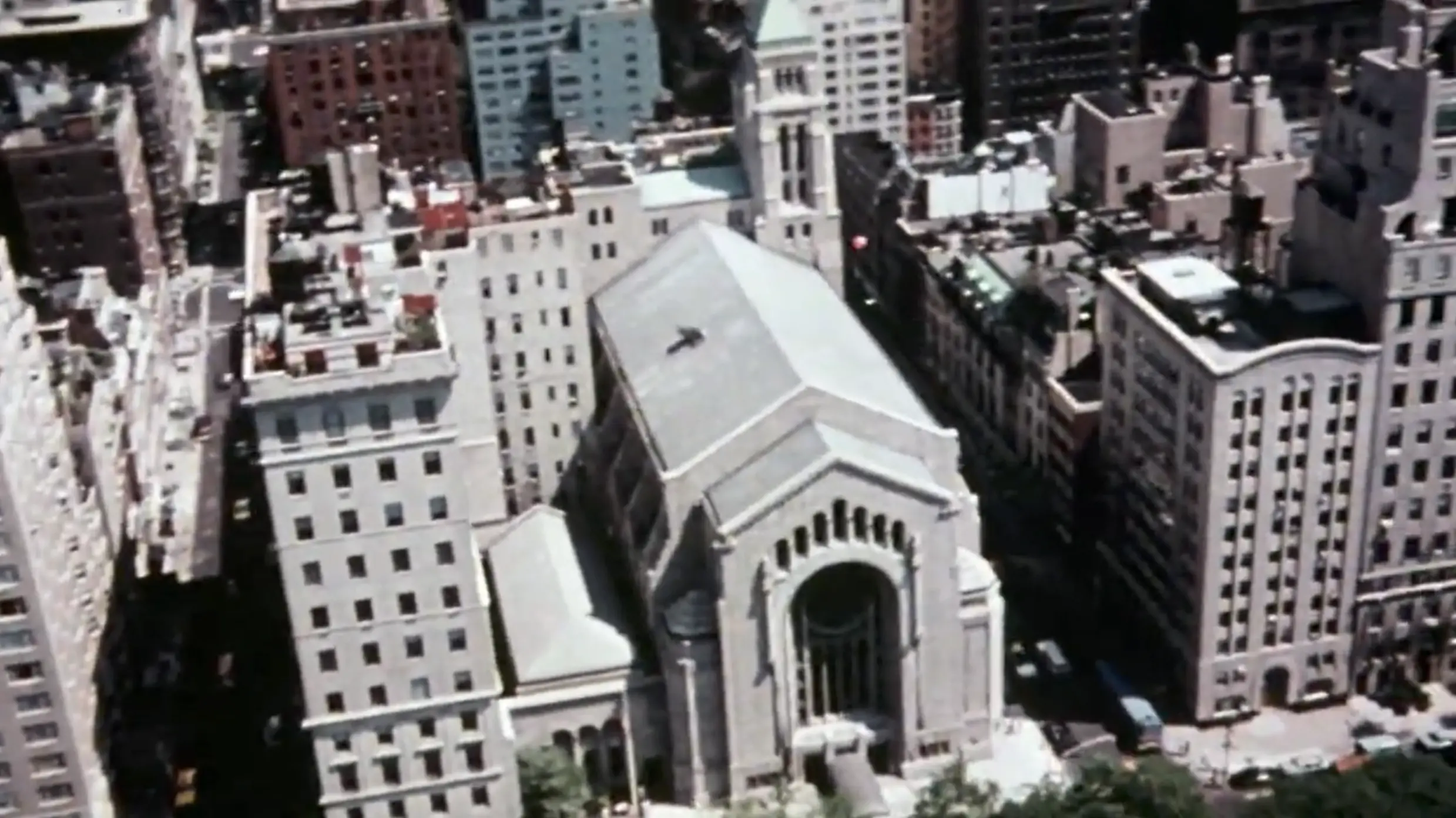
The following sequence returns to aerial space. At this moment, it becomes clear that the montage does not alternate only between grounded and aerial shots, or between oblique and coordinated perspectives, but also organizes the film into blocks that at times privilege the human dimension and at others the spatial dimension. We see a tracking shot that traverses the city more freely. The camera does not remain tied to a fixed axis but floats over the tops of buildings. Seen from above, their geometric blocks and their rational ordering reveal their structure more clearly and stably, in opposition to the low-angle shot of Carradine, in which the same constructions appeared distorted by extreme verticality. In one of these sequences, the camera follows the movement of a balloon crossing the urban sky. It is as if we were following the narrative alternately through the gaze of men and the gaze of gods.
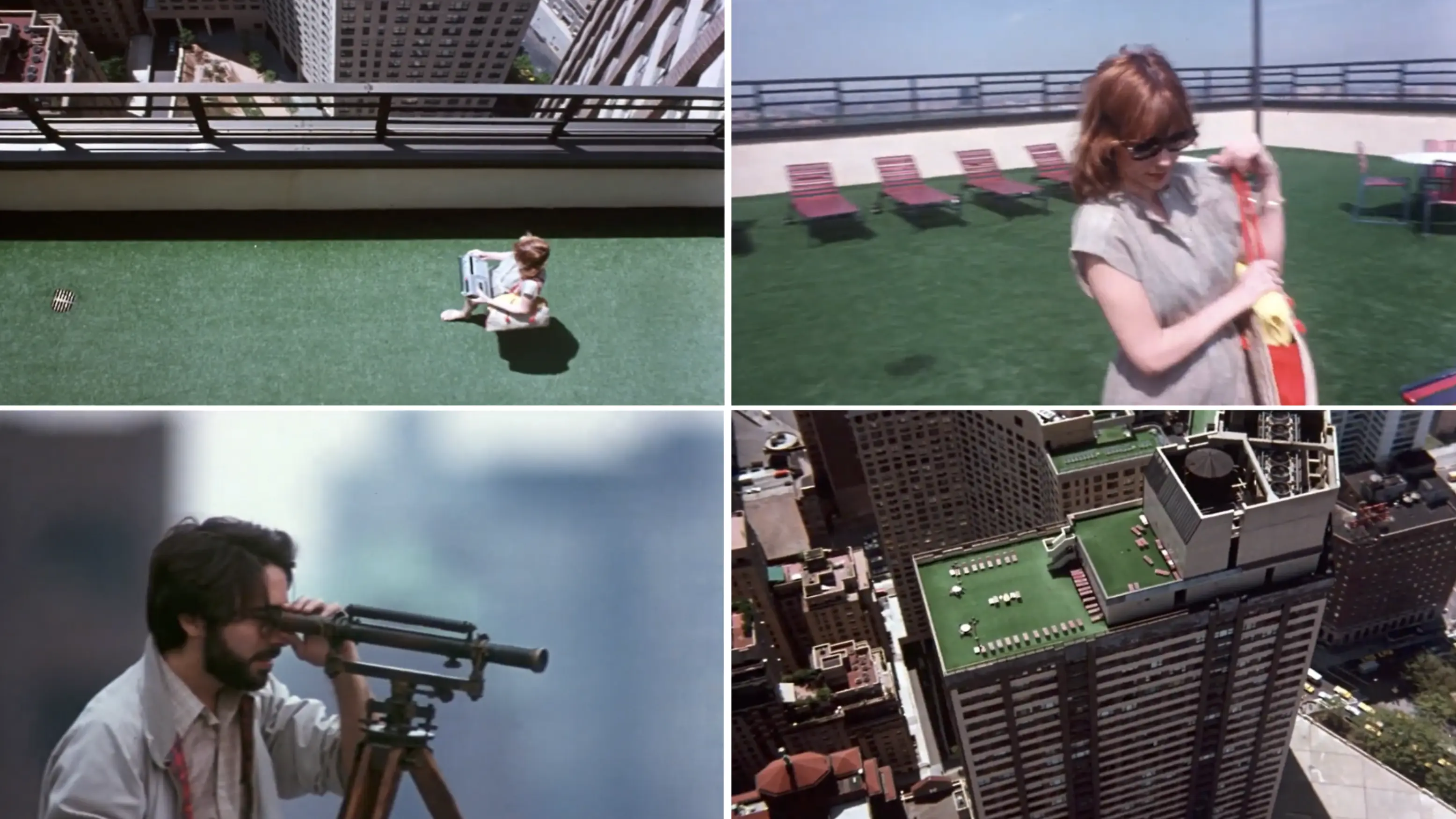
The second death presented by the film, again associated with the aerial perspective, begins after this section. A woman walks across a building’s rooftop. The film cuts to an aerial view of the city, framing its green parks in horizontal balance with tall, gray skyscrapers. The camera moves smoothly, without great flourishes, but freely. We return to the woman, now seen from the torso up, and realize that she is on the top of the building, surrounded by beach chairs. She glances slightly toward the sky, pulls a chair, and the camera rotates around her body. New cut. We again see the buildings arranged horizontally, in a pan moving to the left. The image appears out of focus and regains focus as it reveals a man observing the scene through a telescope.
Another aerial shot follows, this time concentrated on a single building. We then realize that the tracking shots do not merely illustrate the action, but that these wanderings through urban space function as a way of delimiting its coordinates. Without our noticing, the camera had been gradually approaching the building where the woman is seated. Initially, she was observed from a distance, alternated with aerial images of the city, but with each return, the proximity increased.
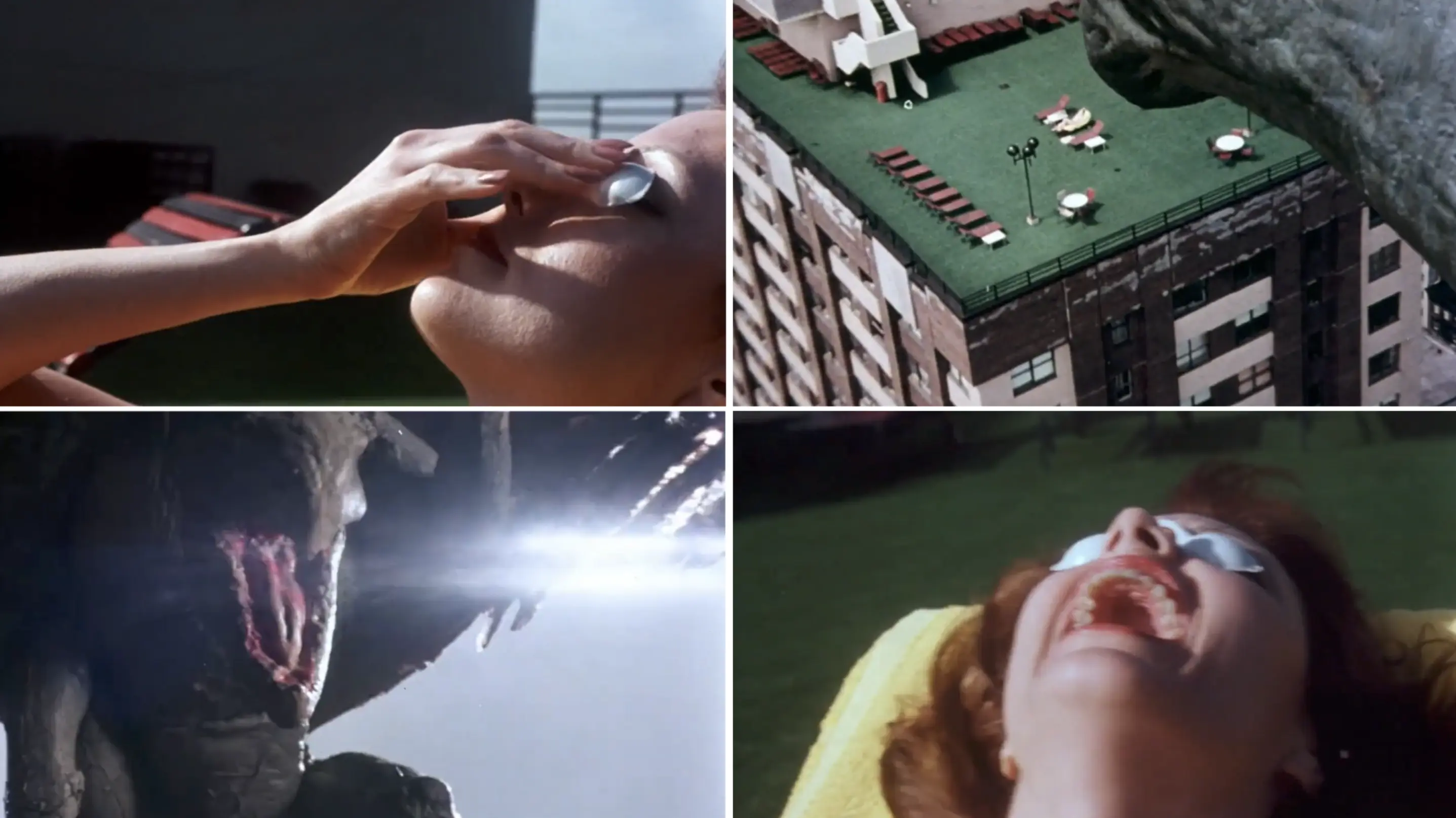
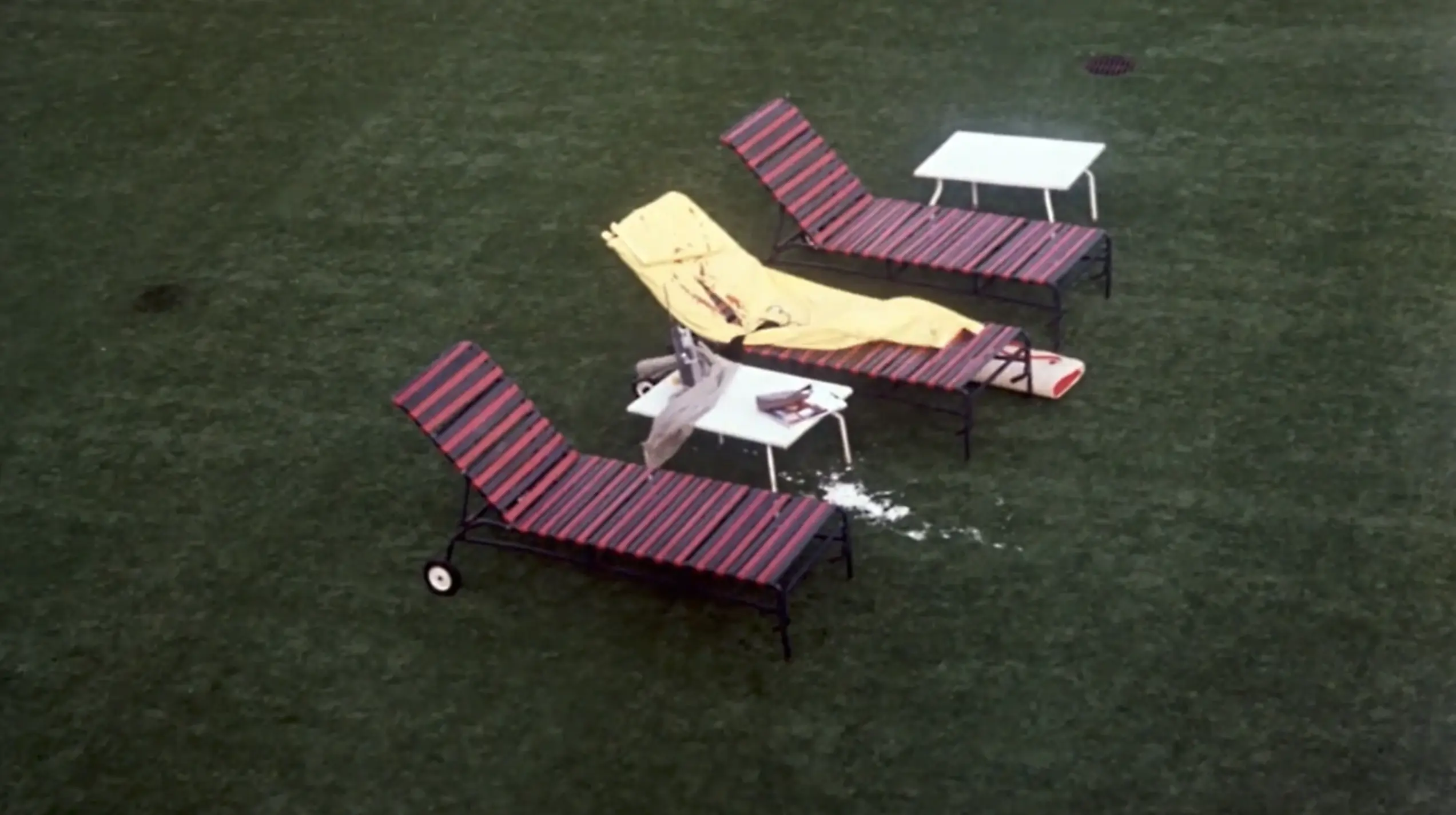
The cut at this moment is particularly effective: from the distant view of the building, we abruptly pass to a close-up of her face, as she places a visor over her eyes to protect herself from the sun. The sequence continues with another aerial shot, now at increasing speed. In the upper right corner of the frame, the back of a winged animal appears. Its face is glimpsed only briefly, enough that, through a montage that places it on the same angular axis as the woman, the spectator can follow its movement. This displacement is accentuated by the scream, which suggests the creature’s imminent attack on its human prey. Next, the beach chairs appear empty. Covered with sheets, they indicate that the human presence that once inhabited the space has been replaced by a brutal absence.
III
After the attack, the aerial and terrestrial dimensions meet for the first time within the film’s visual regime: the camera, which initially frames a detail of a building, gradually moves downward until it reaches street level. We then observe pedestrians reacting immediately to the attack. Blood drips onto some of them, hits automobiles, spreads across the urban space. The characters raise their eyes repeatedly, but what we see are only their faces turned upward. We do not look at the sky at the moment of the creature’s appearance; instead, the film constructs an alternation of faces, registering the impact of the event on the human scale. Only at certain moments does the camera rise again, framing the sun or flocks of pigeons, suggesting the presence of a mythical or transcendental dimension that does not allow itself to be directly apprehended in that space.
Back in the world of men, we see Michael Moriarty’s character enter a bar and ask to play the piano. The bartender, uninterested, gestures indifferently and lets him do as he pleases. At this moment, the film’s physical and intense register presents Moriarty behaving in a slightly unbalanced way. The melody he plays, out of tune and dissonant, suggests a profound misalignment in the character: someone too distant from the world of the gods, yet too oblique when circulating among men. The way Moriarty walks, glancing sideways, with loose arms and a mocking look that is at once lost, empty, and abstract, directed at no particular place, distinguishes him from the other characters in the film. It is not the gaze of someone who fears seeing, nor that of someone who allows himself to be fascinated. Later, when he confronts the egg of the creature, he will encounter it as if it were nothing special.
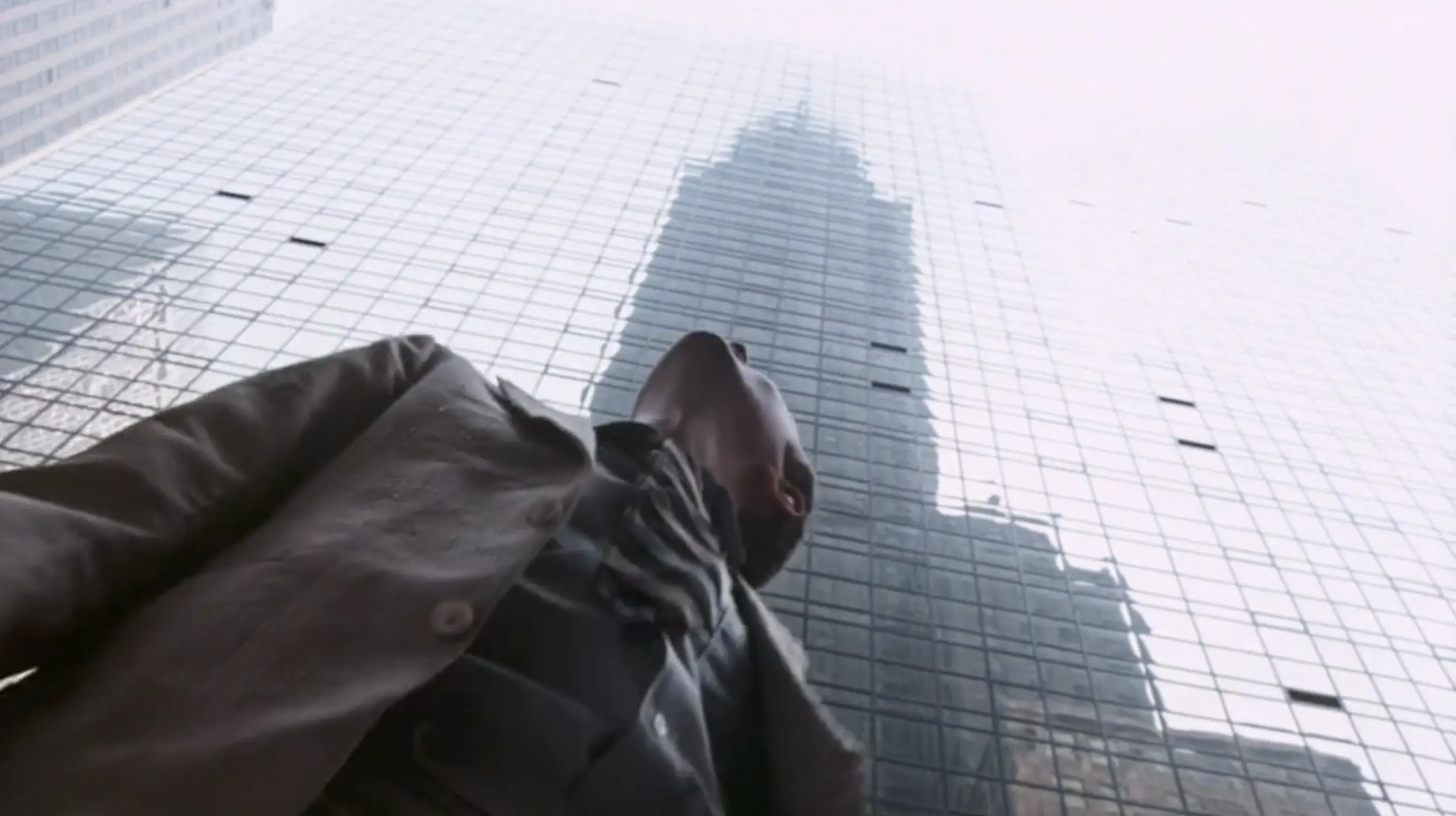
When he appears in a low-angle shot before the building where the creature has made its nest, he looks upward, almost laughing, with a curious gaze, like that of a young person delighted by observing ant colonies or other fragile microcosms. At the top, he faces the city and begins to laugh, in an ambiguous gesture between defiance and disinterest. Later, pursued by criminals, he will deliberately lead them to the serpent’s nest, the place where the creature’s egg is deposited, inside the Chrysler Building.
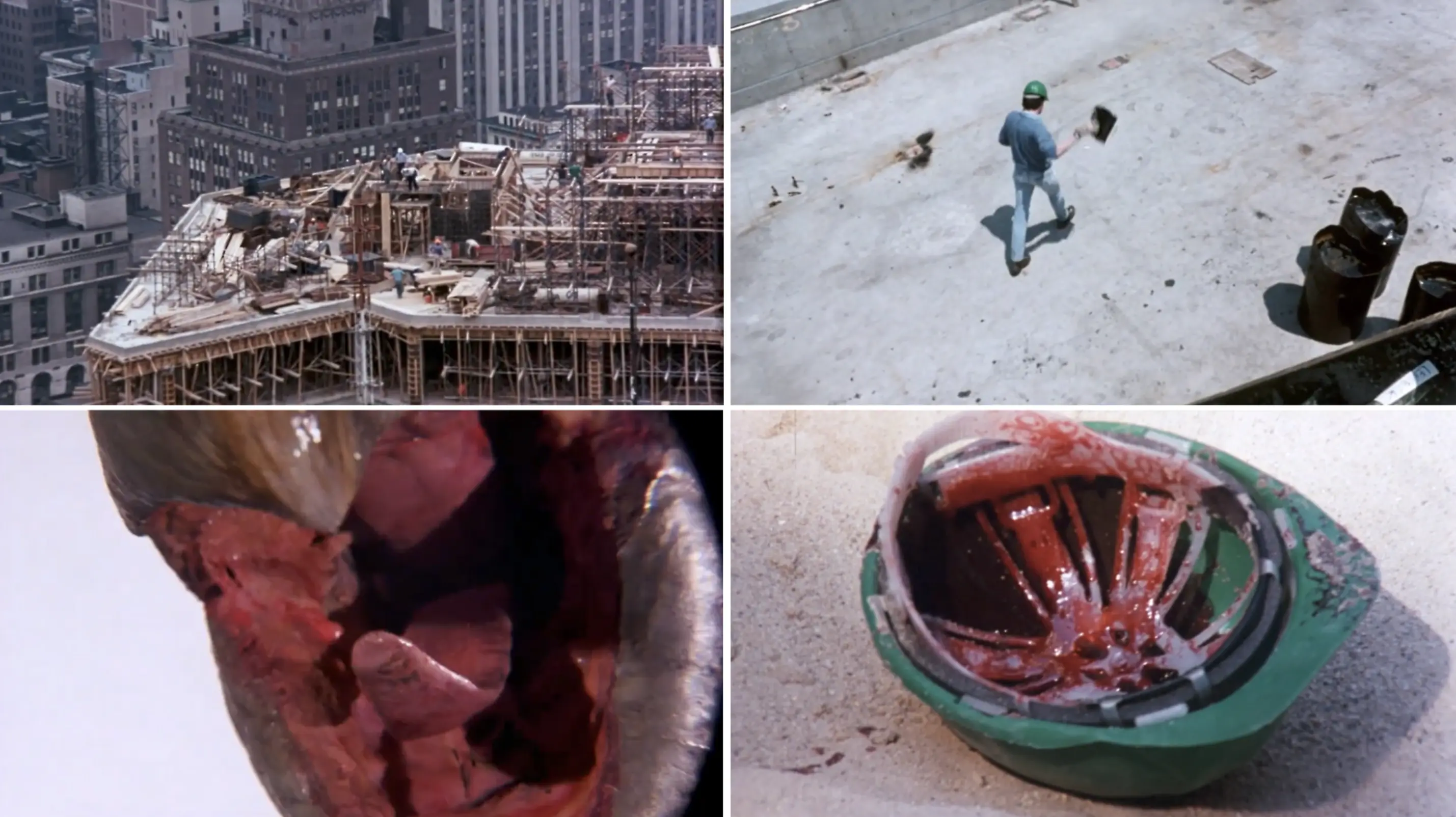
The following death sequence begins with the aerial camera approaching the top of a building under construction. Here, the staging is more continuous than that presented in the scene of the woman sunbathing on the rooftop. We already know that an aerial threat exists; the question is no longer whether it will attack, but how. The workers gesture; one descends the ladder, another throws his helmet to the ground. The moment a noise is heard, that sound synchronizes with that of the creature. A few seconds later, the film cuts and the camera frames the sound’s source: the animal’s entrails. Human absence manifests itself in the bloodied helmet, in close-up on the ground, whose form visually echoes the previous shot of the creature’s throat.
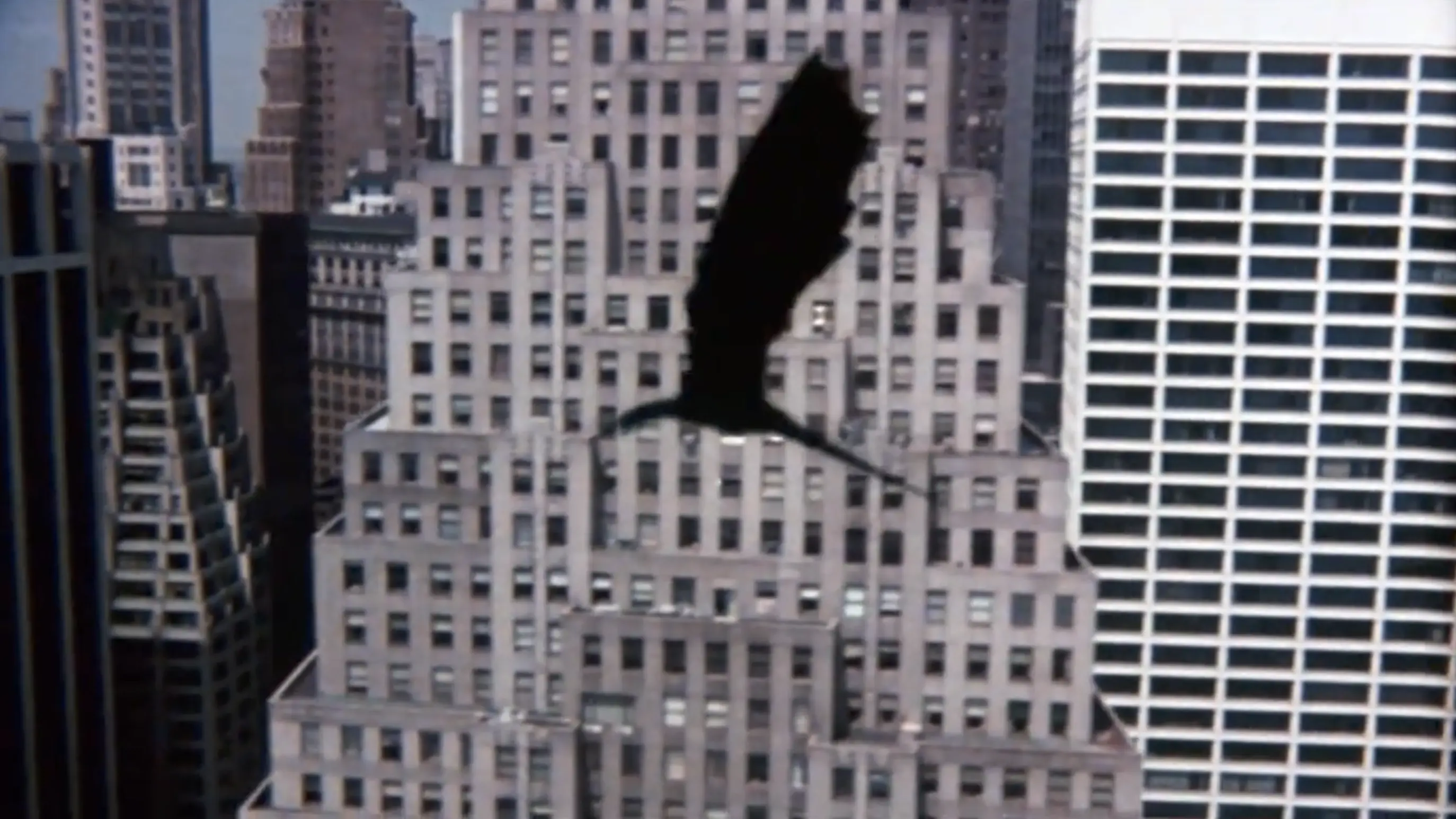
Q, the winged serpent, is then seen for the first time in silhouette. Moments later, we discover it to be an entity from Aztec mythology, brought back to life through human sacrifices carried out by an urban cult that reenacts Mesoamerican ritual practices. From the moment the serpent’s mythical dimension becomes explicit, the film concentrates, for a time, on the human scale. We follow the police investigation led by Carradine and Moriarty’s maladjustments over a long interval, until the creature attacks again. In the meantime, human sacrifices, discarded bodies, and chases occupy the narrative foreground. Still, whenever the film returns to an open space at ground level, or follows the descent of a stairway, a virtual tension infiltrates the scene, far greater than that unfolding on the immediate terrestrial plane.
IV
For a certain period, the film manages this tension by keeping the creature largely off-screen and restricting access to spaces of wide visual openness. Most scenes concentrate on interiors, while the occasional returns to broader views operate as reminders of the initial sequences or as anticipations of new attacks. This period of latency is used to advance the characterization of Jimmy Quinn, Michael Moriarty’s character, who perceives himself as a wronged figure, someone to whom the world is indebted. This self-image is partially shared by his companion, whose compassionate and complacent attitude contributes to the character’s moral ambiguity. Quinn does not recognize himself as a murderer: in leading his pursuers to the serpent’s nest, located in the Chrysler Building and previously discovered by him, he insists that he did not kill anyone, since he merely brought the victims to the place where the creature was located, without executing the final act.
In parallel, Detective Shepard, played by David Carradine, manages to connect the crimes, testimonies, and material traces with the figure of an Aztec divinity. On the institutional level, however, the police resist admitting the existence of a mythical entity, since recognizing it as a god would imply a conceptual and operational impasse. Thus, the serpent is framed as an animal, subject to capture or extermination according to conventional protocols. In this context, Quinn finds himself momentarily in a position of advantage: wanted by the police, he holds decisive information about the creature’s whereabouts and uses it as a bargaining chip, demanding money and rights to the images of the confrontation. Faced with a lack of alternatives, the authorities accept the deal, but later invalidate it based on technical clauses, arguing that Quinn did not lead the investigators to the serpent, but only to the egg, and therefore there was no legal obligation to honor the payment.
The sequence of confrontation between the police and the serpent’s egg follows an inverse path to that traced by the initial scenes. At the beginning of the film, we saw human figures situated in aerial space, being attacked by the winged serpent. It was as if the human scale, by invading the aerial scale, inevitably exposed itself to its dangers. Here, we are no longer in open space, but in an enclosed location, as if the human scale were able to drag the serpent into its own habitat. Images of the sky appear only indirectly, filtered through beams of light insinuating themselves through openings in the building.
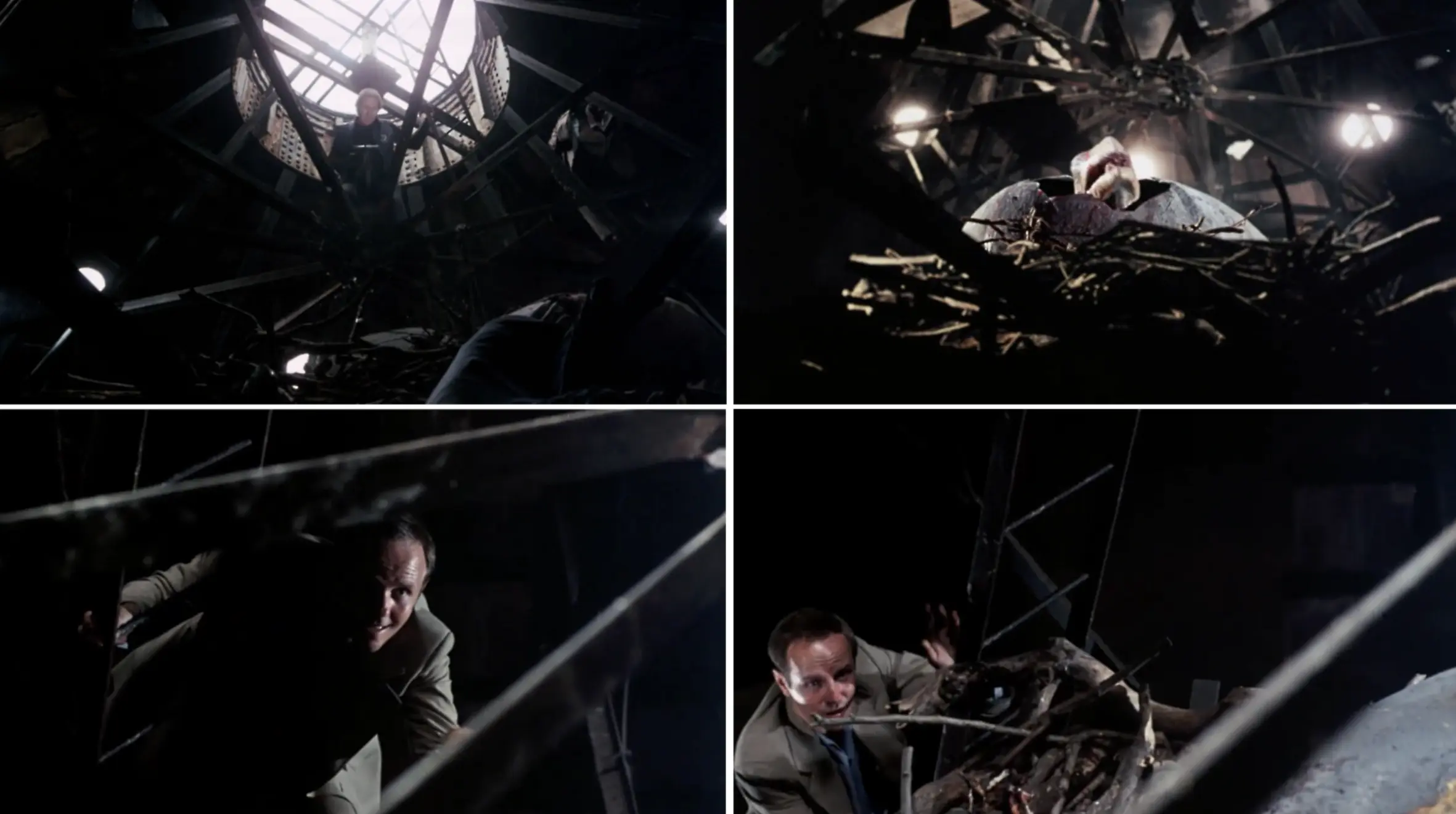
The interior of the building multiplies diagonal vectors. They become dominant and, although still structurally ordered, produce an effect of continuous instability, in which the gaze is constantly displaced, prevented from resting. The multiplication of these vectors creates a visual space in permanent imbalance, a field of forces in which no line offers rest or stable orientation. When the serpent’s hatchling breaks through the egg, stimulated by gunfire, the first image it encounters is precisely this world traversed by aggressive diagonals, an already maladjusted, hostile, fragmented space. Moriarty’s image, previously crystalline when juxtaposed with the luminous reflections of mirrored buildings, now appears obscured, swallowed by penumbra and the oppressive geometry of the interior. The staircases, in turn, reinforce this tension, functioning as oblique lines that intensify spatial compression.
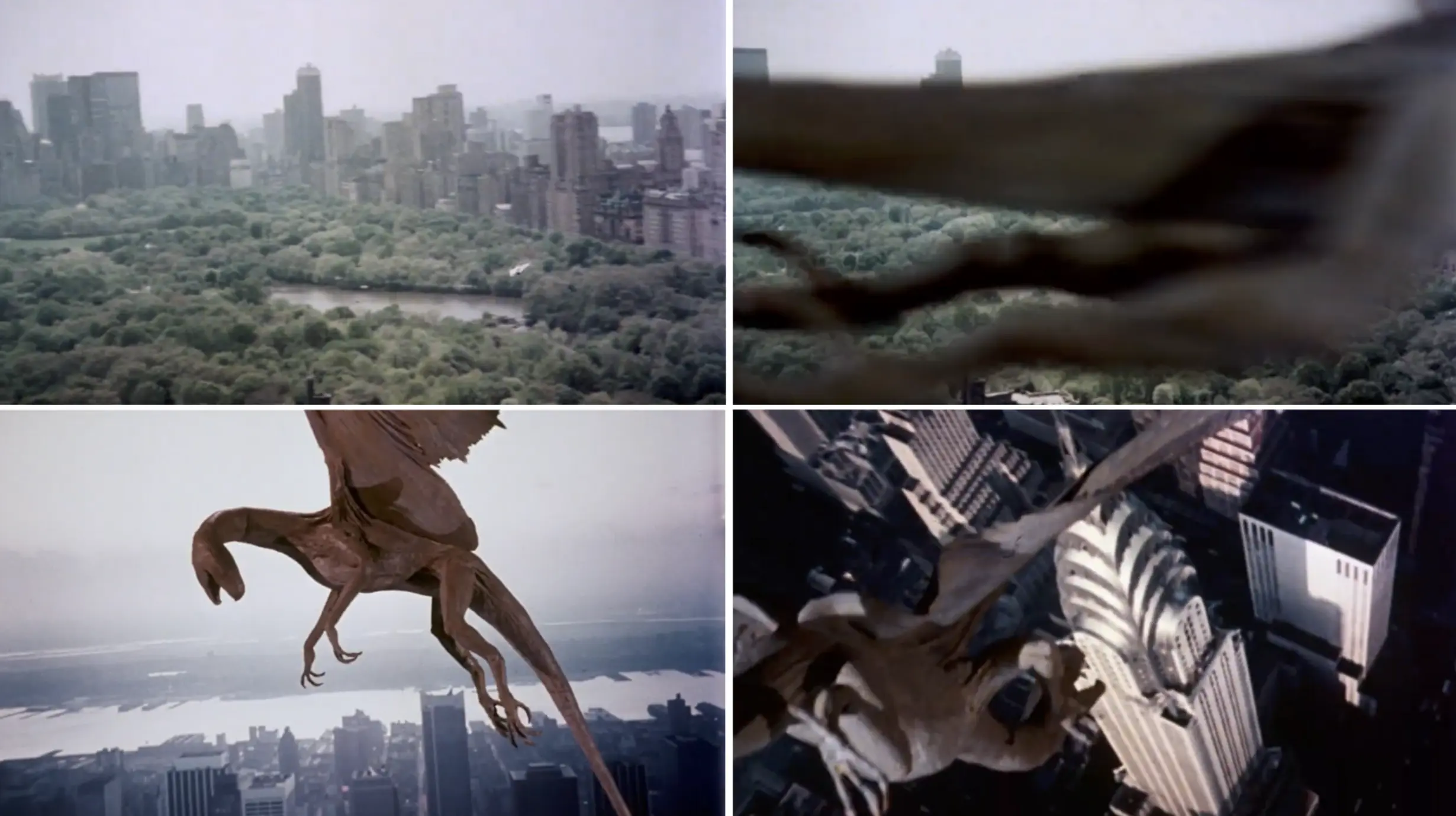
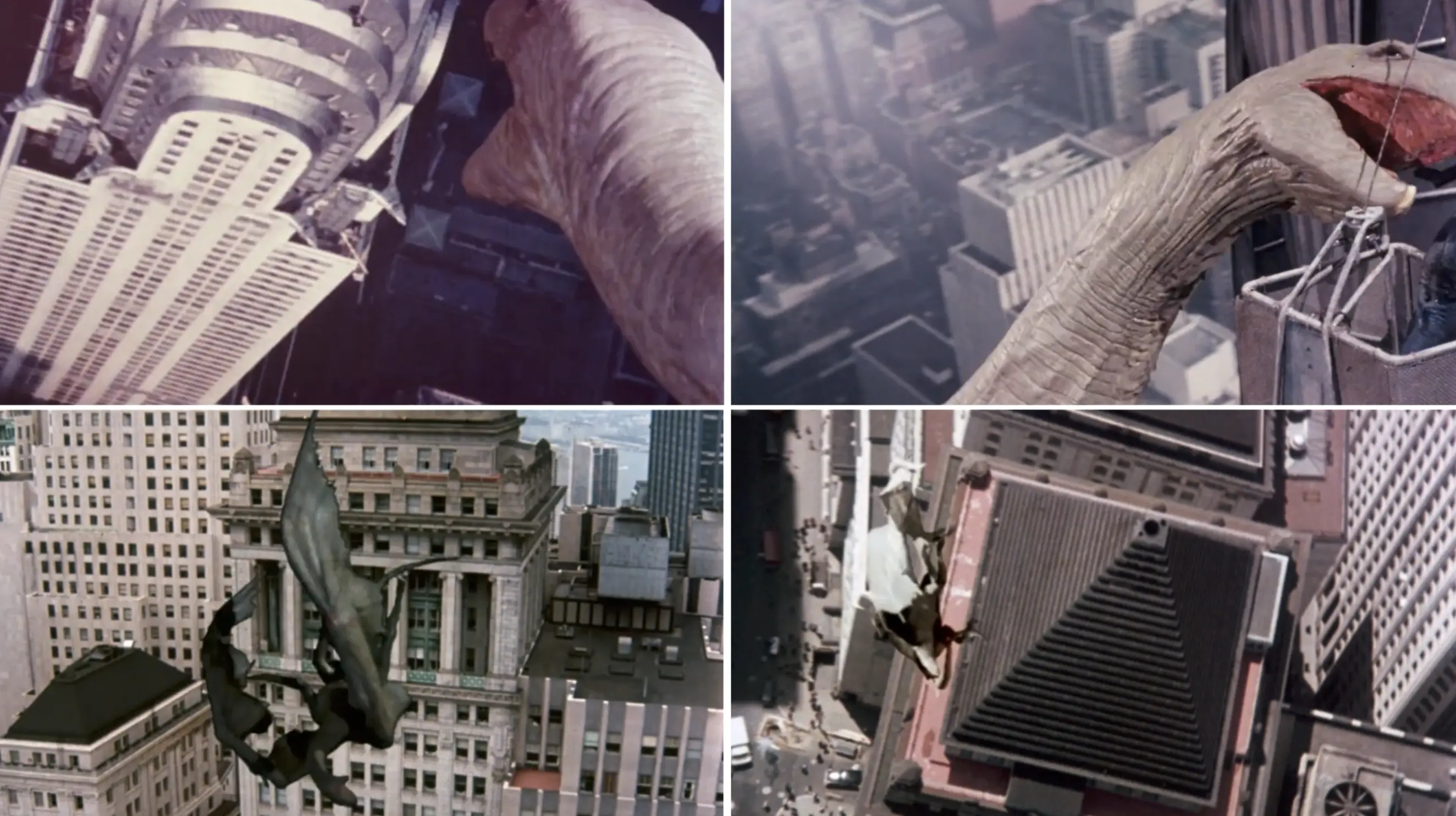
In the confrontation with the main serpent, however, the open sky decisively returns. Shots multiply in which the creature appears in direct contrast with the urban background. It begins to occupy a space increasingly close to the image’s foreground. New York’s cityscape is initially presented in its full extent, until the serpent’s body crosses it horizontally, cutting through the city and relegating it entirely to the background. Next, we see the winged animal from multiple angles: in some shots, the city appears broadly framed in the background, while the serpent stands out in front as a moving cutout; in others, it flies over an urban landscape presented in an almost isometric perspective; in others still, this perspective becomes progressively distorted by increasingly unorthodox angles, until the creature reappears pressed against the side of a building, attacking one of the men firing at it, in a gesture symmetrical to the film’s beginning, when we saw the worker suspended on the façade of another building.
When the serpent plunges, when it begins to fall, and the scene is shown from multiple points of view, until the moment it crashes into a structure reminiscent of a pyramid, it becomes evident that the interest of Q: The Winged Serpent does not manifest itself solely in the articulation of cuts or in the arrangement of sequences. It also lies in the frame itself, in its ability to make the figure, animated, and the ground, captured, operate according to different visual regimes: sometimes figurative, when the creature can still be recognized as an organic and threatening body; sometimes tending toward abstraction, when movement, scale, and verticality dissolve form into lines, masses, and vectors of fall; and sometimes in an almost diagrammatic regime, in which urban space is organized as a geometric surface rather than as a fully legible image, composed of axes, planes, and intersections.