A Conquista de Faro is the first film collaboration between director Rita Azevedo Gomes and writer Agustina Bessa-Luís. The second, years later, would be A Portuguesa (2018), her adaptation of a Robert Musil story by way of an Agustina adaptation — ‘an enigma within an enigma’, to use the director’s own expression — using a script with very little dialogue. In that case, a lucky find at a secondhand bookshop, bolstered by Agustina’s recommendation, led to her reading one of three Musil stories. For A Conquista de Faro, it was Rita who sought out Agustina in search of an idea. Or rather, in search of an enigma. The city of Faro was readying itself for its turn as a National Capital for Culture when this unexpected commission for a film arrived in Rita’s lap from the South. Open to the unexpected, Rita sought inspiration from the North, from where she soon after sent her reply, as she recalled in a presentation sheet for Conquista: There was a historical tale, a legend tied to D. Afonso III’s Conquest of Faro from the Moors, and Agustina would write the text.
It followed Altar (2003), another secret Rita Azevedo Gomes film. A Conquista de Faro, after a title sequence where letters dance on a celestial blue, begins with a blurred background and generous swaths of primary colors in the foreground: Agustinian Leonor Baldaque exposes the dark blue satin of her dress and the vivid red of her wide-brimmed hat before looking up and revealing her face. She plays the porcelain-faced wife of the professor, played by João Reis, and the two form one of the couples who cross paths by chance at an Algarve inn. Two ‘emigrants in marriage’, with him teaching in Évora and her in Vila do Conde. Rita Durão (pre-Vingança de Uma Mulher, 2012) and Anísio Franco (the art historian), or rather, the girl in the pink glasses and Lúcio, greet them at an outdoor table from where you cannot see the ocean, just a sea of leafy trees rendered almost translucent, and from where the sound of the hot wind blends in with the sound of travelers’ passing cars. The conversation drifts to the topic of the soul — and nobody at the table calls it ‘an addiction’ or ‘a chimera’ (an echo of Agustina–Oliveira collaborations like Francisca or O Princípio da Incerteza) — which is invoked in the dialogue about distance and beauty, and in a joke about its modern technological branches. It is then that the conversation turns to the history of Faro, a city implied to lie not far from this inn. ‘Here comes the tale of the Moorish Princess’, quips the woman with the blue dress. And right after, — there she goes again — ‘Here we go with the conquest of Faro’. The tablemates drift along as they help themselves to a traditional dish of slow-cooked mint lamb. This scene dissolves into the woman as she falls asleep; the camera lingers on her after a succession of ‘solos’ that go from character to character in a kind of circle (albeit around a rectangular table and the canvas and wood folding chairs).
From this circle we arrive at the central episode of the couples’ meeting: their journey into sleep in which the dark-haired woman becomes the enchanted Moorish princess, sensitive to the perfume of flowers, or perhaps oleander (she cannot recall the precise name). The Moorish princess and her associated legend are brought to life by the voice of the history professor which had lulled them to sleep moments before. Her head resting and submerged in the shifting light, the sleeping woman signals the changing scene, or rather its unfolding into the performance of the tale of the Moorish princess in which the alcaide of Faro, King Afonso III, and Dona Brites of Castile all play a role, shadow figures of the protagonists of the lunch scene at the edge of the forest, who return to their coffee, betrayal in sight. ‘Liberty, equality… oxalá!’ The Moorish princess’s repetition of this anachronistic line will mark the denouement, but not before the humming cars forms a distant continuity with the motor of the traveling couples’ vehicle, which disappears as suddenly as it appeared. In this small film, history is preoccupied with the telling of the legend in a world of faint, dreamy coordinates, while experience surrenders itself to suggestion.
An interlude, and by the way: the film’s circling also leads to the strident interjection of Janis Joplin’s ‘Ball & Chain’ over the pop image of a donkey standing on a suspension bridge somewhere on a dark highway under the glare of passing headlights. ‘All the perfumes of Arabia, gone.’ The white of the Southern summer sun yields to the darkness of the final act’s fade to black where the animal first appears as a melancholic silhouette and maintains, in its blocking, the perfect ‘pose’ for the frame. It is one of the triumphs of Conquista, how it manages to preserve its distance from Faro, in that unexpected continuous shot which goes on just over the rousing eight minutes of the song made famous at the 1967 Monterey Festival. It’s not unusual to see an animal in a Rita Azevedo Gomes film, but it is quite possible that, of all her animals, the donkey in this shot is the most unexpected addition to the enigma.
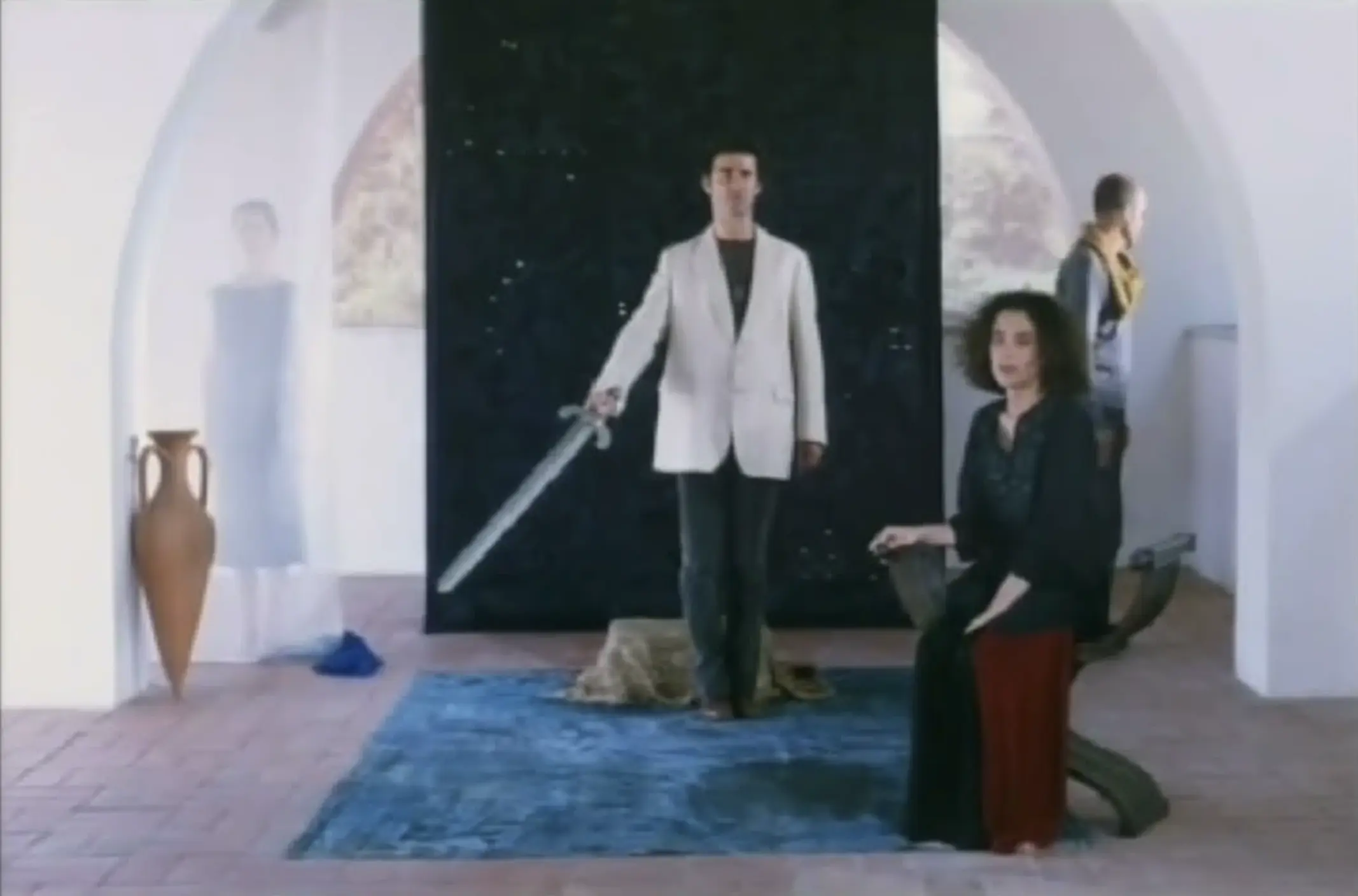
A Conquista de Faro (Rita Azevedo Gomes, 2005)
Published as program notes for ‘Luz e Sombra – Representações
da Idade Média no Cinema’, December 2022.