The Portuguese poet Sophia de Mello Breyner Andresen stated: to say that a work of art is part of culture is something scholastic and artificial; a work of art is part of reality and therefore is time, realization, salvation, and life. I think about this phrase often, almost every time I watch a film, whether from 1895 or 2020. These films coexist with me fleetingly in space, constituting a collection of objects that occupies the present as much as I do and therefore can generate all kinds of permanent effects within it.
Some collections are more visible than others, from a museum’s holdings to those that live in conversations, personal archives, or simply in the memory of the living. Films don’t all circulate equally either; some are more available than others. Some are even impossible to see because they’ve been lost forever. If films remain invisible for too long, they run the risk of vanishing. Since no one wants that to happen, we take notes.
In Rita Azevedo Gomes’s A Colecção Invisível, an art collector bored with what’s in his shop decides to review old client records to see if anyone has something interesting for him to acquire. Among them, he comes across a man he has forgotten, who has been a client of not only his father but also his grandfather. A typical Stefan Zweig twist, whose story is adapted in this film: a conversation, an encounter, or an object materializes something from the past in the present, and within one story, another is told. That man, shut away in his house and forgotten by everyone, reconnects with the world thanks to his presence in an appointment book. The collector arrives at the house, a building in ruins, and finds that the man has gone blind, but still enjoys his collection of paintings and engravings, and is excited to be able to show it to someone who understands what he has in his hands. Here appears the inevitable problem of that intertemporal encounter: alarmed at what is about to happen, the old man’s daughter secretly confesses to the collector that the family is ruined and that they’ve had to sell, one by one, almost all the pieces in the collection. She begs him to play along with her father, who knows nothing of this, reacting as if nothing had happened.
The man agrees and returns that afternoon to meet the old man and a series of folders filled with blank sheets. The blind man goes through the folders’ contents one by one and describes in detail the engraving that used to be where there is now nothing. The man responds from time to time, using sometimes courtesy as a resource — answering generalities — and sometimes his own knowledge, since he, through his profession, could also recite from memory the same works as the blind man. Just before the process starts to become tedious and unbearable, the blind man shows the collector the blank sheet that is in place of Albrecht Dürer’s Saint Jerome in His Study, and asks if he has anything to say. The man tells him that it was always one of his favorites, because the dog sleeping next to the lion moves him terribly. That in the dog’s sleep perhaps lies all of Dürer’s subtlety. The blind man responds that he had never thought of that, but that his engraving is not the version with the dog but the other one, with the lion alone, since Dürer painted Saint Jerome at least seven times, and the dog is not in all of them, which is a shame. From then on, the blind man begins to think aloud about where Dürer’s subtlety lies, thinking about works he doesn’t own nor believes he owns, works he must have seen at some point, as the collector might have seen them too. The small dramatic tension transforms the farce into a conversation dominated by the blind man’s knowledge, previously underestimated, and his ideas, still very much alive, that have emerged for the first time in perhaps years, even if only from the blank sheets of his collection. At that moment, a second disruption of the farce appears in the film: the next shot begins with a clapperboard marking the start of the scene in which the blind man announces that now comes the best part.
Does the blind man know what has happened to his collection? There’s no way for us to verify it. The collector stands up and goes toward the wall where there is an engraving that has been kept in the family. The blind man decides to leave him alone in front of the painting, perhaps anticipating the trance that is about to come. In front of the engraving, the man hallucinates a woman he can only see in dreams, who appears mysteriously in a hallway with a bright light at the end. Briefly lost in a limbo, he politely declines to continue viewing and leaves, claiming that he will return soon. Everyone knows it won’t happen. With the collector gone, the blind man sits in an armchair under a ray of light to listen to music. The shot travels through the room of the house with the few but beautiful things it has: some angel figurines and a red curtain. By the time the shot ends, an indefinite amount of time has passed, the man has died, and the apartment is empty and ready to be vacated. Against the wall is the folder full of empty sheets that his daughter takes with her as she closes up the house.
Azevedo Gomes’s film imagines a bit more air for each character in Zweig’s story, sweeping away their melancholy by filling them with ideas and furies. That air comes shared through objects made by others. The blind man becomes wise thinking about Dürer, not only about the few Dürers he once had and doesn’t know he’s lost, but about his entire oeuvre. He thinks live and therefore lives thinking. The collector draws his air from his hallucinated dream in front of the engraving, which is actually a transposition within another: the scene with the mysterious woman in the hallway is a fragment from Gabriel García Márquez’s ‘Eyes of a Blue Dog’, the story of a couple who meet only in dreams. From Dürer’s beloved dog he moves to another, hypnotized — by the man? by his house? by Dürer? Who knows. The film moves in that manner free of explanations, making a series of objects coexist in its environment to watch them converse.
Are the images that the collection held necessary for the conversation between the collector and the blind man to happen? That it existed is the fundamental element that brings both men together, since without the art, there is no dealer and no client. But the conversation exists anyway about those objects, even though they are absent, lost. In another Rita Azevedo Gomes film, Danses macabres, squelettes et autres fantaisies, co-directed with Pierre Léon and Jean-Louis Schefer, Léon asks Schefer about a matter he usually writes extensively about: whether the function of an image is to resemble a thing or to replace it. The answer to the question refers, for Schefer, to the definition of what an image is. What are images for? They serve a purpose; the first figures had the imaginable function of replacing what wasn’t there, like animals that had certain types of powers, not the ones you eat or the ones that wandered around. Is it an invocation or an evocation? And here we enter the realm of ghosts. If it’s to evoke, some strokes can be made — does it replace what isn’t there? Perhaps, but it doesn’t need to resemble it completely; the substitution mechanism can be pushed quite far from resemblance. Schefer’s final example is this: a friend gives him an image. That friend disappears from the world, from life, and that image, which is not of her, which doesn’t resemble her, for him occupies her place. The pure images of the blind man’s collection, a group of engraved paintings, have been materially substituted by blank sheets, which don’t resemble them at all, and this is a tragedy. But that substitution has no effect on him, who upon losing his sight had already replaced them with the memory he has of them. Although for the blind man having the collection in his hands is fundamental, and being able to show it this way, his relationship with those images is no longer in the object, but in the memory of that object, and that relationship is indestructible until his death. By making the collector part of that relationship, transferring his impressions, the old man prolongs his own life.
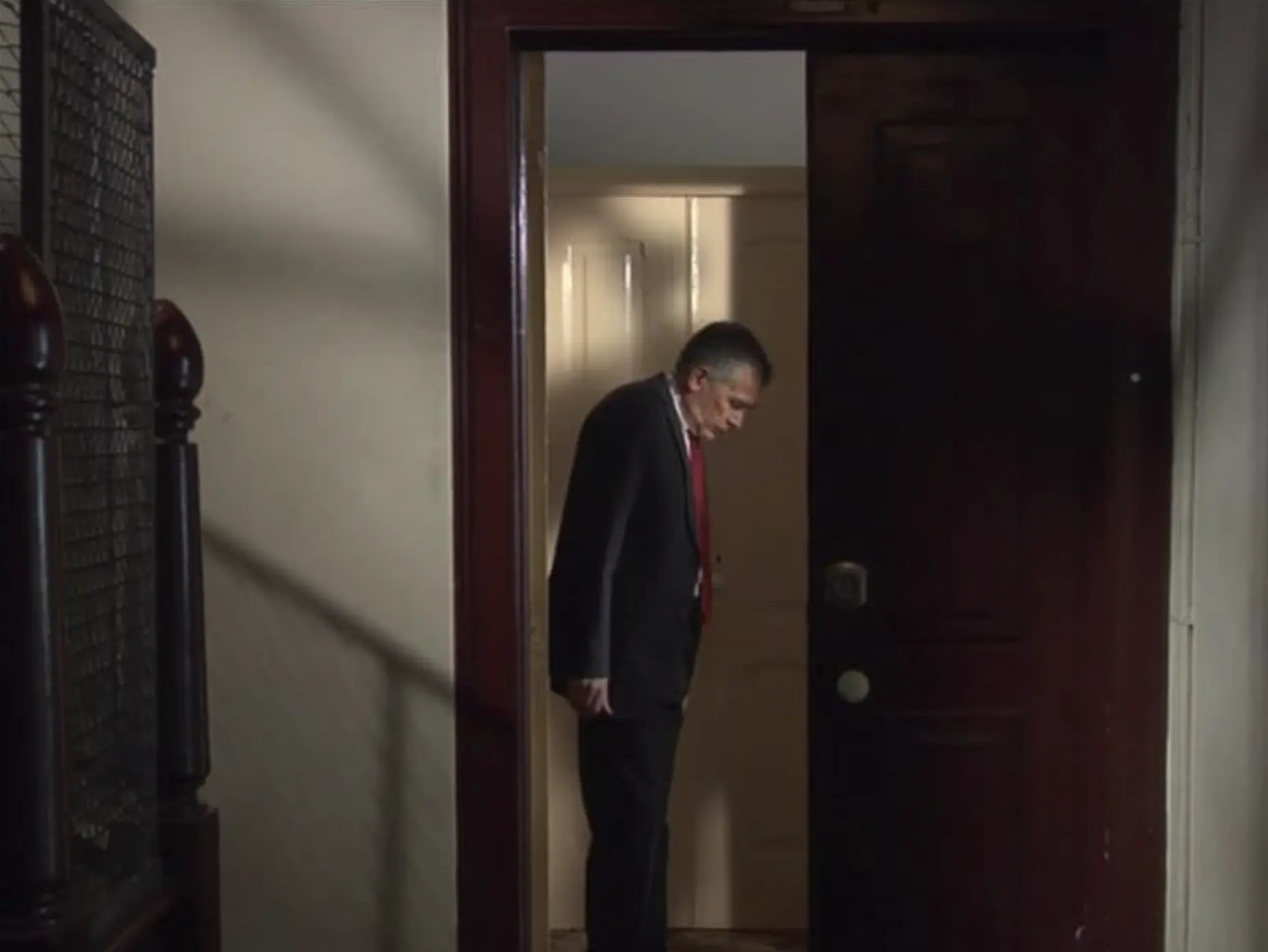
A Colecção Invisível (Rita Azevedo Gomes, 2009)
Serge Daney used to say that we protect the things we love, and the things we love protect us. The works of art that belonged to the old man, today absent from everything except his memory, protect him from oblivion, and vice versa. It’s a double relationship, that of keeping each other alive. In a scene shortly after in Danses macabres, Léon, Schefer, Rita Azevedo Gomes, and Acacio de Almeida (the film’s cinematographer, and cinematographer of all of Azevedo Gomes’s films, among many others) are in a museum looking at paintings and, after spending a good while on one about Saint Jerome with his lion, they turn toward where the camera is and talk about something right behind it, another representation of Saint Jerome by Dürer, very different from the engraving that the blind man and the collector discuss. This is a painting, in color, of an old man with his finger placed on a skull. While looking at the painting, Léon and Schefer approach it (they move towards the camera) imitating the gesture in the painting; immediately after, there’s a brief shot of the painting and then a fragment from Werner Schroeter’s Poussières d’amour, in which two women magnificently descend a staircase singing opera when suddenly a painting falls on one of their heads. A small tableau-slapstick that makes Dürer, the old man, the skull, the two friends, and the women besieged by flying paintings coexist in the present.
In this film, A Colecção Invisível, the blind man is played by a certain Duarte de Almeida, screen name for João Bénard da Costa, the Portuguese critic and programmer who dedicated his life to living and reliving the history of cinema. The film was shot before his death, and he never got to see it finished.
Adapted and translated from Spanish by Lucía Salas
Originally published on Con los ojos abiertos in August 2020.