These notes were originally published as part of a retrospective program dedicated to Diagonale at the Cinemateca Portuguesa, held in February 2025. Cauchemar was screened on the 13th and the 22nd.
‘First of all: I’m from a generation when we were families, not networks. I mean, even if I rarely ever see Rivette these days, if he walked in here now and saw me, he’d come right out and ask, “How have you been?”. We don’t need to see each other all the time, likewise with Godard or Chabrol; we know we are part of the same family. Even the older generation is part of it. Not a day goes by that I don’t think of Biette or Doniol-Valcroze. God knows everyone forgot Doniol-Valcroze; they haven’t forgotten Biette yet, though it will only be a matter of time, sadly. So it was a family, a group, and it was natural for us to show our films to one another. I had no problem showing my short films to Straub when he would come to Paris, or to Claude Berri or Tavernier; it was never awkward. The problem was that they were incomplete attempts.’ When Noël Simsolo said these words during an interview, conducted in September 2005 by Olivier Gonord about cinephilia’s impact on his filmmaking and the Cauchemar exception, this extended ‘family’ he discussed — losses notwithstanding — was still with us. [1]
Cauchemar is his only feature-length film, produced by Paul Vecchiali’s Diagonale troupe, a concentric circle within the concentric circle of French cinema following the era of the 1960s with Cahiers du cinéma, the Cinémathèques under Henri Langlois and Jacques Ledoux, and the Nouvelle Vague. ‘My generation was lucky to be first exposed to cinema at a very young age, through popular cinema, as opposed to through the academic route or through fashion. [...] Cinema has that extraordinary power you only see in poetry and music: as long as we replace the question of “What does this say?” with “How does this say things?”, we can move people. In short, it was cinema that interested me. More than theatre, more than literature. I think the conversations I was able to listen to with the important filmmakers at the time (who went on to become even more important) were based on sensations and inferences that followed from these sensations. I have always sustained my love for cinema through these exchanges, these encounters. And like all great talkers, I am an extremely good listener.’ On his work as a filmmaker: ‘Why did I make my short films? [Some fourteen films from 1969 onwards.] I felt I could put on a theatrical production very well. I could paint very well, too. I could write, not very well, but well enough to defend a certain idea of cinema. But I didn’t feel ready to make a film. So, with no great desire to become someone else’s assistant, I made short films for ten years before I felt ready to direct my feature. Which wasn’t a disaster, but was no great success either. After that, it was difficult to make another. There were opportunities, I received some offers. Over time, I preferred to return to short films, commissioned films [like DVD extras] where I could do things my way, according to my vision, instead of getting caught up in a series of compromises.’ And so, ‘I don’t disavow anything about my experience with Cauchemar. There were some major problems with my producer Vecchiali, who didn’t have any money. But there were wonderful people [like Pierre Clémenti, sound engineer Antoine Bonfanti and director of photography Ramón F. Suarez], and it is thanks to them that it is exactly the film I wanted to make, in the context in which I made it’.
Credited as a screenwriter (for the films of Marie-Claude Treilhou and Marco Ferreri as well as his own films), a director, a painter, a novelist, a writer of bandes dessinées (and one play, Vous ne trouvez pas que ça sent la guerre?, co-written with Vecchiali in 1979 and staged in Avignon), a critic, a film essayist and historian, an actor (for Eustache, Vecchiali, Biette, Chabrol, Téchiné, Skorecki, Luc Moullet, Edgardo Cozarinsky, Otar Iosseliani, and Godard, in whose Éloge de l’amour he plays an esteemed part), a real Renaissance man, Simsolo championed ciné-club culture in Lille, Paris, and Brussels, before finally settling in Paris in 1968. It was at this point that he pivoted from acting studies to film criticism. He had already published a book about Alfred Hitchcock (whose films he had watched copiously at the Belgian Cinematek), the first of his many cinema monographs focusing on figures from Sacha Guitry to Lang, Hawks, Wilder, Mizoguchi and Jerry Lewis, to Sergio Leone and Clint Eastwood, or on film noir and the Nouvelle Vague. The exchanges and circulation that define Noel Simsolo’s fertile and prolific career are — much like his cinephilia and his understanding of cinema — legible all over Cauchemar, as are many other references, from graphic novels to musicals, a noir atmosphere, or certain Hitchcockian traces. The environment, the characters, the sensations they experience in their states of wakefulness, meditation or sleep, merge these references and exalt the enigmatic while still following a clear narrative thread.
The winter beach of Cauchemar recalls Raúl Ruiz’s fantastical and adventurous Baleal shores. [2] At times, it appears inhabited by a Corto-Maltese-like Pierre Clémenti, until the moment he takes off his hat and loses the poetic silhouette of Hugo Pratt’s wandering sailor on faraway adventures. In a recurring wide shot, Cauchemar also evokes Lillian Gish in Way Down East, to name another example. Among other anchors and variations, the storyline centers on the piano bar where a mysterious girl, struck by the memory of a grand concert and a duet with an absent violinist, opens a Pandora’s box into which she falls, like Alice, with soundless and screamless nightmares, until sounds, screams, audible gunshots and ink-red blood arrive to carry the story forward. What’s at stake is the death of Magdalena Schneider and Werner, played by Béatrice Bruno and Philippe Chemin, who are, or were, brother and sister. Or else it is their life, its songs, and the silence of their nightmares.
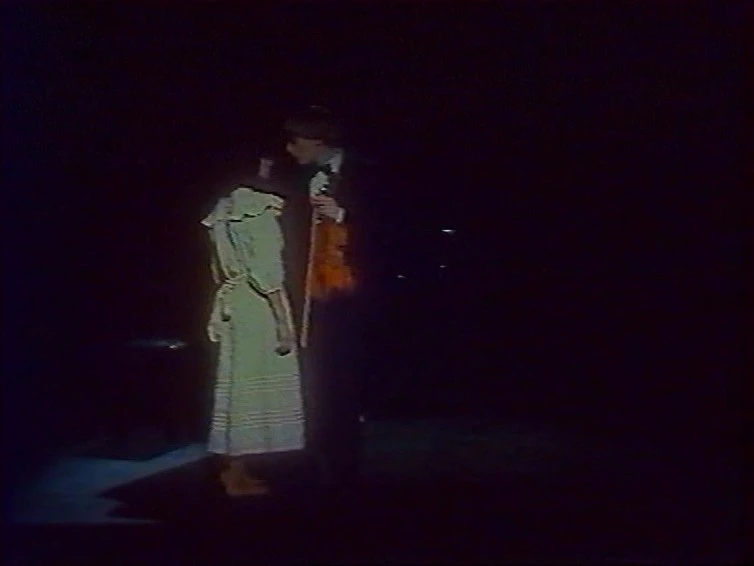
Cauchemar (Noël Simsolo 1980)
Paul Vecchiali, fazer cinema na Diagonal, ‘Folha da Cinemateca’, February 2025
Notes
Translator’s note: Olivier Gonord, ‘Entretien avec Noël Simsolo’, DVDClassik, 1 September 2005. https://www.dvdclassik.com/article/entretien-avec-noel-simsolo.
Translator’s note: referring to a setting in La Ville des pirates (1983).