Throughout C’est la vie !, actors are seen walking between the grass of a park in Villejuif, south of Paris, and Ginette’s (Chantal Delsaux) home, which functions as a stage in the film, its walls open to an audience of the camera and passersby. All things in Vecchiali’s film appear on the surface; its matter-of-factness is clear from the title. The narrative of C’est la vie ! and its production take place together, and its staging draws the crew and the cast to the same space, making the diegesis of Ginette’s story and the creation of the film itself inseparable.
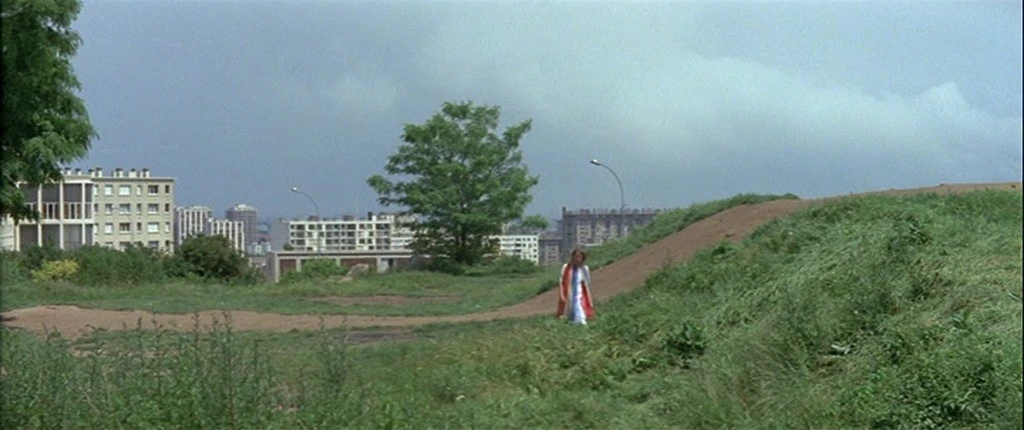
C'est la Vie ! (Paul Vecchiali, 1980)
In the film’s first shot, an unnamed woman (Nathalie Cercuel) walks over a hill and towards the camera in the direction of the stage. Her scarf bears the tricolor — red, yellow, and blue — of Ginette’s experiences, flowing in whatever direction the wind wills; this spectress of memory haunts the film and Ginette. In her next appearance, Cercuel is seen through the window of Ginette’s stage-home. She plays with Ginette’s children on the grass and holds a red telephone at the same time as Ginette is speaking on the phone herself. The next time this doubling appears is through the window once again, when Ginette opens the blinds and Cercuel can be seen on her knees, pleading before a woman in black; at the same time, Ginette pleads with her own woman in black: her friend Simone Barbès, the porn theatre usher in Marie-Claude Treilhou’s film. Simone is an intervention in the film — for black is the absence of color — just as Michel Delahaye, the cop, who is also in black, is the one who covers Ginette when she is on the ground nude, wailing, throwing away everything on the grass outside: her clothes and her given name, Solange Tartan-Jacket, who she will no longer be. As the wind forces the blinds back down, Simone and Ginette step outside the stage. ‘The problem is, reality scares everyone’, Simone tells her friend, who urges her to forget about Richard and find a new love. Then Cercuel walks into frame and watches Ginette from the background; a triangle forms between the three women, with Ginette between the two points. The presence of these women causes a dilemma between reality and memory. Ginette doesn’t look at her double — she walks towards Simone, towards the camera and out of frame into a two shot of her and Simone. She retreats from Cercuel and does not look back at her, going back inside with Simone. Ginette cannot bear to face her past. She withdraws to the stage she has built from her memories but cannot contend with her memories as embodied in Cercuel. She takes Simone’s advice to find a new lover but still cannot face herself.
Ginette is haunted by her past — her experiences and memories are laid bare in front of the camera. These memories exist within the film’s present, in the same space, the same set, and the same field in which the rest of the film occurs. This device is framed by Ginette recounting her past to a radio call-in show. She is alone in the house, telling the host over the phone how she and her husband Richard (Jean-Christophe Bouvet) drifted apart years ago. Bouvet emerges from behind the stage’s red curtain. The memory of Richard walks around her in her home, kissing her and screaming at her. Bouvet walks out of frame to change into a red sweater. It’s the same sweater he wears in the next scene, a flashback to their breakup. Separated by a few meters and a 90° leftward pan from where Ginette was just standing the phone, she and her children wear monochrome outfits, the same shade of red as Bouvet, a shade also shared in this scene by the curtains and letters spelling ‘RIC[H]ARD’ on a poster. Vecchiali stages Ginette’s memory, like the breakup, between her own recollections over the phone in the present. Delsaux and Bouvet wear yellow in the scene where they meet, white on a picnic, and blue when they embrace over the tragedy of their stillborn child. ‘Color obeys a principle of organization of emotional themes complex enough to not seem to belong to any one of the film’s perspectives,’ [1] Jean-Claude Biette says of the film. The stage is constructed from the colors of her memory. Ginette’s home is littered with objects in these colors: flowers, cups, furniture, picture frames — inanimate signifiers of her past, memories that stand still on a stage of her creation.
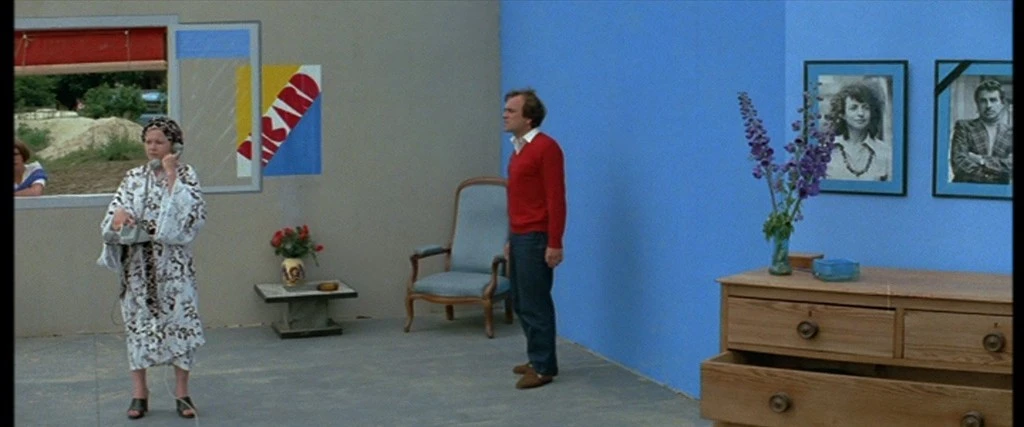
Ginette’s stage-home is her attempt to control the mise en scène of her own life, yet life continues outside the window — people are constantly moving in her backyard, which more closely resembles what it is, a field outside an apartment building. However, a pivotal moment when the camera pans through the red curtain marks Ginette’s becoming capable of accepting her terrible past and the present it has granted her. The penultimate movement from stage to reality is Ginette’s musical number — the titular ‘C’est la vie !’ — which she dances with men who don the colors of her past and her scarved counterpart. The choreography barely holds together, many of the movements may as well be improvised, and the vocals are dissonant, but Ginette continues to sing and dance. In the end there is no choice between reality and memory: she must continue with subsistence, making some peace with a past that won’t stop appearing. After one last pan through the curtain, we do not see the stage again.
There is no resolution in C’est la vie !, merely acceptance. Memory is not something to be avoided or wallowed in, but something one constantly moves with. It is not as if this is enough for Vecchiali, rather that this is all one can do to survive. Like a reel of film moving through the projector, after the credits Vecchiali ends the film with Ginette walking away from the camera towards real buildings — the opposite of how Cercuel began the film. The score from the credits lingers, and before she walks off frame, she dances. She hears the music and for a moment she can dance alone.
Notes
Jean-Claude Biette, ‘Un long métrage en quatre jours: C’est la vie’, Cahiers du cinéma, 315, September 1980. Translated by Christian Flemm and Bingham Bryant, https://letterboxd.com/christianflemm/film/cest-la-vie-1980/.