It’s against the red of the credits, a beautiful blood red that fills the frame, that A Vingança de Uma Mulher opens. [1] Only then is the viewer invited by the narrator to enter the film, via the backstage and prop room of a studio, and so discovers the apparatus set up by Rita Azevedo Gomes to tell, in her own way, this story of revenge, written by Barbey d’Aurevilly more than a century ago. An eminently theatrical apparatus, which the director intensifies by multiplying the frames and reflections, introducing mysterious witnesses in addition to the narrator, demolishing the fourth wall itself through the narrator’s addresses to the viewer, and above all by playing with temporality, so that in the same shot, through a movement of the main character passing from one setting to another or a simple lighting change, different types of narration follow one another, connecting the present, the recent past and the more distant past, without any need to cut up the scenes.

A Vingança de Uma Mulher (Rita Azevedo Gomes, 2012)
The film itself is stretched, like a bow, towards what constitutes its secret — one might say its heart — which is the question of why a duchess (magnificently played by Rita Durão), a young woman in a loveless marriage, has become a prostitute. A secret she tells a man — a dandy, described as a libertine but bored of everything (starting with society soirées) — who, intrigued by the nobility of her beauty, which reminds him of ‘another woman’, has followed her, gone up to her apartment, paid her, etc., like other men, except that he has then agreed to listen to her story — a story so incredible, so senseless, that he finds himself completely overwhelmed, at least for a night.
Bright red
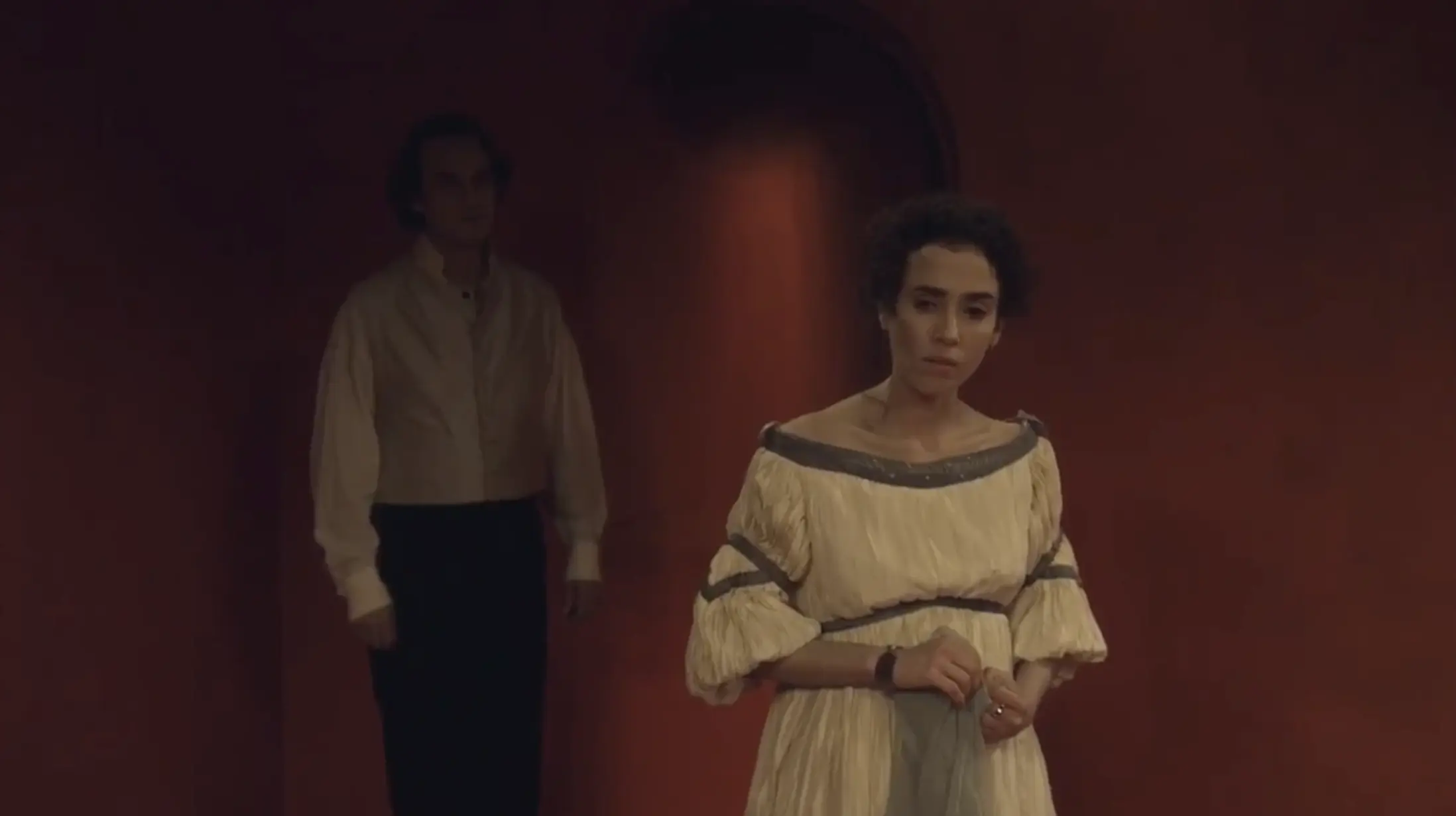
The apartment where the Duchess prostitutes herself is constructed like a stage, with its central room, a little salon all in red, shaped like a choir. At the back of it we can see, hanging on the wall, a painting by Rubens, The Union of Earth and Water. Rubens is the ideal painter to define the rubescence of the film: ‘Rubens, rubescent, ruby. [...] Rubens was born rubens as one is born blond or brown-haired. The present participle meaning “reddening”, a verb in the present continuous, that is, in action, yesterday, tomorrow, today, now, immediately, in the centre of the circle, in its circumference, and all along its curves and counter-curves. Rubens is color and time at the same time.’ [2] A circular movement, integrating several layers of time, which we find at the beginning of the long sequence in the apartment, in the whirling of the camera around the female character, thus reactivating, through the sexual act, the pain of the past. Here it appears that the red covering the walls of the salon is the same as that of the credits, giving it a function at once symbolic and predictive of the secret of the film: a heart, of love and blood. But what else? Let’s return to the painting. It is an allegory, celebrating, through the figures of Cybele, goddess of the earth, and Neptune, god of the sea, the renewed prosperity of Antwerp (Rubens’s hometown) after the economic disaster caused by successive crises during the war between the King of Spain and his Catholic allies and the Protestant rebels of the north: first the Spanish siege and then, once the city had fallen, the Dutch blockade, which closed off access to the Scheldt. This story, of course, is not ours; the ‘truth’ lies elsewhere. Firstly, there is at the bottom of the painting, in the foreground, an angel that looks at us, recalling the festaiolo of ancient theatre, a veritable intermediary between the scene — on which he comments — and the public; that is to say, the same structure as the film. Above all, there is at the centre of the painting a symbol of the union between land and sea: an overturned earthenware vase on a rock, letting water pour out onto the ground, like a fountain. At the left of the painting is a lion (an animal associated with Cybele). This image is in fact in the film, and it is even in Barbey d’Aurevilly’s short story, when the Duchess reveals that she once loved a man — a passionate but chaste love, ‘soul to soul’, unlike her marriage, ‘an affair of two equal families’, [3] which made her the wife of a Spanish nobleman (the Duke of Sierra Leone) and would have condemned her, had she not met Don Estêvão (her husband’s cousin), to perpetuate the long and sad line of ‘irreproachable, stately wives’. As they appeared in the portraits that adorned the walls of the castle, ‘these women whose virtue was as safely guarded by their pride as a fountain is by a lion’. The lion would be the equivalent of pride, a lofty pride, inscribing the reddening [rougissant] of the the painting in another register, something more offensive, more violent, perhaps roaring [rugissant], as evidenced by the figure at the feet of the two gods: Triton blowing with all his might to unleash a storm.
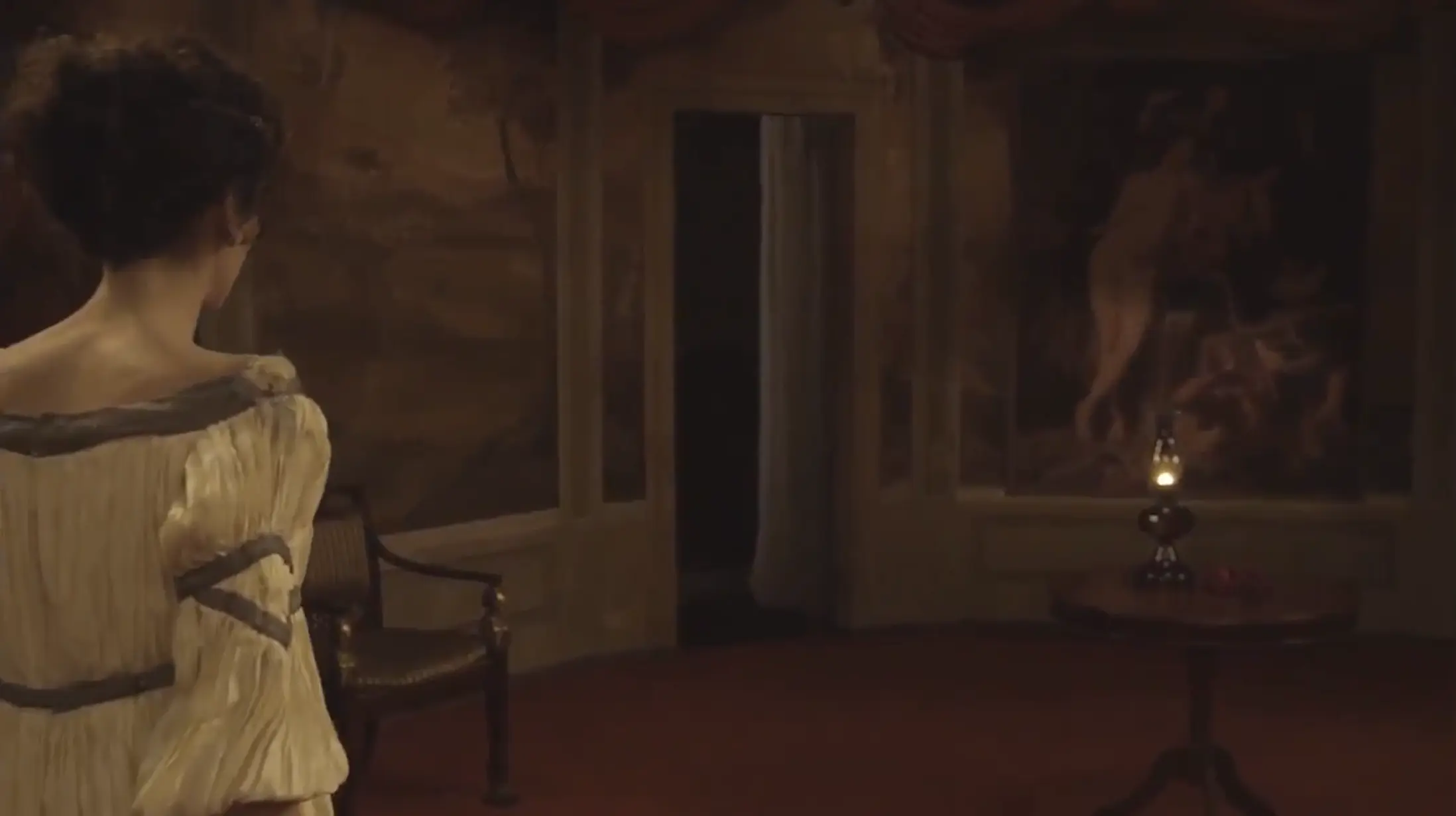
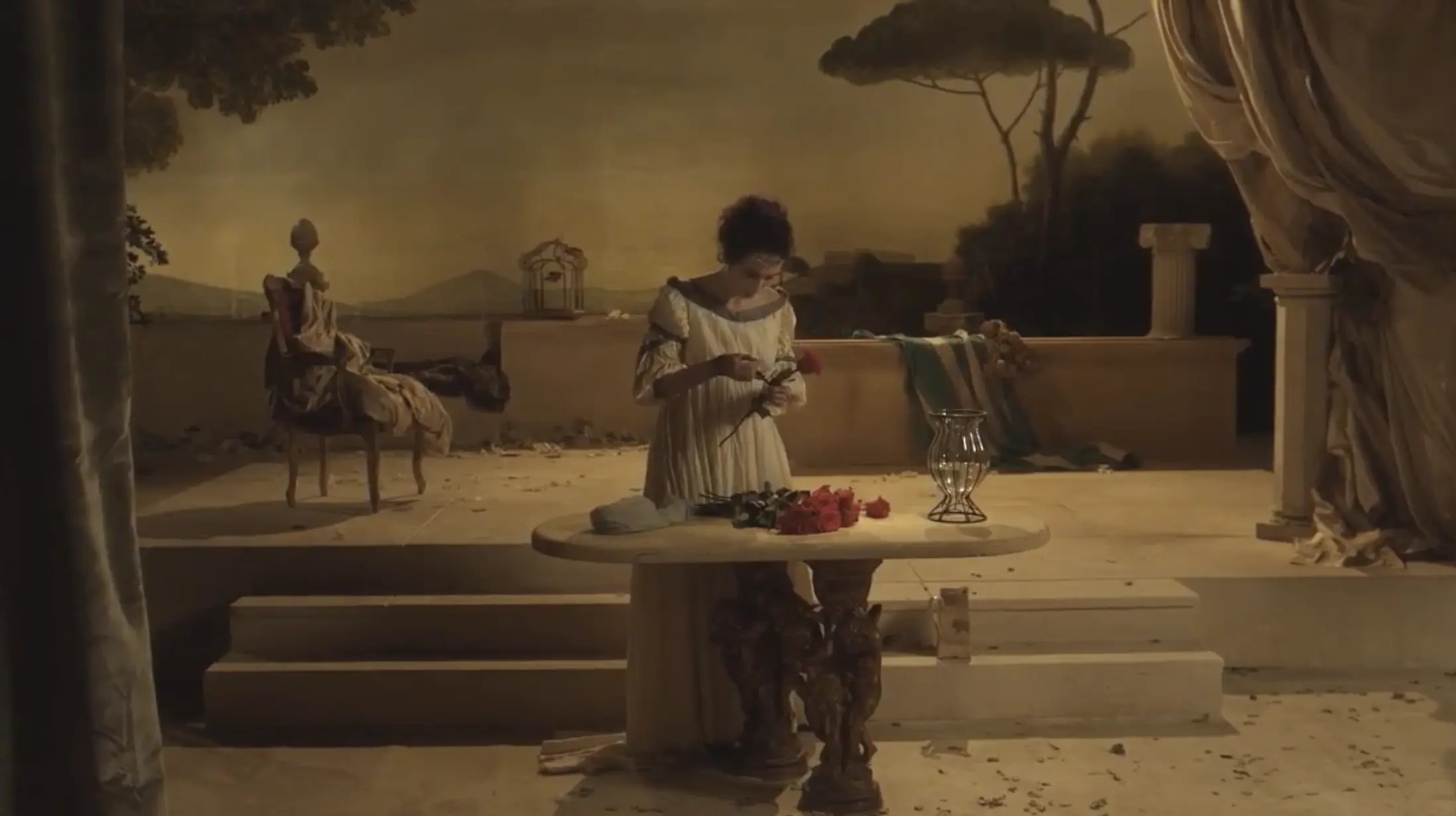
It’s clear that red, like blood, is anything but pure. If, in Barbey’s ‘La Vengeance d’une femme’, it proceeds by small touches, slipped in incidentally (a young girl ‘thick with rouge’, red roses placed on a table or a dress, the ‘mountains of red marble’ that surround Sierra Leone), like traces of coagulation, the frozen memory of a splatter, once we are inside the Duchess’s apartment it is above all the fiery red of the salon, replicating the credits in three dimensions, that catches the eye, though it remains deeply sullied. Evoking the women he met in the markets of the east, the libertine tells his table companion at the beginning of the film that they are hotter than the rouge d’Andrinople, ‘that red which was made with excrement, urine, rancid animal blood, but with which silks are dyed’: a detail that is not in Barbey’s story, through which Rita Azevedo Gomes insists not only on the secret nature of rouge d’Andrinople (its famous manufacturing secret, stolen from the Turks) but above all on its ambiguity, since it combines the delicacy of the red in question and the textiles it will be used to color with the varieties of animal feces used to obtain it. An impure red, referring to the female character, from the Turre-Cremata family (literally ‘burnt tower’), both duchess and whore, a fact summed up by the sign hanging on the door of her apartment (which we will only discover at the end), listing the various ‘sexual pleasures’ practiced therein — a crudeness that should be tied to the expressionist aspect of the film, like its rubescence and putrescence. Here red is much more than a color. Dialectized, bright and provocative, it infiltrates the film, permeates it, the better to return to its source, the key scene, revealed two-thirds of the way into the film, after a slow combustion that carries the story to a climax all the more incandescent because it is the first and probably only time that the woman has told her story — or better: embodied it.
A woman’s pridefulness
What is this secret? The woman loved a man. At first she resisted, going as far as to fulfill her ‘duty as a Spanish wife’ by warning her husband of Estêvão’s love for her. But after receiving in response no more than a contemptuous and arrogant ‘He wouldn’t dare!’, she urged her lover, in fact, to dare — to dare to love her. And they loved each other with a sublime love, as in the chivalrous age of courtly love, freed from vulgar desires, a love felt so intensely by the woman that it was enough for the fingers of the two lovers to brush against each other on either side of the canvas of an embroidery frame for her to be shaken, or for her to pick up a rose on which he had placed a kiss for her to feel faint. A complete and total love, experienced in ‘the blue of the sky’... except that ‘this sky was African, and this blue was the blue of fire’. The husband’s jealousy. The suddenness of his reaction: a black servant shoots an arrow, the lover’s throat is pierced, he collapses on the knees of his beloved, who is seized by horror… [4] Broken up into very short shots, which contrast with the rest of the film, the sequence functions as an eruption of the real, in the sense of the inexpressible, of what takes place offstage, a thousand leagues from the spectacle offered up to this point. The lover’s heart is then torn out and, at the duke’s orders, thrown to the dogs to eat. A hallucinatory scene then follows, in which the woman struggles with the dogs, great hounds with terrifying jaws, to recover the heart and eat it herself, which she is denied. The scene ends on the image of a distraught and exhausted woman, supported by the two black servants, an image of abandonment that we have already glimpsed, for it is destined to return, like memory itself, which ‘always returns, kneeling like a dog at our feet’, an image towards which the narrative had been moving, and at the same time the point of departure, for the woman, of her desire for revenge.
Back on stage. What remains of that time at the moment when the Duchess is telling us her story? A bracelet, bearing in its medallion the portrait not of the lover but of the husband, which she grips violently in her hand while embracing the man she has taken upstairs; the white dress stained with the blood of the one she loved, which she keeps both as a relic and equally as a ‘stimulant’ when her desire for revenge begins to falter. Two objects which, in a certain way, keep her going by feeding her hatred. But it is clear that something else is present, something monstrous, which justifies the fate that the woman has reserved for herself. The prostitution to which she gives herself over is not only the sordid reverse of the idealized love that existed between her and Estêvão. Nor is it merely a means of revenge, the most degrading she could find, to sully her husband’s honor. It’s pridefulness [l’orgueil], more than pride [la fierté], that guides her. Here, the woman’s reaction is equal to that of the man. From pridefulness to pridefulness. And hers is even stronger. It is notable that Rita Azevedo Gomes uses the same effect, soft focus, an effect that is antiquated to say the least — one thinks of Ida Lupino in the fifties — to signify the state of shock in which the woman finds herself at two moments in the film. First, when her husband argues, regarding the ‘risk’ incurred if Estêvão were to remain at the castle, that he ‘wouldn’t dare’; then, once the lover has been executed, when he refuses to let her eat his heart. It is as if the desire for revenge comes less from the death of Estêvão than from these two refusals, taken by the woman as insults, hurting her amour propre more than the love experienced by the two lovers. To the man, who points out that the Duke may never know what happened to her, the fact that she took revenge in the most terrible way possible, she replies: ‘I will know, night after night, I will know…’, demonstrating a kind of rational madness… It doesn’t fundamentally matter whether he knows or not; it is through her that her revenge is expressed. And this involves prostitution. Prostituting herself, in the literal sense of the word: placing oneself before. Exposing herself in all her indignity, the better to savor her revenge. The mise en scène of scandal. A kind of acting out, with all this implies of the demonstrative, of an address to the other and therefore of perfect visibility. Hence the golden yellow dress. [5] That would be the place of pridefulness, immense, disproportionate, making it possible to endure shame without faltering; above all, capable of going all the way, not only to the point of death but further still, even at the cost of sacrificing one’s soul, because the crime here is one of thought — ‘a civilized crime’, writes Barbey d’Aurevilly — and because it ultimately reveals itself, through its intellectuality, to be more atrocious than the bloodiest of deeds.
The tell-tale heart
There is first of all the assumption, the acceptance of what one desires, in full conscience, even to its most extreme consequences. An act of freedom, which explains why, in the Duchess’s case, it is fully realized, without the slightest reservation, though not in broad daylight, so that nothing (power, social rules…) can hinder it. Hence the need to set herself apart, in the margins of a certain society, but without cutting herself off from the world that the woman says she needs so much. She combines the pridefulness befitting her rank with an unparalleled self-destructive power, whose full realization would be synonymous with victory. This fervor in abjection is, we are given to understand, nothing other than the dark side of the quasi-mystical ecstasy that the woman claims to have experienced with Estêvão. What she experienced then, true love, soul to soul, is in every sense comparable to what Teresa of Ávila described, whereby the soul, detached from the body, is alone in enjoying the happiness obtained. What becomes of this soul, now that the lover-Christ is no more, now that his very heart has been torn out? The answer is to be found in Aristotle, for whom the soul constitutes the unity of the body — so that when it departs, ‘the body dissipates and decays’ — but also in Oliveira. If Rita Azevedo Gomes’s film recalls the cinema of the Portuguese master, through its avowed theatricality, the importance of the text, the long static shots, the play of gazes and mirrors, it is also because the director once worked with him, specifically on his film Francisca, the last of his ‘tetralogy of frustrated loves’, adapted from the novel by Agustina Bessa-Luís. It is at the end of this film that we see the main character, who has had the body of his wife autopsied after her death from a wasting disease in order to establish whether she was indeed a virgin — doubting her virginity, he had never consummated the marriage — holding her heart in his hands. If her virginity is proven, the heart, for its part, will retain all its mystery, like the butterfly that appears to escape from it, a possible image of a soul long imprisoned and finally set free. Rita Azevedo Gomes surely had this shot in mind when making A Vingança de Uma Mulher. Not because she drew direct inspiration from it, but because it raises the same question about the fate of the soul. ‘We live torn apart, in search of our bodies scattered across the whole earth. [...] And the heart, in a thousand pieces, enters the most miserable alleyways in search of the blood that will give it form’, says the character in Francisca. ‘What can a heart do?’, wondered Daney in his review of the film. We would answer: nothing. The ‘broken’ heart fails to mend itself; it can only waste away and rot, with this feeling of decay at the very heart of the living as the mark of its melancholy. In Oliveira, everything is diluted in the great melancholic bath, imbued with saudade, which permeates the film. In A Vingança de Uma Mulher, putrefaction also contributes to the melancholic dimension of the narrative, but it is a dimension perverted by the character’s vengeful hatred (as in her declaration: ‘I drink excrement, and it is nectar, because it is the nectar of revenge’) and by the other literary sources to which the director refers, such as this extract from a poem by the Italian writer Cristina Campo, which she has the Duchess recite once her story is over: ‘Warm it’s stayed there, life… | I return to you, who freeze | In my thin tunic of fire’, [6] which reinforces the mystical and secretive aspect of the character, rendering her even more enigmatic.
The film is thus divided into two parts. A first part, the longest, marked by red and blood, sustained by the ardor of the narrative, leading up to the devastating rupture represented by the ‘scene of the heart’; a second, drained of redness, dried out, marked by decrepitude, like the candles dripping with wax, leading up to death by decomposition. As if the film, like a vampire, were gorging itself on this revenge story, until it leaves the teller completely drained of blood. The man will never speak of it. The woman will remain alone with her story, becoming disembodied, her body eaten away at more and more, until nothing remains but the idea of revenge. Where has the soul gone? We are told it is ‘sealed’; it may well be damned. To the man, when he has just learned of the duchess’s death, the priest at the hospital — where the Duchess, reduced to a mere number, died in terrible suffering, though stoically — says, full of naïveté, that ‘she had demanded, certainly as an act of penance, that after her titles, on her coffin and tomb, it be added that she was a “harlot”’, [7] but that ‘she did not even want, certainly out of humility, the word “repentant” to be added’, though this latter was nevertheless inscribed. In fact, there was no humility, no repentance; it is pridefulness, again and always, that has manifested itself through this demand, prolonging her revenge beyond death! And so there is no redemption. All that remains is the mystery of the impossible trinity: pridefulness–love–revenge — which means that if in the end the soul escapes, we do not know where it goes. [8] What is certain, however, is that the woman who gloried in being a Turre-Cremata was ‘the last of her kind’. With her death, the last embers of a once all-powerful caste have been extinguished. Of her ‘kind’, she retained only their ‘face of bronze’, rejecting everything else. This was a gesture of rupture with her own milieu. This is how we should understand the choice of ‘atonal music’, that of the Second Viennese School, to accompany the film, and more specifically the image of the Duchess. If the film opens on red, it also opens on the second movement of Alban Berg’s Four Pieces for Clarinet and Piano, a work to which it will return later, along with other works by Schoenberg and Webern. This music, reviled in its time, evokes dissidence, scandal and exclusion as much as it does an aesthetic marked by expressive richness, the power of chromaticism, the intensity of emotional, generally tormented states, so many elements in keeping with Barbey’s story and its transposition by Rita Azevedo Gomes. Nevertheless, it is the absolute nature of the character that is most fascinating in this story, in the manner of the great figures of Greek tragedy. Love and hate are carried to such a height that they seem without object, as if the lover, then the husband, had been incorporated and had become for the Duchess fragments of herself. So that, finally, this heart that had been thrown to the dogs and that she could not recover was quite simply her own.
Trafic, 93, Spring 2015, pp. 19–25.
Notes
This red could be seen as a translation of Fortiter, the Latin epigraph that opens Barbey D’Aurevilly’s story. Fortiter, that is to say, with fervour and energy, or better: with courage, a word derived from the French cœur.
Philippe Muray, La Gloire de Rubens (Les Belles Lettres, 2013), p. 88.
Translator’s note: all quotations from Barbey d’Aurevilly’s story are taken from Diaboliques: Six Tales of Decadence, translated by Raymond N. Mackenzie (University of Minnesota Press, 2015). I have sometimes silently altered the translation to more closely match the French.
In Barbey d’Aurevilly’s short story, the lover dies by strangulation: ‘The two blacks had thrown around his neck that terrible lasso they use in Mexico to strangle wild bulls.’
The character of the Duchess changes her dress three times in the film, and the color on each occasion, going successively from yellow (the moment of seduction) to black (the moment she gives herself over) to white (the moment of confession). Three colors to express, beyond the red of anger and shame that dominates the film, the tonal changes of the narrative. The simplicity of motifs, almost elementary, is again reminiscent of Lupino, but also of Allan Dwan — for example, in Escape to Burma (1955), in which Barbara Stanwyck wears scarves of different colors, corresponding to the different emotions experienced by the heroine.
Cristina Campo, ‘Passo d’addio’, translated by Adrian West in ‘Six poems from Passo d’addio’, Glossator, 11 (2021), 55–64 (p. 57).
Translator’s note: the French is fille, which literally means ‘girl’ but is a slang term for a prostitute. In Azevedo Gomes’s film, the phrase mulher da vida, a euphemism for prostitute, is used.
This is what the director translates through the last shot, where we see a horse advance alone, without a rider (the equivalent of the soul-butterfly that leaves Fanny’s heart in Oliveira’s film?), accompanied by Grieg’s Peer Gynt.