When A Portuguesa premiered, Rita Azevedo Gomes had just come off the making of (these are her immediately preceding films) an adaptation of Barbey d’Aurevilly (A Vingança de Uma Mulher) and an elaboration on the letters exchanged by Jorge de Sena and Sophia de Mello Breyner, which was called, simply and objectively, Correspondências. These are films in which the text — or texts — have a certain predominance, which is not the same as saying that they are ‘literary’ films. But this old cliché returned with force in the reception of A Portuguesa, further encouraged by the presence in the credits — as the basis of the screenplay — of two names with profound literary weight (now without quotation marks): Robert Musil, who wrote the original short story, and Agustina Bessa-Luís, who worked on a Portuguese translation/adaptation of it, which Rita Azevedo Gomes then used to develop into the screenplay of her film.
But is a film like A Portuguesa really ‘literary’, a film where the material (the presence of the actors, the sets, the landscape, space and time) and the composition (the framings, the use of sound and music, the choreography of the actors’ movements and gestures) have total or almost total primacy over the ‘text’, the words and dialogue, and where anyone who times the lines spoken will surely discover that silence (and noise, and music) occupies a much larger percentage of the film’s duration than speeches by the narrator or the characters. If it is ‘literary’, A Portuguesa is ‘literary’ in the same way that certain films by Marguerite Duras are ‘literary’: that is, it is absolutely ‘anti-literary’, absolutely the antithesis of what ‘literature in cinema’ usually is, acting to dissolve literature itself and the meanings that literary words evoke. An example? That scene near the end, a brilliant long, fixed shot where the ‘literary’ surface of the shot (the meeting, ‘political’ at the highest level, between bishops and aristocrats) is perfectly sabotaged by the internal movement of the shot, the characters who move incessantly through the hall and divert the viewer’s attention to the ‘background’. In this scene, we retain little to nothing of what is said — we retain little to nothing of ‘literature’ — but we retain everything of the action and movement; we retain everything of cinema.
‘What I did was to dispense with psychology’, said Rita Azevedo Gomes in an interview at the time of the commercial release of A Portuguesa. It is clear that this is the case, and that from this perspective, her film, Robert for Robert, perhaps has even more of Bresson than Musil (although — and this is an important difference in a film whose identity and personality cannot be easily pigeonholed — in Bresson, the text, which Rita Azevedo here dissolved in the same water in which she made psychology evaporate — always has another importance; but having Bresson in the film’s DNA does not make it ‘Bressonian’, and the same applies, for that matter, to another common reference in connection with A Portuguesa, Manoel de Oliveira: if we see the importance that another had in shaping Rita Azevedo’s cinematic gaze, that does not make the film either ‘Bressonian’ or ‘Oliveirian’).
All of this makes particular sense in a film that devotes crucial attention to downtime, to inaction, to a kind of vacuum created in a marital relationship — because the husband, von Ketten, is always absent, engaged in wars and/or diplomatic maneuvers, and this defines the place of the ‘masculine’ and the ‘feminine’ in A Portuguesa (‘I have known war longer than I have known you’, he justifies, in one of the few truly significant portions of the text). The film is, then, an ‘invention of time’ in court life, boredom disguised as languor (or vice versa), routine becoming ritual (or vice versa) in the many scenes that describe procedures and formalities, between walls and frames that sometimes seem to evoke the light colors of Giotto’s frescoes and sometimes envelop themselves in the dark tones of Flemish painting.
But it is also, and this is perhaps the most decisive aspect, a film torn from ‘remnants’. From the remnants of romanticism, the ruins of ruins (as in the opening shots, which take place among ruins), the ashes that remain after the embers have been extinguished — we see and hear Ingrid Caven singing her songs, and think that she is there to mark the ‘remnant’ of Werner Schroeter’s cinema, for example, with a kind of indolence that seems more anesthetized, ‘somnambulistic’, than hurt. This is also why A Portuguesa is an ‘invention of time’, — that is, of cinema — in a time of ruin.
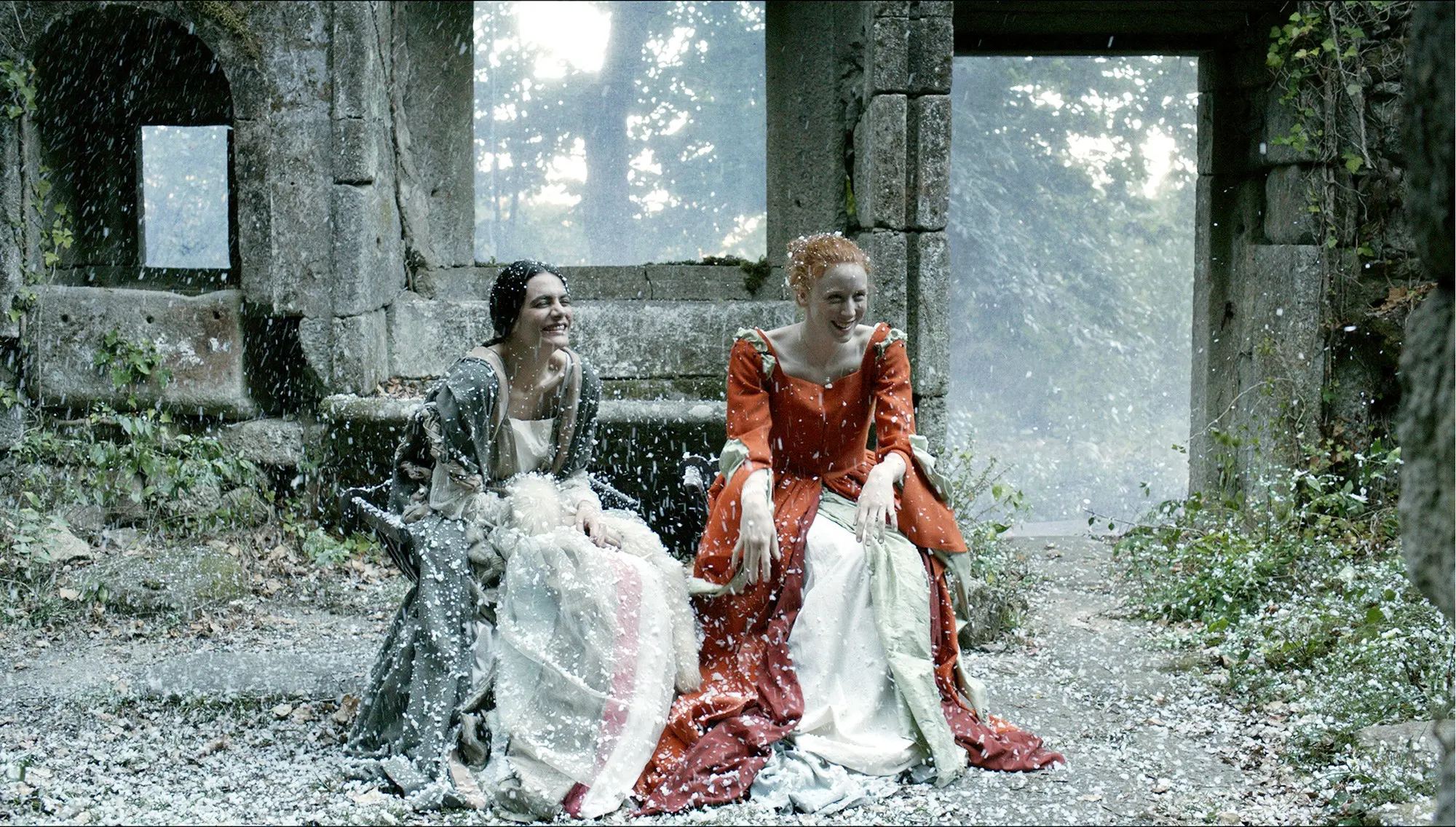
A Portuguesa (Rita Azevedo Gomes, 2018)
Published as program notes for ‘José Mário Branco
– A Morte Nunca Existiu’, April 2022.