… o prazer civilizado impedia o arrebatamento que ilumina a cultura.
—Agustina Bessa-Luís

A Vingança de Uma Mulher (Rita Azevedo Gomes, 2012)
When she adapted it in 2012 for her film A Vingança de Uma Mulher, Rita Azevedo Gomes made one key change to Barbey d’Aurevilly’s story of the same title. A man follows a woman of the night up to an old, dirty house, climbs the dirty, sticky stairs leading to the apartment in which she works, but, upon seeing an out-of-place, lavish sconce next to the door, begins to believe the room they’re about to enter will be just as lavish. The door opens and he finds an unexceptional, messy room like any other girl’s, dresses thrown over the furniture. That’s the story as Barbey d’Aurevilly wrote it. Azevedo Gomes, however, following the lead of a Judith and Holofernes painting by Horace Vernet mentioned a few lines later by Barbey d’Aurevilly, in which bright red drapery serves as background for the killing, decided she would confirm our protagonist’s hasty imaginings and made that ‘nauseating’ apartment into a sumptuous, all-red chamber of luxury and, as we will learn, violence. No doubt she wanted to make full use of cinema’s pictorial possibilities; it isn’t hard to understand why, planning to make an elegant movie in which elegant, incessant mise en scène would convey feelings and moods and what have you, Azevedo Gomes designed a set in which the camera could be relentlessly turned around and never fail to find images at once beautiful and meaningful. She wanted the symbol, yes, blood red on floors and walls so the crime at the center of the story would have an omnipresent visual expression. How could a miserly room compare to this feast for the eyes and the mind? So in this story already full of nothing but the most explicitly romantic symbols — bleeding hearts, raging dogs, African sky, black and ruthless slaves — she saw fit not only to add yet another one (one that Barbey d’Aurevilly himself had merely suggested), but to spread it over all the surfaces, so that for more than half the runtime the actors would be, quite literally, inside of it. Since it’s a story about blood and vengeance, why not go ahead and spread blood and vengeance on the floors and walls?
Or, in other words: she took a story from the monstrous, late-romantic Barbey d’Aurevilly and insisted upon the monstrosity like a kid who believes a little bit more of frosting on his cake can only make it better. She drowned it in frosting. She turned what was allusion into solid reality; then, if that wasn’t enough, she turned what was narration — the story the titular woman tells her client — into images and scenes, because she wanted to see that bleeding heart instead of just hearing about it, because she wanted to see those raging dogs going at it with fury, because she wanted to see the colors of fairy-tale, romanticized Africa. If in the original story the woman fights with the dogs for the heart of her assassinated lover, but fails to retrieve it, Azevedo Gomes had her save it so there could be a shot of a woman holding a bleeding heart in desolation and even attempting to eat it. So what does it matter to me if at different points of the movie the director chooses to show the rear of the sets or the script in the hands of the actors, if this superficial estrangement effect never penetrates the core of the text, never challenges its premises? Cinema should never be a vehicle for literature; the adapted text should, at all times, be put in check by the camera, by reality, instead of simply reaffirmed by it. What does it mean when Barbey d’Aurevilly seems more preoccupied with reality than you, director? When Manoel de Oliveira adapted Fanny Owen, not only did he not back down on the de-romanticizing proposed by Agustina Bessa-Luís, he actually took it a step further, giving us, instead of the mysterious, alluring woman a lesser director would have conceived, a naïve, anemic girl that jumbles her lines and who is certainly much closer to the historical Fanny Owen.
But if I go this far with a movie about which I originally didn’t intend to write, it’s because it offers a succinct example of a recurring problem in her filmography. To put it shortly: it shocked me to go from Rita Azevedo Gomes’s first feature, O Som da Terra a Tremer, to her second, made ten years later, Frágil Como o Mundo, and find that where the former had taken such a dialectical approach to its undeniably romantic imagery and themes, throwing them into question by way of a smart narrative structure that always looked to deflate tension and put everything constantly in perspective, the latter basked in its unapologetic romanticism to such a degree that it very quickly turned into a misty hodgepodge of exuberant shots and profound, poetic gestures. Then it dismayed me to find that in her subsequent work it was this latter tendency that would prevail, all the way up to 2016’s Correspondências, in which every single gesture, no matter how insignificant, seems to have some sort of underlying poetic intention, and the many literary excerpts are presented with a blind faith not so much in the ideas they convey, but in their status as cultural monuments. People stand up in a room, walk around the house, a man throws a coin into a pond, a woman sits outside, but a slowed-down, intentionally profound quality to these otherwise banal gestures means they are always dangerously close to the cheapest lyricism, that is, one that attempts to convey beauty through nothing but beautiful moments, and thereby denies the role surprise and the unexpected play into our experience of beauty. The banal is allowed to enter the work of art only insofar as it has picked up all the mannerisms of the profound; but the task of the artist is not to alter the essence of life and life’s things, like a doorman who would only let enter his building those willing to take a shower and put on a whole new set of clothes; the artist, rather, must take the things of the world as they come, and content him or herself with merely rearranging them. This overprocessing of reality, this art of appropriation and assimilation, betrays more often than not an insufficient grasp of the subject matter — akin to the maladresse of the colonial authority trying to legislate a reality wholly alien to him — and even a certain deliberate blindness on the part of the artist, who forgets the only vision with which he or she can imbue the work of art is the vision of the concrete world where he or she lives, and that to look at things only after they’ve been admitted into the realm of art is as useless as trying to cure a broken bone by correcting its X-ray image.
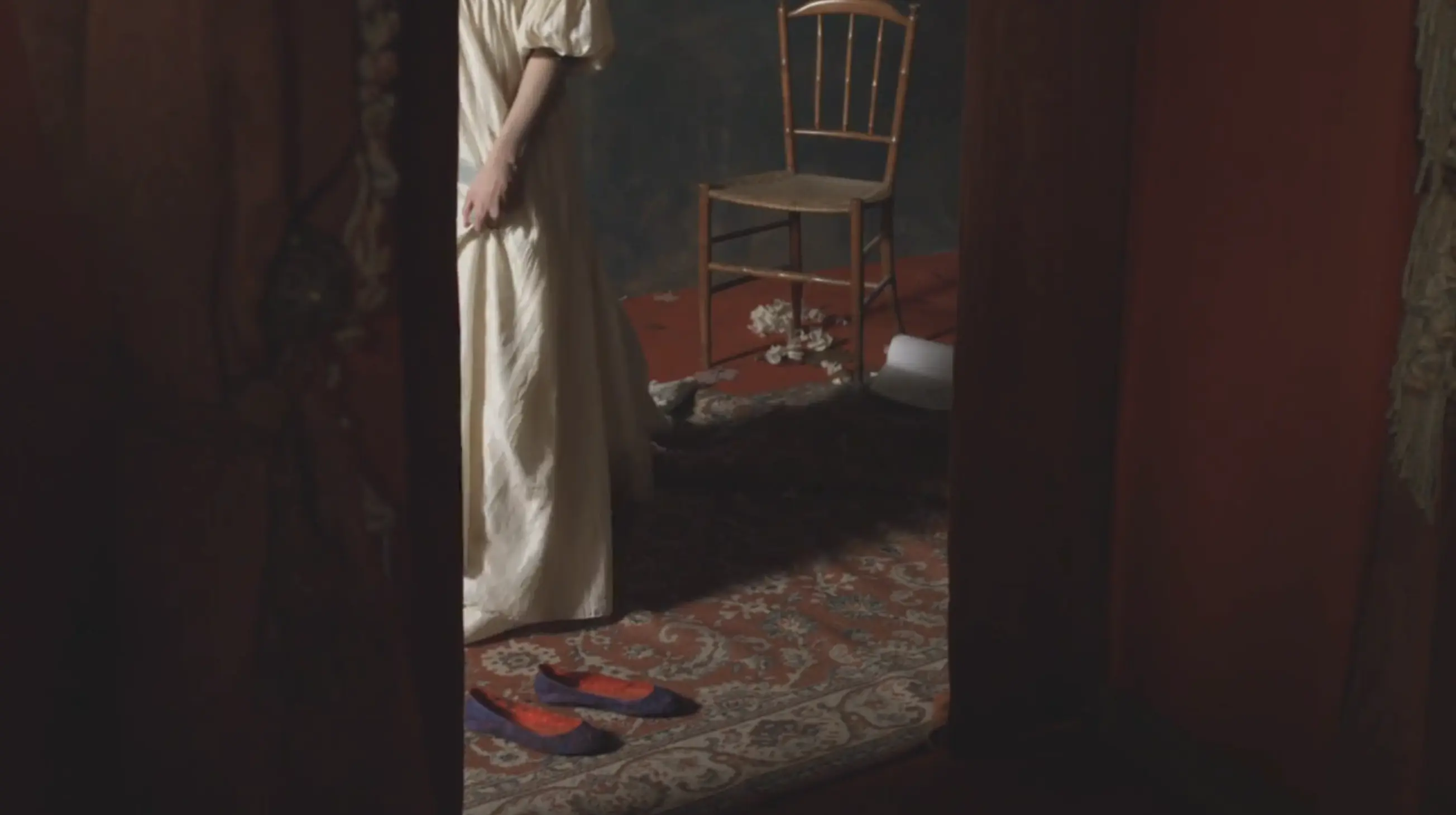
Two years later, A Portuguesa offered a sort of course correction. Though it still adapted a literary work, a short story by Robert Musil, the fact that this story was almost entirely devoid of dialogue and scenes meant the adaptation couldn’t go without radically questioning and reinventing it. So we shouldn’t be surprised if the perspective is shifted from the husband to the wife, for example, or if certain events are given more or less importance than in the source text, or if there should be entirely new additions, such as the scene of the Portuguese woman sculpting; and we shouldn’t be surprised if the resulting movie should have a much thinner argument and if its cause–effect relationships should be much less visible, because, after all, those never were cinema’s fortes and this time there’s no one to make up for them by discursively explaining to us what is happening. And yet, the fact there was a narrative being told, with precise, undramatic dialogue courtesy of Agustina Bessa-Luís, ensured there was a solid enough structure out of which poetic gestures and moments could arise naturally, instead of, as had happened in Correspondências, coming and going as they wished like little spoiled children. Compare the embarrassing dance between man and woman in A Vingança de Uma Mulher to the playful moments between man and wife here; there, out of place, awkwardly trying to make up for the rageful sex scene Azevedo Gomes did not want to portray (why would a woman trying her best to act like a cheap prostitute partake in a dance of seduction with a man she would more logically despise? In the story, let’s not forget, it is sheer rage that gives her the unparalleled attractions our protagonist cannot at first explain), the dance tends more to the director’s whims than to the needs of the story itself, and that is inexcusable. Here, though, when man and wife play with each other, it makes sense not only from a psychological point of view, but in the context of the movie. Finding a subject that plays to their strengths is a big part of an artist’s job; shoving your own preoccupations where they don’t fit is a recipe for disaster. But it was with O trio em mi bemol, from 2022, that we could feel something had indeed changed in her procedure. This time, adapting a play by Eric Rohmer, she went much further in her questioning and subsequent destruction of the text than simply announcing, rather timidly, that it was happening, while not having the courage to actually do it. This time, it is not a shot of Rita Durão reading the script backstage with the expression, and the lighting, of someone who is in fact onstage and acting that will pretend to disrupt literature and assert reality; it’s a systematic attack in the form of lengthy and numerous sequences of the crew working or resting, of the actors resting or rehearsing, that culminate, at the very end, in the director of the film within the film, wonderfully played by Adolfo Arrieta, declaring that the movie they have just finished shooting is no good and everything must start over.
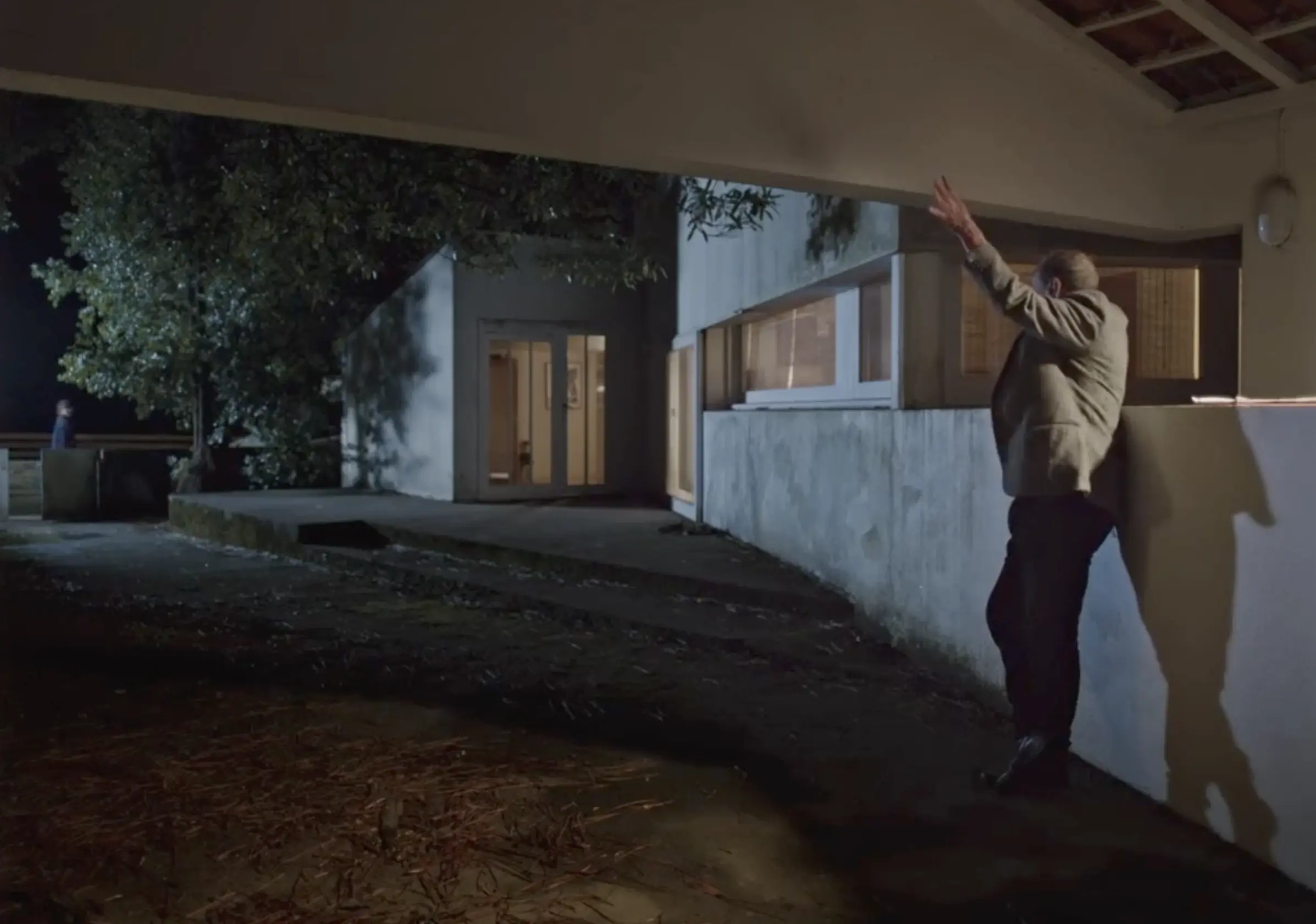
O trio em mi bemol (Rita Azevedo Gomes, 2022)
What happened? What changed? Did Azevedo Gomes herself feel some sort of lack in her previous movies, so that she thought it necessary to push harder this time? I don’t know and I don’t care to. What I do know is that in her following feature (and, at the point of writing, her latest), last year’s Fuck the Polis, all these intermissions of reality in O trio em mi bemol — so marvelous that we eventually get to wishing the play would never return, and start asking ourselves if the play was actually even necessary — are made into the whole movie, one in which literature and culture are never at the forefront, poetry is never read poetically nor awkwardly drilled into the shots, and life and reality can have the final word over everything, as is the privilege of cinema.
I don’t wish to extend myself about Fuck the Polis. But it seems to me particularly beautiful that, forced by circumstances (she couldn’t find the necessary funding for the more conventional movie she originally planned to film), working on a very personal project (the story at its center, though written by another writer, was based on her own trip to Greece nearly two decades earlier), she should have ended up returning to her first movie, the beautiful O Som da Terra a Tremer — where we find many of the same questions, themes, even shots (of the boats, for example) — and, at the same time, that she should have made the movie of hers closest to reality. And also her funniest. And most spontaneous. And possibly her best. So that we eagerly await her next one.
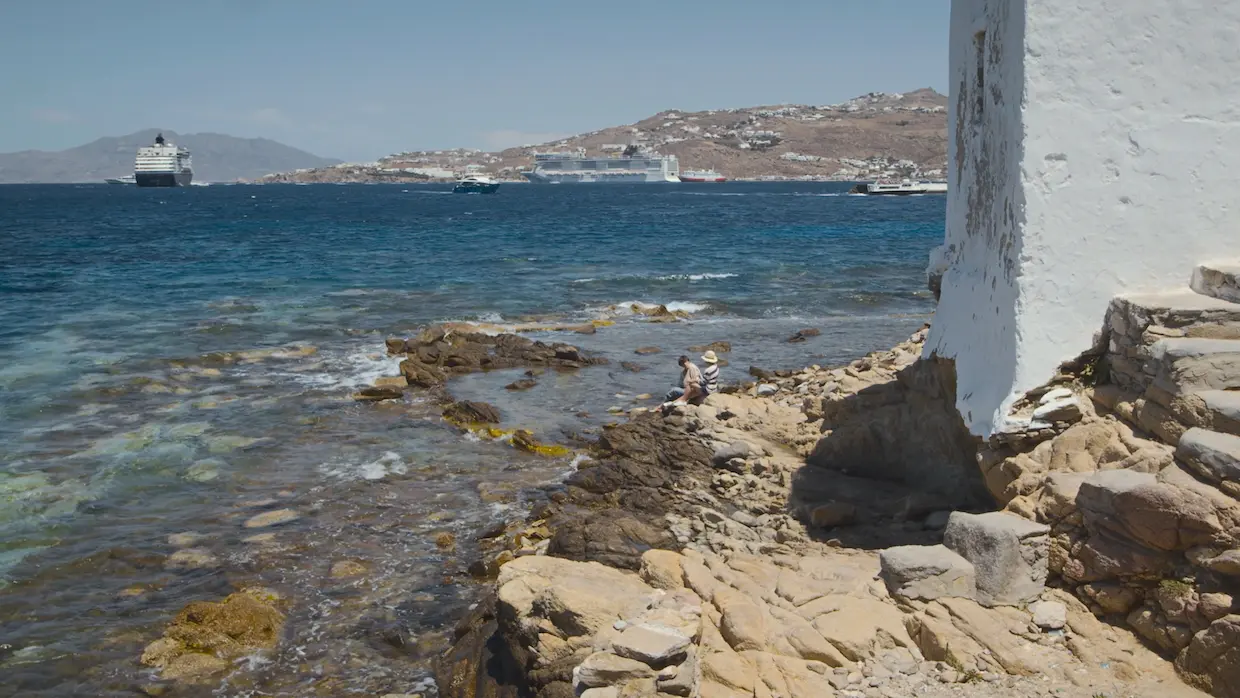
Fuck the Polis (Rita Azevedo Gomes, 2025)