Different bodies occupy a luminous room in their respective poses; others emerge from behind the doors or through the corridor. On the soundtrack, Jorge de Sena reads his own poem: ‘For when your grandchildren no longer know who you are, they’ll know me much better than you pretend not to […]’. A fixed shot composed of geometrical lines and frames within frames, it seems but an artificial space where sounds and rhythms from an archive are newly projected into visible forms. Yet it was at this moment, 7 minutes and 35 seconds into Correspondências, that I recognized this apartment like a lonesome moviegoer would a forgotten movie star. I recalled it from Guillaume et les sortilèges (Pierre Léon, 2007), where a young man encountered strange spirits and apparitions inhabiting this bizarre space. Better still, it was the family apartment in Léon’s Le Dieu Mozart film series, belonging to the fictional Barnums, some of them indeed played by those I see here — Léon himself, Renaud Legrand, Eva Truffaut and her daughter Luna. The particular copresence of these bodies and this space give both an undetermined double status: certainly they are empty containers able to display real historical materials, namely correspondences between Sophia de Mello Breyner Andresen and Jorge de Sena, their poems, their face and voices, etc., that I hereby discover, but, appealing to my memories, I find they are equally already filled with traces of time and familiar — familial — secrets, however fictional those may be.
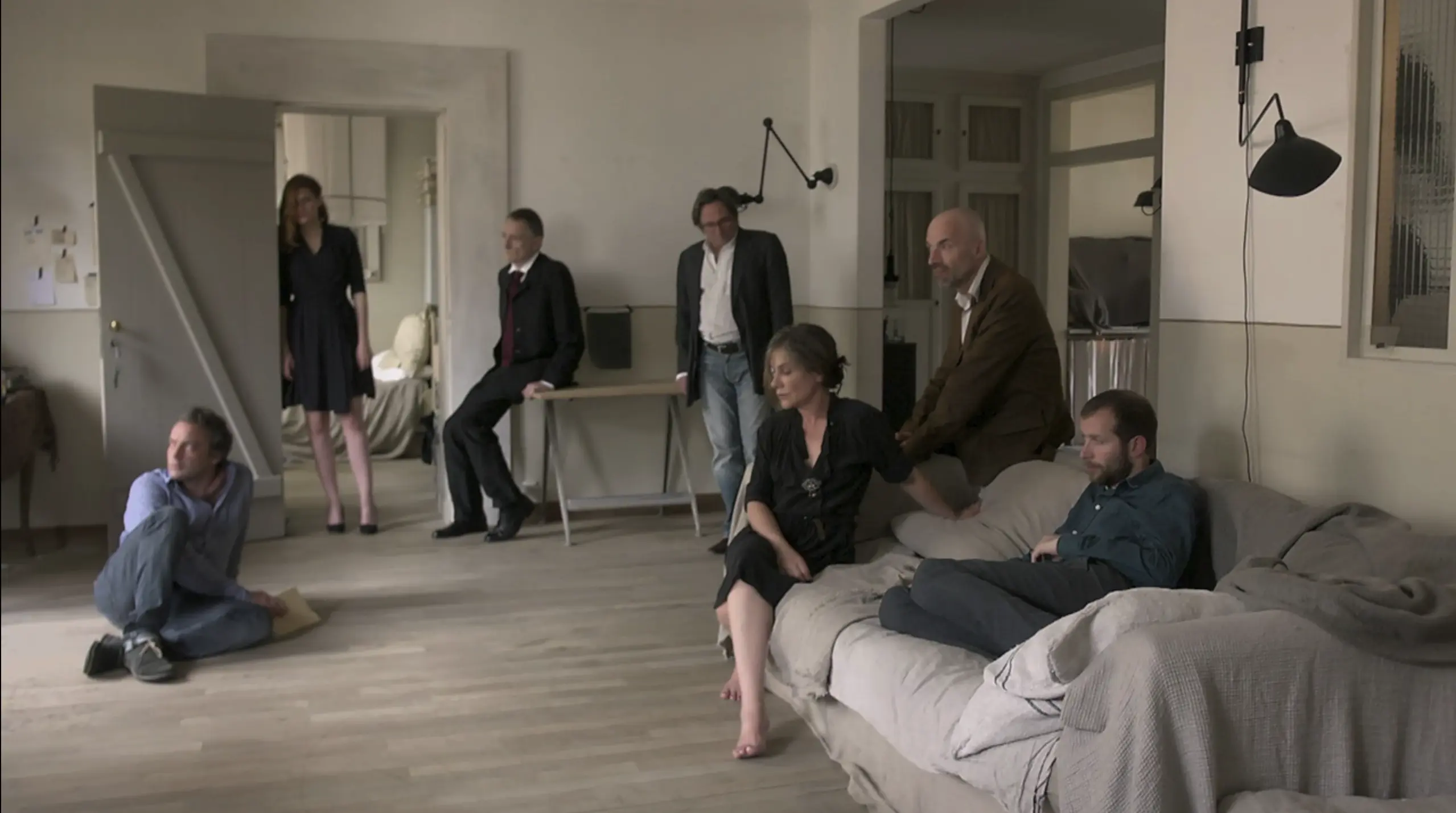
Correspondências (Rita Azevedo Gomes, 2016)
I see each apartment and each house in terms of their everyday details and suspect that each body should hold a specific personal pact with the space they activate as they perform concrete gestures. For example, an old man uses a hammer to pry out a small piece of wood holding together two glass panel doors, so that he can go outside with his dog. The camera stays still, recording from the other side of the room. A large dining table placed in the center of the room more or less hides the figure of the man and the dog, who have their backs turned. However, with the reading of a Christmas letter, the scene suddenly changes to another room, before alternating between the two spaces. Several images of people posing, moving around and reading aloud appear simultaneously with those of some stone sculptures. They destabilize and multiply like fragments of a shattered mirror, turning the second part of the sequence into a continuous collage. Every fictional or real domestic space is successively and alternately shown, weaving a general structure, and this same dynamic repeats throughout Correspondências. The biographical secrets of these stages and their actors are relegated to the background and both are intentionally presented as empty containers after all.
But what is the nature of these ostentatious archives, these poetic intruders of the daily spaces of others? Two people write letters to communicate when they are not in the same place. Andresen stayed in Portugal, while Sena left in 1959 to live in Brazil and then in the United States, in political exile. It is not difficult to grasp, listening to his letters and writings, that from his physical displacement arises a spiritual estrangement. One instance near the end of the film (chronologically further into the exile): Andresen relates her refreshing journey to Greece and speaks of her admiration for its geographical sites and its ever-regenerative culture, which Sena criticizes, with a little mockery, contending that people were no less barbaric in Antiquity, and in any case all this was already lost for good a long time ago. Pure bitterness, or something else? In another instance, a few minutes later in the film, Sophia writes to inform Jorge of the sudden death of her brother, then that of her mother — ‘She’s one of the rare people to appear in my first three books, which almost contain only trees and branches*.*’ Jorge thinks of Rilke’s description of Angels, who do not know if they’re moving amongst the living or the dead, that ‘from one point on […] we remain in an ever-stranger reality, where most of the living aren’t part of the world, they move in it like ghosts in the background, while empty spaces are filled with authentic ghosts, who are precisely the ones who have ceased to exist’. That is to say, this prolonged state of disconnection affects the exiled not only on a general cultural and political level, but also precisely on an intimate and personal level. The past and the future are inverted, producing a negative space.
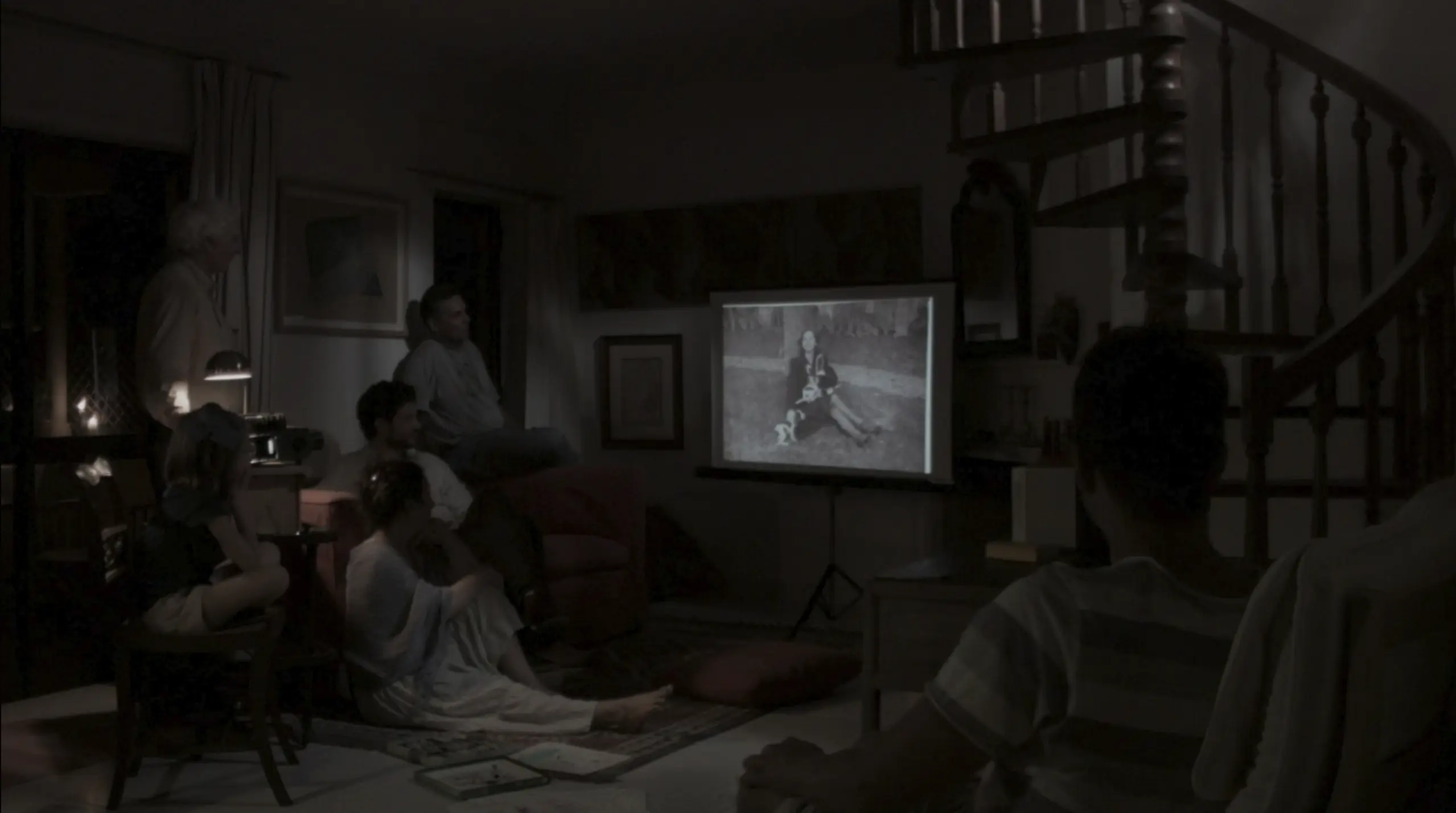
Is it not apt that, when the adults gather in a room to talk about Sophia and Jorge and show their photos, a little girl suddenly asks: ‘But where is “Exile”?’ Exile is the negation of space; exile is nowhere and ‘no place’. So, these dispossessed sounds and images slip into people’s homes to weep and amaze, then tear themselves into smaller pieces and return to their initial two-dimensional state. Repeatedly, like waves. One thinks of Ray’s We Can’t Go Home Again, although whereas Ray’s use of split screen has a distancing effect on narration and actors’ performance, Azevedo Gomes resorts to the same gesture more as a means of catharsis. However, in both films, layers of passions, of reality and fiction remain communal, transversal and intertwined: as one hears Sophia end her letter on her mother’s passing and poems full of branches, there is a rapid Super 8 shot, granular and sepia-toned, where behind dried twigs stands a blurred Rita Azevedo Gomes. More important than significations or interpretations is the superimposition of materials and emotions.
Correspondências is not entirely composed of houses and ghosts looking for a temporary home. A third of the scenes also take place in theatrical spaces and museums. It would be possible to think of the film as a sort of exhibition, where the mise en scène consists of not only the arrangement of a single room, but also the organization and coordination between different spaces. And this digressive idea itself allows us to think about the relation between museum space and scenography in Rita Azevedo Gomes’s work. How can we ever forget this sequence shot in A Portuguesa where the Portuguese woman of the title sits in the garden with her maids? There is a first pictorial composition against some architectural ruins, with lemon trees made of cut-out paper and small rabbits running around (which are motifs referencing the Lady and the Unicorn tapestries). As the Moorish maid (Rita Durão) walks into the foreground, the camera follows her movement and tracks backwards. The first group of actresses are put further into the depth of the image, now delimited by the vestige of stone walls and an arch. Two characters sit in front of the walls. Rabbits run towards the foreground. The first space is exhausted, at once becoming a tableau vivant fitted into and exhibited in the second space newly composed. The frontier between museum objects and museum space shifts constantly; an architectural structure or outline can at any time become the frame defining a work of art and vice versa. Thus the relation between the viewer and the object of vision — the film and the bodies presented in the film — is always under modification.
This museal aspect can take very literal forms in Azevedo Gomes’s films. There is no denying that, for example, in A 15a Pedra, it is quite a humorous gesture to stage Manoel de Oliveira and João Bénard da Costa in an exhibition room in the Museum of Ancient Art in Lisbon. Granted their conversation has an institutional and pedagogical tone, Oliveira and Bénard da Costa also seem to start to go together well with the artworks visible behind them. When Oliveira describes his dreams as black and white and mute like cinema in its childhood, I cannot refrain from thinking how one gentleman talking is 72 and the other 99 years old. After all, Oliveira and cinema did, in a sense, grow up together. And later, playing with their discussion on colors and reality, the image itself turns black and white for an entire sequence. The filmic subjects and the cinematic form continue to influence and alter each other: Bénard da Costa evokes an anecdote in which specialists failed to recognize a late Vermeer painting because the painter’s techniques and style were on the point of change. Oliveira responds: aren’t we, too, almost assimilated into the perspective of eternity but not there yet? Even if we are older than we were yesterday… ‘But surely younger than tomorrow,’ replies Bénard da Costa. Following Oliveira’s suggestion, A 15a Pedra ends timely on this observation, on the metamorphic capacity of art and the differential degrees between movement and stillness.
In Danses macabres, squelettes, et autres fantaisies, Jean Louis Schefer and Pierre Léon go to the same Museum of Ancient Art. Examining Bosch’s Temptation of Saint Anthony, they notice a repeated motif on both sides of the retable, a sort of crossing over a body of water. For example, on the left panel of the shutters, a plank of wood creates a passage between two banks of a current. Schefer explains that what is depicted on one bank is from a much more distant if not mythical past (the arrest of Christ), while the scenes on the other bank showed instead events contemporary to the time of the painting (Christians suffering abuses of Franciscan monks). A parallelism between the two is drawn through this unremarkable flat piece of wood. There is no time in painting, only the suggestion of (the possibility of) movement in time. As Schefer describes the figures in the undecipherable medieval representations of the danse macabre: ‘There is no space, only an abstract line. They are not dancing or walking, they merely glide.’ One realizes here that, no matter the intricacy of scenography and composition, cinema does not differ from painting in terms of space, since both offer only a two-dimensional image. What cinema proposes and provides is the virtual experience of time. Fragments of Dreyer’s De nåede færgen are integrated into Danses macabres, for Dreyer’s film is edited on the principle of cross-cutting (alternation between the road and the motorcycle, alternation between the motorcycle and the car, etc.), which paradoxically dissects time into apparently smaller discontinuous parts in order to unfold an action in a continuity experienced by the viewer — a motorcycle going at top speed side by side with a mysterious truck whose ominous driver, after the thrill of chasing and overtaking, provokes a road accident and two deaths: no more life, no more ‘motion’ in pictures. (But, after all, isn’t all motion in moving pictures illusionary?)
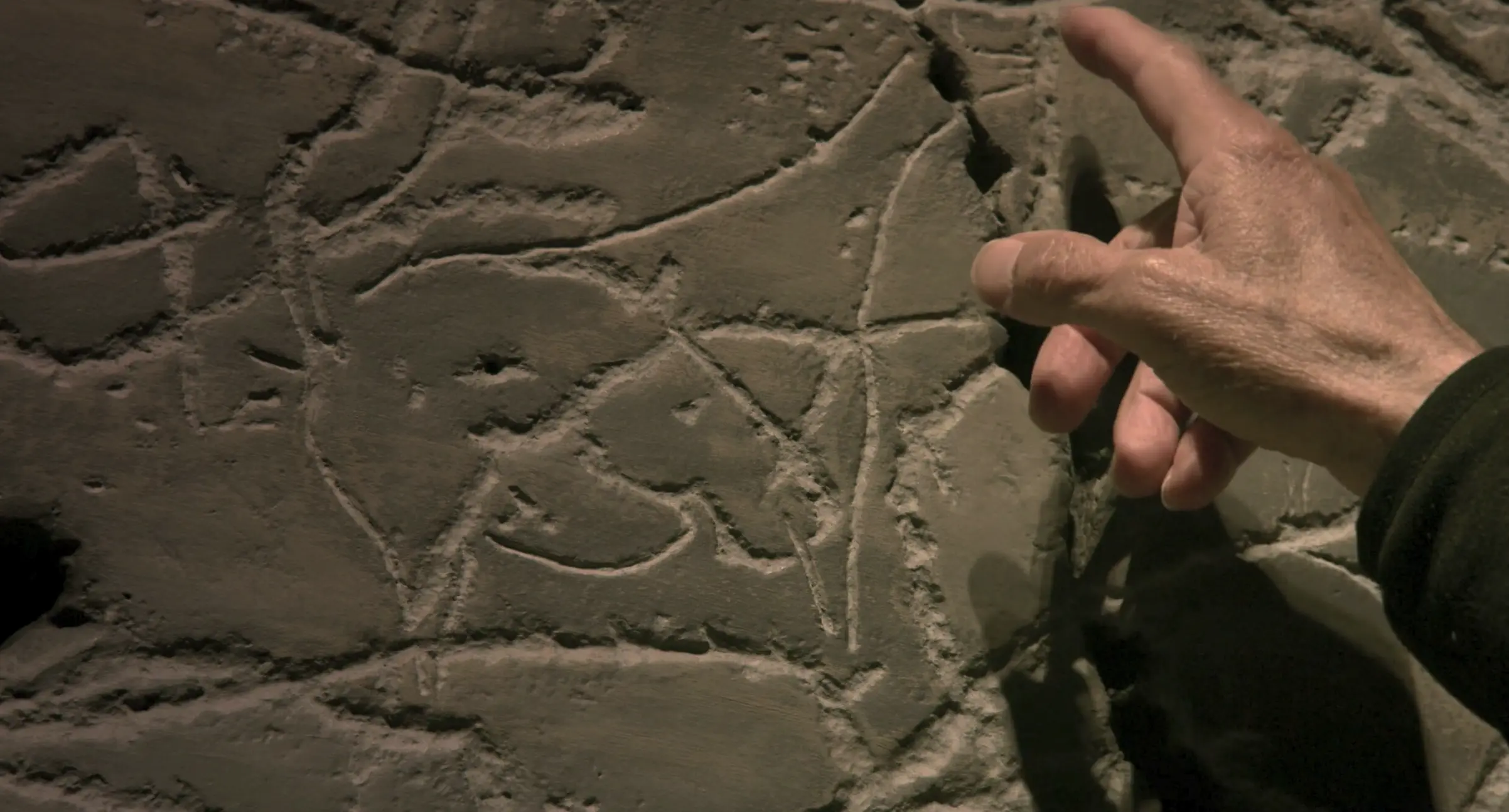
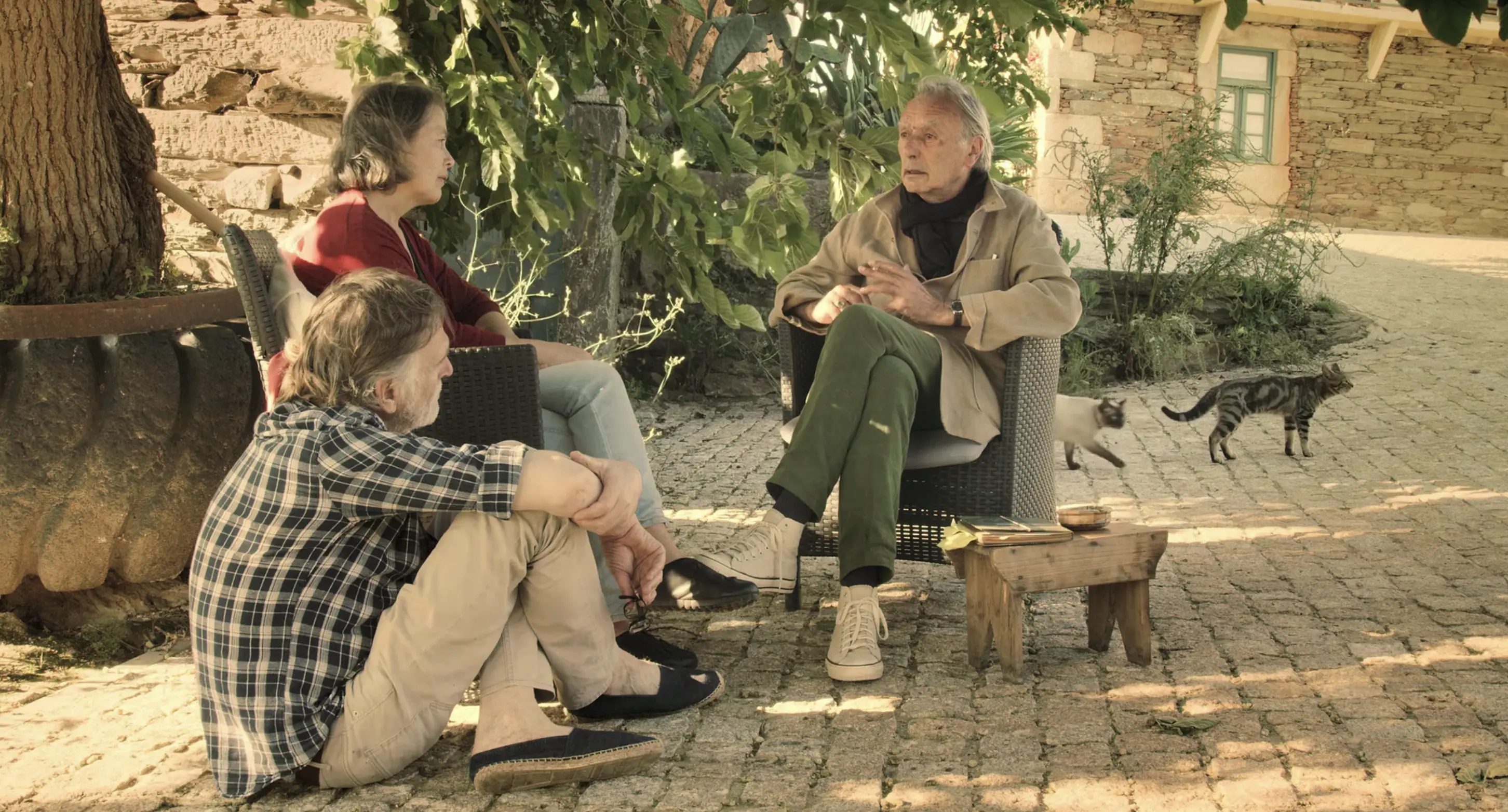
This sequencing of fixed images as surfaces is, as Gomes, Léon and Schefer find during their visit to the Côa Valley, the opposite of the prehistoric engravings. In these, layers of animal forms from multiple periods accumulate, become indiscernible, and with time leave traces marked into the body of the stones. If these engravings are superimpositions of time expressed through the incision of a concrete material, Azevedo Gomes constructs, inversely, a continuously metamorphic space in her films, where she offers the unfolding of time. Time inhabits a hollowed shape, such as a glove or a picture frame. Another sequence comes to my mind: Léon and Gomes dance in a courtyard, and there is a black spot, seemingly a fire-burnt hole, in the image. Then, after a conversation with Schefer, Léon stands up to look at and touch a cactus in the garden, hurting his thumb. Gomes offers to help put on a band-aid on Léon’s finger. Léon suggests that they clap for the sound synchronization. Gomes snips the scissors in her hand. The sequence ends. Here is the motif of the punctum, in the form of a hole, a sting, or a wound, yet it is also associated with the editing of a film, which is rooted in the act of cutting. And cinema functions through such punctum. Just as Schefer theorizes, the real of cinema is not the realness of the images, but the awakening of virtual scenarios in the viewer’s spirit, ‘in his psychic structure, which is incomplete: he is porous to something fundamentally linked to time, that is to say to anguish’. [1] This reminds me of Anne Benhaïem’s Humphrey Bogart et la femme invisible, where a woman doubts her own existence and tries to look for her childhood home. Sneaking into an almost familiar house, she is asked to leave by a real estate agent (played by none other than Pierre Léon). ‘But this is my house. If you lift up the ugly carpet and scrap the cement and the linoleum on the northwest corner, there is a treasury of one-cent coins.’ But so what if the agent ends up finding the hidden treasure or not? She will already be elsewhere doing other things. And the moviegoer is at least as much a ghost as are the succession of bodies and images and sounds that, during the time of a screening, form a dwelling for memories of the lives that will have been.
Notes
Jean Louis Schefer and Gilles Delavaud, ‘Les gardiens du temps’, in Images mobiles (P.O.L, 1999), 53–67 (p. 56).