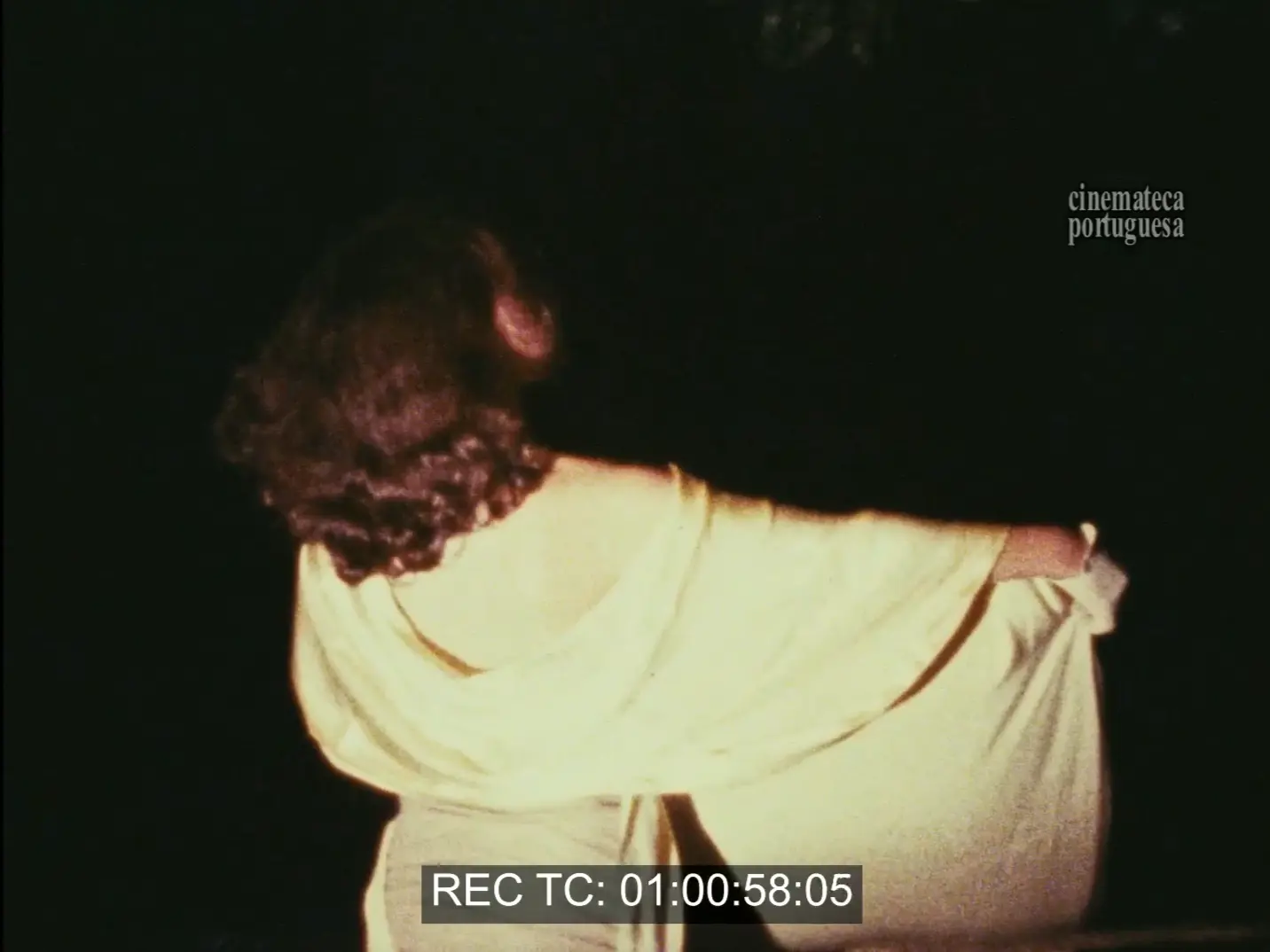
Rita Azevedo Gomes at the end of D. Jaime ou a Noite Portuguesa (Luís Noronha da Costa, 1974), her first film credit.
We thought we could start at the beginning, so to speak.
What is that, the beginning?
Well, that’s a good question. But maybe with your training as a painter?
Oh, yes, I thought I would paint. I went to the fine arts school and, before that, I took courses at the Sociedade Nacional de Belas Artes. It was too academic for me, drawing the Venus de Milo a hundred times. If you made something different, they would not accept it. And I wanted to make some different things. Then there was the revolution, and it was very anarchic, you know, only meetings, nobody did anything, so it was not very interesting. So I left.
What was your experience of the revolution?
It’s very difficult to describe. We always say the same things: it was like a cork coming out of a bottle and finally the air was coming in and we could say what we wanted, what we thought, as we couldn’t before. But it was emotionally like something you’d never experienced before, like a sound you’d never heard, like something you never thought might happen. Like Covid, but in a different way, because it was repression and liberty, and then it was… I remember the day: the first sign for me was at two o’clock in the morning. I was at my brother’s house, and I saw the guy on the news without a tie and smoking. So things changed immediately. My brother and I went out and we were running — ‘it’s there!’ Downtown, there were military tanks passing and we ducked under parked cars. We didn’t know if there would be shooting. My feeling was that the world had changed suddenly, from one hour to the other.
In your filmography there’s a movie made in the late nineties, a short called 25 Anos do 25 de Abril?
It was something I made for the Cinemateca for its celebration of the anniversary of the revolution. I normally did the expositions, installations, whatever you want to call it. For the anniversary, I changed the look of the interior. It was a very, very huge exhibition. The space outside of the cinema presented the prévio de 25 de Abril [the pre-revolutionary era], all the censorship. Inside was after the apocalypse, all the things that were forbidden before. There were twenty-five televisions screening the same film, starting at different times, one after the other; I made the film to be screened there.
For the exhibition, I covered all of the Cinemateca: roof, floor, walls, everything inside the cinema hall, floor, everything was covered with stills from censored films, big black and white images, Rank Xerox. It was a problem because I couldn’t put paper on the carpet, because you walk and it rips, it tears. So I covered it with plastic, and you can’t imagine what it was like to cover all this, then it was raining, and people were slipping, and so it was very risky. And to cover the ceiling of the cinema, which is very, very high, I had to put scaffolding to go up there and pin the photocopies. I got a scar out of that.
Helpfully, João Bénard da Costa was crazy as well; he said, ‘Okay, okay, do it.’ The big joy was that everybody in the Cinemateca cooperated, till five o’clock in the morning from one day to the other, because there were screenings the night before. So from one day to the other, the Cinemateca was all covered with images inside, even in the toilet. It was an incredible thing. There are some nice photographs of that.
These things are a bit lost. That was when that spirit was still more alive. It was the 25th of April, it was important for all of us. Now it’s a bit further back. People don’t think about it the same way, because they weren’t alive then, or maybe they were too small. I was too small, I think! I was still a teenager. No, I was much older, but in my head…
You were working with Luís Noronha da Costa around the time of the Revolution.
Oh, yeah [points to paintings on the wall of her apartment].
Oh, did he do these?
Yeah, this one, too.
Oh, wow.
And that one. And this one, and this has been in one of my films.
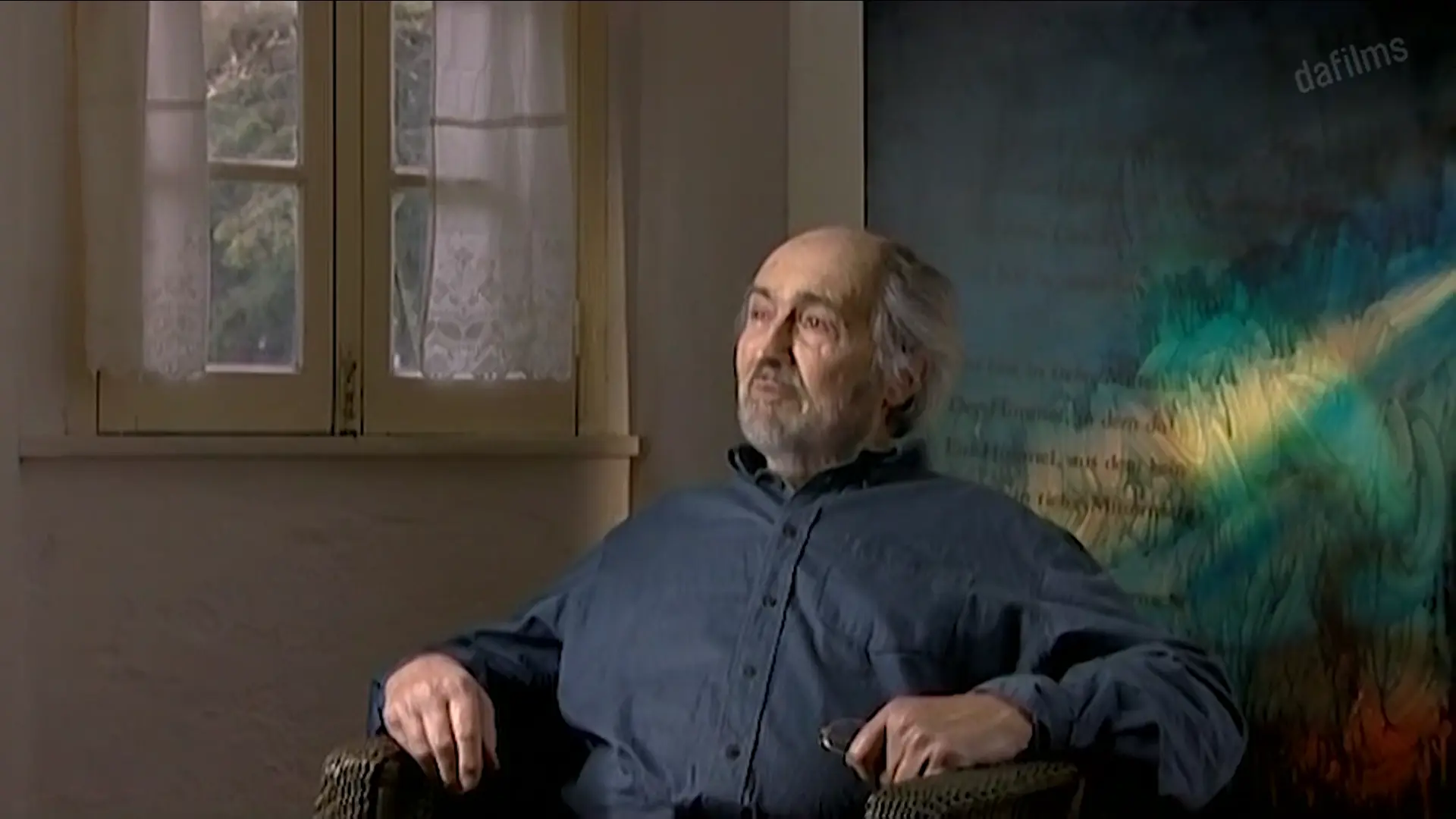
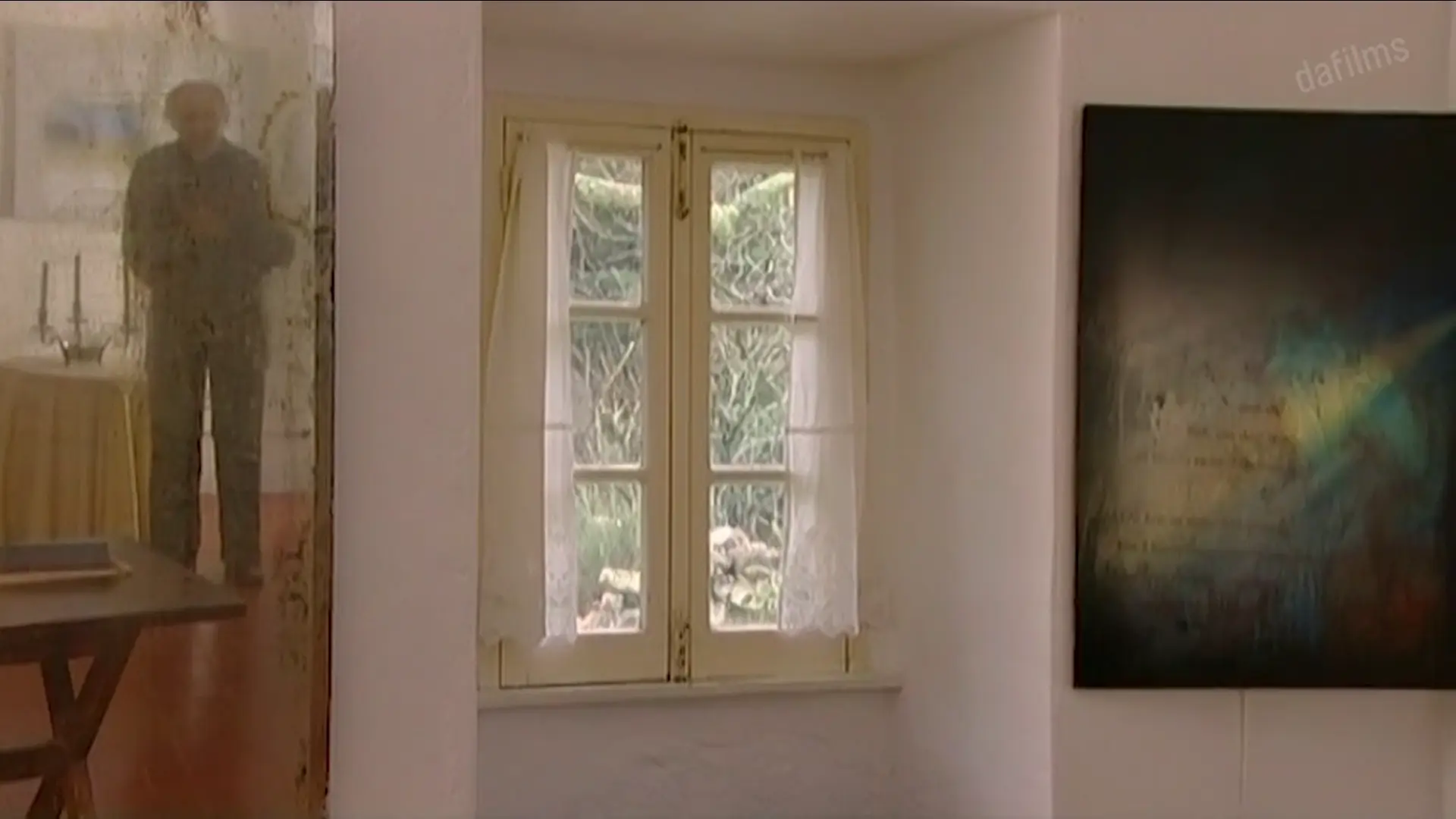
Altar (Rita Azevedo Gomes, 2003)
Altar, right?
It also has a little scar like me. Everything here has been used. That table is in A Conquista de Faro, on the terrace. I made that table, so I know. And these curtains are from A Portuguesa, but they faded a bit because I had to wash them.
How did you first meet Noronha da Costa?
Oh, that’s one of those things, you know. There was an art school, the Ar.Co [the Centro de Arte & Comunicação Visual], that was screening films on a sheet and that’s where I first saw The Birth of a Nation. It was on a 16mm print with the bobbin jumping all the time but I was completely smashed by the film. It was still there. Once they were going to screen some German films including Eika Katappa, and I said, ‘Okay, I’m going to see this.’ And I was completely captivated by the film, but I didn’t understand a word. I didn’t understand anything, but I had the feeling that cinema can also do these kinds of things. It was completely surprising. And next to me, who is sitting there? Some guy with a moustache who is laughing all the time. I knew Noronha da Costa from the paintings, but I didn’t know him personally. I asked, ‘Who is this guy laughing all the time?’ and they told me, ‘It’s Noronha da Costa’, and I said, ‘No!’ So that's how I met him.
It was a very nice period. Lots of things were happening, and then there was the revolution. João Bénard da Costa was very close to Luís and the three of us were having so much fun doing crazy things. I was practically stealing films from the Gulbenkian, putting them in my car, because Luís Noronha da Costa told me, ‘I have a 16mm projector at home.’ There was a film there I really liked, The Story of Dr. Wassell. The colors were incredible so I took it home to see it.
Can you imagine this? It was incredible, at home with the fireplace. Now and then there were interruptions, because you had to change the reels. Another whisky, another cigarette, another log in the fire, and we start again. It was really incredible to experience films like that.
Do you remember some of the other films that you saw?
That I stole?
That you stole.
Truffaut. La Chambre verte.
Luís Noronha da Costa really loved cinema and the conversations in the intermissions between reels were so incredible and creative. I was very young, they were much older than me. I felt like I could say foolish things and they took them seriously.
And then the films: Luís asked if I wanted to be his assistant — he already had a little money from ICA [the Instituto de Cinema e do Audiovisual] for O Construtor de Anjos. I said, ‘Yes, obviously!’ On the second day, it was snowing in Sintra, and we were filming in a convent. I came to the set and said, ‘Listen, I had an idea last night. We are filming two or three scenes here, so maybe we should film them on the same day to make it easier.’ And Acácio [de Almeida] said, ‘Rita, that’s what we do all the time. That’s what we call planificação.’ [1]
Was that film how you met Acácio de Almeida?
No, I had met Acácio before through my husband Jorge Alves da Silva, the father of my daughter. Jorge and João Botelho made a film together called Alexandre e Rosa which Acácio and I worked on. I was a recent mother at the time. There is a peculiar relationship between family — all these friends and couples — and Portuguese cinema.
Do you think that’s because there are fewer people making films than in, say, France, so everyone knows each other better?
I don’t know. It’s like a family: to a point, you know your cousins, but at the next family meeting you think, ‘Who are you? Who are you? Who are you?’ Everybody’s filming, but I don’t know if it’s in proportion. Godard said once that Portugal is the country with the most good directors per square meter. I don’t know if that’s true anymore.
It does seem like it was true at some point. Our exposure to Portuguese cinema in the UK and America is still very partial, but what we know of it is extremely unique.
I don’t know where that comes from. When I started approaching cinema, just after the revolution, I had the sense that everybody from this Portuguese generation was absorbing inspiration from the Nouvelle Vague. Then they were all trying to make something else: ‘I must be unique.’ I don’t know if it’s good or a bad complex to need to be different. Sometimes it’s not being different that makes the difference.
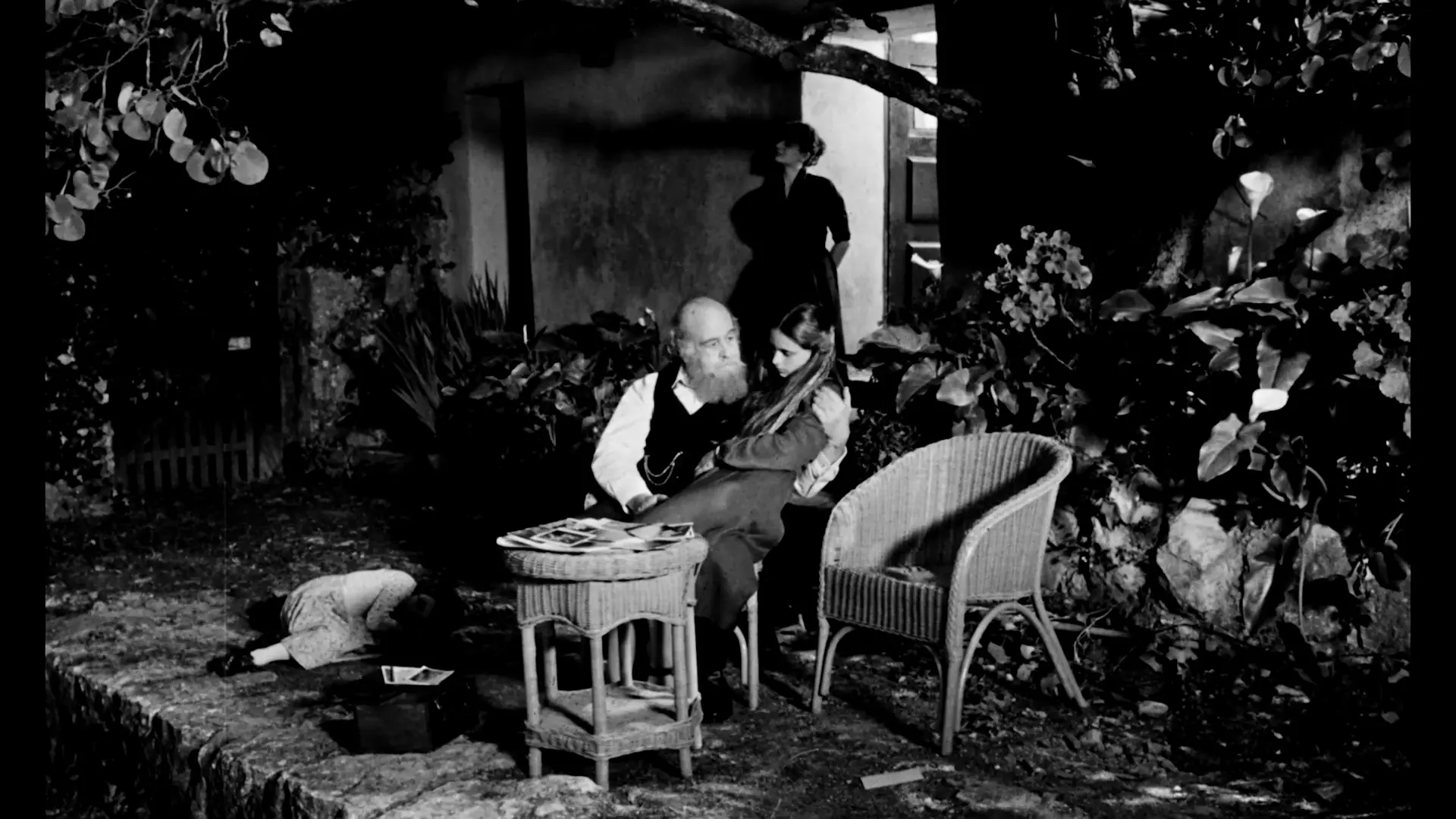
Frágil Como o Mundo (Rita Azevedo Gomes, 2001)
João Bénard da Costa looms large for everyone of that generation and appears in several of your films. How did you first get to know him?
It’s one of those things. I knew him before we worked together. I knew him as João Bénard da Costa, the one! I attended two of the classes he was giving at the Conservatório; they were on Paulo Rocha and Os Verdes Anos. Then when I was just married and pregnant, after the revolution — everything is after the revolution, so you see how it marks us — and I didn’t know what to do. I was not going back to the fine arts school, obviously. I had been teaching in the Algarve, but then I went to the Gulbenkian to do an internship in the photographic laboratory. So I was sitting in the hall in the Gulbenkian. João Bénard da Costa knew me because I had recently married Jorge, who he considered very highly, and we’d been at a party together. And he suddenly sees me sitting there and says ‘Oh Rita, what are you doing here? You are probably the right person to work with me on the ciclos de cinema.’ So I immediately forgot the laboratory and followed João immediately. So it was the start of a love story, of a friendship, of a complicity.
He was a very special person who, in that position as director of the Cinemateca, said ‘Okay, do it.’ [2] The craziest things I did in the Cinemateca were because he was there. You’ve been there? You’ve seen the tower [of old film canisters]? I installed that two days before the opening of the new building. I went to ANIM [the Arquivo Nacional de Imagens em Movimento] and they were going to send all those tins to the ferro-velho [scrapyard]. It was a huge room full of these beautiful canisters. It smelled, I tell you, it smelled… I came back to Lisbon, and I said, ‘João, please stop it. Don’t throw them away. Let me do something with them.’ I even proposed to the architects to put them on the walls of the toilet, or use them for the ceiling, anything. Don’t smash them! So in the end I made that sculpture. Can you imagine? It was very, very risky. When Zé Manuel [José Manuel Costa, founder of ANIM, later director of the Cinemateca Portuguesa], came and saw all the scaffolding to get to the ceiling, he almost fainted. But Joāo said okay. That’s very important. It’s something that I’ve been thinking about lately, this kind of confidence. It’s the most important thing and Joāo had that confidence.
It seems like there aren’t so many people like that these days, people willing to take risks — everywhere, but certainly in cinema.
Pois. Risk was always something very attractive for me. That’s why I did all the foolish things I did. I didn’t have a very planned life, but I think you have to try everything in life. Schroeter said to me once, ‘The only thing I haven’t tried is Viagra’.
Werner Schroeter was one of the people who you did set design for, for the film Der Rosenkönig, is that right?
Not exactly. I was expulso. I was thrown out by the producer.
That was Paulo Branco?
Yeah. I like Paulo Branco, but that was… It’s very difficult to talk about that because it’s a long story. If I have to say something about that film, I have to say a lot of things.
After I saw Eika Katappa and something else at the Goethe Institute, I had told Paulo, ‘You have to make a film with Werner Schroeter.’ Paulo knew Werner and said, ‘No, he does everything alone, he makes his own cameras, he doesn’t need a producer.’ I had recently worked on a film produced by Paulo, Valerio Sarmiento’s Notre Mariage, and at the end he told me: ‘You are not going back to Lisbon, you are staying, you are going to work with Raúl Ruiz on his next film, A Cidade dos Piratas.’ Then things changed after Palermo oder Wolfsburg, and he was going to produce Werner’s next film, Der Rosenkönig. He told me ‘No, you are not going to work with Ruiz, you are going to work with Schroeter.’ Yes! Working with Ruiz would have been interesting, but with Werner it was something I really wanted to see. I wanted to be there.
Werner was impatient to begin work on the film because Magdelena Montezuma was very, very ill. He was insisting, ‘We have to start. We have to start. Magdalena is dying.’ I told him to come to Lisbon and that we could go see Paulo Branco [for the funds]. He came, but Paulo Branco wasn’t there to receive him.
Nonetheless, the crew came and started filming — but with no sound! I found places for them to sleep: on my floor and at Carlos Pinto’s, a wonderful sound engineer who lived in an old house in Sintra, kind of a hippy freak. Magdalena Montezuma was the only one not camping there. The only car in the production was my Mini, so I was bringing Magdalena to Lisbon every two days to have a blood transfusion. Without sound, it soon felt like we didn’t have a way to go on. Werner was desperate, I think — no, not desperate. He knew he was going to solve it. He was not desperate at all. He knew something would come out. Suddenly Paulo arrived and said, ‘I have the money’. So we breathed again. Everybody moved to the Tivoli Hotel. Now Magdalena Montezuma could be next to the team and everything was organized. We had a team for the sound: Vasco Pimentel, Joaquim Pinto. The ones staying at my place moved there, and then I asked, ‘So now what am I going to do in the film?’ And Paulo said, ‘I don't need you. I have the whole team, I don’t have a place for you.’ So what do you do? I went crazy. I went crazy.
But Werner never told me to go away. He wanted me there. So, I was completely thrown out of the boat, but I kept swimming next to the boat and throwing some fish in whenever I could. So, I was swimming and Werner said, ‘Okay, then she's following.’ Someone on the team asked me, ‘Don’t you have any pride left?’ Still now I see that in that moment, only if Werner Schroeter had told me, ‘Please leave the film’ [would I have left].
But we were doing things. I remember one night I went to the Tivoli Hotel — I was always there — and I brought a Caravaggio book that I love very much, a very nice book with the most beautiful prints. Werner kept the book and discussed things with Elfi Mikesch [the film’s cinematographer] about what Caravaggio does with light. If you ask where the light comes from in Caravaggio, it’s not logical. If the beam of light comes from there, this guy here shouldn't be like that. It's all wrong, the light. And then Werner started to develop ideas with Elfi. So obviously, I wasn’t leaving.
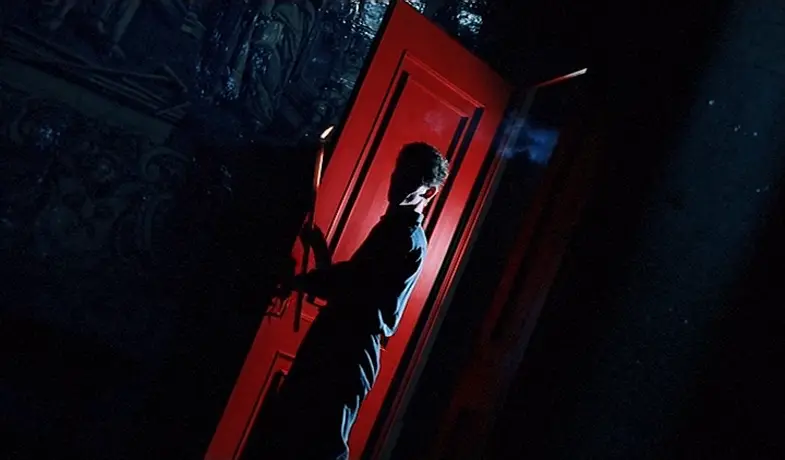
Der Rosenkönig (Werner Schroeter, 1986)
At one point, we realized that Antonio Orlando didn’t have the right shoes, so I brought him to Cascais to find a nice pair. And then there is a phrase, and then there is a poem, and then there is a walk up the mountain with Werner and praying in the church, in the chapel with Orlando, and a candle for Montezuma. And there is Montezuma. It was incredible. I had to leave the film, finally, because they were crossing, they were going to film in the south bank of the Tejo and I could not follow them. I didn’t have a penny to go there. If I did, I would have followed the film to the end. So I couldn’t be there for all the scenes in the barn, but all the other parts, yes. Not being there was a big wound, but maybe I can understand them not taking me because I was a pain in the ass!
Do you know how Antonio and I met? The crew was meeting in Sintra and Antonio had not come yet. While we were having dinner in the usual restaurant, a guy suddenly came in, sat in front of me, and said something that made me have a reaction, like throwing my soup or something. I don’t know how this followed, but suddenly he was showing me his scars, and I was showing him my scar from my Caesarean… That’s how we met. It was like an explosion. I think everybody in the restaurant heard. Antonio Orlando was going to be in my first film, O Som da Terra a Tremer. He was an angel. All my filming is built on these kinds of hurts, but also things like pestering someone till you get what you want. That’s how I went to work with [Manoel de] Oliveira.
Could you tell us about your relationship with Oliveira?
Oliveira had a vision that was based on very inherited principles of etiquette, religion and dignity, that kind of tripod. And I think this is underneath everything, but he was also like that bee that flies in Vale Abraão and goes into a flower and then flies away, flirting with dangerous things. He was very delicate at times, but could be strongly violent as well.
I wanted to work with him because I saw Amor de Perdição in a private screening. I could not be in the screening room — that was for Manoel and the team — but I was in the projection room with João Botelho and Jorge Alves da Silva looking in. I thought, ‘What is this? I want to work with him.’ So I had this fixation, but I was no one. One day, João Bénard da Costa arrived at the Cinemateca and told me, ‘If you want to talk with Manoel de Oliveira, he’s having lunch right now with the Secretary of Culture.’ I went running. It was August, so I was very hot and red when I entered the restaurant and saw they were there having coffee. I thought, ‘I can’t hesitate. If I stop now, they will stand up.’ So I approach and, knowing he’s preparing a film, I say, ‘Mr. Manoel de Oliveira, I’d very much like to work with you on your film.’ He says, ‘Oh, sit down’, and then asks, ‘Yes, and what can you do?’ I say, ‘I’ll do anything you want, Manoel.’ You should not say that to a gentleman! So it started there. Before Francisca, I had never been on a set.
Our dialogue went till the end. When he was filming, I understood something very important: he attempted to do everything. Nothing could escape him. However, I thought maybe sometimes things could be better for the film — a question of good taste or whatever. I dared to say, ‘Manoel, that thing there, maybe it’s not so... I could get you something better’. I would not hesitate on diplomacy. I hate that kind of professionalism; I was speaking not to show off, but for the film. I spoke about the hair styling even if it wasn’t my department. Manoel obviously understood that, so suddenly I was doing Francisca’s hair because the hairdresser, Senhor Couto — who was the most wonderful man, an old hairdresser from television — had that old-school style from fifties’ theater, you know, the ladies all [mimes tight hair curls] and very stiff. It was not right, so I helped. Immediately I had problems with the team, because they kept saying ‘That’s not professional, don’t touch anything, don’t touch anything.’ I think it’s very bad to work like that. It doesn’t happen in my films.
Shall we take a break?
Do you want to go out and see the sea and come back?
Yeah, that sounds great.
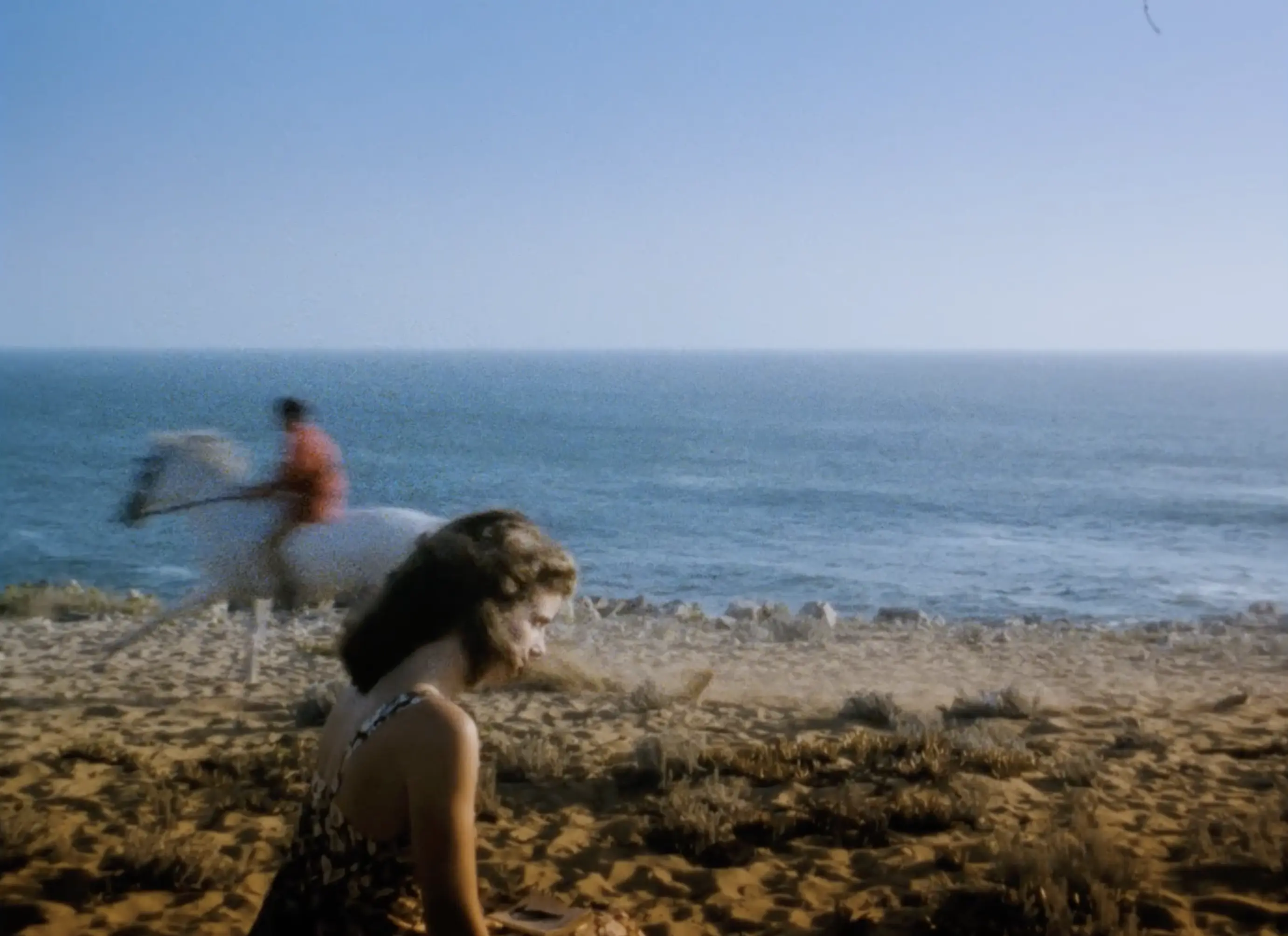
O Som da Terra a Tremer (Rita Azevedo Gomes, 1990)
* * *
You mentioned that Antonio Orlando was meant to be in O Som da Terra a Tremer. How did that film come about? We read that you had the idea for it for quite a long time before you got to film it.
Yes, it’s always taken very long. That’s probably why I suddenly don’t want films to take so long anymore, and I rush doing things like Fuck The Polis.
But yes, Antonio and I met on Der Rosenkönig and he was to be in the film; the script was built on the idea of him as the main character, the sailor. Two days before we started shooting, I called him on the phone. We had been exchanging letters, postcards, and I finally called him to say, ‘I have the ticket from Napoli to Lisbon’. The guy who answered said something that I didn’t understand in Neapolitan. It was Antonio’s voice; no, it was his father’s, and he was trying to tell me something. He was saying ucciso, and I didn’t know this word, ucciso. But when he said incidente d’auto, I understood. I froze, I could not speak. And then I hung up the phone. I was in the office with Acácio and José Mazeda. And they asked, ‘What’s going on?’ I said something, went downstairs, and caught a taxi. I could not say the address, I had to write it down. I went to my room — I was still living with my parents — and I lay down, and then suddenly it was night, and then I thought, ‘What am I going to do now?’
Eventually I said, ‘It took me seven years to get the film on the way, I must do it.’ But how? I don’t have the center of the thing. So I went to Bairro Alto with Serge Tréfault, my assistant, and we ran through all the bars and drank all the whisky, looking for someone who could replace Antonio. Impossible. Suddenly, on the other side of the balcony, there is this guy, and I say, ‘Maybe him’. And I lean over this balcony and I say, ‘Do you want to make a film?’ Three o’clock in the morning, completely drunk. And he says, ‘Okay, if it would pay for my passage to London. I’d like very much to go to London.’ So Miguel replaced Antonio. He has no dialogue because the character was going to talk in Neapolitan. I think it was a good solution. I was not very sure, but why not? I needed to try.
The first part of that film is based on the André Gide book, Paludes. But then it’s —
It’s a mixture. I was completely taken by André Gide and that book at that time.
A lot of your films combine different texts quite freely. How did this way of working develop?
It’s not something I’ve consciously decided to do in my films, to knit texts in this way. No, it’s because when I’m on the way, following an idea, everything comes to this center. Even if it doesn’t seem to have anything to do with it, somehow it belongs. It’s funny, the closer you get to the thing, the more everything seems to have an inner connection. Even the paper you use to wrap a book that you just bought as a Christmas gift: you see the paper has lots of phrases from famous writers and read something and go, ‘This is going to be in the film’. Then, yes, I can draw in Camões in A Vingança [de Uma Mulher]. Somehow they are talking about something that is connected.
It’s like that. I steal everything. No, it’s not stealing. It’s so becoming. It fits. But there’s a big danger because things you feel, you feel. But then you have to decide, is it needed or not? To not include it can feel like a waste, but that’s what I call ‘leaving the dog outside’. It has to be done.
I suppose, when you’re living in a film that you’re making, everything somehow relates.
I should say it differently: when I’m in a film, I’m living. It’s more like that. And the word, the word is the most beautiful thing. So if I take a text, which I like for the pleasure of reading, I want to keep that text: I really dig as much as possible into each word or sentence. It’s incredible, the multiplicity of meanings you can put in a single word. There is a theater play, The Pelican by Strindberg, that starts with a sentence, ‘Shut the door’. Once Hugo Tourita, an actor who is in most of my films, wanted to do that play, and I was going to be the one who says, ‘Shut the door’ — the mother, that terrible character. You know how it is going to end, the fire and all that, [3] but she can say that, and it’s very beautiful, endless. So I was driving home from Lisboa to Cascais, and all the way I had different ways of saying the same thing: ‘Shut the door, shut the door…’
O Som da Terra a Tremer came out in 1990, and we’ve read that it didn’t have a great reception in Portugal. But we don’t really understand why that is.
You know, I don’t know. Because they didn’t like the film! Even [Carlos de] Pontes Leça, who liked it, wrote that it was an ‘eclectic film.’ I went to look up all the meanings of ‘eclectic’! I felt a hard resistance towards me. It took me ten years to make the second one.
And between the first and the second film, you were working at the Cinemateca?
I went to the Cinemateca in ’93. That I remember, because it was when I stopped drinking. I could finally have a normal job, not jumping around all the time. I was doing things, interesting things here and there in graphic design and exhibitions and opera and theater. It was very nice, but I still had to try again.
Frágil Como o Mundo was your first collaboration with Patricia Saramago, who went on to edit many of your films. Could you say a bit about your relationship?
Patricia was a very dear friend, a lovely, lovely girl. I didn’t know her at all at first — it was Paulo Branco who sent her as the one who was going to edit with me. And Patricia came, red trousers, blue cotton shirt, and light summer shoes. Okay! And we started working on Frágil, and then we became very, very friendly.
What’s incredible is that now I think they are preparing an homage to Patricia in the Cinemateca. And for me, that’s a break. An homage to Patricia? Is this possible? Has she gone? It’s very strange to see that, it makes it real.
The images of her in Altar are so memorable. It’s one of our favorite of your films.
Pois. It’s strange, that, because nobody cares about that film, though Olaf Möller says it’s his favorite.
It’s one of Adrian Martin and Cristina Álvarez López’s as well.
Altar was made with things that were around.
It was your first film on digital.
Yes, Hi-8.
We’re curious about your transition to digital. The digital photography in your films is very distinctive.
I hope so. Before, I only wanted to work with film, but you have to explore things. Any material may be interesting.
A Portuguesa could not have been made on film. It’s very sensitive to the way things look in high definition.
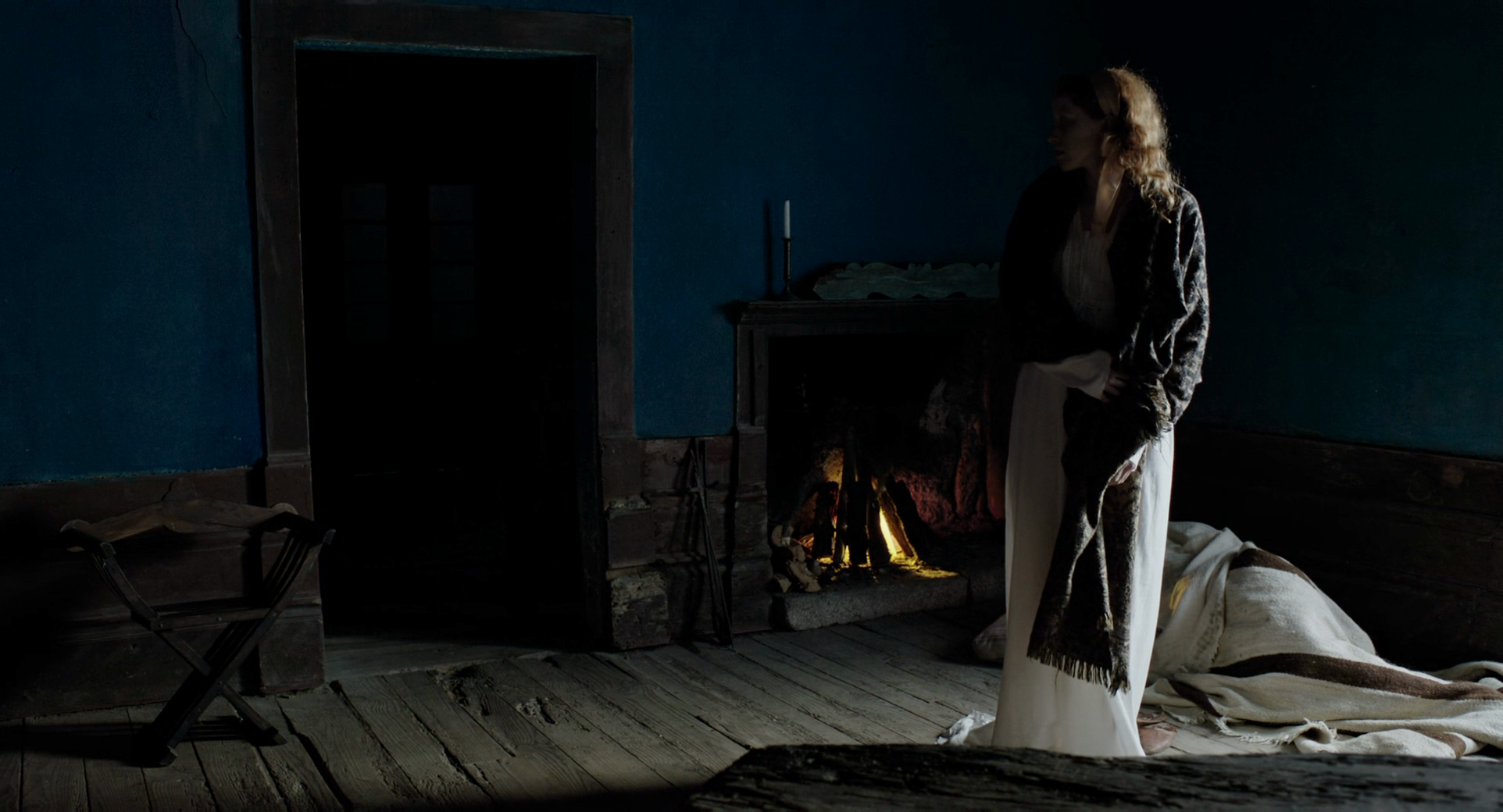
A Portuguesa (Rita Azevedo Gomes, 2018)
I discovered — maybe everybody knows except me, like with planificação — that with high definition you can have a certain depth that is very beautiful. I was doing tests with the cameras in Rossio in Lisbon, because [Abel] Ribeiro Chaves had a studio there, and I could see all the way to the other side of the hill — if a cat was crossing, I could see its moustache. It’s something to explore.
Sometimes you can’t decide on a camera because someone’s lending it to you, and you don’t have much to say except ‘thank you so much.’ So a Blackmagic — that’s perfect. But if I have the chance to choose, I do tests to study the colours I will use, the shine of the materials and all that. I don’t like the filament that digital creates around figures. Black is always a problem. So I make a palette of situations — the hair of Rita Durão and so on — and then I choose the camera. It’s like choosing the negative.
That care is clear in the films. The costumes, sets and colors in A Portuguesa and A Vingança de Uma Mulher look better than in films that are ten times as expensive.
That’s a compliment! I try. That’s why I get so angry when I come to a screening and... Because I spend hours on those things. I don’t like post-production effects very much. When I want to fake snow, I drop something. For A Portuguesa, I couldn’t afford the team that comes in with the Hollywood snow so I went to the internet and found a way of doing it. It’s very cheap, but it works.
Rita Durão and Pierre Léon have become mainstays of your films. How did you come to form this little troupe?
Because I like them. I like Pierre Léon very much, I like Rita Durão very much. So I was curious and tried to find a way of putting them together, to see how they acted together. That’s why I changed everything in Trio [O trio em mi bemol]. Rohmer’s characters are quite young, maybe thirty-something, not sixty like Pierre, but it still fits. Maybe at sixty they are still like that, they are still there, so we can pick them up a few years later. I wanted to see, and it was very nice, and I think they liked to do it too.
How did you meet Pierre?
I met Pierre in the Cinemateca, but I didn’t know who he was. He was here for the festival, Temps d’Images, organized by Teresa Garcia and Pierre-Marie Goulet. Then I was in Moscow because Boris Nelepo was screening A Vingança de Uma Mulher there, and when I came out of the cinema and everybody was talking in Russian outside, suddenly I heard some French, and I said, ‘Oh, Pierre Léon!’
Then at another point in my life, I had to go to Paris for a while to have some treatments, otherwise things would be very, very bad. I didn’t have anywhere to sleep there. I didn’t have much money, I was working in the Cinemateca. So I started calling the people I knew, because I didn’t feel like renting a cheap room and then coming out of the hospital after treatments and going to a depressing place. I called Judy Shrewsbury and Jean-Paul Mugel and then Pierre Léon. It was lovely.
He’s a great presence in your films. We love the moment in Correspondências when he’s looking at the fish and drops the cards onto the table.
[Mimicking Léon] Ahhh! And the cat! He loves to play.
And Rita Durão, did you first find her through Monteiro?
No, it was not directly because she worked with César, though she’s incredible in Monteiro’s films. I knew Rita because she’s a theater actress, and she was working in Cornucópia frequently [Teatro da Cornucópia, theater company founded by Jorge Silva Melo and Luís Miguel Cintra in Lisbon in 1973]. I wanted to try to approach her, and then she came. I don’t know what the first film was.
A Conquista de Faro?
Or A Colecção Invisível?
That one’s a couple of years later.
Yes, it was just before João Bénard died. He didn’t see the film. That was painful. Can you imagine, João Bénard da Costa is suffering in the hospital. I'm there next to him. I leave the hospital and go home to edit. I was rushing, hoping he could see it. Halfway through I gave up, I knew he would not live to see it. It was very strange because the image seemed much more real than the person there. It was obvious that it was the truth. It stays, the image.
In that film, there’s the moment where you keep in the slate.
Because he’s not blind, João Bénard da Costa!
There are lots of little moments in your films that we could spend hours asking you about. For instance, the moment at the end of A Conquista de Faro, with the donkey and the Janis Joplin song.
Do you think it’s too long there?
No!
Sometimes people say it’s too long, because after the music, there is a silence. But yes, there’s a reason for that, it’s not only fantasy. I was teaching in São Bartolomeu de Messines in the Algarve after leaving art school. When I went back to the Algarve to make the film about Faro I was really shocked because I didn’t recognize the place anymore. The beach that was in front of my apartment was concrete and they had a ferris wheel. What you saw during our walk today [in Cascais] is nothing in comparison. I remembered going to the Algarve and seeing the donkeys crossing the road, carrying baskets, beautiful baskets. So where is all that now? It’s highways. So the donkey is drowned in this.
I have a memory from childhood that once the patients of my father, who was a famous doctor, gave me a huge donkey for Christmas. It was 80 centimeters tall — I was very little — with two baskets hanging with all the picturesque things. I’ve always had an affection for donkeys. That’s why Au Hasard Balthazar became unbearable for me. I saw it many, many times. The last time I saw it, I thought, ‘I’m not forcing myself to see this anymore!’
There are lots of animals in your films.
Animals are very difficult to control and only bring problems. But it’s curious, the way the irrational looks at the rational world. They are watching us. They are there as well.
You mentioned earlier that you don’t want to have to wait to make films anymore and that’s why you made Fuck The Polis quickly. Do you think you’ll continue to work quickly in that way?
I don’t see the future, I see the next one. O Sermão de Fogo [a novel by Agustina Bessa-Luís, the basis for the next film] asks for another way of fabricating, another structure. There’re lots of characters, it’s very complicated. I’ve been going through the script again, cutting, cutting, cutting. But I really think it’s a waste to wait. If you can do something, for me it’s better to do it. It’s very, very healthy to have this kind of appetite, to go and see places and work out how to solve a lot of intriguing problems. Things will come.
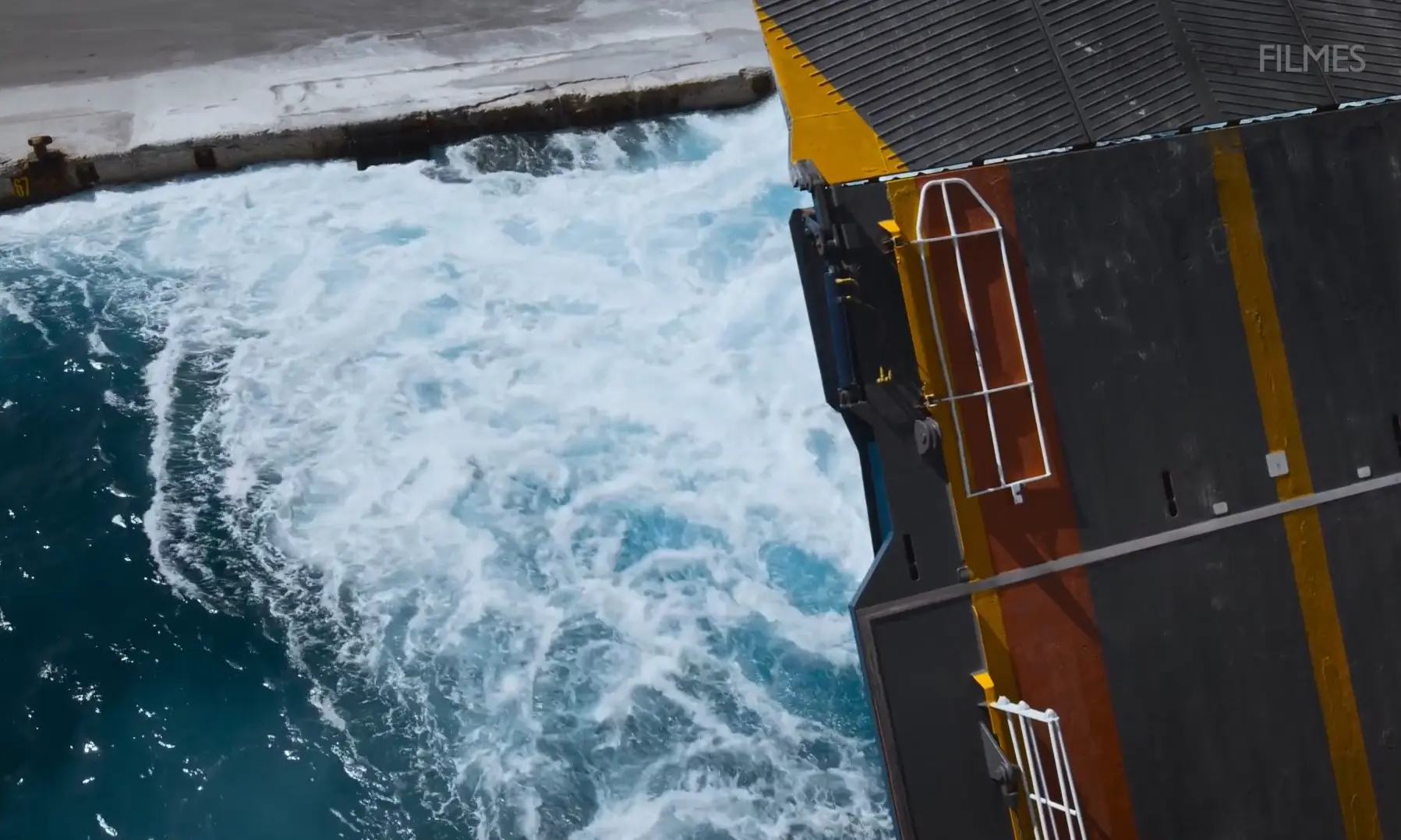
Fuck the Polis (Rita Azevedo Gomes, 2025)
Notes
Planificação refers to the planning of shots before shooting; it therefore corresponds to one of the meanings of the French term découpage.
João Bénard da Costa was head of the cinema department of the Gulbenkian Foundation from 1969 to 1991. He was director of the Cinemateca Portuguesa from 1991 to 2009.
Like Strindberg’s earlier and more famous A Dream Play, The Pelican ends with a conflagration.