‘The French writer André Gide once famously said “I modify facts to such a degree that they resemble truth more than reality”. It’s a very deep statement for me.’ Editor’s note: Discover’s fact checkers could not verify that Gide said this. When asked about the quote’s source, Herzog said, ‘I may have invented it’.
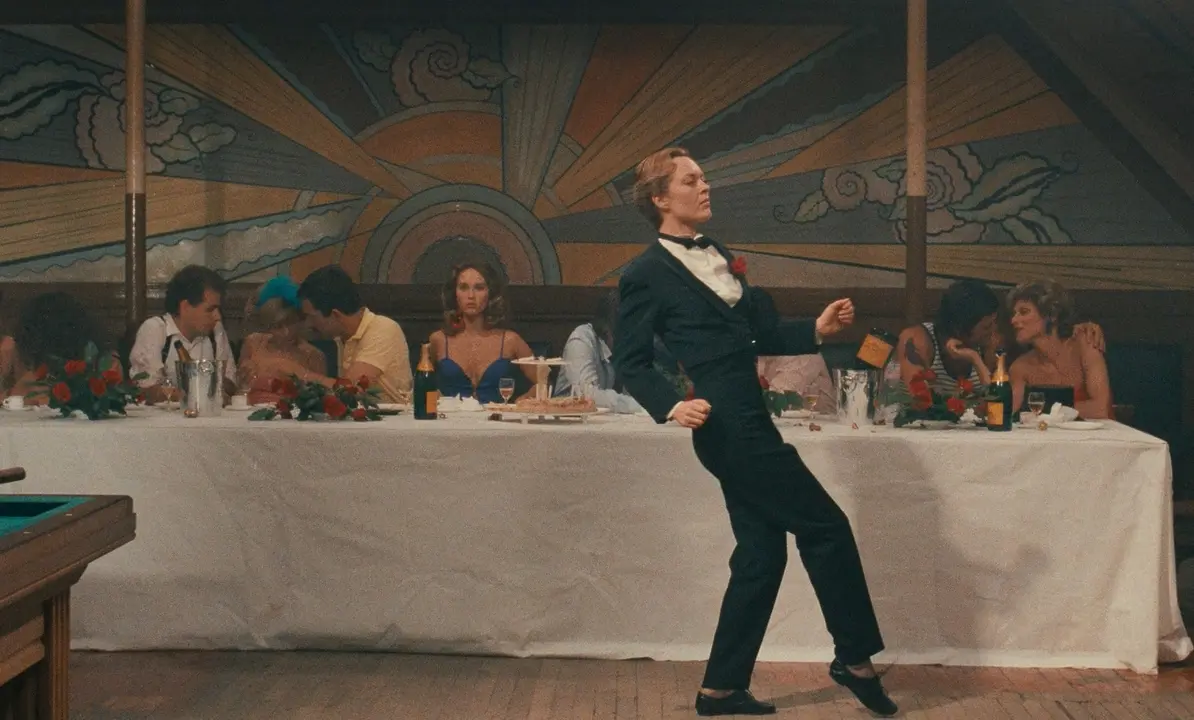
Rosa la rose, fille publique (Paul Vecchiali, 1986)
In Rosa la rose, fille publique, Vecchiali is a tragedian before he is a dramatist, composing a tragedy to which dramaturgy is entirely subordinate, the latter’s intricate continuity an excess not afforded here. Vecchiali’s écriture of vectorial addition — integral as against the ‘dramatic form’ of his lessers’ mere arithmetic — is (to use his term) ensembled here from ‘unity of time, place, and action… above all, misunderstanding’; [1] ensembled toward a supercession of the work’s constituent parts. Vecchiali’s definition of tragedy is simple, even facile, but his sense of unity is truly credible: Rosa, though not strictly discontinuous, is insubordinate to its compositional/temporal landmarks, insubordinate to the auteur-impulse itself. Emergence, irreproducibility, everything in service of this unity of elements: écriture. Staging here, by Vecchiali’s definition, stages inclusively ‘what goes on on-stage’ — unprofaned therefore by formal gluttony or visible artistic despotism, the cloying of ‘film-poetics’, ‘empathy’ as imparted by technical brute force, as distinct from, say, genre-minded vérité, or broader ‘naturalism’, themselves domineered into existence as necessary to make the stage appear as a real-life street corner. The stage in Rosa is a stage, on which improvisation occurs as a solute reflex of reality within the heightened reality of theater — and, strictly speaking, this reflex is emergent rather than improvisational, because the film itself, though inevitably inorganic, is an organism which can internalise the organic raw material of improvisation. Here is a structure in which we necessarily may not share in the perspective of a character (‘see it through their eyes’). Subjectivity, which would compress the film into the volume of a single person’s skull and isolate a given variable from all others, would rupture it totally.
In a film born of that kind of absent artistic profligacy, in which a point is emphasized by means of narrative marginalia, circles and arrows drawn over the important bits, mud slung upon mud, subjectivity is imposed by the very means of creation: the hand of the director, entering the frame to rearrange, as no other may hand may do. Such are the means of his contemporaries, ‘dramatists’ utterly without truth: a Fassbinder, a Varda. Vecchiali in Rosa is voiceless; he is not, as even talented lessers are, curatorial unto suffering in a way that would proclaim his authority or artistic presence, and does not seem to impose his own will. If he does, if he must, it is with such careful measure that the effect is invisible. Narrative or dramatic naturalism is therefore ill-fitting: both things that speak their own name, tell us that they are naturalistic, tell us why, argue for their own verisimilitude by, quite thoroughly, concealing the means of that verisimilitude, even as the sanity of the product reveals the farce every time; Vecchiali is, more than naturalist of fiction, a fantasist of nature, a director of true vérité, wherein truth is a kind of extract of reality, dissolved in fiction inasmuch as fiction may bring reality into starker relief, render it legible, render it beautiful.
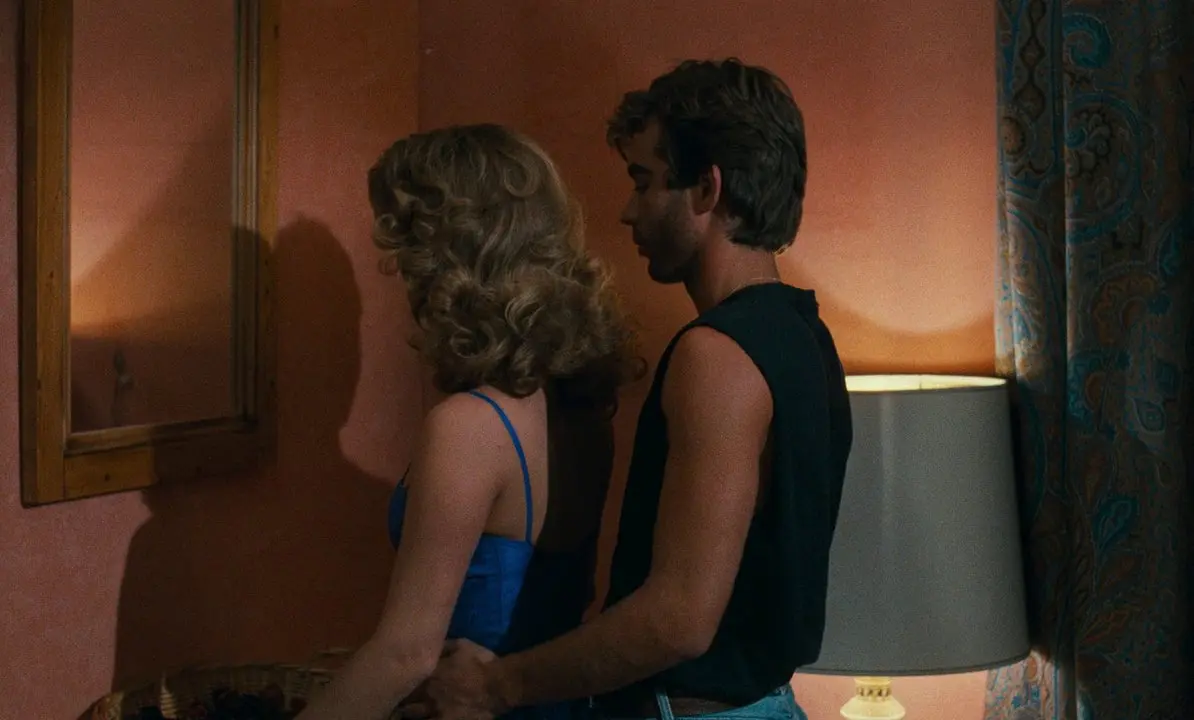
Neither poet nor dramatist, here is an orphan of both, equally estranged from and beholden to his claimed French-cinematic heritage, whose definitions form the object of anticipated meaning by which he achieves a kind of logopoeia. Rosa, the character, abrades constantly against her own archetypal shadow, this meaning of ‘prostitute’ arranged according to her film’s aesthetic context, the ‘expected use’ of ‘someone like her’ — she is in this way beholden, as whore to pimp, to the film industry itself. A client sits her down to share a meal, seeming to direct her: here is our auteur, his scene scripted in real-time, play-action demanded according to his aesthetic whim; when Julien is about to take her to bed, his face occludes a pasted Brando portrait on the wall; photographs around her mirror, family members and old film stars, watching from the corners of the frame as his reflection counts out her payment. This scene, genuinely indescribable in its beauty and emotion, is the first time she is seen for more than utility, and so the character fractures: there is something else, now, in her mirror. Her terror thereafter as she loses her lines.
We would, according to the mores of Vecchiali’s inheritance, expect from his ‘last supper’ scene abject kitsch: ‘the sainthood of broken people’, ‘noble ordinary’; worse, ‘noble criminal’; Vecchiali allows this impression to be suggested by characters we barely know, before the dinner guests disappoint this entirely — they are, instead, real people stuffed into mascot-suits of ‘French-cinematic’ archetype. The dance is nothing but minstrelsy, the image itself is nothing, important inasmuch as it is a site for true love, little else but a mocking invocation of an invocation already mocked, a bad joke told with a knowing smile. Vecchiali’s is in Rosa, then, a poetry of this very abrasion: of an anticipated meaning’s interaction or argument with reality, the violence of this discontent ending in the point of a knife in Rosa’s chest. Tragic fate is here decided by a miscommunication between Rosa and her self-image as both prostitute and prostitute-character — she senselessly agrees with this archetype, and so resolves to die, thereby, she believes, realizing her only freedom from this twofold whoredom.
Happely you think, but bootles are your thoughts,
That this is fabulously counterfeit,
And that we doo as all Tragedians doo. [2]
Rosa is a human woman who fatally imagines herself as a Female Character, for whom unbinding — from the pimp, from Vecchiali, from theatre — were only in death; she is wrong. A simple misunderstanding. Her death is senseless, her true love gone. Who could not say: tis’ pity she’s a whore.