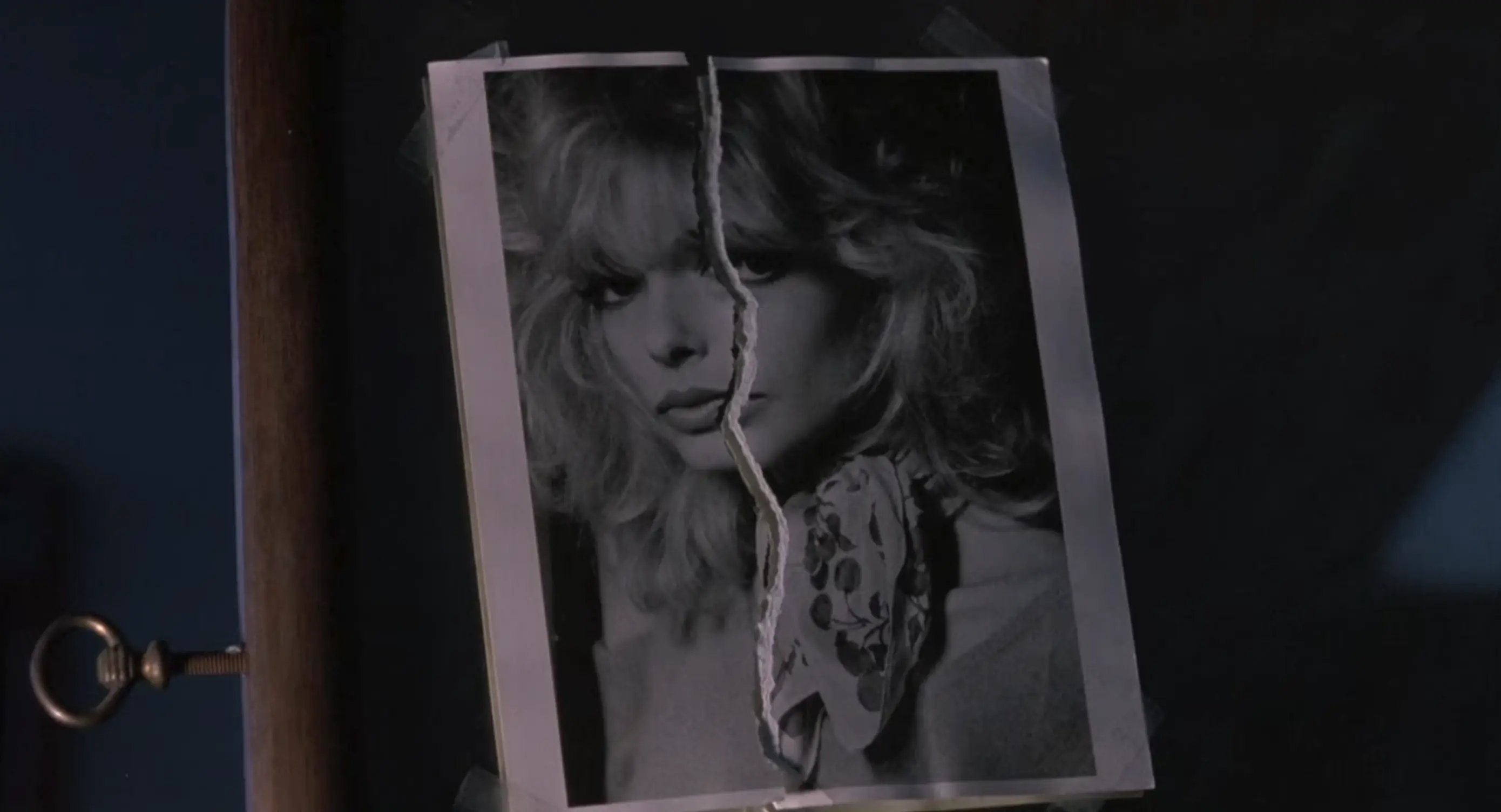
Special Effects (Larry Cohen, 1984)
‘For the first time, I have someone to be when I wake up in the morning. I know who I am, and no one’s gonna blow that for me’, Elaine tells Keefe in Special Effects. Shot in a high-angle close-up, her eyes are obscured by the bangs of her newly blond hair. Even so, the intensity of her emotions is apparent. Just pay attention to how her lips snap at him, how the muscles on her face shift, how she subtly trembles. She is entirely serious about committing to this particular part. The woman who was initially introduced to us sporting countless jobs and hobbies, with a holiday in Amsterdam lined up, is now seeking stability and certainty. She does specify, nonetheless, that it’s just this part she wants, not a career in acting. The commitment still comes with a caveat, a way out. At this point, the film cuts to the reverse shot of Keefe, who asks Elaine to consider the long-term future, one of which he is implicitly a part. Instead of getting an answer from Elaine, the film suddenly cuts on the motion of her standing up, moving out from the close-up to a wider shot. Such slight fractures in continuity are a characteristic of Larry Cohen’s filmmaking, and they disrupt the surface of his work as much as their more overtly self-reflexive elements do.
Rita Azevedo Gomes embraces her own discontinuities in A Vingança de Uma Mulher. When Roberto and the Duchess first meet, their flirtations are captured in several mobile long takes, often with the camera gliding at a safe distance. The camera is cautious and precise, abiding by the same dance of leading and following. At least, that is how things seem superficially. After she has made their first intimate contact, resting herself on his lap, the Duchess escapes the scene and exits the set. The rhythm has shifted. She peeks back at Roberto through a small peephole in the wall, granting the audience a view from the wings, the secluded space of her own motivations. Returning to his arms, she drops any pretense of seduction and instead wears an expression of undeniable sadness. The editing picks up its pace. As she lays down, a series of images launches forth: first, one of her hands clenching her dress; then, an extreme close-up of her forlorn eyes, vignetted by a strip of light, which emerges from no discernible source within the room itself. It makes perfect sense, then, that the next shot is from an entirely different place and time, conjured into the present by her melancholy. Fighting for its recollection, the image remains brief and out of focus. The full story of her downfall is to come. In the meantime, the film cuts back to the Duchess, now laying in an altered position. Her body has been fractured and contorted. The fractures surrounding Elaine impeded her ability to give a response and make herself known, whereas here they serve as the beginnings of a rhetorical rebellion.
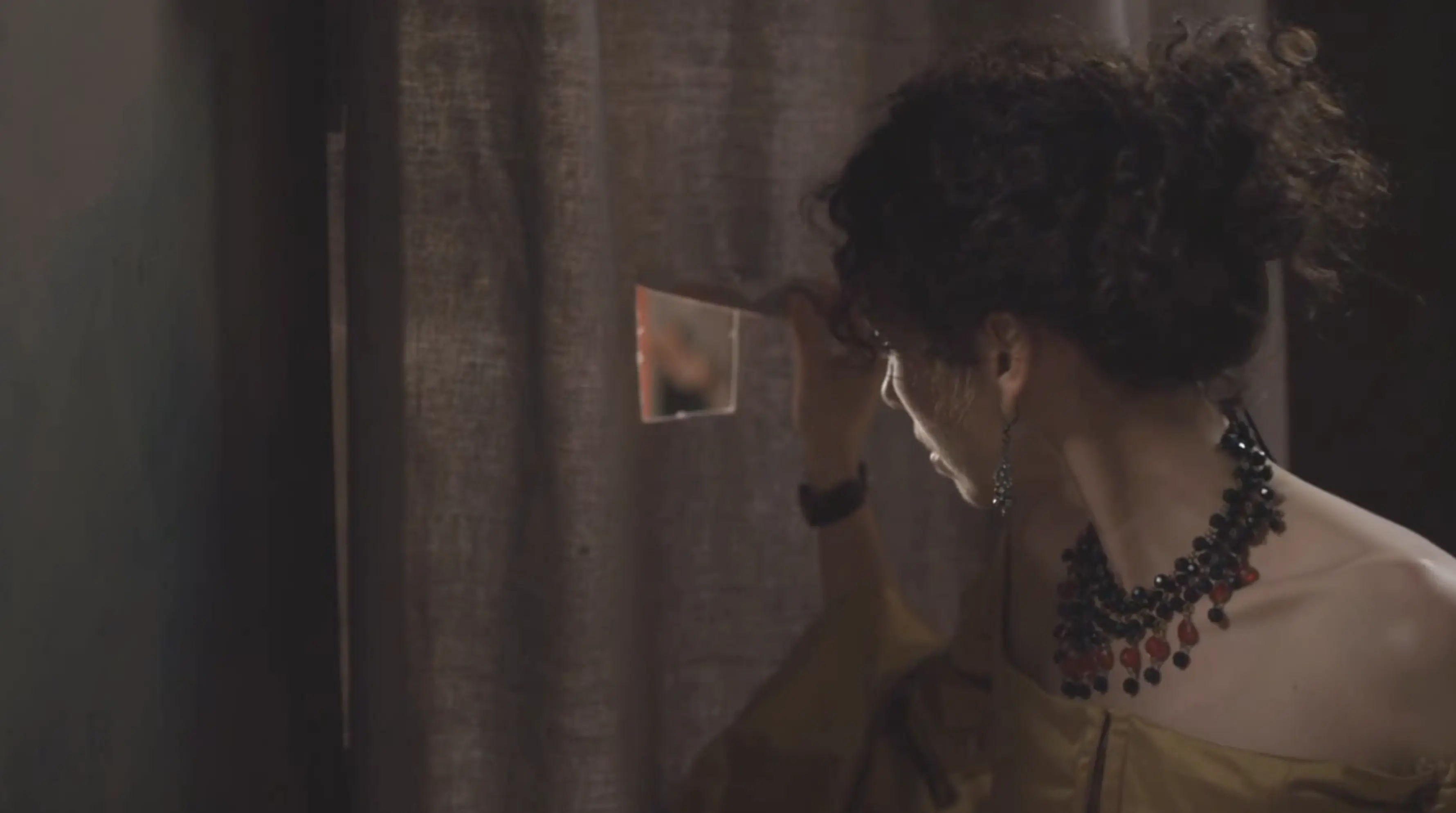
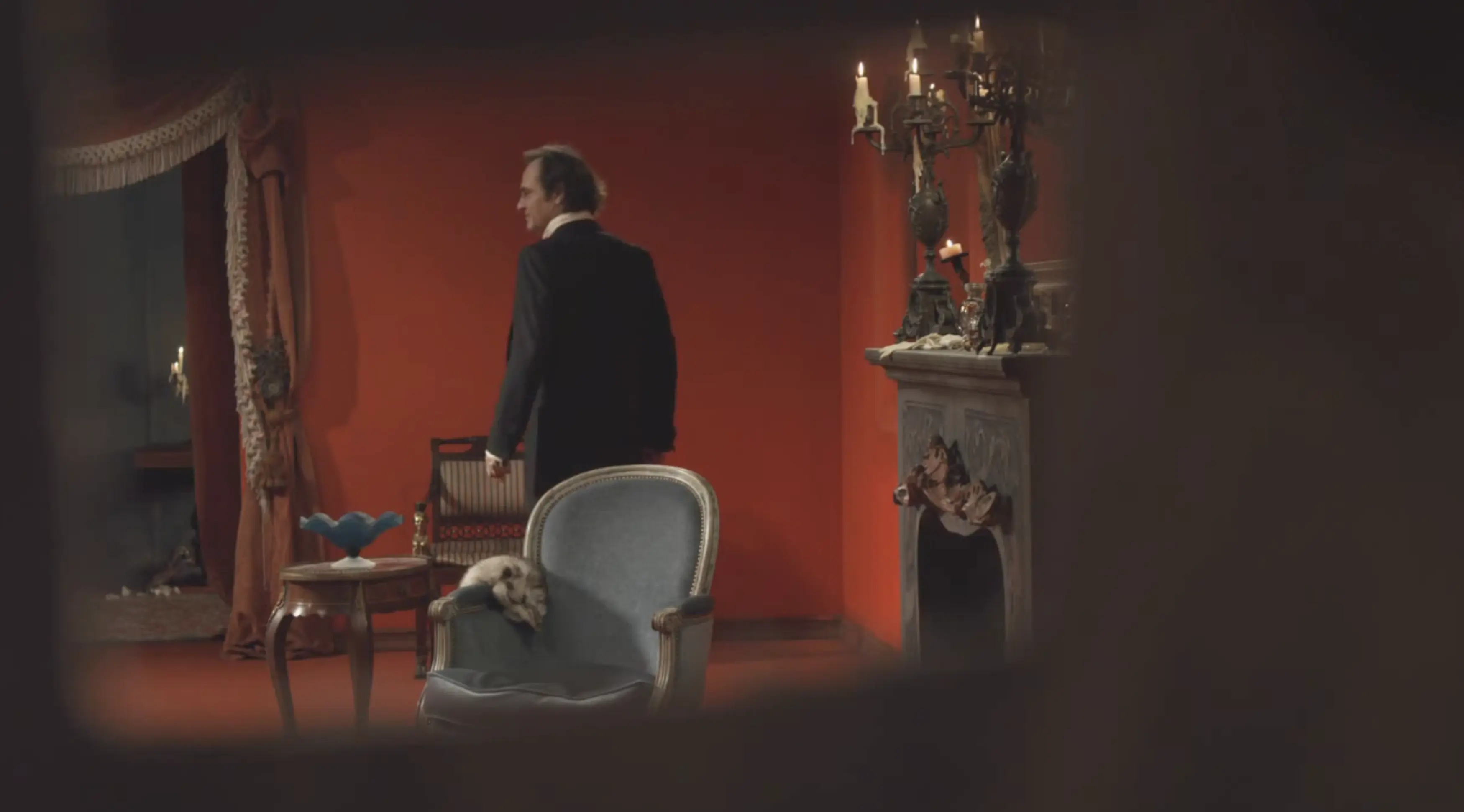
A Vingança de Uma Mulher (Rita Azevedo Gomes, 2012)
With this sequence, Azevedo Gomes channels something comparable to the assault of images identified by Stanley Cavell in Max Ophüls’s Letter from an Unknown Woman. Attempting to hold off the recurrence of memories of the woman he neglected, here constituted by repetitions of scenes from earlier in the film, Stefan dramatically covers his eyes with both his hands. Through such a gesture, he is simultaneously ‘warding off his seeing something and warding off at the same time his being seen by something, which is to say, his own existence being known, being seen by the woman of the letter, by the mute director and his (her?) camera — say, seen by the power of art — and seen by us’. [1] The man’s self-recognition in the other is thus complicated, made unbearable by extending Lisa’s subjectivity to encompass the film’s entire point of view. Understood in this manner, Letter from an Unknown Woman functions as an important precursor to the possibility of female voyeurism discovered in A Vingança de Uma Mulher, literalized by the peephole shot. Without Roberto even being aware of it, the Duchess is about to recast him as a helpless recipient of her story, the camera hijacked for her purposes.
Ten years later, Alfred Hitchcock’s Vertigo will accomplish a similar takeover. Though Scottie is ostensibly the film’s central character, his failure to maintain an investigative distance forces him into a far more volatile and compromised condition. In his case, the assault of images is triggered by Judy’s necklace and its resemblance to the one depicted in Carlotta’s painting, a visual similarity accentuated through a match cut to a previous shot from the film. The pain caused by this discovery derives from Scottie’s realization that he is not the first man to mold Judy into ‘Madeleine’. He has already been beaten to his own desires. As Tania Modleski notes, ‘Just when Scottie had thought himself to be most in control of the woman, to have achieved the “freedom” and “power” that he has been longing for and that the film associates with masculinity, he discovers that he is caught up in repetition […]. Scottie must now confront the fact that, like a woman, he was manipulated and used by Gavin Elster, that his plot too had been scripted for him.’ [2] In a radical reorientation, Scottie is made out to be as much the ‘woman’ of this story as Judy is. Her letter, which enables the film’s first explicit shift away from Scottie’s point of view, is ripped up as soon as it’s done being written. Hitchcock doesn’t need it to fuse the film’s perspective with that of the feminine social role, breaking from the template set by Ophüls.
So, when Scottie coerces Judy to relive every step of her staged death, he is in fact actualizing the collapse of his personhood into hers. Despite overcoming his vertigo, he loses a more fundamental component of his self by watching Judy die, ‘for if woman, who is posited as she whom man must know and possess in order to guarantee his truth and his identity, does not exist, then in some important sense he does not exist either, but rather is faced with the possibility of his own nothingness’. [3] In this way, Vertigo, at least in Modleski’s reading, answers a key question Cavell asked in regard to Letter from an Unknown Woman: why does this assault of returning images become death-dealing? Because the prioritization of a woman’s subjective domain, whether embedded in the narrative framing or imposed upon an emasculated protagonist, entails a rejection of the world as is, which offers only a closed loop instead of a second chance, the retracing of foregone decisions rather than the negotiating of an earned reconciliation. Reconciliation, after all, cannot be possible if a woman’s subjective agency is contingent upon her physical absence, an absence that only promises the mutual destruction of both women and men.
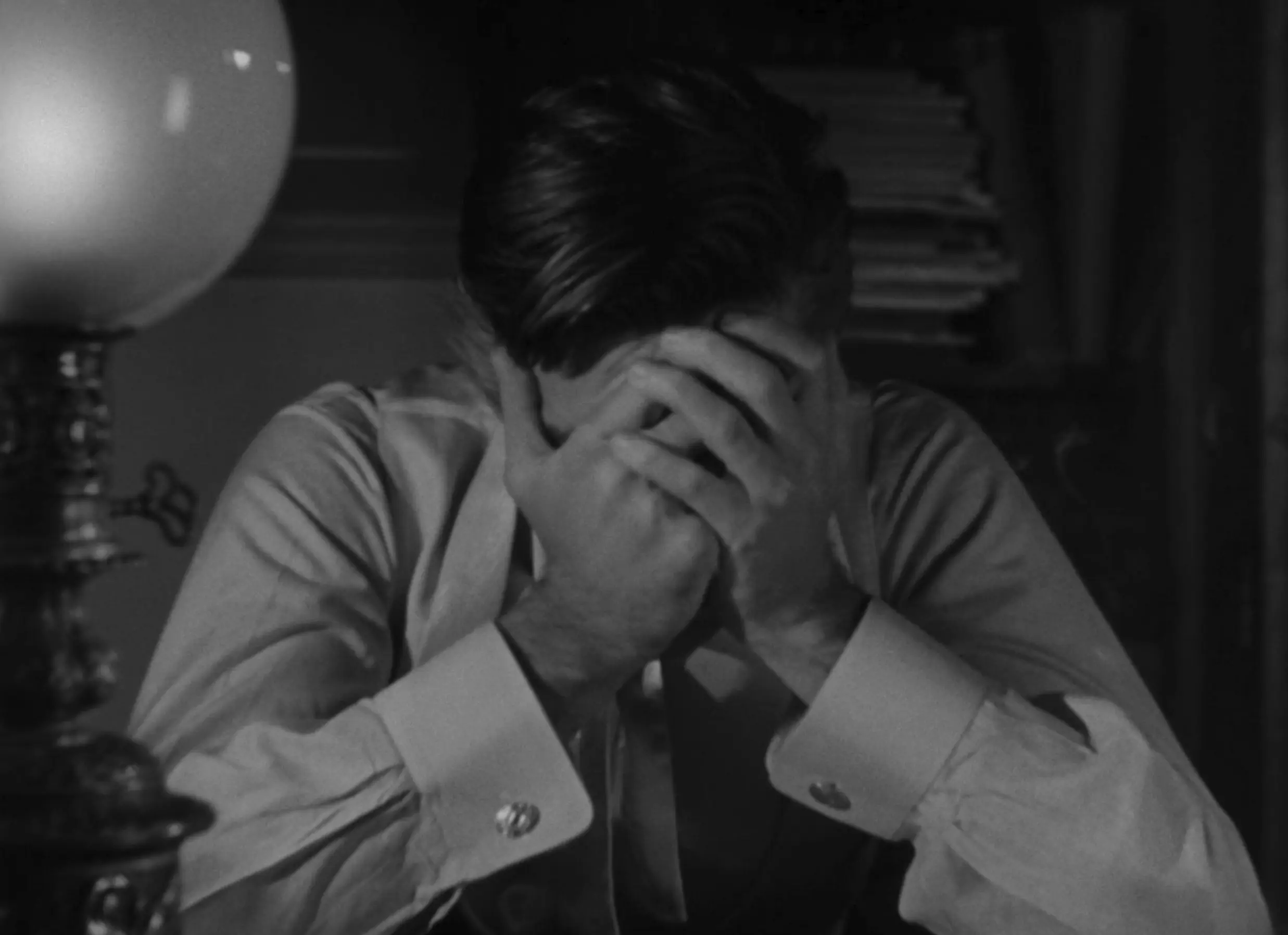
Letter from an Unknown Woman (Max Ophüls, 1948)
In the case of A Vingança de Uma Mulher, this failure of reconciliation becomes all-consuming, replacing the lingering love found in Lisa’s letter with the Duchess’s venomous oral storytelling, a medium more suitable for the contagion of salacious rumors than the private intimacy of delayed confessions. More importantly, the assault of images has been displaced entirely, stemming not from the close-up of a man’s face but from that of a woman’s. So while it is indeed true that ‘the idea of multiple layers, visible to the spectator, is central to Azevedo Gomes’s oeuvre’, in this case these forms of mediation are still directly tethered to the whims of the Duchess and the tale she wants to tell. [4] Almost immediately after the Duchess is struck by that out-of-focus image from her past, Azevedo Gomes moves her camera toward a mirror and uses it to stage the Duchess in the foreground and Roberto in the background, severing them and dividing them into two distinct realms. The Duchess’s rejection of the world is thus made manifest through the mise en scène, rendering concrete her command that Roberto must abandon his talents as a conversationalist and simply look. When he tries to share his sympathy, she dismisses it outright, leading to another abrupt cut to her hand crushing a bug on a rose. She has reached the stage where all reconciliation is doomed from the very start, a deep-rooted cynicism shaped by years of torment. Even without the violence of montage, she is able to magically open up new spaces within a closed set, new rooms that appear and disappear with the simple brightening and dimming of studio lights. As limited as it may be, this one set is completely her dominion, embodying a relative sovereignty exercised through the fluidity of spatial montage as opposed to one defined by the rupture of cuts. Fittingly, these conjured spaces are physically inaccessible to Roberto. It is here that her memory is gradually allowed to come into focus, unveiling an image of her bloodied and heartbroken, stunned before the ripped-out heart that once beat for her. Like Roberto, the audience is compelled to continue looking until the picture is clear and her story is complete.
Yet Roberto remains convinced that he has to reason with the Duchess and show her how self-destructive her efforts are, as though the outside world of sense was not the same one that murdered her beloved. In a final confrontation, they each shuffle between foreground and background, never quite able to find a fixed point of agreement. By the time the Duchess herself is out of focus, the discussion comes to a definitive end. No concessions are made, little gold is exchanged. Only by leaving this self-imposed prison does Roberto finally get a close-up. His tear-streaked expression indicates how, as Adrian Martin aptly describes, ‘the time it takes for someone to “process” a story narrated especially to them is also the event that transforms them forever, perhaps tragically so’. [5] The cost of rectifying boredom is ultimately cataclysmic and paralyzing because he is incapable of imagining what freedom and happiness for the Duchess would actually look like. His capacity to create images has been denied and overwhelmed by the images imposed by the Duchess. Although the film concludes with a privileged, detached view of the set, demystifying the verisimilitude of everything the spectator has seen, it doesn’t change the fact that the Duchess has merely moved from one prison to another, that of her coffin. There is perhaps some power to be found in the Duchess’s reversal of the usual formula. Roberto is disempowered by an oversaturation of knowledge about her, rather than by her mysteriousness. Unfortunately, being known is not the same thing as being liberated.
Where does this leave Elaine and her newfound desire for certainty? Paralleling the ending of Vertigo, she retraces the steps of Keefe’s deceased wife Andrea, whom she performs as in Chris’s sleazy biopic. Unlike Andrea, however, Elaine doesn’t make the same mistake of taking Chris at face value. ‘You don’t do things, you stage them’, she says to him. As she hesitantly plays along with his routine, another man rushes to ‘save’ her and place her in a role of his own. She is clamped from both sides and given no real option for herself. In Cohen’s cinema, ‘there is no “correct” position offered within the action in relation to its conflicts, the resolution in every case leaving a sense of dissatisfaction, uncertainty, or loss […]. There is never a suggestion that things can be put right, solutions be found, within the system; the conflicts are presented as fundamental and unresolvable, short of a total rethinking’. [6] It’s no coincidence that both Chris and Keefe wield film equipment as weapons, one a projector and the other a camera. Whether displaying a film or recording one, these tools work at the expense of women, serving either to pressure them into motherhood or to have their image unknowingly exploited. Consequently, by killing Chris, Keefe ‘learns to recognize his identity with the figure he is committed to destroying’. [7] Rather than vanquishing the return of the repressed, he is simply eliminating his competition.
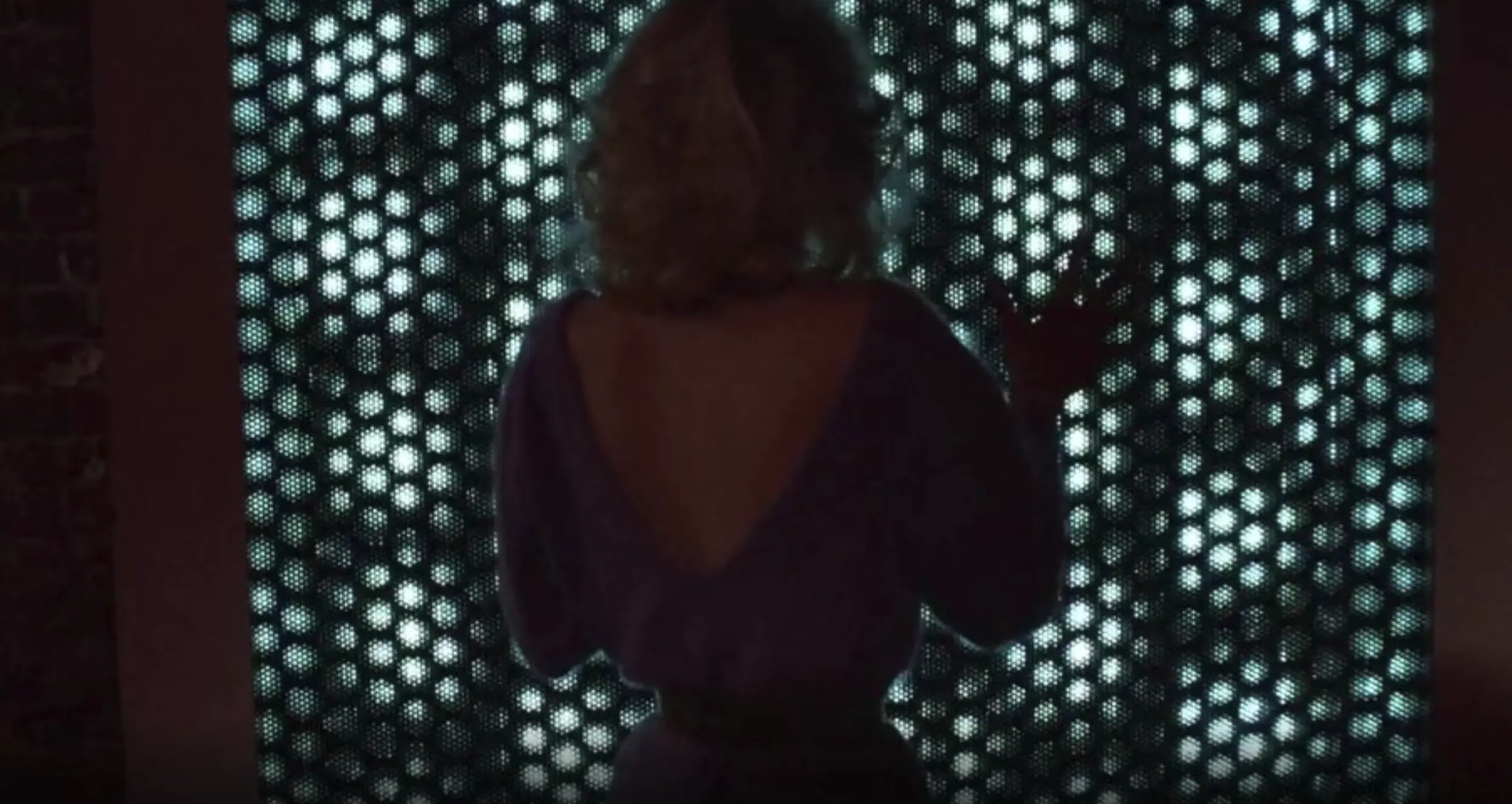
Special Effects (Larry Cohen, 1984)
Skipping any celebratory reunion between Elaine and Keefe, the film jitters ahead to its rushed conclusion. Elaine almost seems to grind her teeth with the words she speaks, a smile never able to fully develop across her face. The fractures of editing once again prevent her from giving a verbal answer that is sincerely her own. There is no assault of images to complement her final close-up because her expression already communicates everything. The blankness is never broken, the fear never shaken. She failed to take the way out before her role became a socially-mandated career. One can guess that there is an assault of images playing in her head, transmitted not from the past but the future, one that the Duchess already lived through. Elaine therefore occupies a position similar to that of the Duchess when her lover was executed. In both instances, the chance of a life outside the institution of the family is foreclosed. The difference, then, is that Elaine has yet to reach the juncture of revenge, even though her expression betrays an understanding of what lies ahead for her. Stuck in this purgatory, she is essentially denied her physical presence by performing the role of another woman, while still being unable to materialize an assault of images that is visible to the spectator. Whatever minimal power the Duchess holds in her storytelling is not to be found here.
The abyss that materializes at the end of both Letter from an Unknown Woman and Vertigo is thus provided a contour by Special Effects and A Vingança de Uma Mulher. The delusions of men, which instigate mutual destruction in the former pair of films, gives way in the latter pair to its political underbelly, a social regime that denies the same flexibility and freedom to women, necessitated by the structure of the family. Through this literal peek behind the curtain, this newfound clarity regarding the source of such catastrophic ills between women and men, the path toward an actual cure becomes ever so slightly more apparent. As the light pours in during the final shot of A Vingança de Uma Mulher, the Duchess’s prison is shown to be held up merely by wooden planks and beams, manmade constructions that need not be inevitable. The missing final step, the rupturing of this world entirely, is recognized but not yet taken.
Notes
Stanley Cavell, Contesting Tears: The Hollywood Melodrama of the Unknown Woman (The University of Chicago Press, 1996), p. 111.
Tania Modleski, The Women Who Knew Too Much: Hitchcock and Feminist Theory (Routledge, 2016), p. 99.
Ibid., p. 92.
Adrian Martin and Cristina Álvarez López, ‘Letters from an Unknown Woman: Rita Azevedo Gomes’, Film Critic: Adrian Martin, August 2020, <https://www.adrianmartinfilmcritic.com/essays/azvedo_gomes.html>.
Ibid.
Robin Wood, ‘World of Gods and Monsters: The Films of Larry Cohen,’ in Robin Wood on the Horror Film: Collected Essays and Reviews, ed. by Barry Keith Grant (Wayne State University Press, 2018), 141–160 (p. 145).
Ibid, p. 146.