From this series of so-called ‘damned’ Portuguese cinema, [1] there is perhaps no film as bizarre and as heteroclite as O Som da Terra a Tremer, the first feature film from Rita Azevedo Gomes, who would not return to cinematographic fiction for another eleven years with Frágil Como o Mundo.
1990 was — as some other publications and historical musings have noted — a rather surprising year. It was the year that saw the release of Pedro Costa’s debut O Sangue, the release of Teresa Villaverde’s debut Alex, and the beginning of Eduardo and Ann Guedes’ singular wanderings (Na Pele do Urso). It was the year that saw the debut of the (television) films of Manuel Mozos (Um Passo, Outro Passo e Depois…) and Luís Alvarães (Malvadez). It was the year that saw the arrival of João Canijo’s second opus (Filha da Mãe), José Fonseca e Costa’s most disparate work (Os Cornos de Cronos), António de Macedo’s esoteric singularity (A Maldição de Marialva), and, in a completely different register, Manoel de Oliveira’s Non ou a Vã Glória de Mandar.
The reception of Oliveira’s film proved divisive, but it was, among his body of work, one of the most widely seen in Portugal. Pedro Costa and Teresa Villaverde were critically lauded. Some spoke — grouping in Manuel Mozos and Luís Alvarães, too — of the emergence of a new generation. Yet the commercial failure of almost all these works, along with the growing campaign against Portuguese ‘auteurism’, led Pedro Santana Lopes, the Secretary of State for Culture under President Cavaco Silva, to make significant policy changes to what was then called the IPC (Portuguese Cinema Institute). A National Secretariat for the Audiovisual was established, the path emerged to subsume cinema into the realm of the ‘audiovisual’, and a growing chorus of voices called for a ‘cinema for the public’. In 1991, Luís Salgado de Matos left the IPC, already on its way to becoming Zita Seabra’s Portuguese Institute of Cinematographic and Audiovisual Art.
When the Cinemateca held a preview of O Som da Terra a Tremer (and ‘preview’ is a manner of speaking, as the film never had a formal premiere), there was no dearth of sentiment that it arrived at the worst possible time. It was the type of cinema the new establishment wanted to do away with, a work which was extremely unlikely — it was said — to reach any kind of public. Reach a public it did, as the film was selected for several European festivals that still had the power to swim against the current. Yet, in Portugal, the response to the film was one of almost complete silence, and the few who did speak of it, spoke ill.
It’s no wonder. Rita Azevedo Gomes, older than the youths of her cohort, did not even have generational camaraderie in her favor. Relatively established as a costume designer and set decorator, she was neither a young up-and-comer nor a student. Only with a healthy dose of imagination could you maybe find her in a lineage with Pedro Costa or Teresa Villaverde, with Manuel Mozos or with Luís Alvarães. She did not fit into any of the existing models of Portuguese cinema, even its most nonconformist. In every sense of the word, she was marginal.
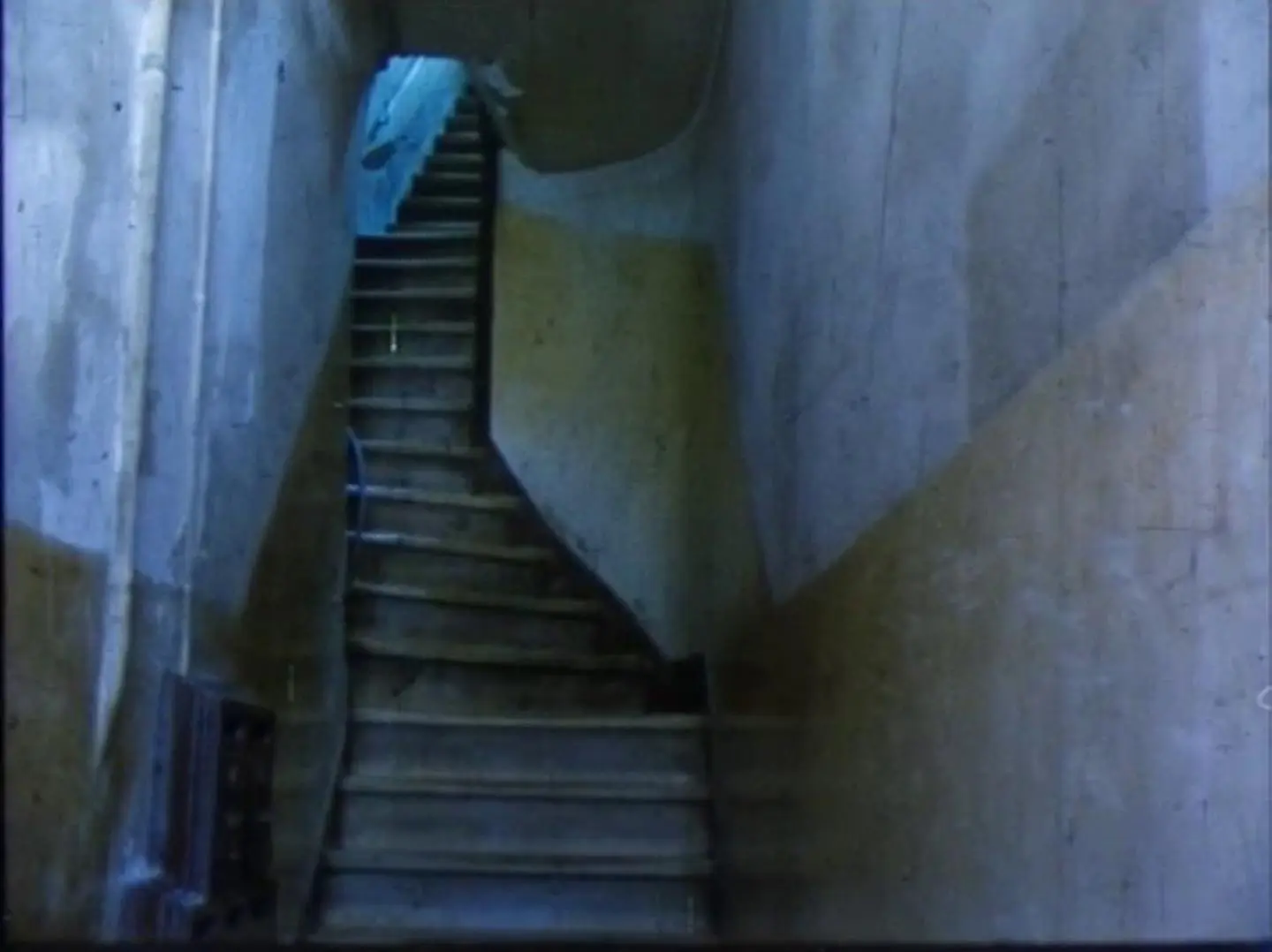
O Som da Terra a Tremer (Rita Azevedo Gomes, 1990)
Her film was neither a political film, nor a film about the frustrations and hopes of nineties’ youth. While it is true that O Som da Terra a Tremer contains a love story, that story is a fiction within another fiction, and it remains unrealized and elliptical, falling between reverie and a ‘no man’s land’ at its most abysmal. Does that meeting on the ghost train really happen, or is it a rhetorical device, a delirium conjured up by a writer who doesn’t write, in a bout of schizophrenic autism? That afternoon by the water in Guincho — when the two do not speak and Luciano (if Luciano is the sailor’s name) gives the unnamed girl the book with a crow on its cover with the love letter she will never read nestled inside — did it really happen? Was there really an encounter between them, or was it an encounter more akin to the one the professor attempts to establish with the girl as he tells her about his experience gazing at Van Eyck’s Madonna of Autun beside another young woman?
And what does this story have to do with the story of Alberto, the writer, and his strange circle of friends, all out of phase with any reality, all spectral and phantasmal?
Those who carefully review the technical sheet will find a partial answer to this discrepancy. The story of the swamps and the salt flats from the writer in permanent denial of creation comes from Gide’s Paludes. The story of the writer’s journey, which ultimately leads him to a shoddy inn in which he intends to spend only a few hours and ends up spending eternity (a journey to his own death), comes from Hawthorne’s Wakefield, that tale that so obsessed Borges about ‘the Outcast of the Universe’. The story of the letter that never reaches its recipient is a recurring theme in the literature of romance and lost love.
There are more reminiscences to be found: the dream of the stork (Freud’s Leonardo da Vinci and A Memory of His Childhood); the conversation at the aquarium and the theme of prehistoric animals; the transposition between the wandering Cipriano and the so-called Luciano, who are muddled only in the writer’s imagination.
But Rita Azevedo Gomes is never concerned about the eventual articulation of these diverse sources of inspiration. The film begins off track (with Palolo’s beautiful opening credits) and off track it continues and ends. There is not, even in the most conventional sense, a script, much like there was not in the cinema with which Rita Azevedo Gomes is closest to being heir and which dates back to Schroeter, to Carmelo Bene, and a bit of Daniel Schmid, that whole poetic vanguard of the seventies, which opened the door, ephemerally, to the free passage to the most outrageous imaginary, without looking in it for cohesion or consistency. Is cinema a narrative art? Is cinema a poetic art? Is cinema an allusive art? Is cinema the art of recitation?
The great fascination of this heteroclite and decentralized film resides, for me, in the plain assumption that none of these questions has an unequivocal answer. Nothing in this work is a symbol or an allegory, but nothing is ‘automatic writing’ either, or a solipsism identical to that of its characters. From the unicorns and the androgynous figures of the credits to the final encounter between its two fictionists (the writer and the professor), the film constructs itself as a fiction of its own fiction, as if all were creations of the other, united only by this fictional dimension. Returning to Hawthorne. He wrote: ‘Amid the seeming confusion of our mysterious world, individuals are so nicely adjusted to a system, and systems to one another, and to a whole, that, by stepping aside for a moment, a man exposes himself to a fearful risk of losing his place forever.’
This is the risk the film took on, trusting only in beauty as the unifying bond of such a deserted and desperate universe.
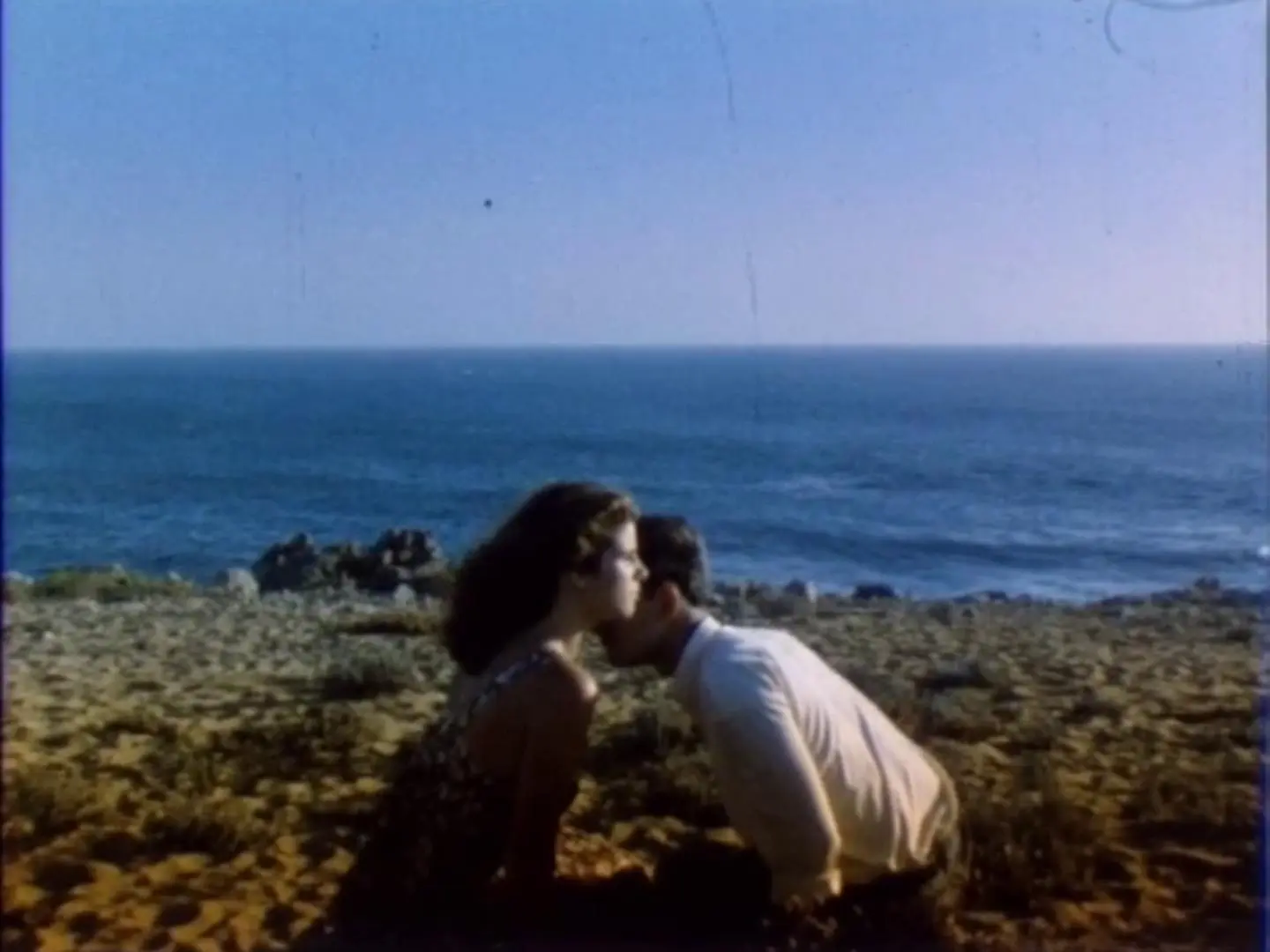
That beauty — erratic and convulsive, stabbing and magnetic — is the only answer in this unique work. It is that beauty which unites the maniacal precision of objects and the writers’ commitment to the supreme lyricism of the walks through the tunnels, that ocean blue of ‘Remember Me’ in Purcell’s Dido and Aeneas.
Can this beauty be anything other than the ‘outcast of the universe’? The answer might lie in the horse that passes through the shot of the sailor and the girl against the sea. Or in the reinvention of the shot/reverse-shot in the train sequence. Or in the golden toenails of the woman’s feet at the Cais do Sodré.
This is as much a film about a man who lived in a swamp which he was happy to never leave, as it is about a sailor who idled at sea and never saw anything in the water but a foaming surface.
‘Let’s hope God will not measure Man’s efforts by the poor results he obtains.’ This phrase, appearing as a refrain throughout the film, acts as its epigraph and colors it with secret and inextinguishable emotion.
From the salt flats to the birds in flight, from the comings to the goings, what remains is that poetry which blinds, like we see in the slide projection at Isabel’s house. The finger of God is commencing to commence a story that, being our story, is no more erratic than this one. And beneath our steps — steps in vain and steps in circles — the sound of the shaking earth.
There is no title more befitting such a display of raw wounds. When the earth shakes, who can face it without shaking too?
Originally published as program notes for ‘Os Malditos de Cinema Português’, June 2004.
Republished
as program notes for ‘José Mário Branco – A Morte Nunca Existiu’, April 2022.
Notes
Translator’s note: The film was screened as part of the retrospective ‘Ciclos Os Malditos’ (literally ‘Cycles of the Damned’).