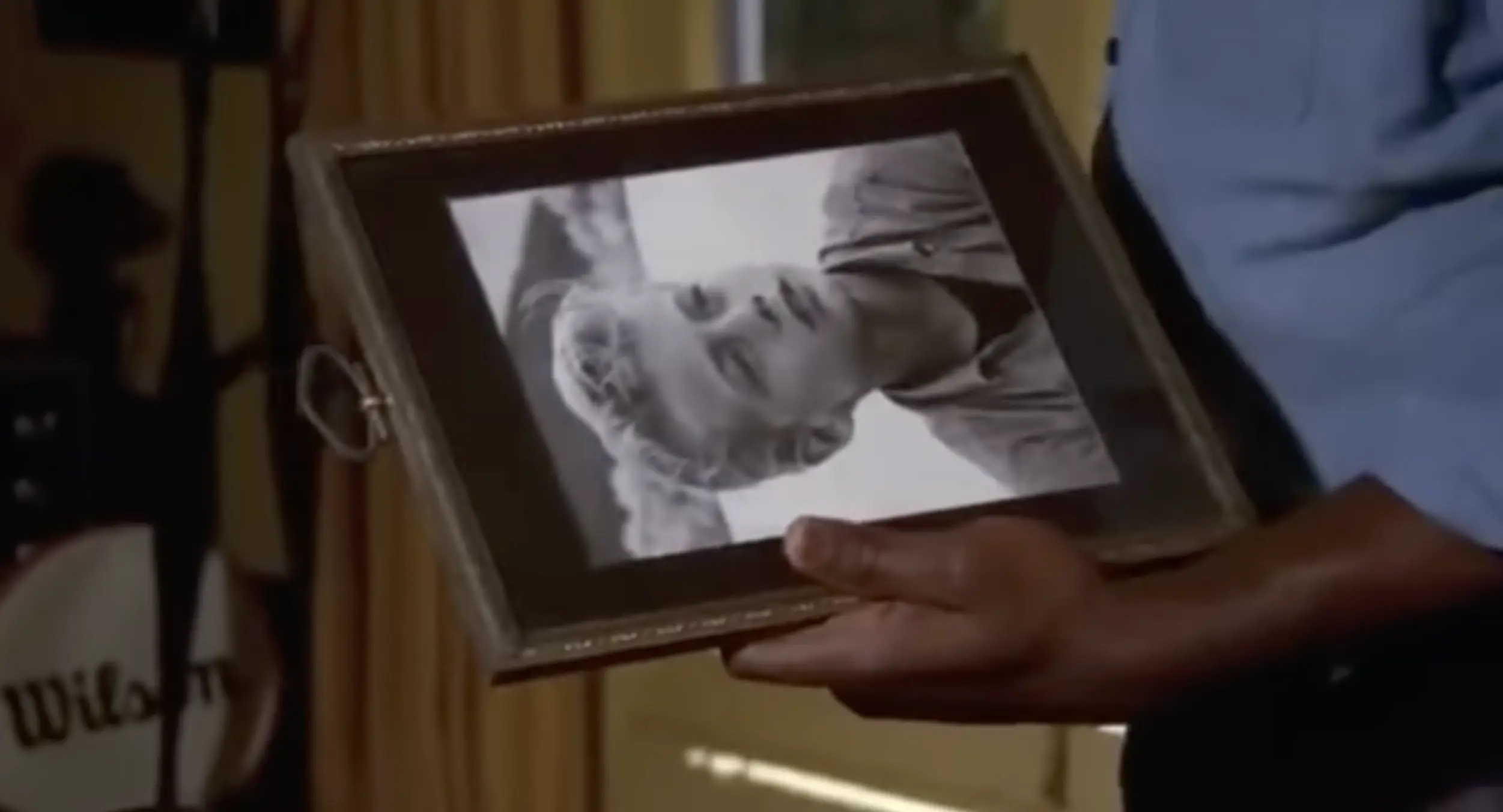
Bone (Larry Cohen, 1972)
Larry Cohen’s families are like those of Attic tragedy — defined by their treacheries, infidelities, and trespasses. Where Sophocles would ascribe these malfortunes to the gods, Cohen identifies another conspirator, the patriarch. Such is the case in the first and last films Cohen made as writer–director–producer, Bone: A Bad Day in Beverly Hills and As Good as Dead. Both are smaller, more intimate affairs.
Bone was Cohen’s directorial debut, for which he was able to use his own mansion as the backdrop to a domestic tragedy. Bill (Andrew Duggan) and Bernadette (Joyce Van Patten) have a big house. A stranger, (Yaphet Kotto, the titular Bone), appears, and asks about a framed photograph of a nice-looking, clean-cut blonde boy: the owner’s son, whose absence is explained across a series of cuts that divide the family unit — the parents in Los Angeles, the child in a cell somewhere far away. Cohen’s form in this sequence demands that the son’s presence is fleeting, that he is more of a specter than a man. This effect is achieved across three vignettes, each lasting less than a second, showing the son’s present situation contrasted against his parent’s explanations of where he is. A single light bulb illuminates the imprisoned son, his posture modeled after the Boxer at Rest of Greek antiquity: head turned up, arms in repose on his legs. His dramatic turn towards the light might suggest salvation. Bernadette explains, ‘He’s in Vietnam now.’ The second view, this time from above the light. Now, the son’s defeated face, his uncut blonde hair, and a torn baby blue shirt. Bill continues, ‘He’s a lieutenant.’ A final look, the son distressed, lying on a mat on a straw floor. ‘Flies a chopper.’ The stranger doesn’t care about their son; he moves on. The parents seem either unaware of the son’s current incarceration or deeply embarrassed about it. Our view of the situation differs, only because Cohen’s camera is there to guide us. Cohen insists on the reality that his characters turn away from.
Later on, Bill leaves the house to go to the bank, after the stranger demands money in exchange for his wife’s life. Where does he end up instead? With a young woman. Bill takes the opportunity to regale her with his ideas about life: ‘Thank god that after you’ve lost your virginity and had your kids, that phase is over and you can go on to the business of making money.’ Since the world of Bone is heightened, the caricatures that inhabit it can say things like this with complete sincerity. Bill’s obsession with wealth is not a shortcoming in his role as patriarch in the family unit, but a necessary feature of it. Yet Cohen does not portray Bill as remotely sympathetic or successful in any sphere, economic or domestic. He is flailing about in his business ventures, in his marriage, and, most importantly, in his obligations to his son. At home, Bernadette confesses to the stranger, ‘I lied about Kenneth [...]. He’s in jail, in Spain, for trying to smuggle hash back from Tangier [...]. He wrote to us for help, and we told everybody he was flying a helicopter in Vietnam.’ Cohen takes the neglect of the parents and cuts to a wall in the concrete prison which separates the parents from their child and about which the parents lie to their friends. What sort of reconciliation can come from this? When the film comes to a climax, Bernadette kills Bill on a beach, beating him with her purse. Every other strike is intercut with a shot of her son in prison. After she kills Bill, Bernadette pleads her innocence, blaming the murder on Bone, a Black man. She cries, begs, and justifies herself however she can — the lies and contradictions build, until Cohen cuts to the son breaking the light bulb in his cell. There is no point anymore in Cohen illuminating the son, because the lie of the ‘ideal’ American family has been exposed.
* * *
Cohen had a career full of mobsters, mutant babies, teenage werewolves with a connecting thread, an axis on which tragedy functions as the reconciliation or non-reconciliation of a parent and their child. Children find their parents and are presumed to want to kill them. What happens when they come face to face? Parents, just as often, try to kill their children. In Full Moon High, poor Tony (Adam Arkin) is bitten by a werewolf after his father, Colonel William P. Walker (Ed McMahon), kicks him out of their hotel room in Romania to ‘infiltrate’ (as he puts it) a few women supposedly of importance to the communist government. When he later discovers his son halfway through transformation, he attempts to kill him, but in the process kills himself. Here is a father who would rather die than accept his child. This is reflective of the tragic origins of the monogamous family unit. From Agamemnon to Oedipus, the family contains the seed of its own destruction.
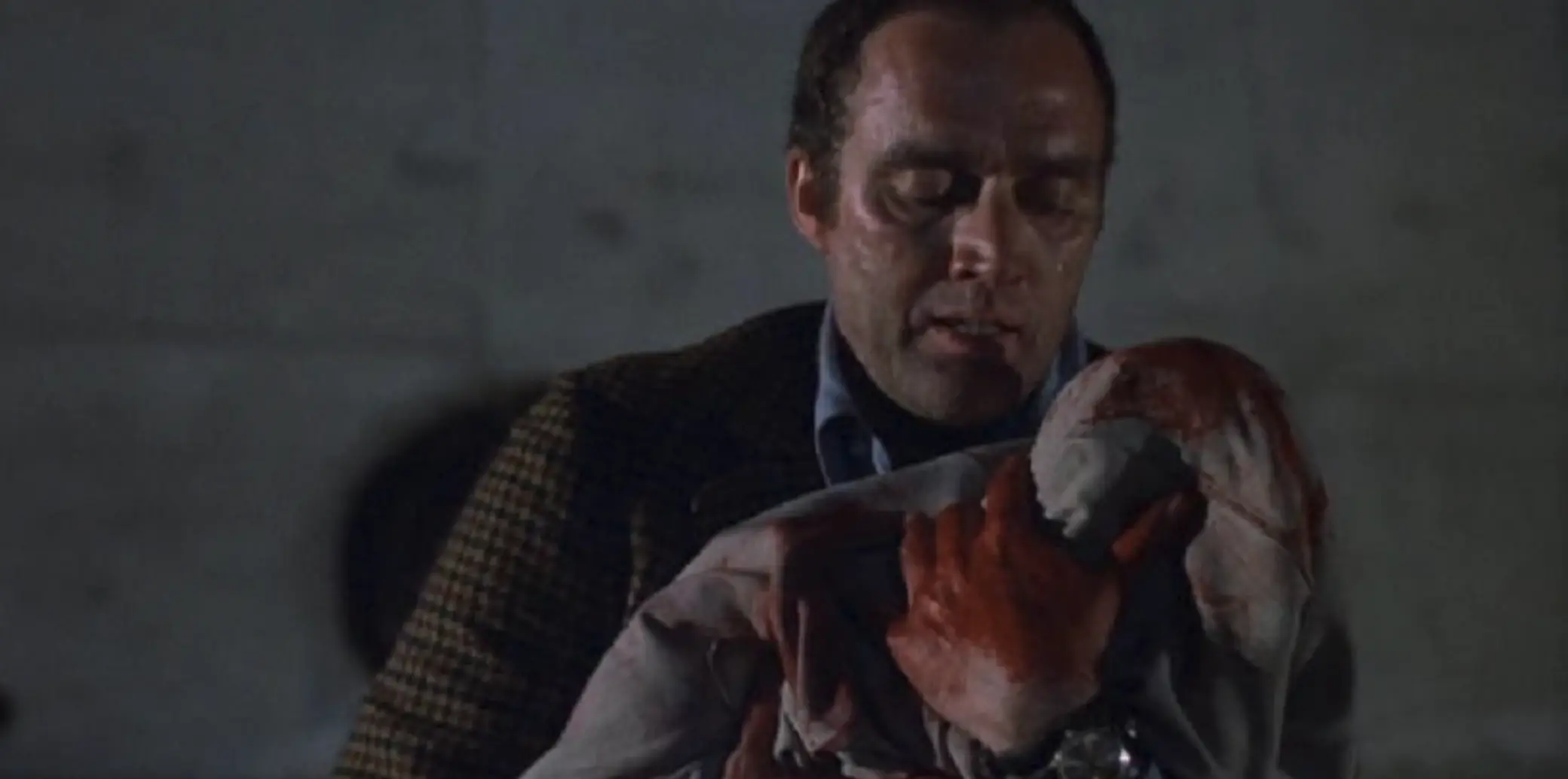
It's Alive (Larry Cohen, 1974)
* * *
As Good as Dead is a USA Network television film, one almost completely neglected even by Cohen enthusiasts. In the early minutes of the film, Susan (Crystal Bernard) and Nicole (Traci Lords) meet in line for a club and ‘party’ the night away talking. Two important facts about Susan are established in this scene and the next: her mother is recently dead, and her father left them both when she was an infant. As the two are bonding, Nicole picks up a framed picture in Susan’s room of her dead mother and absentee father. Cohen emphasizes the father with a cut to a push-in of his face in the photograph. Nicole is a party girl, Susan is a caretaker — their dynamic is summarized when the latter cautions the former against drinking and the party girl replies, ‘I’m not your mother, you don’t have to take care of me.’ When Nicole is in medical distress because of an ulcer and finds the American healthcare system impossible to navigate as an uninsured person, Susan volunteers her own identity so that Nicole can get the treatment she needs. No one will know. When Nicole dies on the operating table, ‘Susan’ dies. The rest of the film is told from the perspective of the ghost of ‘Susan’, the real Susan, alive but without a legal identity. Susan’s job, home, belongings, car, and her only friend in Los Angeles are all lost. She must navigate her death and find her way back to the world, and does this by taking on the identity of Nicole.
As Susan investigates ‘her’ death, she finds that the man who had not seen or thought of her for several decades has come to sue the hospital for her death. The father, true to his origin, is absent until matters of inheritance are concerned. She first begins to search for her half-brother, Aaron, who brought the suit against the hospital and whom she has never met. She goes to a room in a hotel expecting to see him. Cohen doesn’t shoot the scene from behind her, straight on, but rather approaches the entrance to the room on the diagonal, so that Susan faces left, dividing the frame. She stands almost precisely at the frame of the doorway from this angle, the wall which partitions behind her, the door before her. Her face is still visible to us, and we can see her hand recoil from the door as she knocks and bites her lip nervously when a man responds from behind the barrier: ‘Who is it?’ An opening. A new shot. The back of a bald head clears the frame as the door opens to reveal Susan’s face, searching in the face of the stranger. Cohen returns to the first shot, but with his camera shifted slightly so that we can no longer see the wall. Now standing in the doorway, the old man, looking around nervously, dominates the frame. He looks at Susan. ‘You sure you got the right room?’ We can’t see Susan’s face anymore, until Cohen returns to the same over-the-shoulder shot as before. What’s changed? He’s leaning towards her. She looks like she’s seen a ghost. Cohen cuts to her father in a framed photo, standing next to her mother, then to the old man alone, his torso outstretched in a void between his room and her world, closer than ever before. Until Cohen again cuts. The face dominates half the frame — that face suspended in a photograph, the model of the man who smiles nervously and abandons his child. Cohen now cuts to a new view, a close-up of Susan’s face, still over his shoulder. Instantly, she knows who this is. She replies, ‘I was looking for a Mr. Warfield.’ Cohen cuts back to the medium shot of him. He leans back. He doesn’t know who she is. The man just buried a daughter he didn’t know. He didn’t recognize her either.
Susan has expected the man in the photograph only ever to be an image she could despise — and now he is material, standing before her as a man, quietly reeling from an absence that is now more profound for its permanence. She talks with him about ‘her’ death in the hotel room, posing as Nicole. Behind the pleasantries of strangers, the father and his daughter negotiate his betrayal of she whom he does not know; across thirty shots and 163 seconds decades are summarized, flags are planted. Cohen excavates every corner of the encounter: a total visual map of their conversation is found in the mise en scène. He sticks mostly to static shots, only moving his camera when his actors move — seven times over the course of the scene. No composition is repeated twice once the threshold of movement has been crossed. At the end of their conversation, he asks ‘Nicole’ if Susan had ever mentioned him. He stands in a medium shot, almost similar to his original position in the room, but now farther away — his arms are no longer on his hips but at his side. His neck is turned down, but he is looking straight at her. He is almost entirely consumed by a faint shadow, except for parts of his torso, clad in a baby blue shirt which bounces back light in its gestures and folds. In the beginning, only his face was in the shadow. How much time has passed? ‘I’d seen her last as a baby. And then I saw her dead.’
This is not the same patriarch Cohen introduced in Bone. Over the last twenty years, a softening had been occurring. Grief had been allowed room to develop where reconciliation was not possible. Cohen was always practical, especially when dealing with supernatural forces. If there are mutant babies, they can be traced to a pharmaceutical company; when there is a spree of mass killers crediting ‘god’, detective Peter J. Nicholas knows better: there is no ‘idea’ in Cohen’s cinema which transcends the material reality of the film. He films things plainly. This is why, when in the last minutes of his last film Cohen reconciles an absent father and his dead daughter, it appears completely natural — the kind of miracle that occurs in the world and isn’t noticed. When her half-brother plots to kill their father at a seaside cemetery, Susan intervenes with a rock. Aaron does not know who she is, and imagines he’s in love with her. She plays romance to bide time. A diagonal marks itself in the frame, pronounced in the void between their faces, descending from left to right, as he towers above her. Susan breaks the shot, moving in the same diagonal direction towards the ground, saying she loves flowers, noting some near a grave. Cohen films the flowers, panning in the same diagonal movement, to identify several stones beneath them. In a new shot, Nicole dominates half the frame, contrasted against the ground, as she reaches for the largest rock. A drumbeat. She forms a triangle shape, remaining anchored to the ground at two points while rising up. In the next shot she is small, reduced to one element in an uneven frame, so that Aaron stands over her like a pillar. She swings her fist hard, stone in hand, and throws it down so it crosses the bottom of the frame in the same diagonal. Cohen immediately cuts to Aaron falling in the same way, ending up bent over, head and feet on the ground as his hips remain elevated. But the director’s camera does not follow that trajectory; it instead rises and pans to the left and follows Susan running towards her father. He looks towards her, as frightened as he is confused when she warns him that Aaron has come to kill him, she whom he still presumes to be a stranger, except she lets it slip, ‘He’s going to kill you like he killed Nicole.’
‘Who are you?
‘Don’t you know who I am? I’m Susan.’
It is not a shock to her father, to whom this was a complete surprise. He can only ask as an estranged father does, ‘Why didn’t you tell me?’ as she buries her head in his shoulder. Susan is able to return to life as she is finally recognized by him. If the fate of Cohen’s families has been ‘death’, here he breaks tradition, at the very end of his career. As father and daughter embrace on a beach, Susan finds her life.
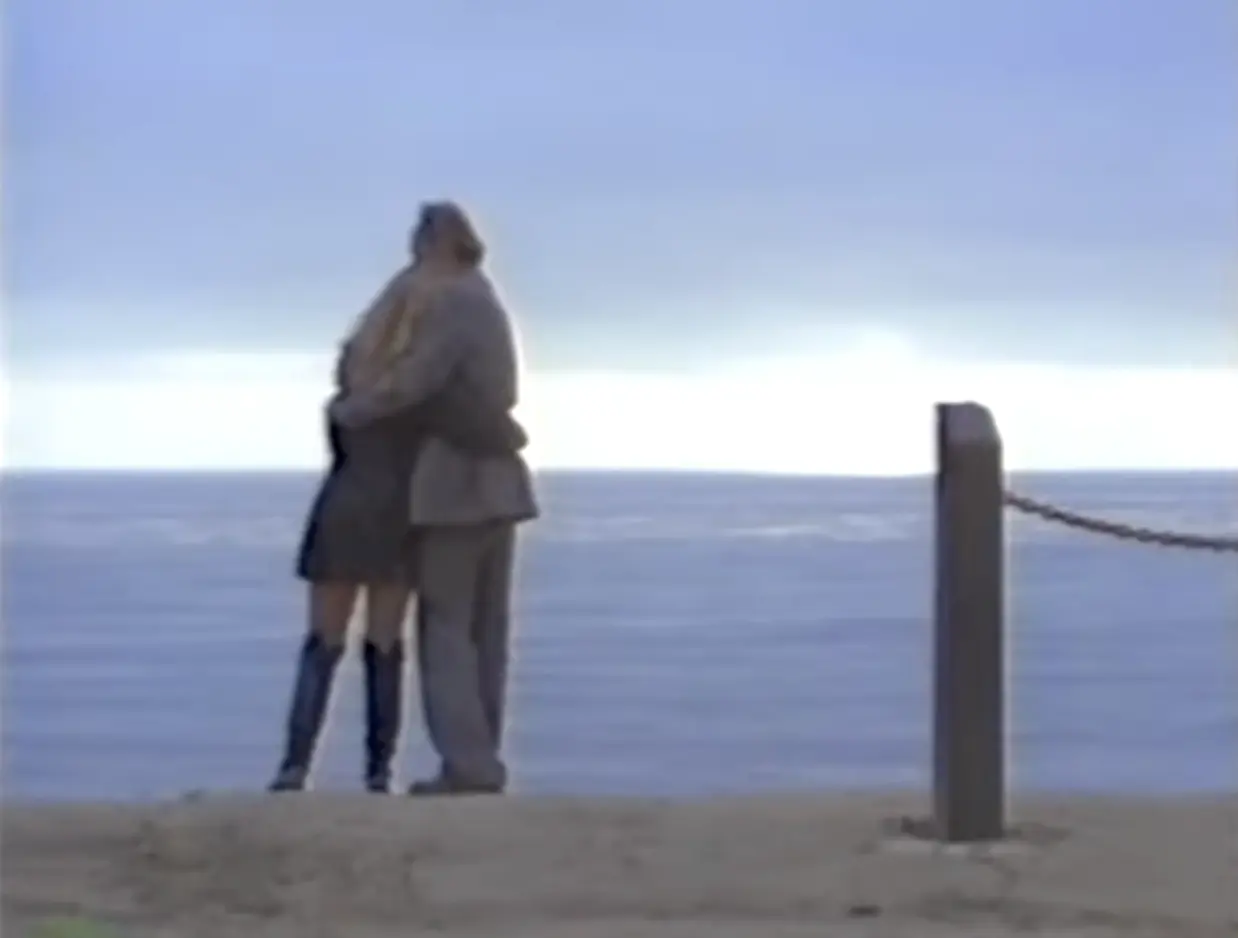
As Good as Dead (Larry Cohen, 1995)