Jack Seibert: Why did we choose to discuss The Ambulance? Why did we choose it over any other Larry Cohen movie? Why is it important to us?
Matt Hare: Well, your review on Letterboxd was important for me in the genesis of Narrow Margin. Specifically because you talked about this film I’d never seen before in terms of Daney. I can’t remember the details of your text, but it lead me to watch the film, and I remember feeling that it was incredible for all kinds of reasons, and that it showed how there’s a huge amount of great ‘genre’ — fast-made, cheap, whatever — cinema, made long after the works canonized by critics in the 1950s, with respect to which there’s real critical work to be done, outside of something like the vulgar auteurist debate. This is a great movie, but people aren’t talking about it as a great movie. It’s not a ‘film class’ film. How do you write about this film in the way that Rivette needed to write about Anthony Mann? I haven’t gotten to why it calls for that kind of reflection. But it’s just a basic fact that I see this and I see that it’s great. I see that it’s worthy of the attention that was focused on films made in the forties, the fifties, the sixties. And there’s no discourse around this movie and so many other films, except among a few random people on Letterboxd. So maybe a magazine makes sense, you know? There’re maybe five, six other films we could talk about in this way, which were in the air from the start of our discussions — Violent Saturday is another major one, or New Rose Hotel. For me, it’s mission number one for the magazine to think about what’s happening in these films, which don’t come to us couched in cinema critical discourse, but which seem to demand the construction of such a discourse. The Ambulance has been one such film for me since the beginning of this project. But ‘why?’ is a different question. Why is this film so great?
Sam Warren Miell: Something about the movie suggested by what Matt said is like what Rivette famously suggests at the beginning of his article ‘The Genius of Howard Hawks’, that the evidence is on the screen. [1] The Ambulance is great in a way that seems self-evident, which calls for a more particular understanding of why it’s so special. The point you make in your capsule, Jack, is a good place to start, when you quote Daney’s piece on The Go-Between by Joseph Losey, where he says it’s impossible or very difficult to imagine a fiction as complex as The Leopard Man or Uwasa no onna being made at that point in the early seventies. [2] What he’s talking about in that article is what he calls a ‘gearing function’; what gets stories into gear. Something had broken down in the way fiction was made and received that now made it difficult to get it going, and it was difficult to use character to spark fiction in the same way. There was a loss of that shorthand film had developed, by which a story is kicked into gear through the relationship between characters and environment. And one very special thing about The Ambulance — and a lot of Cohen’s films, but I think The Ambulance is the best example — is how it does manage to use that ‘gearing function’ to set fiction into motion and keep it moving in a way that other directors, even genre directors at that time, struggled to do. He does that without seeming like he’s making some retro or classicist move. He’s not a filmmaker who immediately strikes one as a classicist. He’s making films that are B movies in a way, but it doesn’t feel at all to me like he’s trying to make a film from the fifties. He’s making a film in 1990. And yet the relationship to fiction and its workings is in some way close to what we see in the forties and fifties. So that’s possibly a place to start.
MH: The lack of nostalgia is important. This is tied up with a kind of — I don’t like the term — ‘immediacy’ that the film has in its relationship with bodies. What really strikes me, from beginning to end, is the central figure of Eric Roberts. Think of the late sequence in the limo. There’s an ease and pleasure in the playing there, which reminds me of the films of the forties and the fifties, even the thirties. Let’s say there’s a less self-conscious relationship to playing than what one generally finds in the highly mediated, reflexive style of the eighties and nineties. The acting (or the use of acting) in The Ambulance is not engaged in a ‘postmodern’ play of representation, it’s not arch or ironic. Even with respect to situations or dialogues that are very heightened, even artificial, there’s a naturalness and ease of gesture that I associate with an earlier period of Hollywood. Yet as you say, Sam, it’s not a matter of classicism, of looking back and trying to recreate some prior virtue. That was one of the things about the film that caused me to say, ‘There’s something here.’ I hadn’t seen any Cohen when I first saw it. So then I had to work my way back, to figure out how that ‘something’ was there.
Tâm Minh Phạm: Cohen says he does not understand feedback he got at the time of the movie’s release, which is that it couldn’t make full use of its dramatic potential. That, like other pictures of his, it embarks on a strong conceptual premise that never gets to a point where it can be at full steam. [3] Since I read that, I’ve been thinking about how I can perhaps imagine a contemporary viewer raising such an objection, with a different sensibility regarding the unfolding of good and evil in the urban scape, or how the romantic plot or the buddy dynamic should be ‘satisfactorily’ developed. But, on the other hand — and this is why our conversation can be fruitful — the metaphor of putting things into gear and keeping fiction dynamized refers precisely to a maximization of potential that Cohen, in fact, achieves.
JS: It sounds like we’re ready to talk about the structure of the film. But before that comes character, because structure and character are very intertwined in the way Sam was getting at. And that can sometimes fly in the face of ‘dramatic potential’, because it becomes character over drama. James Earl Jones is a great example of this. He and Cohen decided to have the character chew gum all the time, and when he dies, we’re left with the image of his final chew. On one level there’s a levity, a lack of drama, there, but on the other hand, it’s extremely emotional and moving to see somebody’s last chew! There was one thing holding him to earth — gum chewing — and then he loses it. To go back to Rivette’s point that the evidence is on the screen: The Ambulance actually makes me think of it in a somewhat different sense. When Cohen was working in the nineties, there was this phenomenon of things not being on the screen. So much was happening in an abstract place in your head or referring to something you were supposed to know. But somehow, with The Ambulance, everything is on the screen. Nothing lives in that abstract realm. Jones’s entire character is there in his performance.

The Ambulance (Larry Cohen, 1990)
A careful modulation between logic and serendipity
SWM: One interesting thing about the structure — heavily and uniformly up to the long hospital scene, then in much of the rest of the film — is the repetition of Eric Roberts in a conflictual relationship with someone he’s talking to. He’s constantly trying to convince people of something and constantly up against antagonism from every kind of figure he meets, whether it’s him trying to chat up Janine Turner (Cheryl) or —
JS: Even before that, he’s arguing with his friend about whether he should talk to her.
SWM: Yes. Then there’s conflict in the great moments with the receptionists and nurses in the hospitals he goes to, then with James Earl Jones, and later on with the other detectives. Cohen makes something fruitful of this structure of conflict, which we have a tendency to think of as a screenwriting cliché, but it’s a cliché because conflict is abundant in popular cinema. This is also an example of a close intertwining of the immediate establishment of a character and his relationship with the world through a series of moments that are actually the unfolding of a plot, a classic investigation plot. It’s an appropriation — the shorthand — of procedural genre movies of various kinds, which can work essentially through just dialogue scenes of someone trying to get to the bottom of something. It’s completely embedded in the character’s relationship to the world around him, from the first lines he speaks in the film all the way through to the last.
Thomas Delahaye: Serendipity is important in Cohen. He’s able to create situations where there’s an intense coincidence. Josh (Roberts) happens to run into Cheryl’s roommate when he’s carrying around that drawing of her, which happens to look like one of Veronica from Archie. There are these lines the characters are saying, ‘You look familiar’ or, ‘I’ve seen you before.’ Some part of it almost feels like he’s taking up what in films today would make us go, ‘All this is happening at the same time because there’s a conspiracy.’ But Cohen’s world is actually one of pure coincidence. You’re standing on Fifth Avenue with this drawing, ‘Have you seen this person?’, and suddenly her roommate walks up: ‘I’ve seen her. I know who that is.’ Our suspension of disbelief is absolute, and yet, we understand this because it certainly could happen.
JS: It’s a careful modulation between serendipity and logic. The overriding rule of the film’s structure is logic: from the first moment when he sees the girl until the end of the movie, each scene follows from the previous one. At the same time, there are these loose threads, these UFOs that suddenly appear. As you said, for example, with the roommate showing up, or the horses running out of the stable when the ambulance takes her. It’s a serendipitous thread that has an immediate logic, but not a grand one. Usually, movies have this myth of a grand logic that doesn’t hold up when you look closely, but with each step of The Ambulance you can convince yourself that it makes sense — that maybe her roommate would be nearby because they work together, so it’s not so crazy that the roommate shows up, and it’s not so crazy that the roommate is diabetic like her — but when you zoom out, it ends up looking like serendipity.
TD: It’s also the fact that the conspiracy is directly addressed with the evil doctor character, who says, ‘I could have cured diabetes if it wasn’t for you.’ Ironically, his entire raison d’être is for the future benefit of humankind and in pursuit of cures for major illnesses. The problem is that the sedate procedure of modern science is far too inconvenient for this man: ‘It’s too hard to deal with the lab rats, so why not just kidnap the right test subjects instead?’, he seems to think. A typical Cohen antagonist, whose true motivations are often obscure. You have to crack a few eggs to make an omelet, yes, but what sort of omelet is it? Certainly it would be unexpected to find drywall or pieces of fur in an omelet. But it’s also the way this whole scene with him happens, where Cheryl asks, ‘You’re going to kill me, aren’t you?’, and he replies, ‘Why, yes, eventually I will. But I promise… you're gonna be in perfect health before you die.’ That is a profoundly unexpected and ambiguous piece of dialogue. It takes some work to think about what structural purpose it serves, how one character’s motivations could possibly be so mysterious as this.
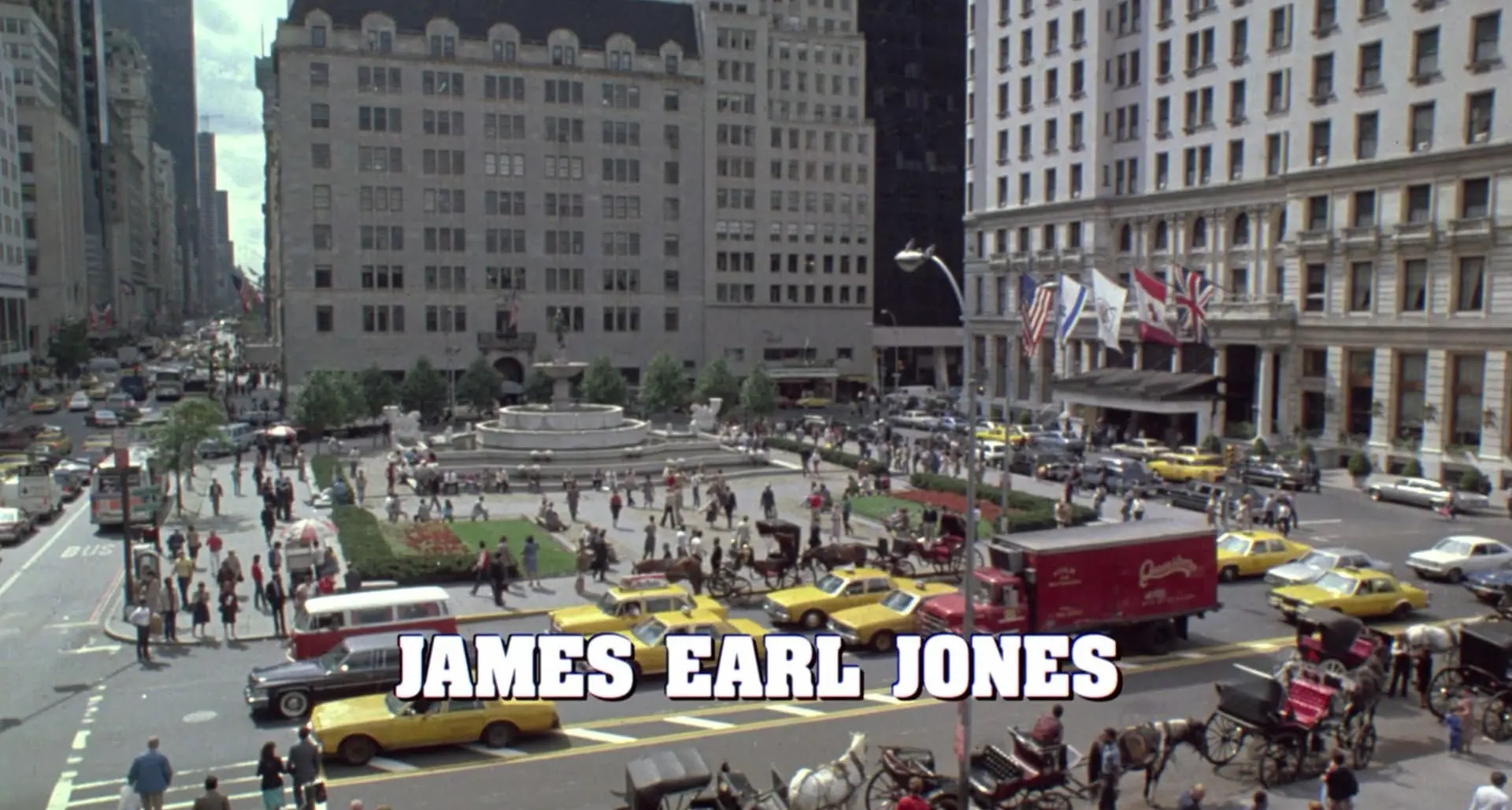
TMP: A structural thing that struck me right away is how the very first shot is a wide shot of Fifth Avenue. There’s this square with a line of taxi cabs, carriages, a truck painted red; there’s no ambulance, but already these anonymous vehicles seen from a distance suggest objects we will witness in a big way in later scenes. From there the film narrows down location-wise. You never get that wide of a view again. The recurring motif of the protagonist having to cross the street is also established here: first to meet the woman, later to get to the horse stable and find out what’s going on behind it. The same thing happens when he is in a phone booth trying to report that the ambulance is across yet another street. The repetition is fascinating, because you start off with that wide view of a signature location, and right away stumble step by step into these enigmatic sites. In the background of these sites you can see the World Trade Center or some such landmark that identifies the city from afar. It’s always about a character’s relationship to the locale as he goes from one ordeal to another and is exposed to emerging or re-emerging elements, wherever he finds himself.
Lore Schwartz: I really like your focus on crossing the street — it always holds a special place for me in the movies, or maybe it’s just my love for They All Laughed, a film we actually know was on Cohen’s mind given his direct reference to it in Special Effects. In Bogdanovich’s film, the only language is that of love, and its primary method of expression is in crossing the street. So much time is spent with the characters in these parallel choreographies on opposite sides of an equally blooming Fifth Avenue. Gazes and gestures like Poynting vectors between them, with the rupture of the physical barrier, the street, as this death-defying release of the magnetism between their bodies. This propulsive logic is so important to The Ambulance — stepping through the diagonal and finding oneself, the momentum and the physical space reinvented. Because of this, I found myself so preoccupied with what’s directly in the frame that I couldn’t even begin to assemble any larger conspiratorial framework. For a film whose logic necessitates such freedom, there is a stringency to its design such that the color red in the corner of a frame is enough to get my heart pumping.
Joseph Grimault: On the subject of logic, I was also reminded of the text by Rivette. The final line, which captures best the Hawksian side I perceive in Cohen, goes: ‘What is, is.’ [4] You have to take in everything in this film as it comes, as absurd as it may appear at first. All that is happening is happening for a reason, which is usually explicit in the plot. Why is James Earl Jones chewing so much gum? Then we learn that he had a nervous breakdown and tried to commit suicide. Everything at first seems haphazard, and I’m fascinated by how Cohen, little by little, brings out the logic within it.
MH: What makes this logic interesting is that it is not primarily narrative. This isn’t to say it’s not a narratively strong film, because I think it is, but what Tâm said — that at the time people complained that it didn’t fulfill its dramatic potential — is interesting. Because, when I think of the structure of this film — and I’m interested to know what Jack got to with his attempt at an act breakdown — it doesn’t have an immediately legible, traditional three-act structure. Of course, you have the inciting incident, which is the ambulance kidnapping Cheryl, but once that gets going, the film becomes more of an accumulation of the same kind of things happening. Josh is wandering around and bumps into stuff. He gets pulled here, he gets pulled there. But what actually gives the film structure — aside from the symbolic register of the locations, the elements in them — is the characters. The film is made up of a series of extremely precious times spent. How many times do Eric Roberts and James Earl Jones meet? Twice, once in the office and once in the hospital. Then Roberts calls Jones on the phone, and that’s it. So two and a half times, let’s say, but those carry a great deal of warmth and comradeship, and enough is established that you care about both of them and their rapport. The film is made of these moments. Red Buttons turns up at probably bang on the thirty minute mark. Act two is Roberts meeting him, and now that encounter matters for the film: they’re going to have a thing together. But this doesn’t correspond to another shift of the gear; here is the plot, but the stakes of the conspiracy don’t go up at the same moment. This is a liberating kind of logic.
Joshua Peinado: I was really interested in what Sam was saying about conflict, about all these conversations he’s having. He struggles to convince people that the ambulance is real, but it’s more so he’s struggling to convince them that he and this girl can have a relationship, that he knows her. One guy at one of the hospitals he goes to says, ‘It doesn’t seem like you know her, if you don’t even know her last name.’ All of them are questioning if this connection they have is real; his friend who appears at the very beginning questions him, ‘How can you convince this girl to go out with you?’ In the end, it feels like he’s finally convinced the world that he and this girl can be together. The ambulance is real. The attraction is real. He keeps trying to prove over and over again that he and this girl can have this connection that is then totally dissolved in the end.
SWM: I wouldn’t want to push this too far — since I don’t think this is at all how Cohen thinks of things — but there’s a sense in which there’s something… I’m trying to think of a word other than ‘metatextual’, because it’s so annoying to call things that. But it is interesting that the convincing of people that he has some relationship with this woman is in some sense also Cohen trying to convince them that there is a plot, that enough has happened for something to have been put into motion. All of Cohen’s films, or nearly all of them at least, are structured around a very small concept that is then — as Matt said — followed through without the need for a pronounced ‘rising action, falling action’ structure. It’s more of a structure of logic, as we’ve been saying, a convincing that there is even anything there. And then to convince whoever he comes up against, these authority figures, to get what he wants out of them or to have them point him in the right direction, is also to persuade us that the film can continue, that there can be a next scene. Every scene is an act of persuasion that the film can continue. And I realized the second time I saw it that one very important way Cohen structures it is to have James Earl Jones die exactly halfway through, to the minute. Then there’s a fade to black and fade back in. This bifurcation is not necessarily in lieu of a three-act structure, because it can be analyzed in three acts, but at least one of the structures working in the film is this bifurcation between Roberts’s relationship with Jones and his relationship with Megan Gallagher. Jones doesn’t quite become his sidekick, though he sort of is right before he dies. Gallagher as the putative sidekick then becomes part of the romantic story of the film and its denouement, which is also interesting because there’s the fake romantic structure that is set up in the first scene with Janine Turner only for it to be resolved in the last. Well, it’s not the last scene of the film; it’s a fake ending as well, where Josh is at first really tender about phoning Cheryl’s boyfriend for her before getting bitter about it. Cohen has his cake and eats it: Roberts’s character is nice to her, but he’s also pissed off that he’s gone through all this and she’s already got a boyfriend. The division in half is one of the ways Cohen excavates a structure out of his material. There may be others. I’m curious what Jack found, looking at it in a more fine-grained way.
JS: Logic, conflict, character, and structure are one and the same in Cohen’s movies, especially The Ambulance. As we’ve mentioned, the characters are defined by a logic of conflict, and the structure is defined by those characters, set in motion by that ‘gearing function’. What’s funny is that this is the exact dictum of classical dramatic writing, that we as good critics often swear off as hackneyed or ‘screenwriterly’. It’s as if Cohen is saying, ‘Here, I’ll show you a three-act structure!’, and does it with such endless invention that it becomes the drama’s uncanny reflection. You have the inciting incident — the ambulance taking Cheryl — right at that 7- to 12-minute mark. He uses the logic of his normal life — visiting hospitals, drawing her comic picture — before the ambulance captures the roommate and thrusts him into the second act. He gains allies in that ersatz world, and Jones’s death occurs — as Sam mentioned — at that exact midpoint. His foil, Sandy Malloy, pulls him out of that malaise, he reaches his low point of getting separated from her, and we have the third act where Malloy learns she can shoot a gun and Josh learns that his ideal was a mirage and that true love was in front of him the whole time. It really lines up to the minute, but at the same time you get this sense that every scene could be the last, that the plot only continues due to Josh’s extreme force of will. You’re not thinking, ‘This is going to tie back in an hour’; you’re thinking ‘If he doesn’t get this person to help him, the movie will end.’ It’s what every screenwriting manual dreams of, but what none have the total clarity of thought and execution to pull off. It’s like he’s inventing these rules for the first time.
TD: Cohen is very good at selecting the elements he wants to put into play. I guess if you’re making a film on a low budget, there’s always going to be a limited amount of elements, but I don’t know how he was able to execute, for example, that moment in the hospital where Red Buttons says, ‘I snore a lot. So you’re not going to get any sleep.’ And then it cuts to a shot of him snoring, but then he opens his eyes and the snoring continues. And he’s like, ‘Oh, that’s not me.’ I wonder how that was done — it’s such a deft selection of an element to propel things forward. I feel like it’s more than just logic. Cohen is extremely cued into the randomness of character traits. I don’t know how you would write a moment like that. It feels like it would have to come about spontaneously. Roberts obviously needs to be taken away by the evil orderlies, but Buttons also has to be alerted to this situation. And if he’s a heavy sleeper and snores a lot, how does that transfer? Well, Red Buttons and Eric Roberts are comrades, so they both happen to snore too loud.
JG: The way Cohen writes is particular because he didn’t actually write. He grabbed a tape recorder and just began speaking the story, acting it out. Then a secretary transcribed it into screenplay format. So when I think about this film, I also think about the improvisation that is going on, how he’s going through the tape recorder and the story is flowing from him. And if he’s writing it like that, how does he create a structure — if we can talk about it as a structure — how conscious is he of it? In Doyle’s book, Cohen talks about being pissed off — also for budgetary reasons — that the crew were printing a new copy of the script everyday because it was being rewritten everyday. [5] Every single day it was being realized; new things were added.
JS: That’s one of the joys of watching Cohen’s movies, especially this one: you’re watching somebody think in real time. You’re watching him solve problems. It’s like the joy of watching improvisation on stage: seeing people create a problem and solve it before you even knew there was one. The snoring bit is a great example of that. Cohen says that in the original version of the movie, the villain (Eric Braeden) wasn’t even there. You can see that based on how it’s cut. And with that problem being solved, you see joy. It’s the same joy you get when you know the phone booth where Roberts is calling the police is not part of the same set as the New York Post building. You’re seeing Cohen smash two things together that aren’t proximate, but he finds a way to co-locate them in one place.
TMP: The way actions succeed one another is commonsensical. Roberts’s Josh suspects a person has gone missing and reports it; he draws his testimony the only way he knows how, which is through the comic book style. But what keeps that practicality energized is the fact that every character exudes a larger-than-life presence. What Jones’s policeman does after he was stabbed is to still get up to shoot the ambulance, which then turns around to run him to his gum-chewing death. It’s such an excessive instance of his drive to pull through under pressure! Then the next scene is at the Marvel office, where the policewoman played by Gallagher seeks Josh out. It’s the first time another person has truly acknowledged that he’s struck up this connection. She’s the first to be like, ‘You’re saying you met her. Let’s assume she exists. How can we go from here?’ And before that initiative is taken up, there’s that movement of hers surveying the tables of the artists and mysteriously being able to identify which one is his, which drawing bears his mark. Of course, in the script, she is supposed to help him solve the crime. But this is also someone who happens — let’s say she happens — to exude a personality that renders her attuned to unknown links between existing persons, little details about them. As Thomas was saying in regard to serendipity, you can make a similar argument about how other dynamics in the film fit naturally into the contexts in which they evolve. At one of the hospitals where Josh goes to find Cheryl, you can see two extras playing a security guard and a nurse chatting about who knows what. And it’s so exciting to sit back and observe that it’s only when we get to the next hospital where Josh is admitted that this quotidian proximity of a guard to a nurse acquires the thrill of fiction. All the surfaces — hospital corridors — recur.
The person you were supposed to meet
JS: This may be as good a time as any to talk about the main hospital scene, because it’s come up a few times. The scene starts about twenty-five minutes into the movie, and it goes on for ten or fifteen minutes. Until then, every single scene has been driven by Eric Roberts getting into conflict with someone and trying to find something out. Suddenly, he is admitted for food poisoning and is trapped in stasis. Matt and I have talked about before as a Hawksian scene, in that the drama stops for a second for the characters to lay atop one another. But it’s also Hawksian in the way the camera works: once you look at it closely, it turns out to be a very complicated series of movements, because there are so many people, and the room needs to be seen from so many angles. It jumps the 180-degree line, cuts in unexpected ways, and has these beautiful pans to tie multiple setups together. But you don’t notice this on a first watch. And you start to see how much importance Cohen must have placed on this scene, if he’s going to such lengths to shoot it.
MH: That scene is an oasis in the middle of the film; the ethics of the film lie in the pleasure of the encounters there, particularly the one with Red Buttons. That encounter becomes the emotional core of the film, even though narratively speaking it’s not necessarily the most important moment. Jack, you mentioned Hawks; in our previous conversation about the hospital scene I mentioned my version of the Ford/Hawks dichotomy, which of course is a classic film critical catechism. Hawks is a manic-depressive filmmaker, because in his films we sense an element of a desire to keep the party going. You want the characters to be there, but they slightly overstay their welcome. The editing is joyous, but you ultimately feel the hand of the director: ‘Come on, let’s wring a last bit of pleasure out of this.’ Everything ever so slightly lingers. By contrast, the Fordian ideal is that every social encounter has its quasi-Aristotelian — natural, rightful — pace. The ethic here is, ‘Don’t overstay your welcome’, which is not a nasty thing to say, but simply a matter of, ‘Let the gesture run exactly as long as it should, but no longer — then appropriately tie it off.’ The hospital sequence ultimately reminds me more of the bar sequences in She Wore a Yellow Ribbon, or the downtime sequences in The Long Voyage Home, than the ‘communal’ scenes in Hawks. The encounter with Buttons is suffused with the camaraderie of the right time. I waved my hands in the air while watching it on my laptop, because this is a scene that contains what I love in Ford and in other filmmakers possessed of breath (there’s some of this in Milius as well). It’s not, however, a mode proper to the nineties, which brings us back to the out-of-time character of the film; we don’t see those kinds of character beats so frequently after the 1970s. Every time I watch The Ambulance, I ask myself, ‘How does this kind of grace arise?’
JS: I think anybody who watches the movie would have a similarly strong reaction to this scene. There are character beats like it in other movies from the eighties and nineties, but they’re so circumscribed, like there’s a halo around the characters. I’m thinking for some reason of Jude Law’s character in A.I.: Artificial Intelligence, who is absolutely grating to watch. There it’s so mannered, but here it’s so natural. In terms of structure, it’s such a relief to get this character that is crazier than Eric Roberts. He has set himself up against every single person in the world, and now there’s this person who seems to not even care about him, because he just wants his scoop. I think the fact that he is entirely determined by his desire to write a story is another beautiful character touch. Every single action he takes is towards that. The clarity makes it beautiful.
TD: They find each other. You find your people in the world; in a place like New York, certainly. Maybe that is a classical Hollywood scenario. You only need a single location to find the person who’s going to be your comrade or sidekick in the course of life’s events. I am curious why something so simple as this is difficult to capture in films today, because it’s not like camaraderie doesn’t exist; it’s just that sidekicks are hard to come by, especially because in Cohen, the relationship moves both ways. For all we know, it is Red Buttons who is taking Eric Roberts on this adventure, not vice versa. Maybe it’s the economy with which the materials are used to create the set and setting that causes so much good feeling for anyone who watches it. This also happens also in Hawks and Ford. Roberts has never met Buttons, and yet they enter into a collaboration almost immediately. They improvise, and, together, they confront the unpredictability of events. I can say from experience that something like this happens only once or twice in a lifetime. You meet someone randomly, you could never have expected to find this person, but here is the person you were supposed to meet and with whom you were supposed to improvise life.
LS: He found the one person who snores as loudly as he does!
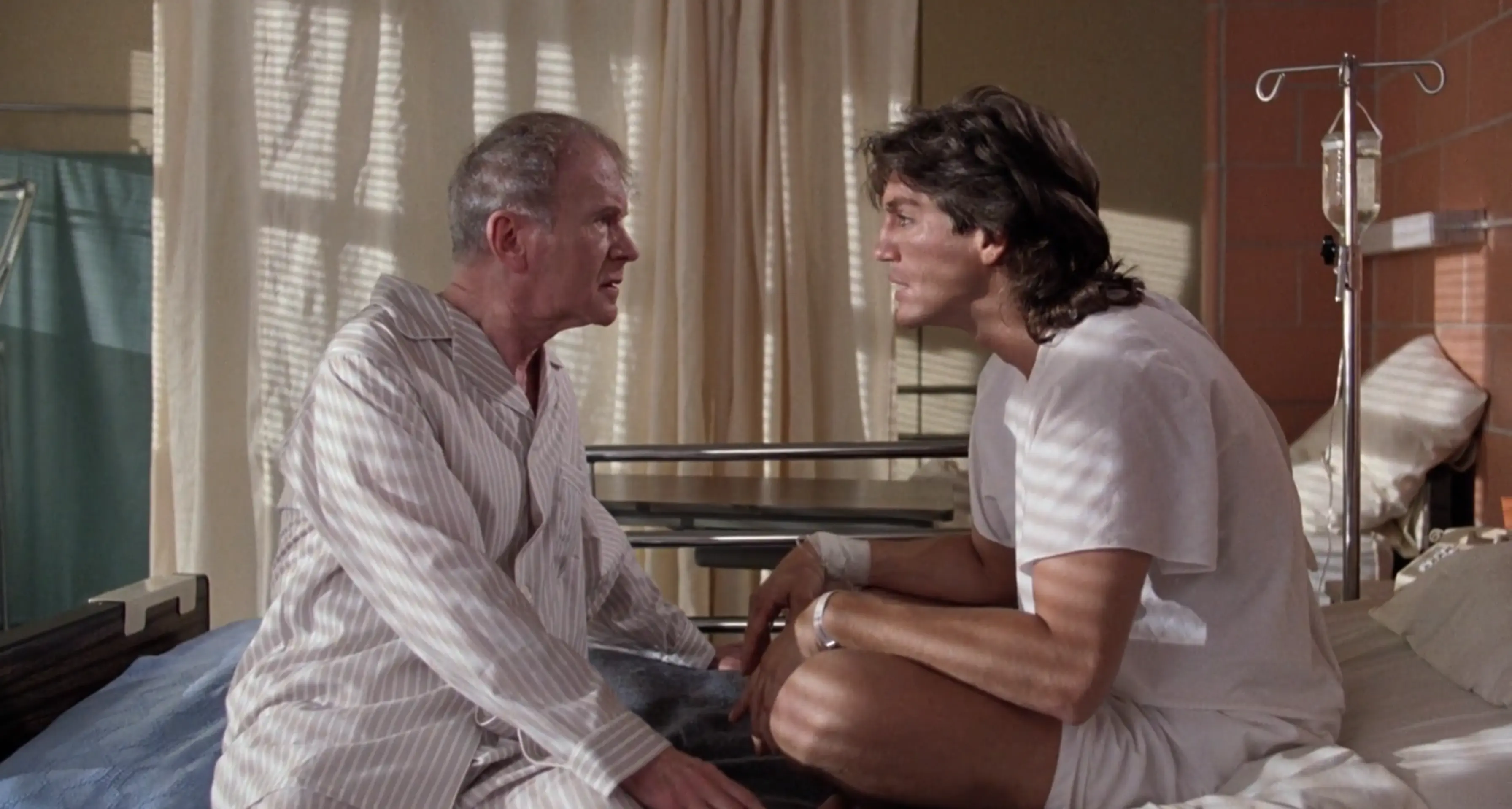
SWM: One thing I love about that scene — a small detail near the beginning — is when Eric Roberts is struggling to get out, and we believe he’s been kidnapped by the ambulance and therefore is in this nightmarish world of the victims. James Earl Jones’s character then comes in from the right of the frame so quickly, in a close-up, that you can’t see his spatial relation with this corridor. So we’ve had Roberts trying to make his way out, in a classic horror shot of someone trying to get away; we’re dollying back in the corridor as he tries to wrestle free of the hospital orderly. And this close-up of Jones seems to come from some other space. You don’t know what it is. It seems almost like an apparition. Then immediately in the next setup, the signification of the space has changed: it turns into a normal hospital at exactly the moment Roberts realizes that it is normal. Narratively, it’s a fade-out moment of the danger, and the context of the scene changes with the entry of Jones. It’s a really good example of how Cohen can, with a lot of economy and without any huffing-and-puffing, change the meaning of space in a very agile way, something which happens a lot in this film.
TMP: This agility is indeed at work in what immediately follows that false moment of danger, in the room where the camera waits until the exact moment it becomes necessary to shift its point of view to show the left corner and the new character lying there. For a while, you watch the already introduced characters interact, then two of them leave and the camera alerts us — as much as it does Roberts — to the absolutely fateful presence of Buttons. By the way, I was wondering if anyone was intrigued by the fact that in that room, the blinds are half-open and the shadows they create fall on all of the actors’ faces. It reminds me of the way lines are drawn in comic books. In no other scene, except during the chase down the city reservoir, do you see lines of shadow on the characters so clearly. It feels like it could have been from a noir, but the atmosphere is different.
JS: Noir was my immediate association. The cinematography here is in general more ‘beautiful’ than most of Cohen’s movies. Jacques Haitkin, the DP, had just done Nightmare on Elm Street. He was kind of a big name. This is a total side note, but some of the cinematography choices do add to the classical feel. Here, with the Venetian blinds in almost all the shots, there’s a big hair light on the actors, which is what we associate with classical Hollywood, which by this time in the nineties would have been old-school. It takes us out of the realism a little.
SWM: There’s definitely less of the nitty-gritty handheld camera you get in Cohen’s earlier films. There’s still the thing where he’s quite happy to — not always, but often — change his distance from the subject a lot within a scene. The most obvious example is right at the beginning, when we’re at many different distances from the subjects. But it’s not as much of the quite jarring thing in his earlier films, where you’re changing a lot from handheld to a fixed camera or a camera on a dolly within one scene. In this sense, this film feels more classical, like the camera is to an extent more directed than responsive, especially in this hospital sequence.
Tactical bluntness
JP: This episode with Red Buttons also illustrates how Cohen thinks of hospitals or healthcare in general. It’s a theme throughout his career, as early as in Black Caesar. Here an ambulance is being used as a vehicle for assassination. And all the way into the last film he wrote and directed, As Good as Dead, the medical system’s mistreatment of patients is due to nothing intrinsic to it, but to a malign influence that’s corrupting it and turning it into a vehicle to exploit people for money or health. Buttons’s character says, ‘You know, for ten years, I haven’t seen a doctor. I didn’t have a problem. As soon as they touch me, I have problems everyday. And as long as I have insurance, they’re keeping me here and they won’t let me die.’ In It’s Alive, aren’t the mutant babies a by-product of a fertility treatment gone awry? Some pharmaceutical executive is devising a treatment for couples to have babies, and this is why the mutant babies are popping up all over. A lot of good intentions go screwy in healthcare.
LS: You’re totally right. I was just thinking about your choice of words from earlier, how you mentioned Eric Roberts’s struggles to convince anyone in a uniform about what’s happening. In the end though he really doesn’t actually convince anybody at all. They have to see it for themselves. You can see this in the villain’s logic too, which is simply: people aren’t getting help, so I guess I have to do something. This goes back to the drama being the result of what’s immediately on screen. Everyone is reacting to a world where nobody in power gives a shit, unless there is a problem directly in front of their face. Yet it’s this same idea which makes the moments of genuine connection feel much more precious. Cohen treats the encounter as sacred, something that can save someone’s life or simply be the substance of a beautiful relationship.
TMP: I agree that medical malpractice is a recurring theme. But in It’s Alive or Black Caesar, the drug trade or other shady businesses, as they play out, usually implicate a nexus of characters and relationships on varying levels of institutional power. Whereas in this film, the plot with the evil doctor is pared down, contained in two scenes of him explaining to two of his victims his operation and ethics. Echoing Lore, here the theme is totally woven into the images. It’s in the neon green of the ambulance, in how it’s the same color as that of the nightclub. When Gallagher’s character walks in, on the upper part of a semi-opaque wall — before we even know there’s a second floor — we see the silhouette of a stripper. The camera will return to that slightly anomalous spot before panning back to the present scene of people dancing on the ground. And when we finally come upstairs to discover the truth, featured prominently in the first shot of that second floor is the silhouette of a patient against white fabric, whining in pain. It’s like our subconscious must then connect these images of the stripper and the patient, without necessarily coming to any specific sociological thesis. The theme of mass injustice against public well-being in this film seems less grounded in a political reality at the time compared to some other films by Cohen, but what it does very well is to carve out the uncanny within the normal to propel an extension of the facts. I also appreciate how Josh’s means to identify the girl he’s let off from sight — pencils and a sketchbook, or his sheer stamina — is in stark opposition to that monitor in her ward running a list of information about her: female, Caucasian, age 25, 5 ft. 5, diabetic type 1... These are all details that are not trying to grab your attention, but rather built onto the surface.
MH: Cohen has a remarkable capacity to pick one-liner ideas that are taken from some political actuality, but then not belabor the point. This is a strange aspect of his explicitness. He sets out to make a film about consumerism being bad for you, so here’s a product that kills people; he sets out to make a film about healthcare, so the plot is that you go into a hospital to die. This initially comes across as very blunt, it almost bashes you on the head: there’s no subtext to the point. The text is the point. And yet it doesn’t become metaphorically over-determined, unlike in ‘elevated horror’. It’s not The Babadook or that recent bad Jaume Collet-Serra’s remake, The Woman in the Yard, where there’s a ghost… and the ghost is grief! That’s truly bashing you on the head: the films become allegorically over-determined, and the images are never able to transcend the allegories. Whereas what’s interesting with Cohen is that he will choose some super direct point, but in taking up this subtextless, declarative point (‘the product is the enemy’, or whatever), he lets the exploration of the images and the construction of space create something which doesn’t end up tying down what the film is about. Instead, you get somewhere much further than the initial proposition from which you set out, which is why these are real films. It’s interesting to compare this with attempts to do ‘politicized’ horror nowadays, with their failure and with the specific bluntness of their metaphors.
TD: I feel like Cohen’s imagery has a tactical bluntness that seems to generalize past the political into the metaphysical. I’m not someone who cares for metaphysical concepts, to be clear. And certainly political questions are often front of mind for Cohen. But there is constantly this venturing past the strictly local arrangement of political situations. ‘You’ll be in perfect health before you die’, is an irrational statement because it lingers at this point where a transcendent evil interfaces with the very peculiar shittiness of the US healthcare system. This line represents the Cohen we associate with the comic book, the one whose panels are so full of details that it takes work (and repeated viewings) to assemble all of them in your mind. At the same time, there is a legibility to such an absurd thought, a magnificent irrationality that transfigures immediately into a wry political insight.
MH: There’s something to be said about the play between literalism and the formal considerations Tâm was touching on. Cohen allows a very potent gap there. This connects to what Sam was saying in the previous roundtable about Moullet. There’s this great pan in Foix where there’s the factory, and then there’s the graveyard, and it’s as if the director is saying, ‘It’s there, come on, look at it!’ The Ambulance, too, serves things up on a plate, which is a very different way of making a film have a theme, as opposed to making it happen on the level of allegory.
SWM: This makes me think of another thing Jack once said about Abel Ferrara’s The Addiction: the metaphors are so blunt that they’re on the surface. They’ve stopped being metaphors in a way. There’s something so obvious about the mistreatment of people, to put it in the broadest terms, that it doesn’t need to be belabored.
The guy in the reservoir
SWM: One of the places the realism comes from is in Cohen’s faith in interactions, in the plainest sense of people encountering each other and developing a rapport. The great thing about Roberts meeting Red Buttons in the hospital is the fact that Cohen believes in the striking up of conversation between people. I wonder if that’s also related to the New York of this film. I think Cohen has an amazing ability to make the New York here a New York of fantasy and also a New York grounded in a reality of how people relate to each other and their environment. At the beginning, we are literally in the thick of things, with cars in the background and people walking past. When we first see Eric Roberts and his friend, they’re quite a way back. We don’t open where other filmmakers would open, with his characters in front of the crowd. We see a crowd around them that signifies they’re in the middle of Manhattan. They’re way back in this milieu.
JS: Dreyer has an essay on the importance of direct sound. In it, he’s sitting in his room, writing, and he hears these noises outside his window, and while they have no direct relation to what he’s writing, somehow they do because they’re located in the same place and time. This co-location takes on some metaphorical or metonymic significance, metaphysical even. It’s almost a hokey thing to say about New York, but again, it’s just its directness that makes it true. The fact that you and another person are on the same block ties you into an orbit. It’s sentimental, but so beautiful. I think that’s where all the subtext comes from, all those details that are halfway between coincidence and fate, or coincidence and intention. That’s the CliffsNotes of New York, right? That you run into someone on the street and fall in love.
TMP: For some shots of Roberts’s character interacting with his co-worker and then Janine Turner’s character, what they did was to build a structure of sorts and cover it with tarpaulin. Then they had the crew hide there to zoom in on the actors. If you look at some of the shots, you can see passers-by — not all, but one or two of them — staring amusedly at these young people being so locked into each other’s presence. It’s a great way of capturing something like an animated conversation amidst a crowd, because you wouldn’t get that distribution of reactions if you were placing a camera in front of this crowd, at ground-level. I mentioned earlier that in the wide shot of Fifth Avenue, we can see yellow cabs, a red truck and horse carriages: normal, tiny objects in this scene that return so fantastically later, as with the scene that takes place in front of the stable. Behind the stable is the top of the Empire State Building, and next to it a garage, where a cab is being repaired. Those colors — the red of the stable’s door, the yellow of the cab — come back with such mystery in this unknown setting at night. The collision or scattering of elements works structurally, so that when an insane event erupts from this alchemy, you feel that it has to have come to that point.
TD: It’s absolutely out of this world. With respect to New York, I’m thinking of the scene where a guy taunts Roberts for not taking the subway. And also that chase scene in the reservoir: I want to know where that was filmed, first of all. When Roberts gets to that gate and immediately knows, ‘Oh, this is fine. I can break through it, no problem.’ If you were in that situation in real life today, that gate would probably have been reinforced with another layer of steel, and you would not be able to break through. In 1990, this was just another way to exit.
LS: We’ve been talking a lot about New York and this sense of breath and life in the film. I love the scene where Roberts believes he’s been poisoned and is running around his apartment building. All of a sudden, the whole world comes alive. People start coming out of their apartments in this very staggered fashion — some emerge first, then more, until there’s this whole crowd milling about in the lobby. The scene is very conscious of how these people exist in space and how Roberts has to navigate around them. Someone’s blocking his path, so he has to veer to the side. There’s this specificity to the choreography that makes them feel like actual presences. There’s a similar sequence in Marty Supreme, following a big fight in an apartment, when the film suddenly cuts to a hallway full of people just standing there. None of them have lines. They’re not doing anything. They’re props — expertly cast faces arranged to indicate the screenplay’s assertion that ‘people are watching’. What a waste! In the Daney piece Sam mentioned, he describes the camera field as one ‘crowded with a bric-a-brac of realist notes and true little facts intended to prove that a social analysis is happening.’ [6] There is little cinema as resistant to this description as Cohen’s. The Ambulance incorporates life and individuals so deeply into the way Roberts and his pals experience the world. Thomas brought up the reservoir scene — even the guy there saying, ‘You can't come in here!’ has this quality. It’s someone doing their job and asserting their small authority over this space. People aren’t little facts of the screenplay but obstacles and irritants to the plot, or as we were saying earlier, a new opportunity for play.
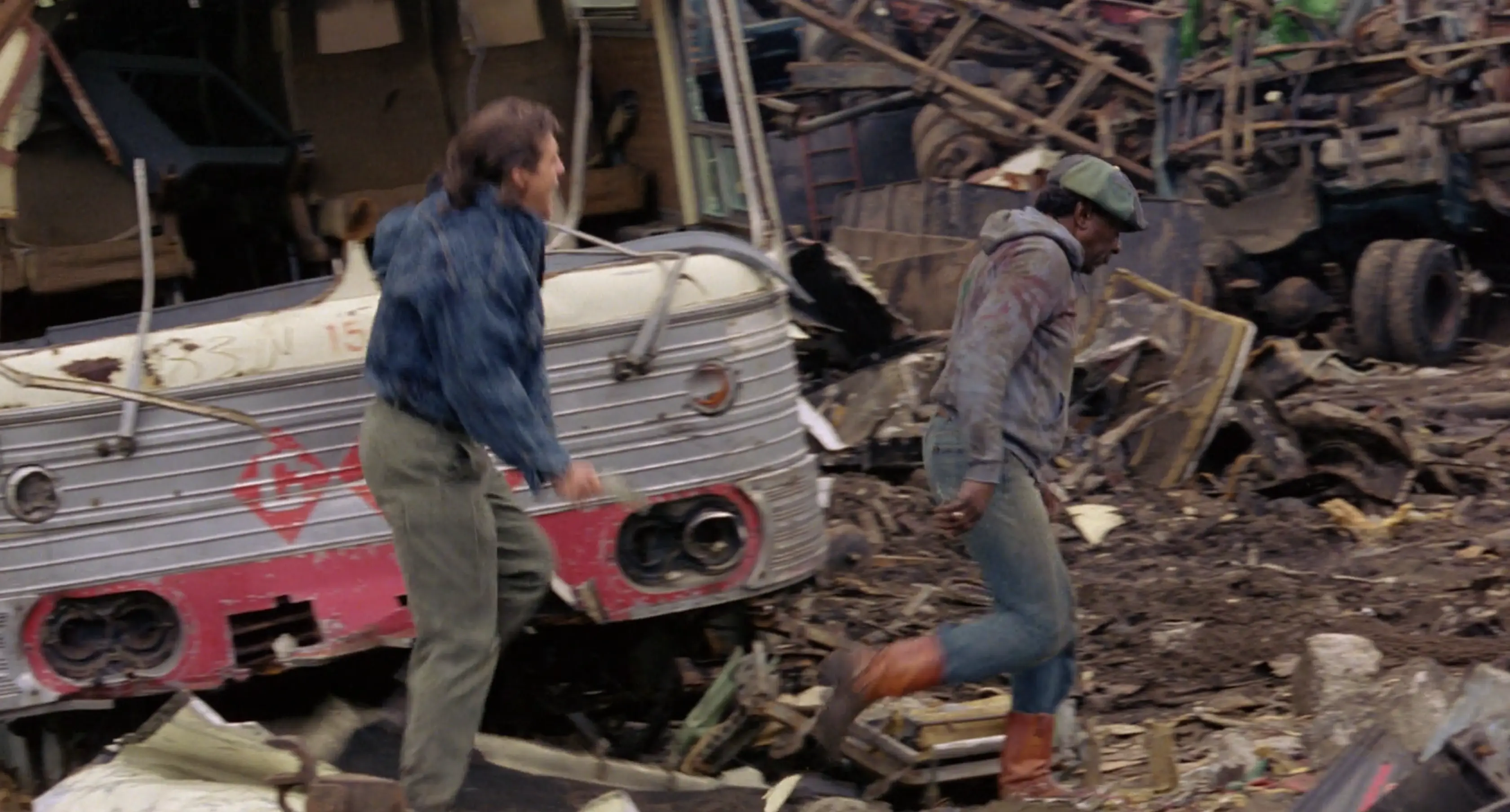
JS: That guy in the reservoir is fascinating; I had the same reaction as Thomas. What would that interaction be like today? I grew up in New York — I certainly never went to a pump house. You’d imagine that nowadays there would be some automated security system that would shoot you on sight. Would there even be a guy working there? What’s this guy been doing all night? What’s his job, really? The film makes you ask those questions just by the collision of elements. Same thing with the junkies at the junkyard, which is within New York because you can see the city in the background, but separate. Tâm is spot-on about recurring colors being key. There’s a reality to that: in New York, you get recurring colors, no matter which neighborhood you’re in, because you see the same signs, made of the same materials. I guess that’s the case in any city, but Cohen makes it metaphysical. He makes the world somehow be made up of these patterns of colors. You could draw a map decoding the world that way.
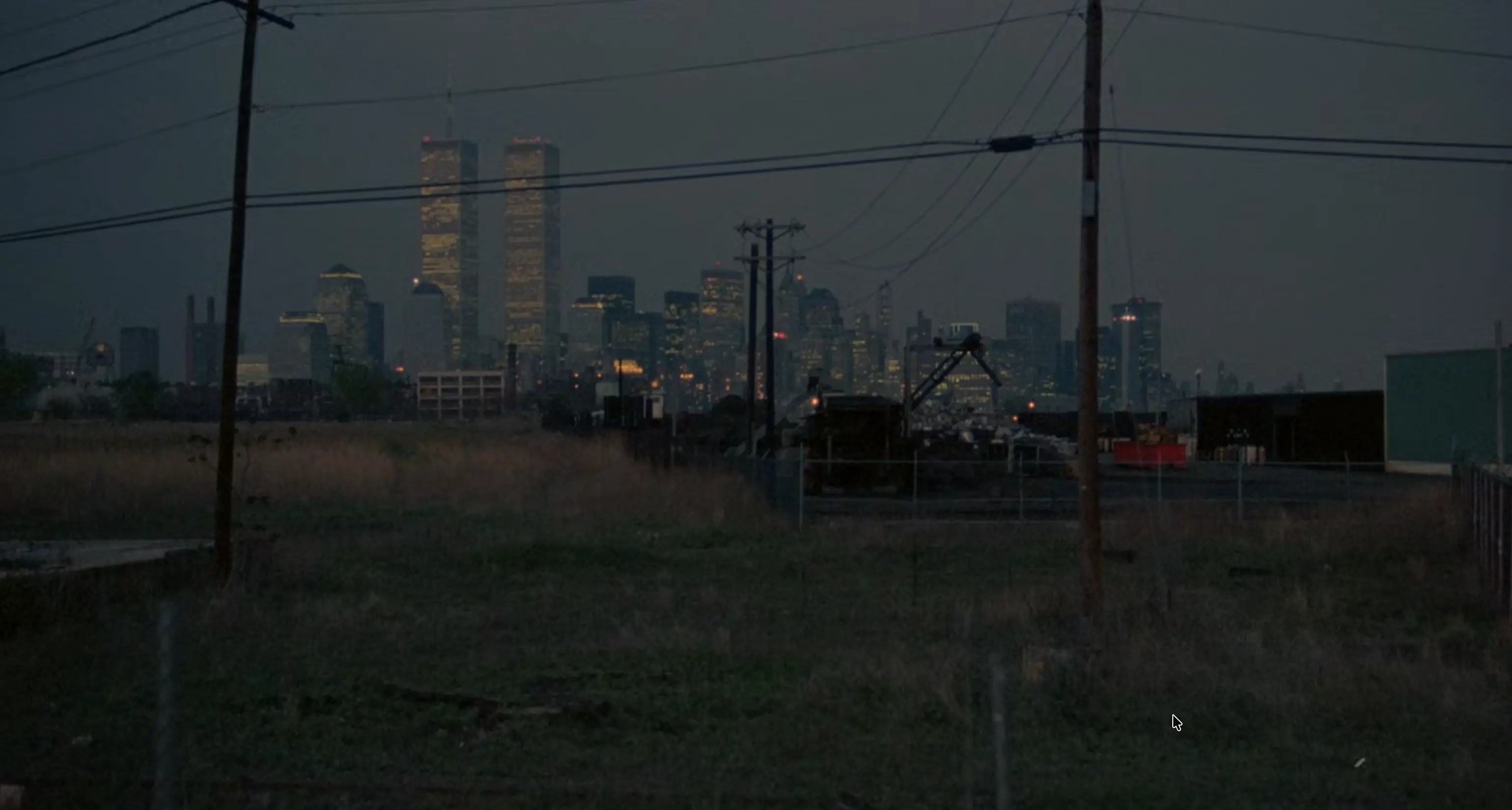
SWM: One part that really strikes me is the bit Tâm was talking about, when they’re outside the stable, and Cheryl’s roommate goes in through this big red painted wooden door. You’re hearing these horse noises and it’s like something from a dream. It’s so odd. Why would you think of that as something happening in New York? It always sticks out in my head as such a strange collision of what you see and what you hear. It’s one of the moments in the film where it seems there’s another world within the world. All these things — and this is partly to do with The Ambulance being a low budget film — concern the approach to New York. There’s a fidelity to some sort of reality there. Part of that is due to Cohen being from there, and he’s like Ferrara in this way, both being from the Bronx and not from wildly different generations. It’s just a place where you encounter things and people, where conversations are struck up, so it doesn’t become sentimental for him. It seems to come naturally as something he can grab onto. But there’s also a visual fidelity. At the end of the junkyard scene, after he gets captured, there’s an interesting shot, like a grace note, of New York from the location of this junkyard, which reaffirms it as the setting. Partly because we’re about to go back into the city, right? But it does something else, too, when you see the skyline over there from this junkyard, it reconnects the whole space. One of the things Cohen can do is to disconnect a space from the context of the city, like he does with that stable where things seem to happen in a kind of other place — the club is a little like that as well — then reconnect it efficiently, so that he always seems to be playing with how much we’re in the New York you’d be in when you leave your apartment and how much we’re in the New York where a fiction like this takes place. Again, I think it’s something filmmakers of this era in general were finding difficult to do to such an extent. To be able to treat places in that way was something rare. In the films of this era, there’s usually more of a dichotomy — we think of the various realist films of the seventies and eighties with this documentarian approach to cities, which seem to say, ‘This is the real New York and we’re filming it as it is, and you’re going to see the dirt and the pollution and all that stands between it and the fantastical.’ Whereas I think Cohen is one of the last people for whom reality and the fantastical were things that could be imbricated, without having to create this huge song and dance of it like what you find in someone like Guillermo del Toro, where that idea is so much more belabored and the whole point of the thing becomes just that. For Cohen, it’s something you can move in and out of.
JS: That to me is the one place where Cohen is very nostalgic, that idea of reality and the fantastic merging, because that’s New York as seen by a five-year-old — this place where anything can happen. Behind those doors there might be horses in a stable; around any corner there might be something magical. Some of Raoul Walsh’s New York movies have a similar nostalgia, like The Bowery or Under Pressure. There’s a nostalgic possibility. That’s the kind of nostalgia that Cohen gives into, but that’s also what gives The Ambulance its power.
Cuts, panels, planes
MH: The connecting of threads through color or location is interesting with respect to the comic book style of this film, because one thing that comic books are good at is traversing space while keeping certain elements constant. If you want to transition from someone’s shirt to a phone booth in a comic book, you don’t ‘cut’ from one constructed shot to another, you directly juxtapose them and the shirt will have the same color as the phone booth. You can do this because you literally have the same color to hand, the same ink. Whereas in film, a massive work of mediation is required to keep elements constant across space in that way. There’s something to be thought about here, because The Ambulance is a very comic book-like movie in the ease with which it jumps across registers and keeps certain things continuous across them.
TMP: It might be interesting here to bring up two moments where some discontinuity in what is ostensibly the same space is recast onto the fictional plane. There are others, but one that stands out is when Eric Roberts is in the phone booth that’s supposedly next to the New York Post. As Jack said earlier, you can see that the booth is not actually on the same street as the building. On the other side of the street, where Red Buttons’s character is taking photos of the ambulance, there’s the highway bridge, the river, night lights, and we get a great depth of field. Cohen is able to make use of the need to refer to such discrete portions and qualities of the world to generate the suspense he needs for the outcome of the scene, which is that this character in the phone booth will have failed to run across the street to be with his friend in time. The other moment of discontinuity is the penultimate scene they had to shoot in LA, in which the ambulance crashes into an excavation site and explodes. You see a little daylight in the shot as the sun was coming up, which highlights the fire consuming this vehicle that will no longer sabotage Roberts’s meeting with any woman on the street. Fictionally speaking, we’re in the middle of the night in New York, not approaching dawn in LA, but that slight loss of continuity seems to give the final destruction more surreality! I wonder what we make of these resolutions, which are in tandem with Cohen’s fidelity not simply to a given geographical layout, but to the possible unity that the screen affords, through such ‘cheats’ available only to cinema. He rarely fails to take advantage of this throughout his career.
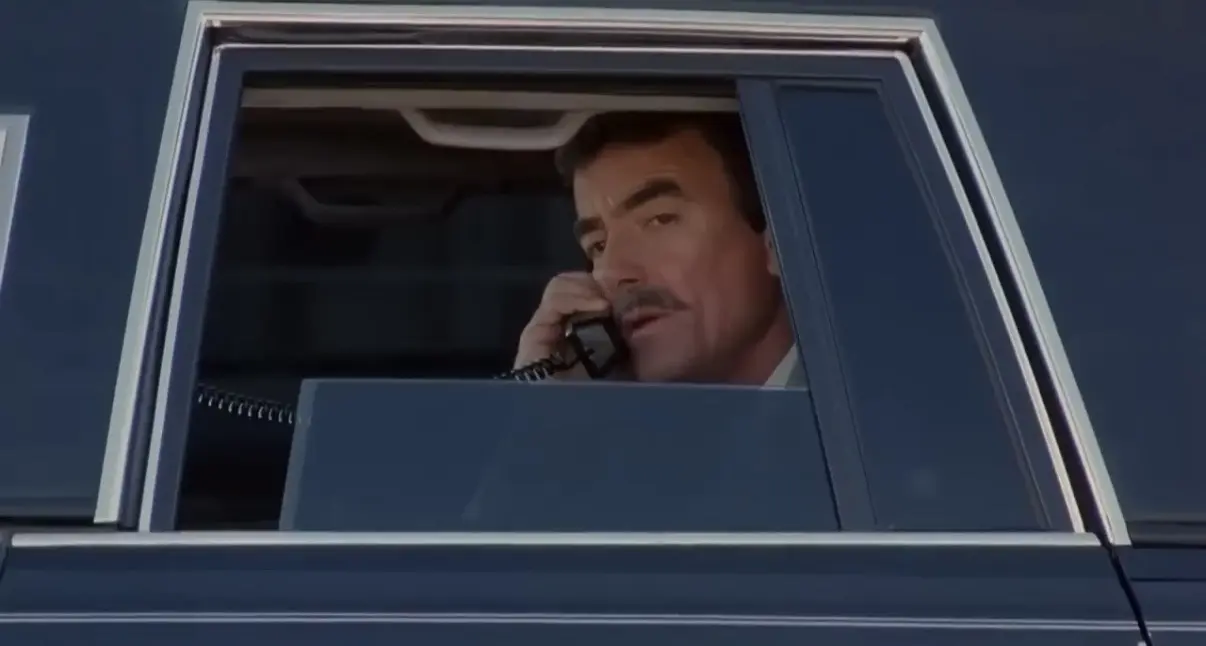
JP: There’s also something interesting about the way Cohen uses geometry in his framing, especially in a really early sequence. I was struck by how the frame gets narrower and narrower over the course of the initial sequence. This builds up to the eventual medical crisis that Janine Turner’s character suffers. There is a juxtaposition where the doctor is in a limousine and it’s the first time we’re seeing him. He’s far off and removed, but his face is centered in the limousine screen by a kind of sideways ‘L’ shape formed by the tinted window. And then it’s an immediate cut to Turner in a close shot — one of the first big close-ups of the film — but the space around her is forming the same shape that the limousine screen did. Where the doctor is distant, her face is very close, and that gives me the feel of a comic book sensibility, how he’s using those shapes and negative space.
JS: Her jacket is also comic book-like, with that black and white pattern.
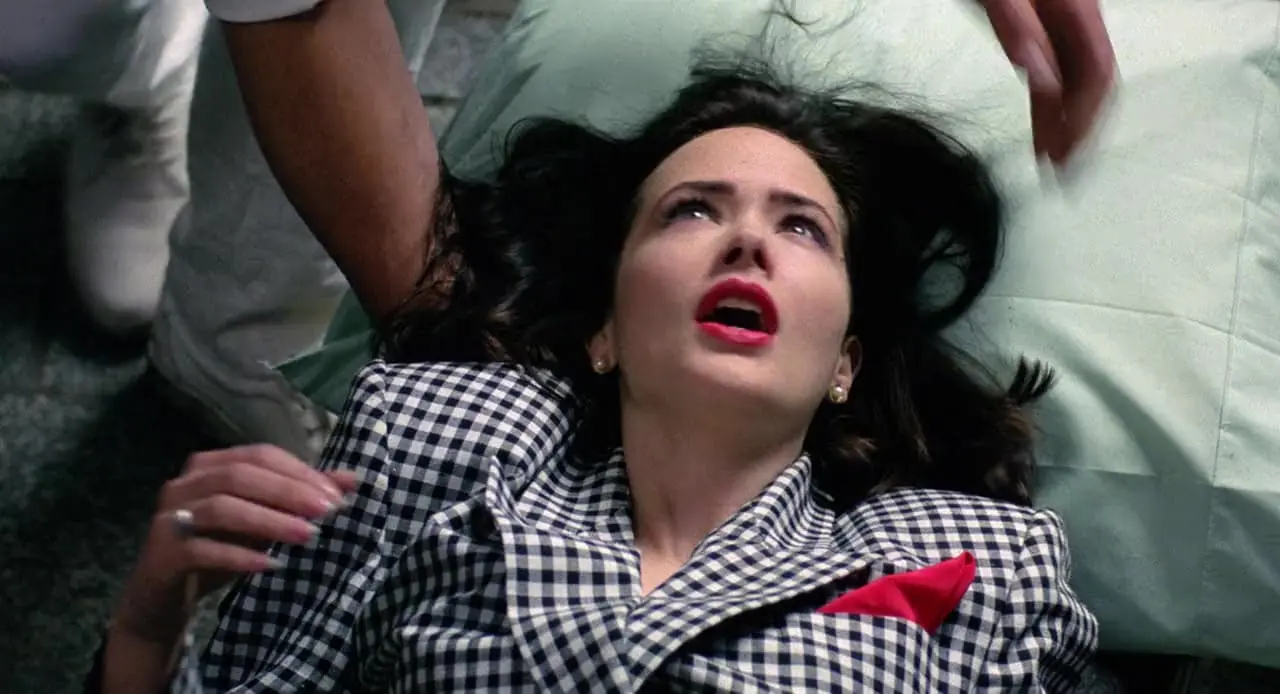
SWM: If you go through the film frame by frame and look at the art direction, you’ll notice there is this way of using color to punctuate visual events throughout. You can think of the film in terms of a series of colors. It’s a film you could create a really interesting photo layout out of, the kind of film where you could take disparate moments and find color or geometric relations between them. Again, I wonder if that’s a slightly unusual way of thinking about visuals in this period of American popular cinema, or at least in this kind of film in this period of this cinema, which maybe does relate to the comic book feel. Does anyone know the story behind Marvel’s involvement?
LS: Cohen was hired to make a Doctor Strange film which never came to fruition. Since they were friends, I think Cohen treated giving Stan Lee a cameo and putting Marvel characters on screen as a sort of favour. [7]
TMP: I don’t know how much thought has gone into making Roberts’s character a comic book artist, but surface-level research shows that major things were happening to Marvel around the late eighties and early nineties, with mergers, artists leaving and changes in how they wanted to maintain brand continuity. I doubt Cohen had more intentions other than the fact that, you know, Josh makes a living drawing these panels, so he’s more inclined to see the fantastical in things.
JG: 1990 is around the time of what they call ‘the comic book boom’, where comic books were selling so much. The prices were going through the roof, due also to the ‘comic book speculation bubble’. Cohen may just have had a pulse on it, that there’s something going on in the world of the comic book, that it was going to take more precedence in pop culture than it did before, as it eventually turned out. But the biggest thing that to me in this film recalls a very ‘comic book’ quality is what you all were previously talking about, the use of color and space and how he can create differences between the spaces. I was also just thinking of that sequence in the two junkyards, how in scenes like this, he usually uses a ‘visual pointer’ that characterizes the space they’re in. Before the shot of the first junkyard, there’s a shot of a cute little puppy, and then in the second junkyard where Roberts gets attacked, there’s this violent barking dog. As for the use of green light, I believe that in the hospital sequence, the only thing that can tell you that Eric Roberts is in an actual hospital before he acknowledges this is the lack of green light — which is in turn the ‘visual pointer’ of Eric Braeden’s ‘hospital’.
JS: I’m sure he shot those dogs because they were there when he got to the locations. I doubt they hired those dogs — why would he waste money on that? So either it’s his experience of going to junkyards knowing there’s always a dog there, or it’s that they got to the location and saw dogs, so they chose to film them. It’s the blend of reality and fiction.
LS: Matt brought up Violent Saturday earlier, and I found myself thinking again about the density of its exteriors — pressurized with bodies in a way not unlike several of the sequences we’ve discussed. This effect, as first mentioned by Jerry Johnson, wasn’t a result of hiring too many extras, but of the mining town’s massive population boom during production. Cohen, like Fleischer, took reality as it was.


Eric Roberts is an axiom
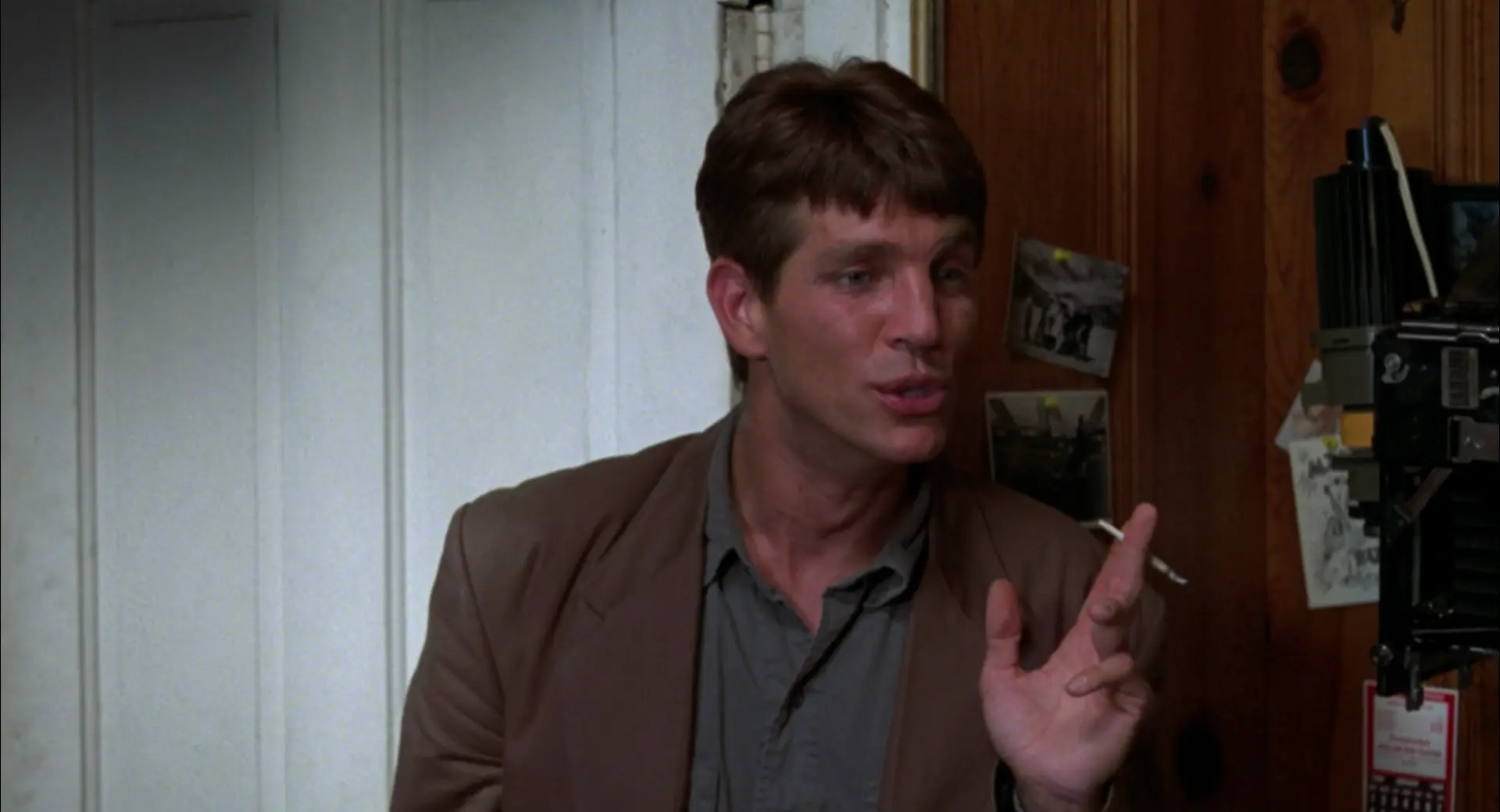
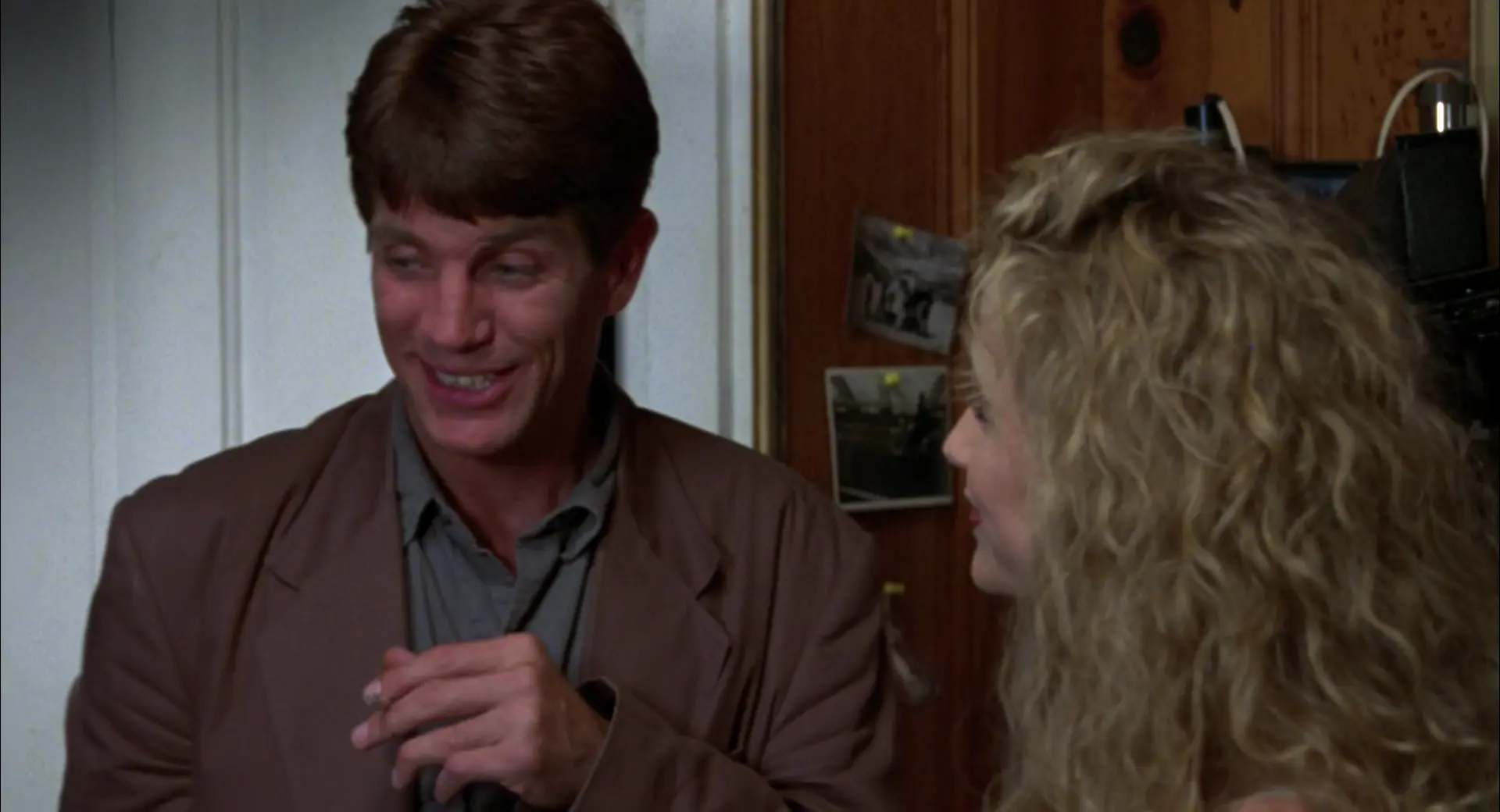
MH: Should we try and pull in a little on Eric Roberts? He is such an incredible figure; he turns up and you immediately feel, ‘This is one of the most charismatic actors I’ve ever seen.’ By now, I’ve watched a bunch of his films, and the Eric Roberts that Cohen found is there in them, but I’m not sure I would have found him had he not starred in The Ambulance. Cohen has a whole stable of these people, Michael Moriarty being the most famous. He picks up on a specific kind of physicality, especially in his male actors. I prepared a clip here, from Love is a Gun, a couple of years after The Ambulance. It’s not a very good movie — well, it’s okay — but I want to show less than a minute of footage, where Roberts is flirting with Kelly Preston in the pool house.
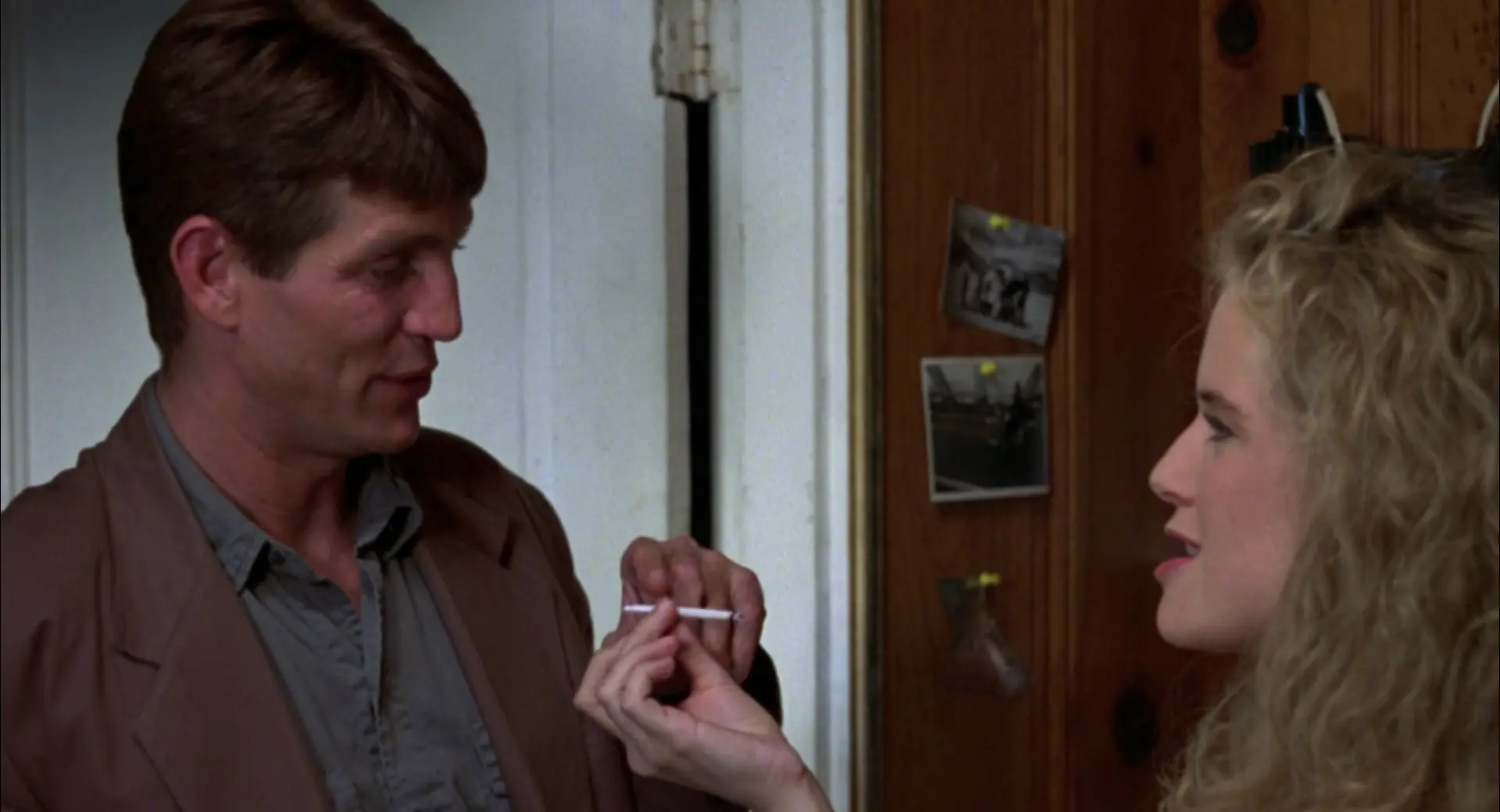
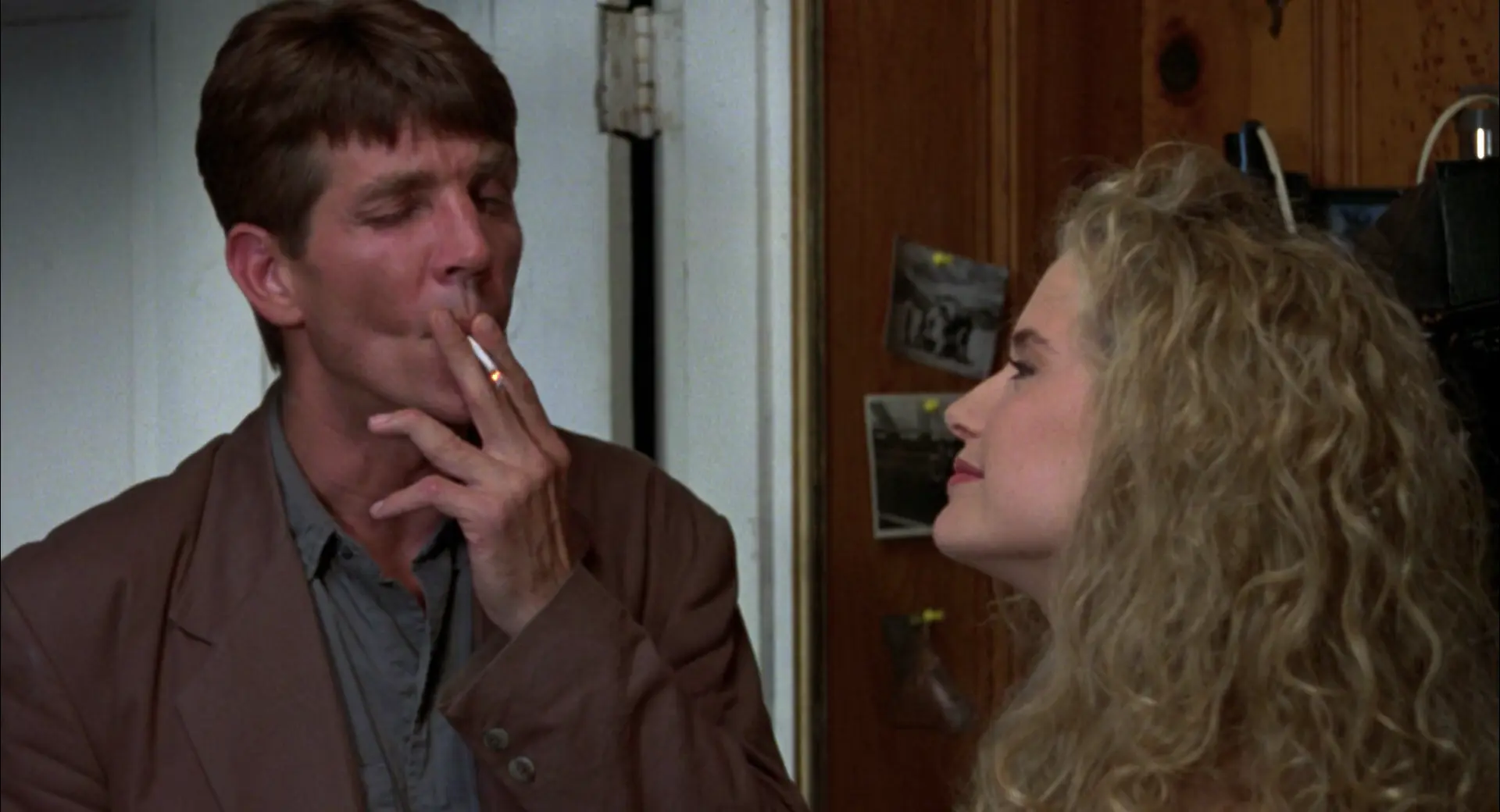
Love is a Gun (Hartwell, 1994)
Roberts pulls off an incredible set of expressions here, especially the Bugs Bunny bit with the joint at the end, which is pure Cohen. Cohen is attracted to that particular kind of face and physicality, which I wouldn’t have seen if he didn’t singularize it; he’s able to exhibit a certain kind of persona and a way of moving in the world. That’s a beautiful capacity for a filmmaker to have.
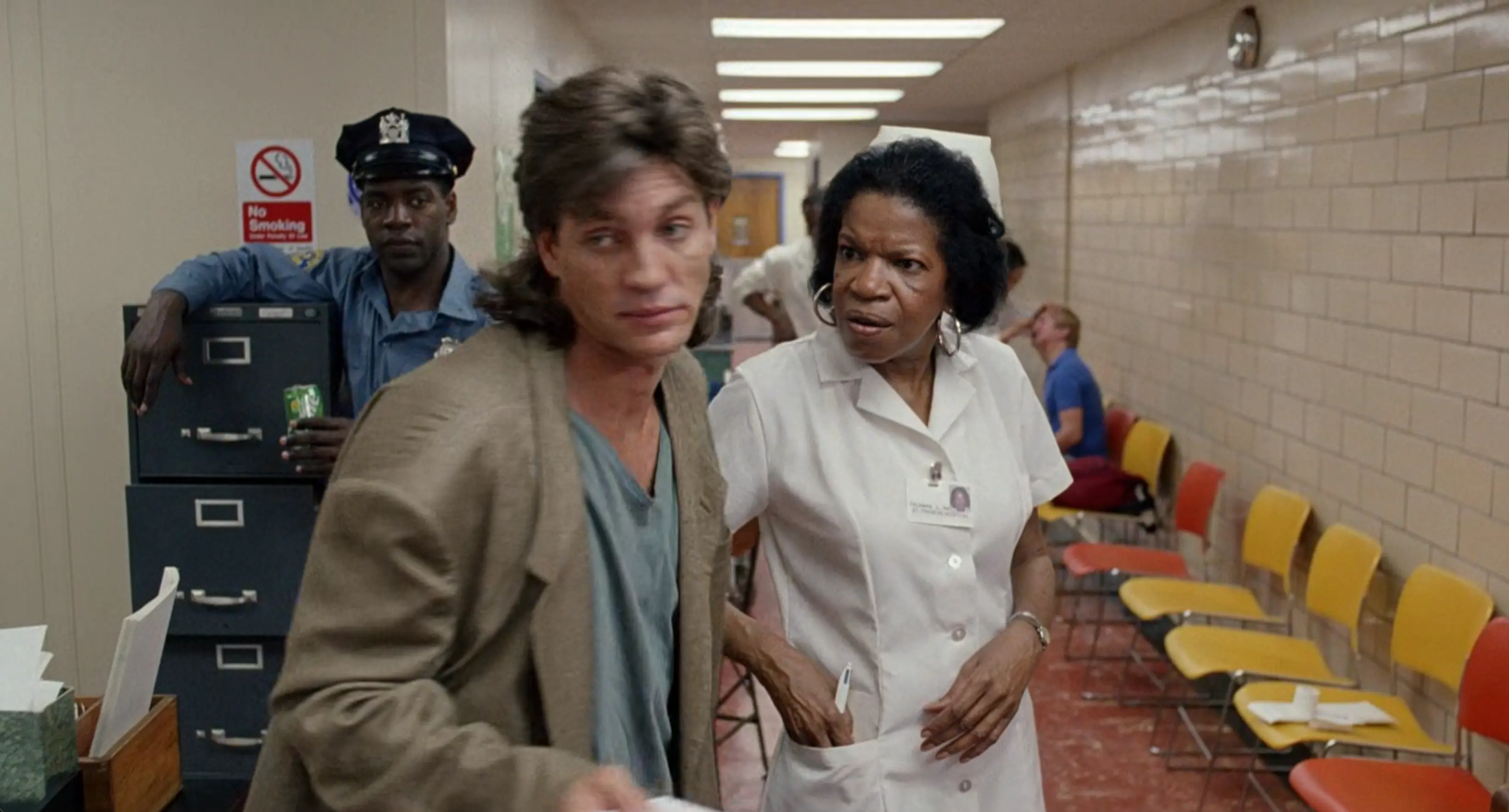
SWM: I feel like Cohen is pushing people to go the whole hog, maybe more than other people would with the same material. My favourite moment with Roberts is a tiny thing he does when he gets fobbed off by the nurse in the first hospital scene. As he turns away from her, he makes a face that is just perfect; it’s very cartoonish. I think most actors, and maybe Roberts himself when directed by someone else, would pull back from that cartoonishness, but it’s Cohen letting him use it that brings this out. Bugs Bunny is a good example, because the interactions are a little like those among Looney Tunes characters. There aren’t really straight men in the film because all the straight men are also eccentric, because everything is exaggerated, and it does have a Looney Tunes feel to it. It’s also just because Roberts has an amazing face with very large features. There’s a lot of capacity for expression in that face. One striking thing is how you are immediately on his character’s side, even though he’s essentially bothering a woman in the first scene, which on the surface of it is not something that would bring you onto his side.
JS: I think that’s Cohen’s brilliant screenwriting, how the character is always shit upon and in conflict with people. That puts you on someone’s side. And without the scene with the friend at the beginning, the moment before he approaches Cheryl, we wouldn’t be on his side; he would just be a creepy guy. But because we’re getting this look into the rest of his life, we’re somehow in support of him.
MH: Cohen’s direction of actors is able to emphasize things that a more naturalistic attempt to instruct them would have sanded off. It’s a skill he has. Moriarty is directed this way. He’s such a strange, vibratory presence in all of the Cohen films he stars in; he’s pulling different expressions in every frame, and the editing somehow manages to capture this prismatic personality. I don’t know anything about Moriarty's technique, but the impression you get watching him is that if you had asked him to repeat the line twenty times, he would not be absolutely hitting the blocking with the same expression each time out. But Cohen finds that expression. There’s an exuberance in the face of the performer, and Cohen knows, ‘That’s what I need’, and the film is set up to be able to capture it.
SWM: He sees something in people’s faces. When I think of Adam Arkin in Full Moon High, I think of facial expressions he makes before anything that happens in the movie. In the first scene in James Earl Jones’s office, essentially you have two guys with really big faces, who are really using those faces. The amount of movement in Jones’s mouth when he’s saying things is extraordinary. I’m not completely conversant with his filmography, but I’ve not seen a similar performance from him where he’s almost making his face into plastic, and it’s the closest you can get before you’re doing a Jim Carrey thing, where you’re trying to do Tex Avery with your face — where, as Jack says, if it wasn’t for the brilliance of the screenwriting, it would get to the point where it just becomes garish. But it never gets to that point. This is maybe the overall thing that is most extraordinary about Cohen, which is that his films are never garish. He takes the most garish subjects, but he never makes a film that feels crass. There are no cheap moments. It’s like he doesn’t know how to film cheaply; everything is filmed all the way, and that’s what allows him to go so far in directing his actors. But there’s never the feeling that there’s a gratuitously over-the-top element, never a feeling of being hectic. You’re not goaded to react, even as there is constant commitment to that which is larger-than-life.
The Ambulance (Larry Cohen, 1990)
JS: In that scene with Jones, there’s this reaction he has when they’re talking about his dentist’s appointment: he breaks into this huge smile for no reason, and it’s given its own close-up. I think that if we didn’t have those sorts of shots — this is now back to Thomas’s earlier points — if we didn’t have those irrational moments, the film would lose something. A shot like that allows us to suspend our need for every shot to have an explanation, and that suspension becomes necessary for us to go along with the film as it develops. So these extraneous character moments are, counterintuitively, the most essential parts of the film, and that’s why Eric Roberts is an axiom: without him, the whole movie falls apart.
SWM: On that, there’s one more thing I’ll say about the very last shot of the film, which is one of my favorite last shots ever: Eric Roberts and Megan Gallagher are on the gurneys, strapped down and trying to lean over to kiss each other but can’t quite do so. Beckett would have killed for that, to put that on stage! I’ve watched it loads of times, but from the laugh Roberts does there, you can kind of tell he’s breaking. Obviously it works in character, but I think it’s the actor corpsing. Maybe it’s just good acting, but it is one of those moments you get in films where it feels like something is breaking across, which again comes from the physicality Cohen introduces into things through his conceptualization of scenes. He conceptualizes these things that allow those kinds of moments for the actors.
MH: You can say the same about the flirtation scene in the limo near the end. Obviously, film is about creating a fiction that you buy into, and it’s a bit ridiculous to watch a film and think, ‘Oh my god, it’s so nice to watch people actually flirt’, as if it was all real, with no barrier anymore. Nevertheless, I feel like when I watch that sequence, Roberts and Gallagher are flirting. Roberts steps into this silly mode with his cornball setup. He’s requesting protection from the policewoman, ‘What if there were people outside my door?’, then, ‘But what if they came in through the window? Wouldn’t you need to be near my bed?’, and then, ‘Well, maybe you need to get between the sheets?’ It’s so ridiculous, but the actors are having such pleasure with the silliness of the script without any ironic distance from it; they’re not making fun of it. The script is there in a first-order way to allow them the pleasure of saying this silly thing, which then also becomes real flirting, at least for the duration of the shot. The screenwriting and the exuberance go together intimately.
TD: Perhaps it isn’t strictly ironic because I’m thinking of more outrageous examples of this, something that happens in films like Showgirls. But where Verhoeven would go in an intellectual direction, Cohen usually resorts to the physical aspects of the situation rather than some detour through a veiled joke. I’m curious how people feel about irony in Cohen’s films — if they can be called ironic — because they feel almost resistant to it. I don’t understand how they achieve that resistance, or what the mechanism behind it is, because there would be so many opportunities for it. It’s an especially rich technique. As Sam said, he’s unable to do something cheap.
TMP: The ironic denouement is when Josh finds Cheryl at last and realizes she has no interest in him. It does make him more sympathetic in that it reinforces his insistence that he has to find her, that she’s someone he should approach regardless of the fact that their rapport starts out with her feeling bothered and ends with her not reciprocating. As for his scene in the limo with the real romantic interest, Sandy, what’s great besides the flirtatious dialogue is how it then cuts to them looking out from the limo’s roof, and he announces, ‘That’s my apartment.’ It’s reminiscent of a cut in Hello, Sister!. There is tact in treating such a moment; Cohen builds up steam just enough for us to slide into another register still within this intimacy. What makes this relationship work throughout is this sense that they can find time to spend together, that they can amuse each other with seductive rejoinders. Things like the intonation and timbre of each actor also work to this effect.
JS: The irony you’re pointing out is such a heart-on-the-sleeve irony. In that line when he meets Cheryl, ‘Well, I guess I just got it in my head that I had to find you’, he really emphasizes the ‘had’, which is the opposite of — or maybe the same as? — serendipity. It’s amazing that Cohen, Roberts and everybody else involved were not afraid to get laughed at. It’s the same with Oedipus Rex, which is almost stupid with its irony, or with a Jerry Lewis movie. To me that’s the mark of a great entertainer: not being afraid to get laughed at. While irony is usually a way to avoid laughter, The Ambulance begs you to make fun of it.
Notes
Jacques Rivette, ‘Génie de Howard Hawks’, Cahiers du cinéma, 23 (May 1953), 16–23 (p. 16): ‘Evidence is the mark of Hawks’s genius; Monkey Business is brilliant and imposes itself on the mind through evidence.’
Serge Daney, ‘The Go-Between’, Libération, 22 September 1983. A translation is published on the blog Serge Daney in English, https://sergedaney.blogspot.com/2011/03/daney-on-losey.html\#gobetween.
Michael Doyle, ‘The Ambulance (1990)’, Larry Cohen: The Stuff of Gods and Monsters (BearManor Media, 2016), 389–401 (p. 398).
Rivette, p. 23.
Doyle, p. 399.
Daney, ibid.
See our translation of the interview conducted by Mathieu Li-Goyette for more information.