Wearing a moss-green leather suit over a cream-colored cashmere turtleneck, Louis steps out of a sun-dappled drawing room into the glen where his daughter’s wedding is taking place, having just informed his ex-wife that he’ll soon die of AIDS. As we’ve seen him do before in the film, Louis yields to the family and friends who are urging him to sing, and loiters his way into a musical number. The rest of the wedding guests slowly emerge from the woods — they follow and surround Louis, becoming in a sense his background singers, and the camera pulls back to give us a sentimental crescendo.
Accept the constraints.
Reject your dread.
Tolerate your pain.
Don’t live in fear.
Never again be cold.
Bet on happiness.
Ignore oracles.
Love is a miracle:
Learn it by heart.
__
Once more, forever.
Once more, tomorrow.
To shout again.
To dream again.
To suffer again.
In body and heart.
To cry again.
Tremble again.
The sun, again.
Once more, to wake.
Once more, go mad.
Desire again.
Pleasure again.
Happiness again.
Once more, to kiss.
Go too far again.
Sigh again, come again.
Tomorrow again.
In the final moments of this song, as Louis and the wedding attendees trade alternating verses — him the martyred romantic admonishing his lover, Michel, to live; their straight chorus admonishing them both to repeat — he seems to slip the penultimate verse: ‘vivez la vie / encore, encore.’ He barely manages to mouth it, or he chokes it down. Is this failure intended for effect, meant to reinforce the burden of Louis’s stoic suffering? Is it a simple accident of the way that Once More’s musical vignettes, rendered with a sparse, rehearsal-like candor reminiscent of Chantal Akerman’s Golden Eighties (1986), disdain the precision normally operative in ‘the musical?’ Or is it a sign that the romantic discourse of this work might be grounded in an ironic distance that requires effort to think rather than feel?
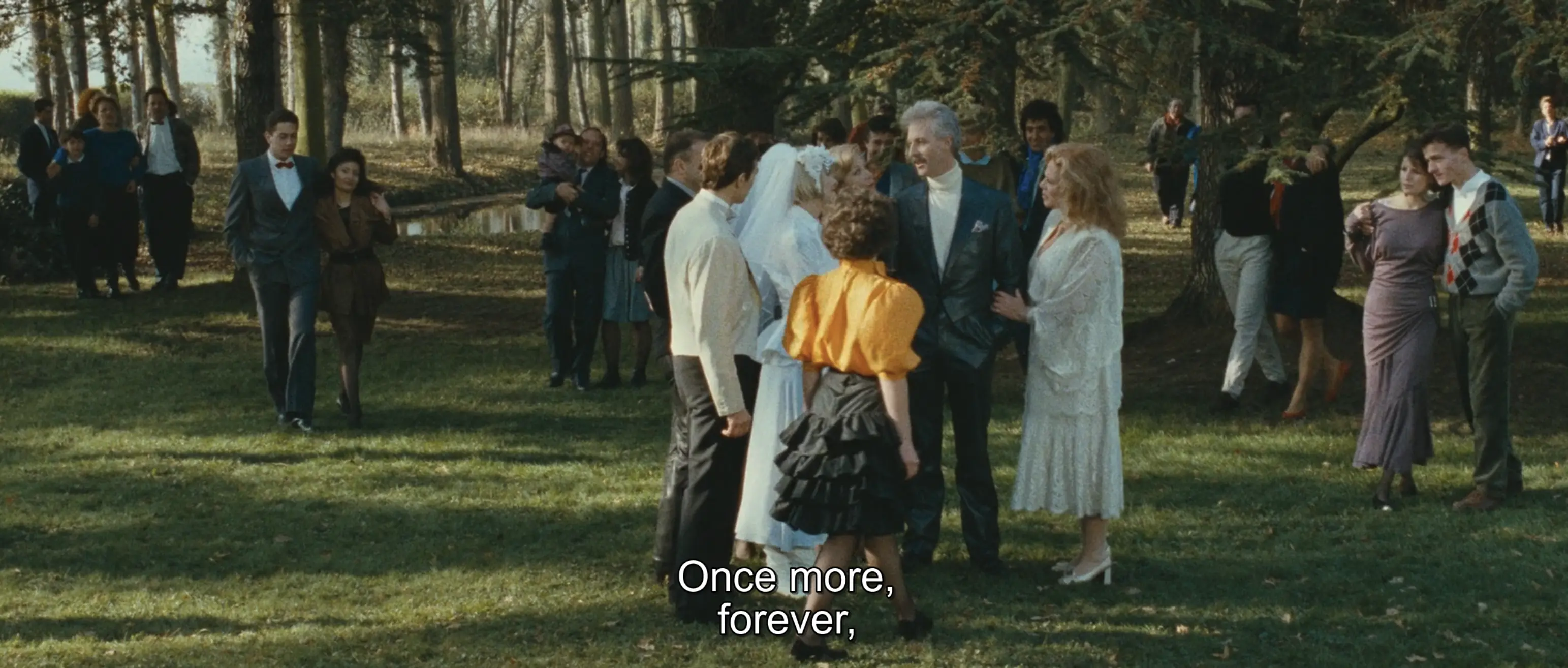
Once More (Paul Vecchiali, 1988)
Once More is broken up into ten sections, which each depict a day somewhere around the birthday of Louis’s daughter, Anne-Marie, on the 15th of October. In the arc of these ten sections, which cover the decade between 1978 and 1987, we see Louis — bourgeois, Parisian, middle-aged, and unhappy — walk away from his married, heterosexual, fatherly life. He falls in with those whom (as the opening monologue states) society considers ‘inappropriate’: homeless grifters and homosexual libertines. He soon meets and falls in love with Franz, who introduces him to the world of cruising and leather bars. While Franz quickly dumps Louis and insists that their relationship was a fling that meant little to him, this loss stays with Louis for the rest of his life. No matter the love his other partners have for him (both men and women, and including Michel, with whom he is in a longer-term relationship by the time of his death), Franz remains the lost object for Louis. Five years later, as the lovesick Michel waits patiently at Louis’s side in hospital — ‘I hope I die from you,’ he whispers in the older man’s ear — the last thing Louis utters is not Michel’s name, but Franz’s. Unable to remain with the beloved, in the love that reshaped what love was for him, Louis settles for becoming Franz for someone else, drawing a clear allegory between the destructive transmission of love and the transmission of AIDS itself.
This melodrama is only accentuated by the characters orbiting Franz and Louis. The two are introduced by the charismatic Ivan, a grifter just as happy making money disguising himself as a preacher of sexual chastity as he is playing the pool shark at the local gay bar, as well as by the earnest Immondice (‘Filth’), who functions as conduit and message-carrier between them in the years of distance following their breakup. Despite her birth and aging giving the film its structure, Anne-Marie functions like a mercurial joke about heterosexual bourgeois fantasies, being sexually attracted to her father and constantly trying to bed him. If this is a film about love, then Louis has supplied his daughter, too, with the same model he bequeaths to Michel, in which the truest love is the least reciprocated, the most tragic, and the hardest to move on from. After Anne-Marie gets married, her new husband seeks out Louis’s advice, finding himself unable to fill the role for her that Louis had: ‘don’t try to accelerate the movement,’ her father tells the groom.
But what is this movement that must be allowed to take its natural course, to find its natural pace? How can we square Louis’s romantic admonitions with a film that does everything it can aesthetically to evade ‘naturalness’? Vecchiali accomplishes this through modulating the serialism of the film’s formal structure. Other than the final one, each section of Once More is a single shot ranging between around seven and eleven minutes in duration. The first four sections ascend the scale of duration: part one lasts seven minutes, part two lasts eight, and so on. In part five, when Franz leaves Louis and Louis tries to kill himself as a result, the ‘timer’ resets, and the scene ends at the baseline seven minute mark. Part six resumes the count, giving us the peak duration of eleven minutes — in this section, Louis, like his daughter, seems to have resolved to find new love. But as the sections progress the duration of each shortens, to nine, to eight, to seven once more. In the final section, where the one shot rule is broken and we are shown the people in Louis’ life as he dies, the seven minute duration repeats. At first love prolongs his access to time, giving more of his life to him; when clung to ‘past its expiration date,’ however, love condenses his access to time, bringing him closer and closer to his death.
On the one hand, this play with duration gives us the hint that Louis can’t take his own advice. By stubbornly hanging on to his love for Franz, and by forcing it to play a structuring role in his new life, Louis tries to slow the movement, which is evidently as much a sin as accelerating it. On the other hand, the decision to limit each section to a single shot gives us the hint that Louis is only partially captured by the rigidity of such constraints. In one scene, Louis spontaneously breaks into a figure-eight jog on a sandy beach, and briefly escapes the continuousness of the shot; show horses prance freely in the background. In another scene, Vecchiali masterfully moves the camera through, out of, and back into a subway car: dressed as beggars, Ivan and Immondice take turns singing loudly, and an uncomfortable Louis drifts nearly out of shot as we follow the song. When he tries to duck out onto the platform during a stop in order to move to a different car, presumably to dodge the social discomfort of the pair’s poverty and emotional unguardedness, the camera follows him back in, just as Ivan does — it isn’t just Ivan to whom Louis’s defiant ‘what do you want from me?’ is addressed. Far from showing us a man constrained by straight life and freed by queer life, Once More shows us a man who delights in his capacity for the transference and maintenance of a constraint. What we see of his life is apportioned according to the arbitrary index of October 15th; this is the day of Anne-Marie’s birth, but it also happens to be the day Louis first met Franz. It matters little which of these events yields the cross-section, just that the runnelling of the one made possible the runnelling of the next, and that both events were outside of him, outside of his control. Louis enjoys his unfreedom, and surrenders wherever he can to the obliterating dialectical movement of love.
In a 1988 interview published in Cahiers du cinéma, Vecchiali described Once More as an exploration of ellipsis. For him, the ellipses of Once More’s ten-part structure point also to the basic rhythm of filmmaking: between each take, between each shot, there is a pause, a hiatus, from which everything must be picked up again. As in love. These ellipses, in Vecchiali’s view, are the material worked by the director in the composition of a film, as he tries to make them invisible, or tries to make their visibility structurally useful. In this same interview, Vecchiali reveals his intentions with the climactic song at Anne-Marie’s wedding:
The wedding song’s function is to prolong, to cast doubt, even to entrap: it’s apparently ridiculous, voluntarist, when in fact it’s an alibi. Why does the camera rise up into the scene? Because I can’t show the ellipse of the figuration in any other way than by diving into it, with the two focal points of the ellipse being the two lovers, in the context of the bourgeois institution of marriage. This is where the film takes place: we see these two households, the camera descends, and suddenly the song becomes aggressive: ‘Encore, Encore’. The whole family behind seems to be threatening the couple in front [...] That’s how the shot is constructed, and the song is there to provide a façade; it’s doubly ambiguous, because of what it says. It presents a philosophy of life, which is certainly a lie on the part of the character who is sheltering behind it to commit suicide, and it has the appearance of grandiloquent cinema, whereas it is [...] its reverse: the horror of the family, cruelty... For me song has always served to extend a universe, an opinion, an idea, or on the contrary, to stand back, take some distance, or even deny a universe. And that comes from the French cinema of the thirties.. [1]
Given Once More’s distinction as the first French film to depict AIDS, it may be shocking to hear Vecchiali describe Louis’s death as a ‘suicide’. After all, it was state incompetence and homophobia that killed men like Louis, not love. But we cannot deny that our protagonist assents to his own destruction on a more fundamental level, by participating in a regime of song that metaphorizes his enslavement to bourgeois, heterosexual ideas of romance. What is remarkable about Once More is its irreducibility to AIDS history, and the way its formalism allows Vecchiali to demonstrate how subjects shot through with history, constrained by history, can also free themselves into transhistoricality through their subjection to love’s operative movement.
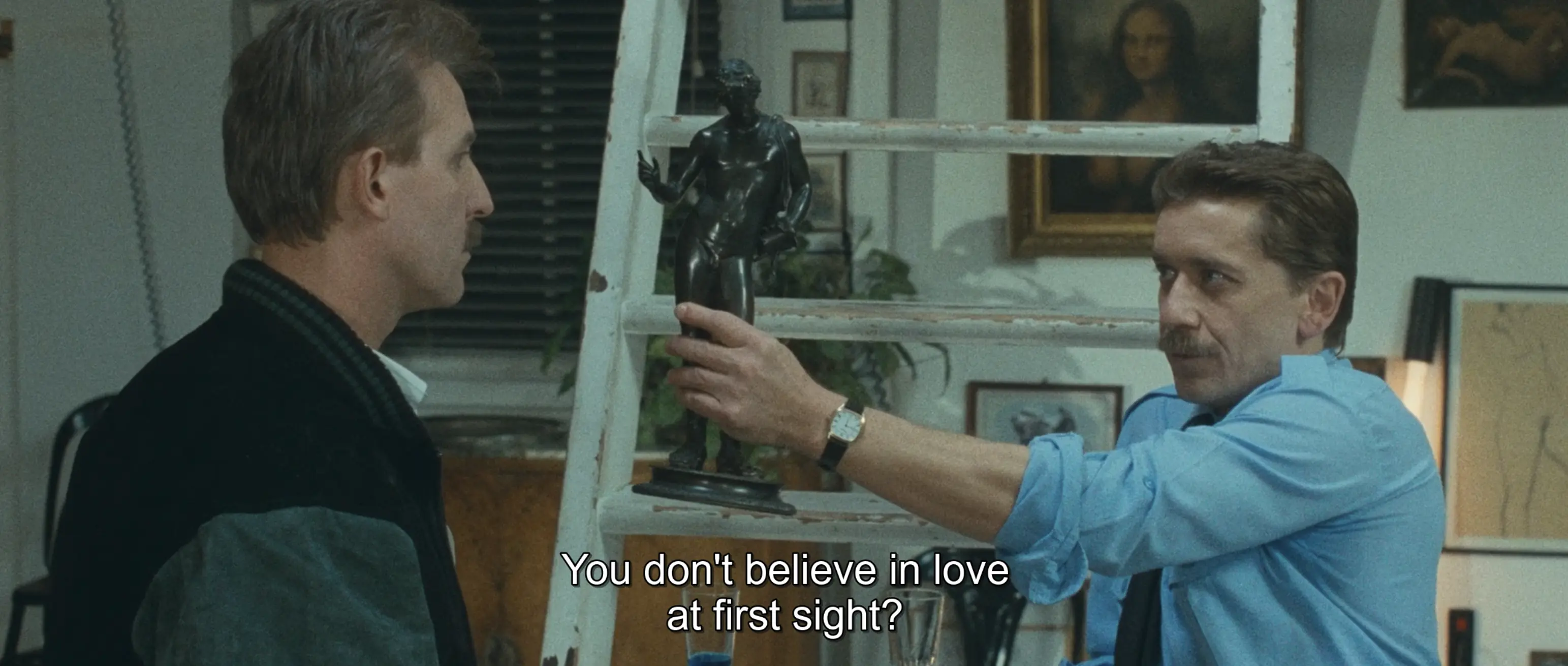
In the very first scene, Louis and Anne-Marie chat over a puppet of the commedia dell'arte. Given the choice between loving in the way the music asks him to, as a puppet, and not loving at all, in the end Louis chooses the former. At least then it remains possible that constraint might become material from which to compose something new, something ‘romantic, yes… but differently romantic.’ Franz, meanwhile, chooses the latter — there is something he cannot utter. He doesn’t reply to Louis’s love letters, likely aware that Louis will write his replies for him. He attempts to live without love, without memory, alone. But this silence, too, can be treated as an ellipsis, equally able to form and sustain the rhythm of a love. Julie Kristeva has said that ‘the language of love, whitewashed and sung as resonant inanity, is rather the ellipsis than the metaphor.’ [2] When the ‘“I,” a perverse, sensual lover, sees the thing, straightforwardly and without embarrassment,’ it ‘cannot utter it wholly.’ [3] Vecchiali has no doubt that what Franz and Louis see is the same thing, the same basic situation to which Once More applies all of its formal armature… ‘le romantisme par excellence: ni avec, ni sans.’ [4] When the formalism of Once More collapses with Louis’s death, we linger on a shot of Franz, distraught in a distant nightclub. Where once the camera had followed Louis as he looked for his love, weaving through the crowd under Wagnerian synths, now all song is absent. It may be that this silence is the same as that which interrupted the wedding verse Louis once struggled to deliver. It may be that when even a loss retained as hiatus is lost, something of love’s rhythm is preserved. What Vecchiali’s filmmaking knows is that it is only through constructing and submitting to constraint that we might approach the situation to which such possibilities are oriented. For every ellipsis, and every love, fetters us with a promise: not that we will get to live the encounter ‘once more,’ but that we will find it there still, enduring.
Notes
Frédéric Strauss and Serge Toubiana, ‘“Ne vivez pas la peur”: Entretien avec Paul Vecchiali’, Cahiers du cinéma, 411, September 1988, 19–21 (p. 20). See the translation published in this issue.
Julia Kristeva, Tales of Love, trans. by L.S. Roudiez (Columbia University Press, 1987), p. 278.
Ibid., p. 369.
Pascale Bodet and Emmanuel Levaufre, ‘Le branle des évidences (2)’, La Lettre du cinéma, 19, Winter 2002, 20–55 (p. 41).