Rejoice, unhappy creature; time would have without cease weakened the tyranny you are leaving; time will without cease strengthen the tyranny under which you are going to pass.
—Denis Diderot, Sur les femmes
The opening credits intercut matte blues with nocturnal sparseness, light-diffuse humidity. The ‘Boyfriends’ Cafe’ has a name: Le Relais, sitting on the fringes of Paris in late ’88, between vexed peri-urbanization and looming geopolitical mutations. The anonymizing title suggests that its macrosocial contours will be contingent upon the disposition of its clientele. A synth score plays over the vibration of tires on wet concrete, over the percussion of a woman’s heels and the dishes she’s clearing out. From outside, the camera follows her walk across the cafe, revealing its interior (a sunken dining area, an elevated bar, a pinball machine, a billiard room, a white-tiled kitchen) and exterior (double façades, a vaudeville poster of sorts — we recall the ads for exotic strip shows in Rosa’s quarter — and a visitor hurrying towards the visibility of their sex, their class, their ethnicity).
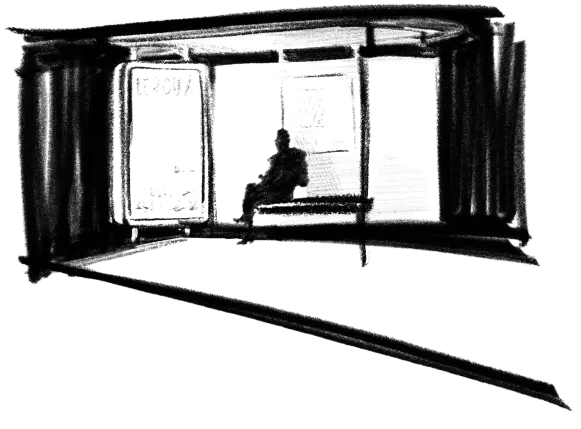
Le Relais, likely walking distance from La Diagonale. Paul Vecchiali picks up these signals from this relay station in Kremlin-Bicêtre with a resourcefulness made possible by lived proximity: in and around the cafe, over the course of a night, whatever emerges in some spatial significance is underlined without overemphasis, articulated through its relationship to the mobile characters who bring with them mysteries from beyond the frame, substantiating points of contact previously null. Our imaginary construction of the vicinity exceeds visible contiguities: shots of the bus shelter, for instance, reestablish it throughout the film, first as being seen by itself, then as being seen behind the cafe, and finally as being kept out of sight by it, thus alternately suspending and resuming its adjacent existence as a site of departure. Vecchiali sieves through such constituents of landscape, exploring its legibility without recourse to a substantial change in location.
Original illustration by Kate Sianos
For his part, Jacques Nolot, the film’s writer, thinks his script ‘shows a little of the milieu where [he, or his character,] lived in his childhood’. [1] Which would have been decades earlier, further south in France. Perhaps it was an effect of memory (of the bigotry and suffering of folks one grew up with) that rendered his initial text, in Vecchiali’s judgment, excessive and didactic. Two revisions reinforce the contemporaneity of the film to the world, and of its events to their execution: first, the creation of the character Guy, possibly an immigrant living in social housing, a black factory worker who makes fun of both the oil shocks and communism, apathetic to the contempt Jeannot (played by Nolot) shows for the circulation of capital; second, the intensification of the plot involving ex-lovers Jeannot and Christiane, which binds every expression of their bygone history to immediate circumstances.
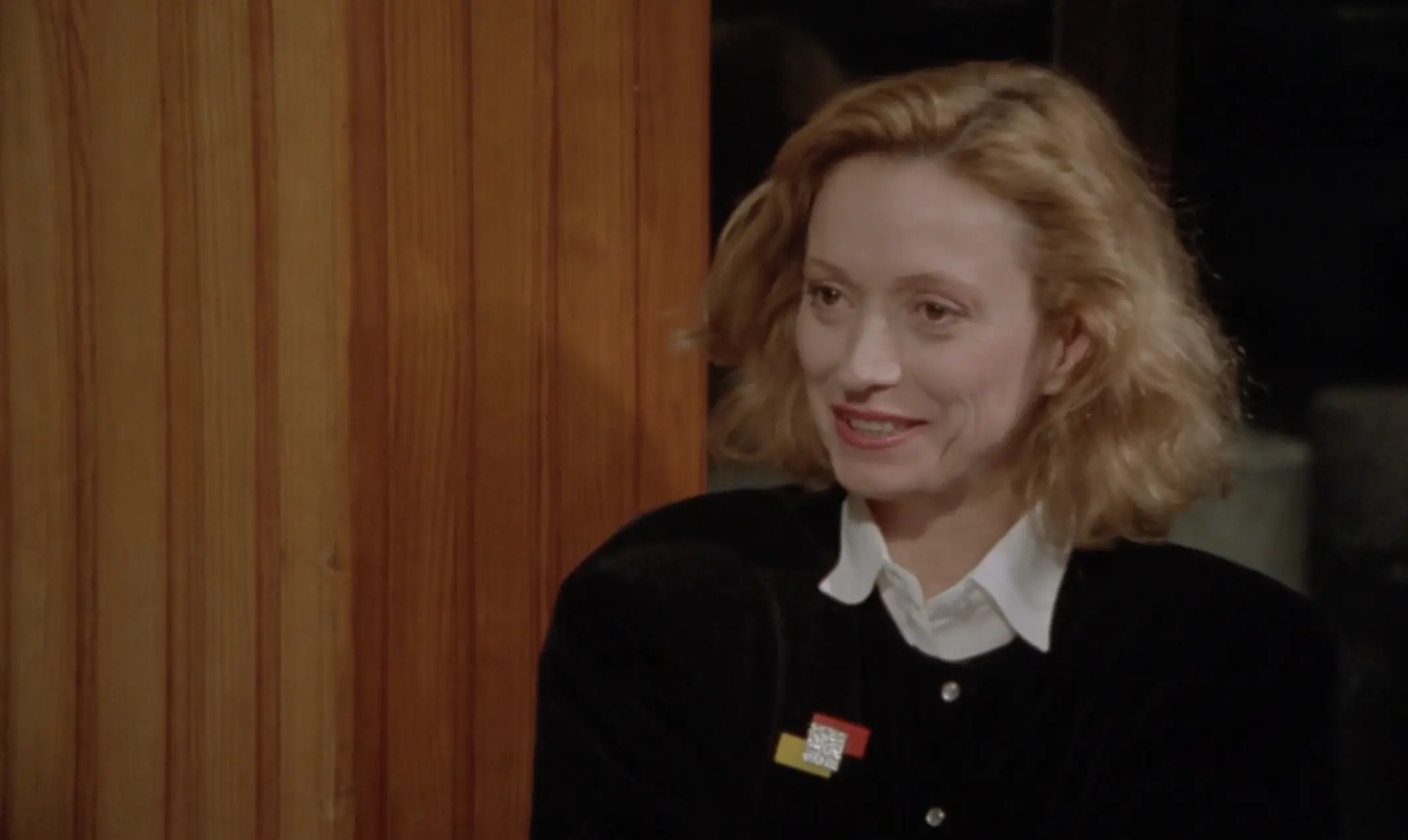
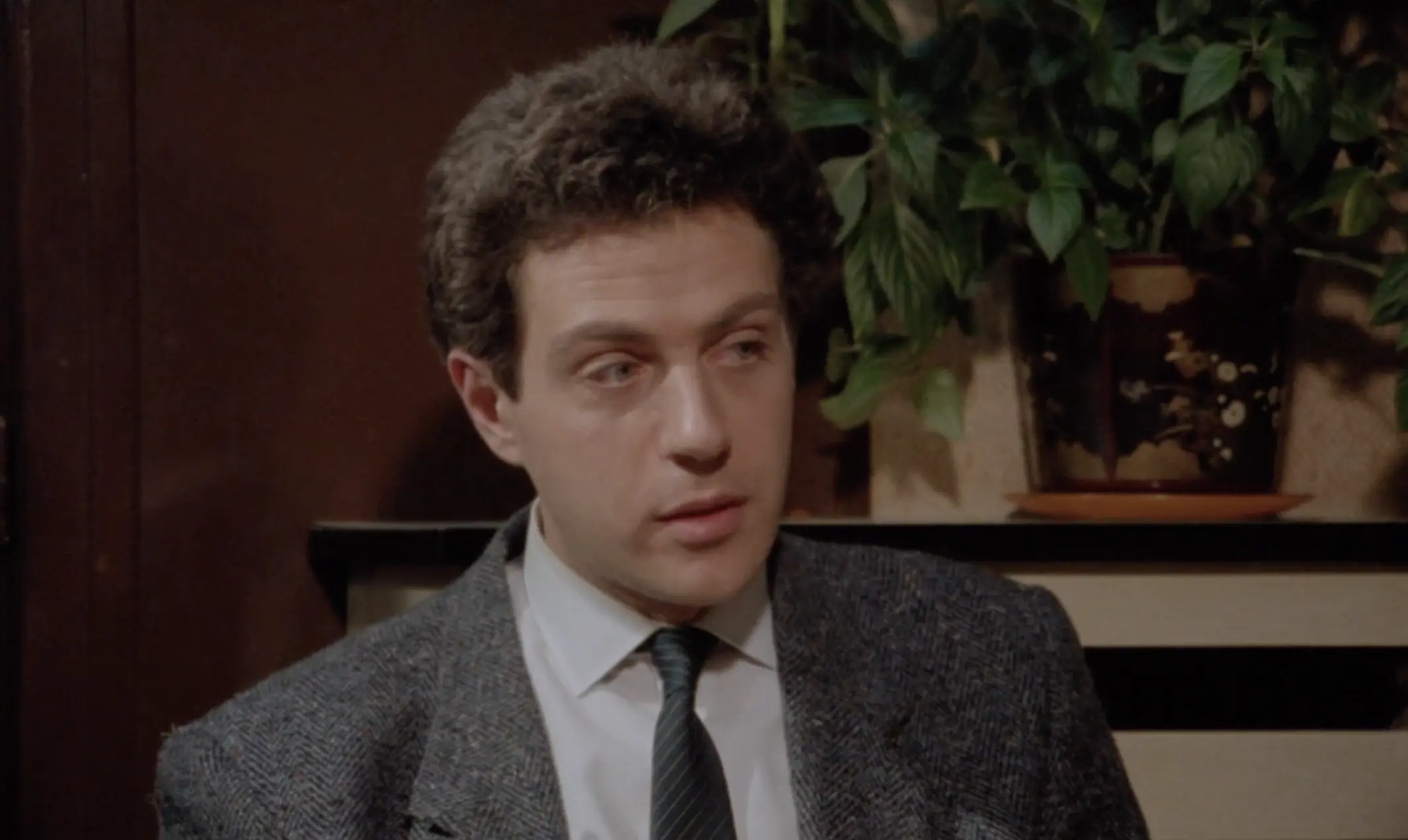
In particular, almost all ellipses in this neighborhood drama feature only in the portion before Christiane appears; an impression that the fictional time aligns with ours is then sustained until she leaves. A local who moved to Paris years ago, she invites herself to the cafe last and is the only character who takes a second to peer inside, as if lured ex nihilo along cinema’s chiaroscuro towards the distress of an acquaintance over his vanished cash, his lost youth. For distanced lives are seamless despite themselves: they greet her arrival with a strange lack of response; the ensuing exchanges treat her past as given, known among themselves. The only one who has not met Christiane, yet who shows more in common with her than them (in terms of attire), is David, first seen hurrying here at the beginning. Until their meeting, this newcomer has often been stuck somewhere in the depth of field, while those familiar with one another move between varying registers of proximity to the viewfinder; he’d find his body parallel or perpendicular to theirs, somewhat underprepared for mutual address. The scene of him and her sitting together, thereby discovering they’ve had similar jobs and lived in the same area, is thus exceptional: it consists of shot/reverse shots of them simply getting to know each other, amid an obscure negative space with no obvious continuity to the rest of their environment.
Le Café des Jules (Paul Vecchiali, 1989)
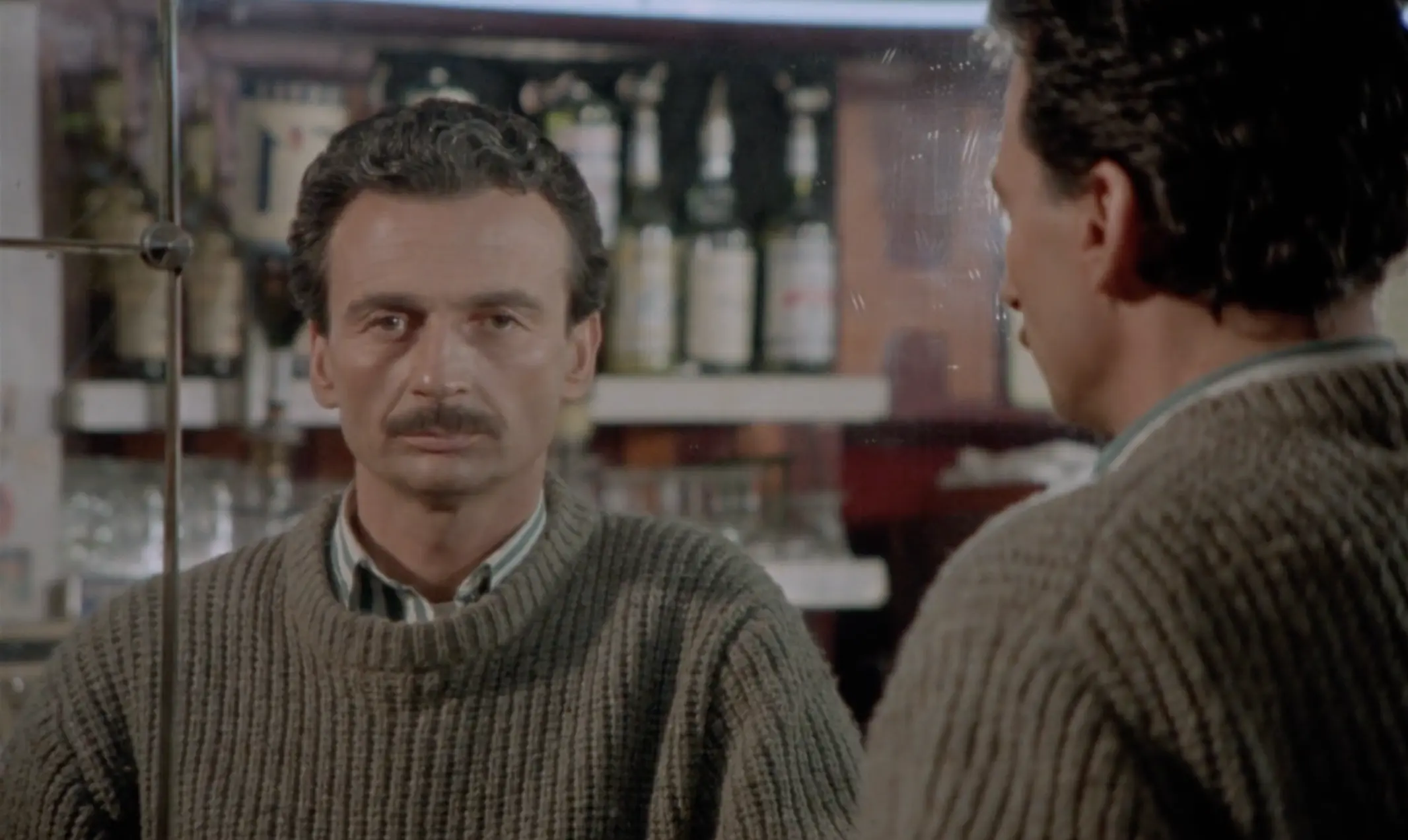
No other interaction in this cafe was framed like this; no other will be. For a ‘poetics of mirrors’ has been escalating erratically ever since its regulars showed up: Jeannot, Guy, Robert, blue-collar men hanging out at weekend. We find here attempts already initiated in Vivre sa vie (1962): inquiries, à la Griffith, into what a change of shot obtains of the human, how any such change delineates this filmic object and allows others to articulate it on its behalf. [2] Vecchiali mobilizes reflections (on mirrors, the counter, the storefront glass, the cover of the pinball machine and elsewhere) in their dissociation from — and identification with — those beings reflected. The result is a ‘relentless biopsy’: in the pliant receptacle that is mise en scène, the intercorporeality of the actors is constantly dissected and recapitulated. [3] ‘You told me two cameras, I see a hundred’, Georges Strouvé (director of photography) joked. [4]
Of the film’s many mirrors, the panes oblique to the counter are primarily present during the first third of the film, where already sour, volatile misalignments and eclipses of identity glide over their surfaces. The others, especially the column with mirrors on two sides, separating the bar from the dining area, are predominantly used to stage within (as opposed to after) a shot its reverse shot, a time capsule rendering concurrent the reciprocal and the unilateral, the reflexive and the projective — in short, instantiations of the dyadic numéro deux in this historical situation that overflows the sum of its part(icipant)s. The dialogue weaves its own prosodic threads: listen to how the homophobic utterances of the syllabic ‘cul’ cluster, in an inconspicuous scheme, around Jeannot criticizing Martine for shoving too many means of production up her ass: ‘L’accumule! Ouais, tu accumules!’ (as he reminds us, Le Relais, which she owns, is a cafe–restaurant–taxi–driving school); listen to how the onomatopoeic mooing that begins Robert and Jeannot’s juking add a ring to the former’s boast of his virile bulldozer. [5] Heed also the declarations of the intention to piss, which function like a leitmotif, or the charged puns, the drunken refrains (‘I wash, I shave, I divorce!’). All these ‘arpeggios [of] sonoric and spatial rhymes’ are achieved with multiple-camera shooting (unusual for Vecchiali–Strouvé) and meticulous soundwork (which interacts contrapuntally, forcefully with the blocking of interior scenes, in stark contrast to the spatially detached voice mixing in certain exterior ones). [6]
The film so acutely indexes its prefigurations, repetitions and juxtapositions of behavior that when the men finally notice David’s suitcase behind the counter, we can only retrace, against dramatic fate: had Martine not left the bar for reasons not quite privy to us (her husband Dédé explains: she ‘feels the mood changing’), it might well have remained unnoticed. Had David not been unwittingly locked out of his home, he and his suitcase would not be at this cafe at all. In a sort of satirical take on the Baudelairean mundus muliebris, the feminine items found there — lingerie — turn the wearers of heterosexuality inside out: Robert puts panties on like a diaper, while Guy changes out of his pantalon rouge into silk camisole and knickers. Together with Jeannot, they coerce David into performing a number; the latter then sings Verdi’s brindisi in an abject way, evoking all too current tensions curiously mixed with anachronistic stereotypes (the Jewish evirato, the bourgeois courtesan). Trying to stop the farce, Christiane insults Jeannot, who retorts by tossing her around (not unlike the ball he was earlier mocked for failing to catch), then raping her at the table facing the column (where Martine earlier refused to seat him, on account of David). Guy witnesses the rape from behind, himself mirrored on the same plane as the victim and the perpetrator, while Dédé’s reflection watches him watch it unfold, his onscreen complicity restricted to a property owner pulling curtains and locking doors. Only when Jeannot has burst into dysphoric sobs and recoiled from his image on one side of the erect column does Dédé leave his on the other side: from offscreen, he walks over to slap Christiane — whose physique is largely blocked from our view — out of her blackout.
This entire spectacle and its entanglements, for which my words are of necessarily finite representational value, justify Bazin’s (and Jean Domarchi’s) postulate: a sex scene gains its aesthetic worth by dealing with and in the fact that its actors are not acting on their own libidinal needs. To the spectator, the ‘supposed plausibility’ of the experience must then be thinkable in cinematographic terms, for which how sex is filmed, and not that it can be filmed, matters. [7] The gestures that resolve this scene, and ultimately this film, matter: across the distance of a shot flanked by reverse shots, the camera observes the downcast gaze of the woman rising to meet that of the man who raped her; it later delivers, during the end credits, two final close-ups of them, of which that of the former seems to be the same take but now cut short, just seconds before — as we know — she looks up, while that of the latter is a new shot, framing him in a way we haven’t previously seen. Over these reprises of their faces, still ‘in character’, but no longer in each other’s eyeline, atop what sounds like real noise at the film’s setting, I hear the director announce four distinct names, and remember what Christiane/Brigitte Roüan said of Jeannot/Jacques Nolot before all this: ‘He’s very kind. A bit violent, but very kind.’ The Vecchialian operation is true to the paradox of the actor; it claims the fortuity of fictional beings, all while doubling down to see them through… once more.
As for the elaborate sequence shot which ends the film in sensu strictu and, for Vecchiali, ‘sends naturalism packing’: I will just say that this écrivain filmique often uses this term pejoratively, attaching to it the sense of an uninspired, lazy reproduction of material, and that, by the same term, a certain écrivain littéraire never means that at all. [8] ‘So take the contemporary milieu, and try to make men live there: you will write beautiful works.’ [9] The next morning, Martine, moved by the bare freedom of seeing how time has again disarticulated yesterday’s relations, leaves her cafe for the first time and heads towards the bus shelter, where the camera has left Christiane. She stops at the street corner, where a pigeon crosses her path, and looks beyond the frame. We will never know whether Christiane is still waiting for a bus. Seeing that, in order to find out, Martine has just walked the exact inversion of her walk at the beginning of the film, we rejoice at their lives to live: they will have done what they did not do. This — commissioned and shot in six nights — is a beautiful work.
Notes
Janine Euvrard, ‘Jacques Nolot: Entretien’, 24 Images, 95, Winter 1998–1999, 36–42 (p. 37).
On a tangential note: Jean-Christophe Bouvet’s face, notably in Change pas de main (1975), is the counterpart of Anna Karina’s, through which ‘our art reveals its transcendence most strongly, making the beauty of the object signified burst forth in the sign’. Jean-Luc Godard, Godard on Godard, trans. and. ed. by Tom Milne (Da Capo Press, 1972), p. 28.
Jean-Claude Guiguet, Lueur secrète: carnets de notes d’un cinéaste (Aléas, 1992), p. 191.
Paul Vecchiali, Le cinéma français: Émois et moi — Tome 2: Accomplissements (Éditions Libre & Solidaire, 2022), p. 132.
To stretch the semantics at play: the type of demolition project that crushed the interconnectedness of working-class existence in the banlieues has at times been dubbed ‘rénovation bulldozer’.
Guiguet, p. 191.
Hollis Frampton, ‘Erotic Predicaments for Camera’, On the Camera Arts and Consecutive Matters: The Writings of Hollis Frampton (MIT Press, 2009), 89–94 (p. 89).
Pascale Bodet and Emmanuel Levaufre, ‘Le branle des évidences (2)’, La Lettre du cinéma, 19, Winter 2002, 20–55 (p. 25).
Émile Zola, Le Naturalisme au théâtre: les théories et les exemples (Charpentier, 1881), p. 21.