‘Yes, we are in a bad place. Der Tod des Empedokles calls us to order: the murderers are among us,’ proclaims Jean-Claude Guiguet in his short review of the Straub–Huillet film. [1] Though he wrote these words nearly a decade after the release of Les Belles Manières, they remain pertinent to the film’s concerns, its pained grasp of how ‘we live with hatred for each other, we work without conviction, we chase money we don’t need, only to die one day without anything having really happened in our lives.’ [2] Our enemies are indeed close to us, suffocating us, denying us an escape. In response, both films’ heroes choose suicide, the total negation of the world, as their solution to its unbearable ills. The key difference between Empedocles and Camille is that the latter is able to share the frame with his interlocutors, whereas the former is not granted such a luxury.
Although Empedocles tells the Agrigentines that they have been reconciled, the découpage continues to separate them into individual shots. Their reconciliation is never actualized. Instead, the very next reverse shot doesn’t contain the Agrigentines at all. In their place appears Mount Etna, anticipating the film’s final shot. For Barton Byg, ‘the absence of Empedocles, his ascent as a hero into the flames of oblivion, is contradicted by the verdant presence of nature, particularly in the form of the repeated long shot over the valleys toward Mount Etna’, accentuating these still frames as discrete units devoid of spatial overlap. [3]
Les Belles Manières, on the other hand, literalizes the flames that Empedocles plunges into. They are in that close-up we get of a Camille genuinely free for the first time, an ambiguous expression shrouded in foreground fire that carries hints of wonderment, his eyes darting around as Hélène’s prison crumbles. Because of this literalization, the film lacks its own version of the Mount Etna landscape shot, the external world inserting itself. Compared to Der Tod des Empedokles, Les Belles Manières is an exceedingly insular film, taking place primarily in Hélène’s apartment and then a jailhouse. There are only four scenes where Camille is outside, often on one end of an unpleasant and estranged interaction. While these moments contribute to an overarching feeling of alienation, they never become structuring elements, in contrast to Guiguet’s later work. In the shot of Camille looking out of his window after Hélène has left the apartment to him and her son Pierre, the camera pushes forward but halts partway, failing to breach the glass in the manner that it will in Le Mirage (1992). It’s why Guiguet must defer to those acrobatic long takes. In such close quarters, where the precise allocation of space becomes paramount, choices in framing are primarily informed by how pairs of characters can be staged best. Guiguet most strikingly relies on mirrors, which not only collapse space but also imbue these encounters with a certain emotional character.
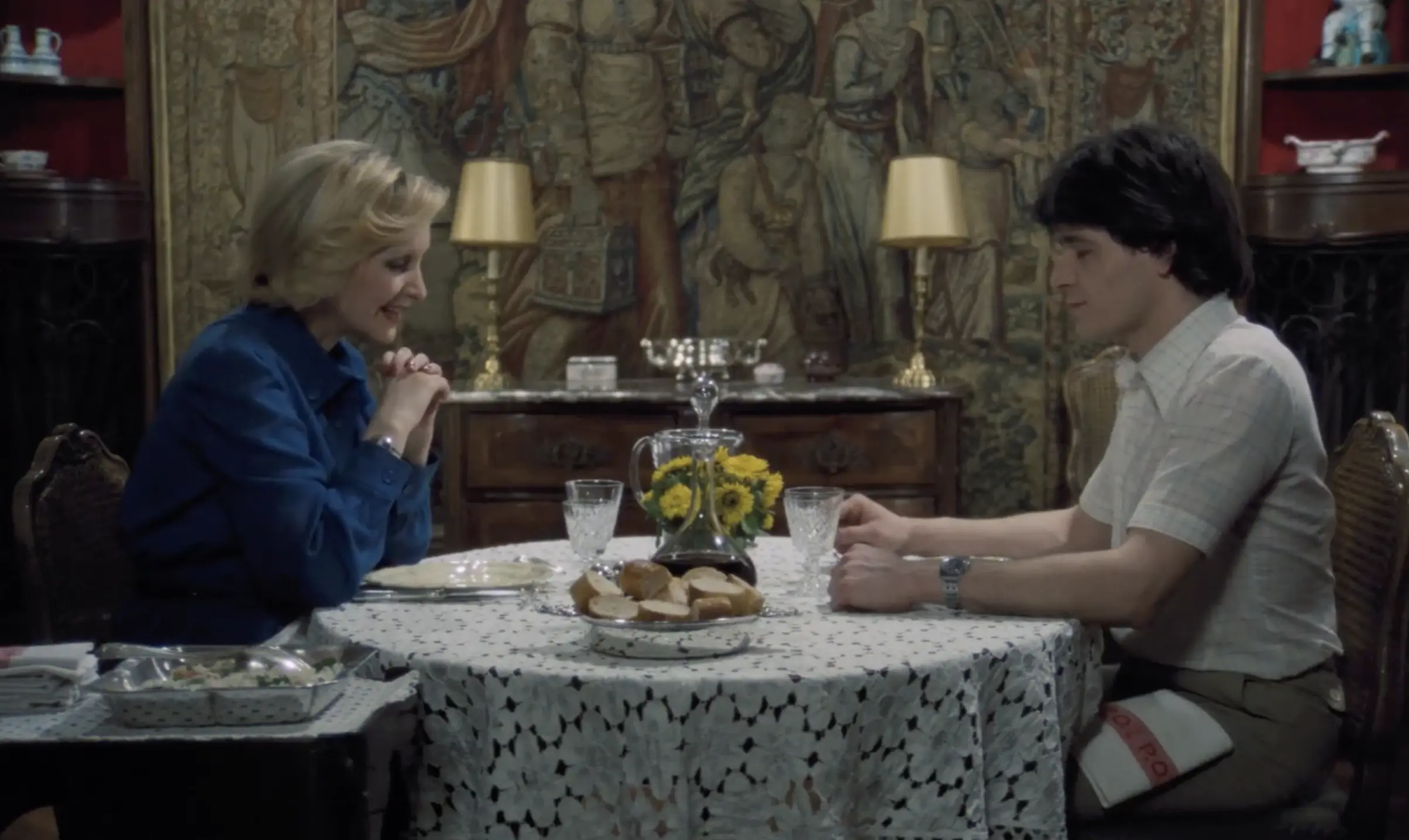
Les Belles Manières (Jean-Claude Guiguet, 1978)
Initially, there is nothing remarkable about the mirrors of Les Belles Manières. Camille cleans the mirror in his room and uses it while washing his face, and in these instances its presence in the frame doesn’t lead to any discernible shift in perception. Two scenes later, he enters Pierre’s room to deliver his meal. The direction of Camille’s gaze suggests that the camera is roughly occupying Pierre’s position in the room. However, instead of cutting to the expected reverse shot, the film holds on the same shot. As Camille walks from one end of the room to the other, a cut arrives and the camera angle shifts. Pierre is finally shown onscreen in the reflection in a mirror in front of Camille. The film insists on placing their first meeting within the same frame, even if in mediated form at first. After a further pan left, the pair’s meeting is properly consummated, taking on an existence free from intermediaries. The tether between them is set, unsevered by Camille’s harsh words on exiting. Once the door closes, the film makes a point of cutting back to Pierre, who stares as though he can still see Camille. While mirrors may not guarantee a novel encounter, they do enable the possibility of such a relationship emerging.
In other words, this sort of connection is not merely a general feature of Guiguet’s mise en scène; this much is clear from the staging of Camille’s reunion with his sister Domino. At a pivotal moment in their conversation, a mirror returns to dictate the staging. This time, it is Camille who sits reflected in the background, though unlike Pierre in the scene discussed above, he is visually obliterated by the shallow focus, reduced to an amorphous patch of colors, remote from Domino and by extension the struggles that have shaped her as a sex worker. Even a massive push-in does not bring him into any sharper focus. Domino disparages her own appearance, and all her brother can do by way of response is say that he preferred the old version of her. We have already cut back to a wide shot of him on the bed. Intimacy has borne no fruit. This is confirmed by the scene’s sudden ending, with Domino shoving Camille out of her room upon hearing stories of her past life. In their next and final meeting, the camera initiates a similar push-in onto Domino’s face. She asks if Camille will come and see her, only for an abrupt cut to deny us an answer. The film, despite its many long takes, still refuses to guarantee the closeness of a shared frame or the full articulation of a consummated emotion.
The most productive encounter that Camille has is thus a homosexual rather than heterosexual one. After Hélène leaves the apartment to his care, Camille goes to retrieve Pierre’s tray. Just the night before, Pierre left his room for the first time in two years in order to watch over a sleeping Camille. The light of day has not altered Pierre’s strange and urgent concern; he implores Camille to preserve his unique beauty and not fall for the pursuit of material wealth. The blocking, in conjunction with Camille’s performance, appears to separate the pair along two different planes of the image, with Pierre standing in the background against the window as Camille makes a lateral move in the foreground. Rack focus prioritizes one or the other, depending on the moment. Yet this shift in focus isn’t enough to overcome the simple fact that they do share a space. It’s no coincidence that only a few scenes later, Camille will initiate his rebellion in all its blazing glory.
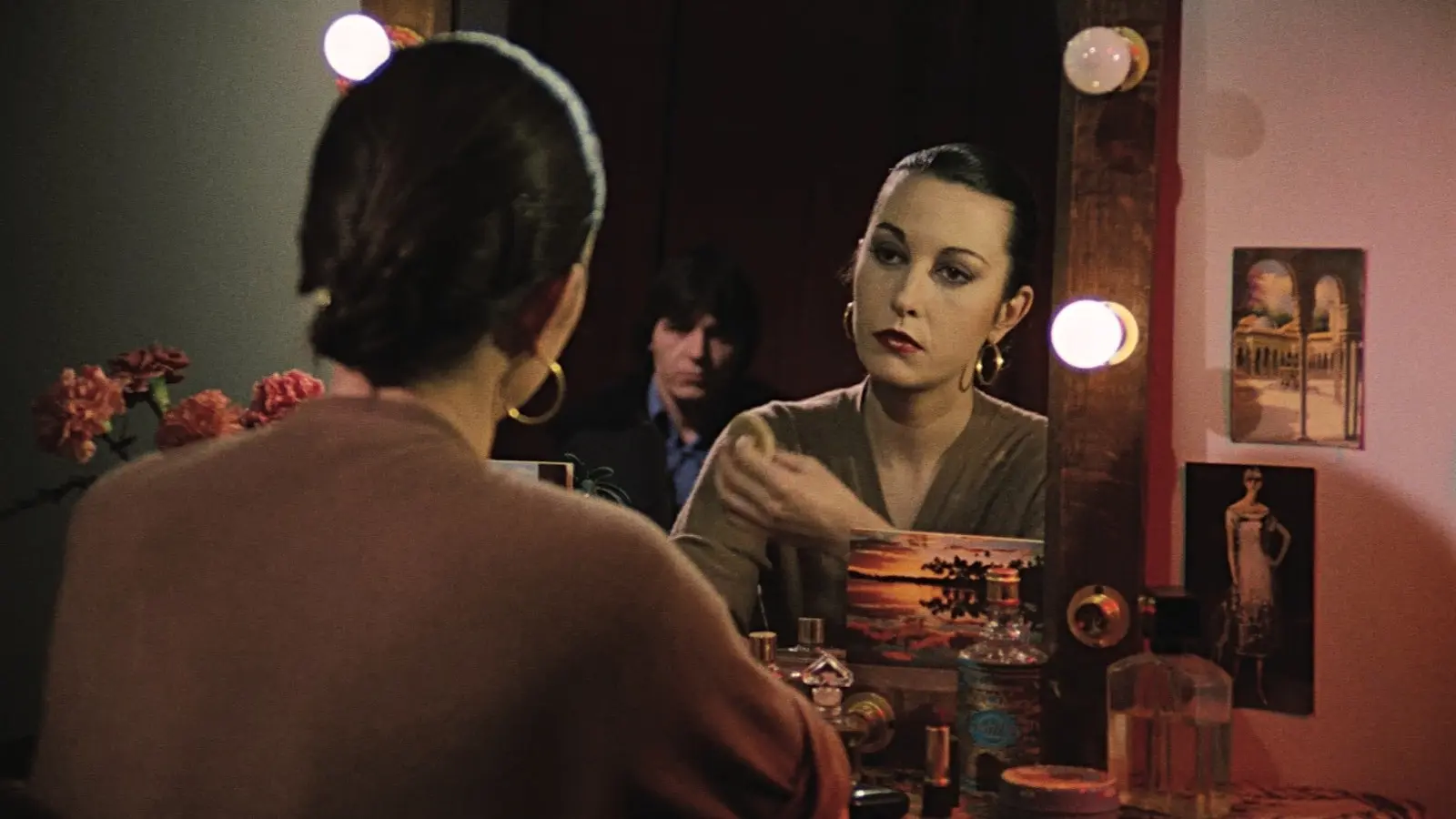
Nonetheless, Camille cannot be completely severed from Hélène either. After all, it is her mirror that he ultimately uses to gain a new clarity in perception. Her absence from the apartment enables him to break character and start mimicking her own. Sitting in front of her vanity table, he fiddles around with her jewelry and perfume, then mockingly intones to his own reflection, ‘Remember, this is your home.’ What a joke indeed. It’s suddenly apparent that he sees through Hélène’s act, sees through the ideological veneer that was meant to soften the exploitation he actually faces. Not only was he the better performer, he was also the better spectator. This pivotal scene calls back to an earlier one. Right after Hélène dismisses Georges, her romantic fling, she cries in front of that same vanity table, seemingly heartbroken by the breakup. However, once Camille, who has shown Georges the door, leaves the room and the camera placement shifts, she dabs her face a few times and her smile miraculously reemerges. Even if he wasn’t there to observe this shift happen, he seems to have been able to detect it just by looking in the same mirror. There is a limit, however, to this kind of appropriation. Wielding the ready-made tools of your superior carries the threat of being branded by their trace, constraining the course of freedom you are actually able to pursue.
Hélène is thus a vampire in a dual sense, both as capital personified, surviving off the blood of living labor, and as a symbolic mother figure. Putting forward an unconventional Marxist reading of Dracula, Jon Greenaway argues that earlier socioeconomic readings of the novel depend upon the argument that ‘feeding and caring for those who cannot feed and care for themselves; what Sophie Lewis terms gestational labor — is non-productive’. [4] It’s true that Hélène treats Camille’s wounds after he is beaten by a group of hooligans, offering him tea and tucking him into bed. Were these infrequent acts of gestational labor enough to pacify him, to neutralize the power of his eventual revolt?
The shot of Hélène tending to Camille’s wounds does not begin on either of them. Rather, it starts on another mirror, a blank one with no person occupying it, before panning over to our two characters. Inexplicably, when Camille is left alone, the film makes a sudden cut back to this mirror, still reflecting nobody. Montage once again gets in the way of unified space, and by extension the comfort of an undisturbed relation. The absence signified by this mirror brings forth another kind of encounter, not with other people or even vampires, but with nothingness itself, an incompleteness suggested by the borders of the frame and the unidirectionality of a single angle. It’s the encounter that bookends Camille’s onscreen existence. The film’s first shot depicts him staring straight into the lens, a gesture he repeats in his final shot as a living person. Guiguet’s approach starts to resemble the words of Jean-Pierre Oudart: ‘Every filmic field is echoed by an absent field, the place of a character who is put there by the viewer’s imaginary, and which we shall call the Absent One. At a certain moment of the reading all the objects of the filmic field combine together to form the signifier of its absence.’ [5] In this instance, that Absent One is not merely a world that Camille seldom experiences, a set of economic relations and political institutions he has no control over. It also becomes us, the audience.
Arriving at this critical juncture, I hesitate before taking my final step. I heed the critiques of Lacanian-Althusserian film theory made by Gilberto Perez, who paraphrases Brecht’s assertion that the work of art should ‘show enough [...] for the spectator to see that art is work, not magic, but do not show so much that the illusion of art breaks down altogether.’ For Perez, ‘Lacanian-Althusserian theory fails to grasp this. It assumes that illusion is complete, that we wholly accept as reality the representations of art or ideology, and that the alienation countering the illusion must accordingly be complete as well.’ [6] Straub and Huillet, with whom we began, never turn the camera on themselves nor use a reflection to reveal the camera’s presence. Some gradations of illusion are maintained under the presumption that we are an audience worth respecting, intelligent and aware enough to achieve a critical distance without the artwork completely undermining its own functioning. And so it is not with a knowing wink that Camille stares at us, but with a blankness to match the one he faces. His terror and confusion are earnest, emotionally and narratively, until the very end, even as the film form grants us an interpretive vantage point. The characters remain trapped while we are set free.
Notes
Published in Libération in October 1987, and available in Foco, 2, November–December 2010, https://www.focorevistadecinema.com.br/FOCO2/guiguet-empedocles.htm.
Ibid.
Barton Byg, Landscapes of Resistance: The German Films of Danièle Huillet and Jean-Marie Straub (University of California Press, 1995), p. 192.
Jon Greenaway, Capitalism, a Horror Story: Gothic Marxism and the Dark Side of the Radical Imagination (Repeater, 2024), p. 66.
Jean-Pierre Oudart, ‘Cinema and Suture’, Screen, 18:4 (Winter 1977), 35–47 (p. 36).
Gilberto Perez, The Material Ghost: Films and Their Medium (The Johns Hopkins University Press, 1998), p. 292.