I wanted to discuss Body Snatchers because it feels like a film that resists being talked about clearly. Every time I try to describe what it’s doing, I end up contradicting myself. So much of this film feels like falling down stairs over and over again, and this sense of vertiginous collapse is built into the film’s formal procedures. The very first images are protean — the promise of freedom implied by an expanse of glistening water, which a pan cruelly transforms into the unmoving, shallow pools of an Alabaman swamp. A dissolve plunges us further still: hundreds of dead trees, their roots descending into total darkness, then moving to the film’s first diagonal image, a highway slicing from bottom left to top right, with the Malone family in its center. If one wants to consider this an establishing shot — there are no others in the film — it’s worth spelling out that the reality ‘established’ by this shot is dissolving between different vertical planes, offering only a tilted axis on which to stand.
Cutting to Marti inside the moving car, the film announces its central preoccupation: the collapse from an expansive view of the world into an enclosed one. We are introduced to her as the lone daughter of a remarried father, already peripheral to this newly formed nuclear family. As the family arrives at the military base, Ferrara denies his audience any panoramic view of the setting, instead bringing the camera down and cutting to a disorienting extreme close-up of the father’s face in profile, with a faceless soldier and the American flag consuming the remaining space of the frame. We cannot situate ourselves geographically or spatially.
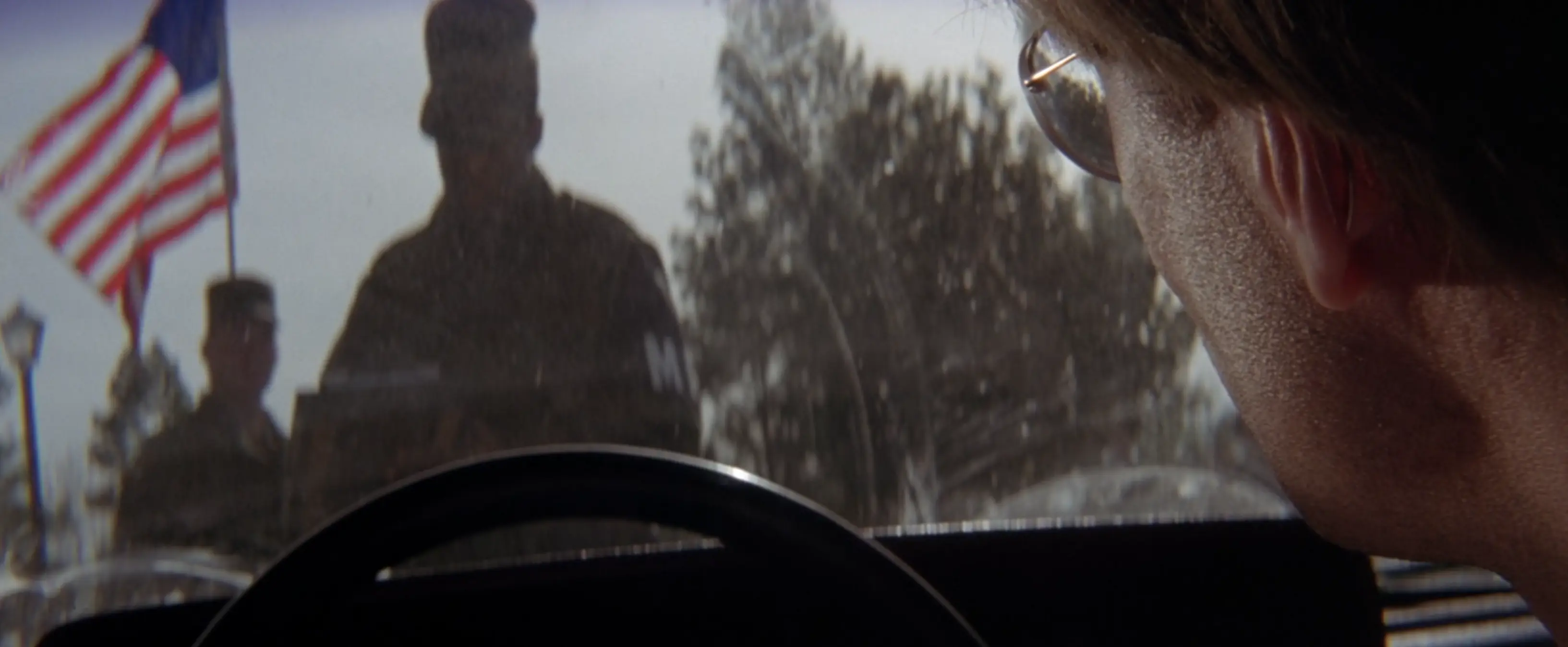
Body Snatchers (Abel Ferrara, 1993)
The film continually deploys tilted axes — often bisecting the frame with diagonal stair banisters, or staging conversations with distinctly skewed vertical dynamics — but its most extreme destabilizations occur between shots. An early transition dissolves from Marti observing the soldiers dropping off a suspicious package in her father’s bedroom to a shot from just outside of the school window where Andy, her little brother, is in class. Beginning outside the window, this new shot racks focus just as the image of Marti achieves full transparency, shifting from the window’s reflection of soldiers patrolling to and fro outside to the classroom scene unfolding inside. The whole process — during which time the viewer is situated entirely between spaces without clear demarcation — lasts a near-endless twelve seconds. From the home invasion occurring in Marti’s presence to Andy’s classroom, the transgressing of the window’s thin boundary is just a matter of pulling focus. The protracted transition between them creates a third space between home and school, inside and outside, which invites the viewer to dwell in this in-between zone, groping for its non-existent boundaries before being thrust, unconvincingly, back into the film’s plot.
* * *
This formal permeability is itself a precursor to its spiraling fatalism; the dissolves describe a world under threat and open to it, with this invasion of the body snatchers arriving as a mere confirmation. It’s like Marti says at the beginning of the film, ‘If we’d known what was waiting for us, we would have run. But in the end, it had to happen.’ Inevitability haunts the film as much as — and perhaps because of — the chimeric nature of its development. The original treatment was written by Larry Cohen, and while we can only theorize about how much he shaped the film’s interest in the failures of family, [1] what we can be certain remained from his draft was the military base: [2] a zone of nuclear functionalism into which the progressive and therefore ostensibly antithetical family enters, only to have the environment clarify their own equally circumscribed dynamic. This is also where Ferrara enters. His cinema, obsessed with self-deception and its slow unraveling, joins the picture. His characters' drama hinges on the slow negation of their own fantasy, reality arriving as the fictions they have desperately tried to ignore.
The procession of images which constitutes the film’s first half functions as a drumroll toward the chaos introduced at the halfway mark, when the doom awaiting Marti’s family is finally realized. Nicole Brenez, in her essay on Body Snatchers, is particularly interested in this scene which finds Marti in the bathtub while her father is getting a massage in the next room. [3] Father and daughter are lulled to sleep, and a series of umbilical cords extend from the ceiling above Marti and below her father’s bed into their various orifices. This tendency toward dissolution, extending from the montage to the very spaces of the film, extends as well to the physical bodies Body Snatchers depicts. The skin is but another surface that betrays its usual functions: to verify identity and repel invasive forces. Even before these thin cords penetrate the noses, ears, and mouths of Marti and her father, during his massage, sensitive to his wife’s hands, his skin is marked by red following her every touch. In extreme close-up, rotating to blur the boundaries of back, neck and arm, we see his every pore, a visual rhyme with the perforated ceiling tiles above his daughter’s bathtub. Like the selves they contain, and the structures which contain them, these surfaces which have proven treacherous from the start are here revealed as porous and hopelessly exposed. We are a species full of wounds and entry points — anything can get in, be it a worm or a pill.
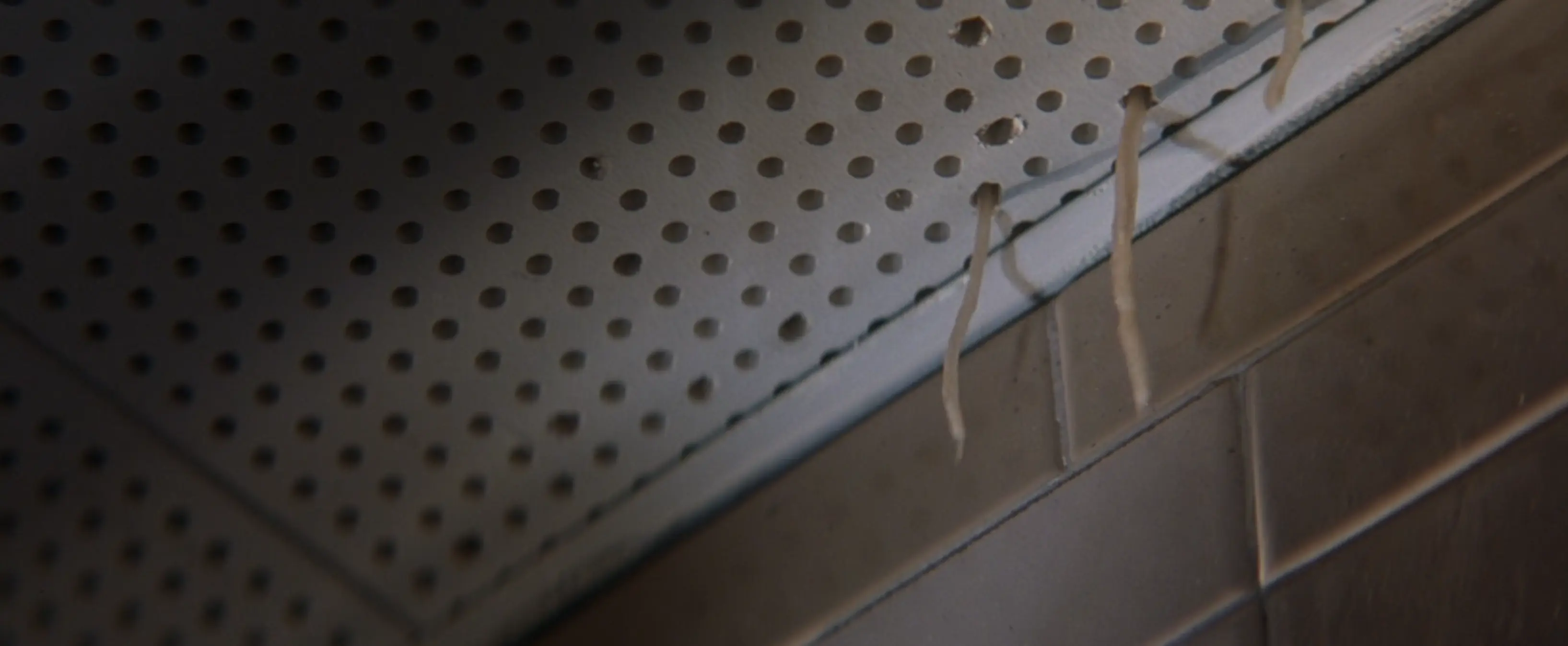
For a film whose découpage is so reliant upon the Dutch angle and extreme close-up, the bodies of the pod-people are filmed with a striking neutrality — presented in unassuming wides, their forms offer total clarity. We may think of the wide of Mrs. Malone as she appears nude before her young son, or the first depictions of successful rebirth: newly emerged soldiers stand under moonlight which falls across their bodies in thick beams, sanitizing their form leaving out neither texture nor blemish. The pod bodies appear sealed, later reinforced by uniform as second skin. This fantasy of impermeability is corrupted only by the pile of dust which rests beside them. This dust — the sole remnant of the former self — is the single filthy discrepancy to their newly realized image of purity, one which the soldiers sweep into dustpans with a perfunctory efficiency. The pod-people define themselves via negation; however, this gesture betrays the performance as a form of inverse mourning, the deliberate erasure of humanity which requires one to sweep instead of walk. As in addiction, we may understand this behavior as one of the many internal refusals which occur during recovery: which friends may one still see? How may one reconstruct identity in the wake of this refusal of vice? We also see this tension fray late in the film, as a still-human soldier voids himself of emotion as his friend who has been snatched tries to stir it by claiming he ‘fucked’ the former’s girlfriend. This vague assertion of power is difficult to square with the pod-people as we have understood them. The sealed surface cracks.
The insistence on surfaces and their penetrability, which structures this film, succeeds finally in displacing attention from where the threat truly resides: the internal and systemic. This becomes especially legible through the film’s use of framing. At the very moment their father is being turned, Marti and Andy find themselves isolated to the edges of the frame within a network of wires and colossal plastic tubes, a mechanical echo of the organic tendrils. This serves to literalize the film’s gestures toward infrastructural horror and serves to embolden the film’s dominant compositional instinct in its marginalization of the human form. Characters are constantly pushed to the edge of the frame as massive abstractions or swaths of deep black dominate the visual space — each image, as Astruc writes of Murnau’s image-making, presents ‘an unstable equilibrium, better still the destruction of a stable equilibrium brought about by its own élan’. [4] George Kouvaros describes a similar relational model in the visual darkness of Cassavetes’s The Killing of a Chinese Bookie: ‘We remain suspended in a world whose contours and borders are always at the point of receding into darkness.’ [5] Within Ferrara’s film, this overpresence of extreme darkness proposes an evacuation of contingency as the lived world of his characters forecloses them. Thrust between spaces without clear demarcation before being swallowed by the next image, the same spiraling quality which haunts the film’s dissolves is clarified by these shots as a formal absolute. Tension is replaced by predetermination, and identities, both human and non-human, are annihilated by the images which contain them.
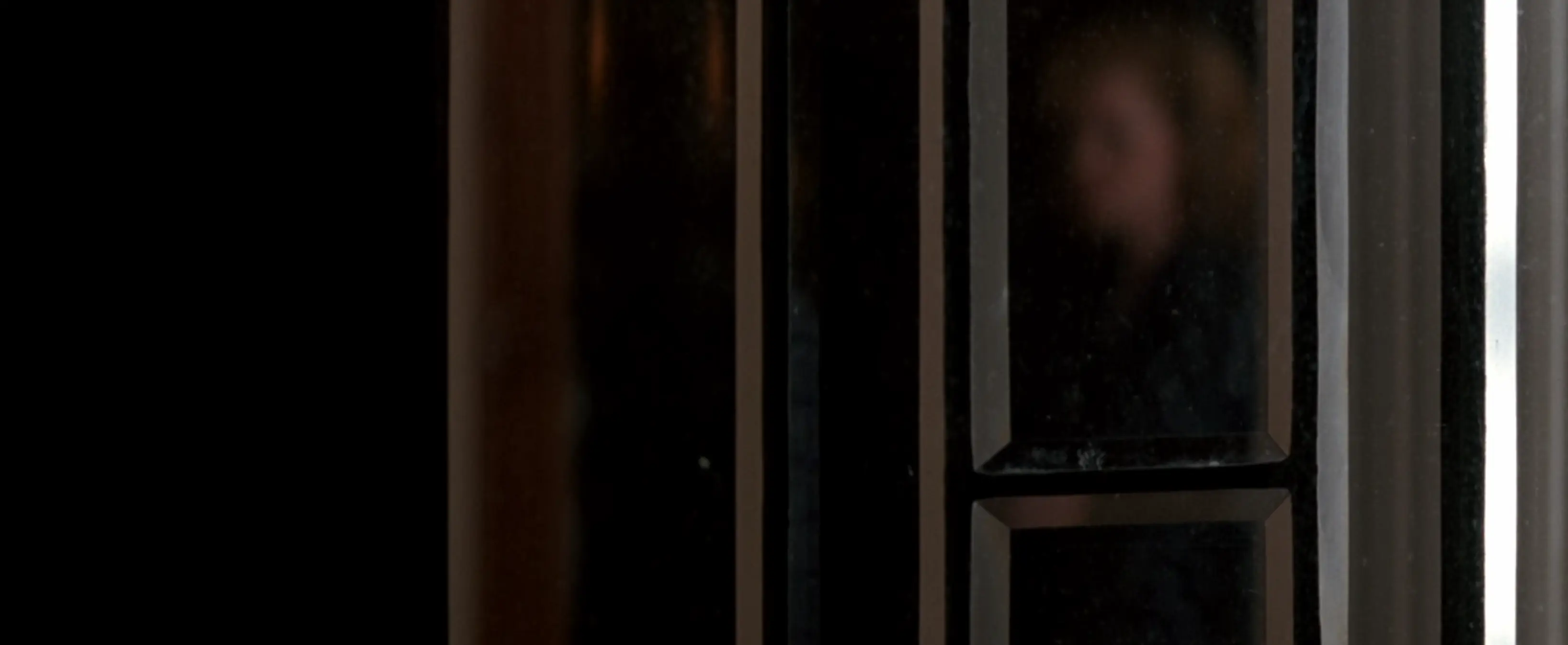
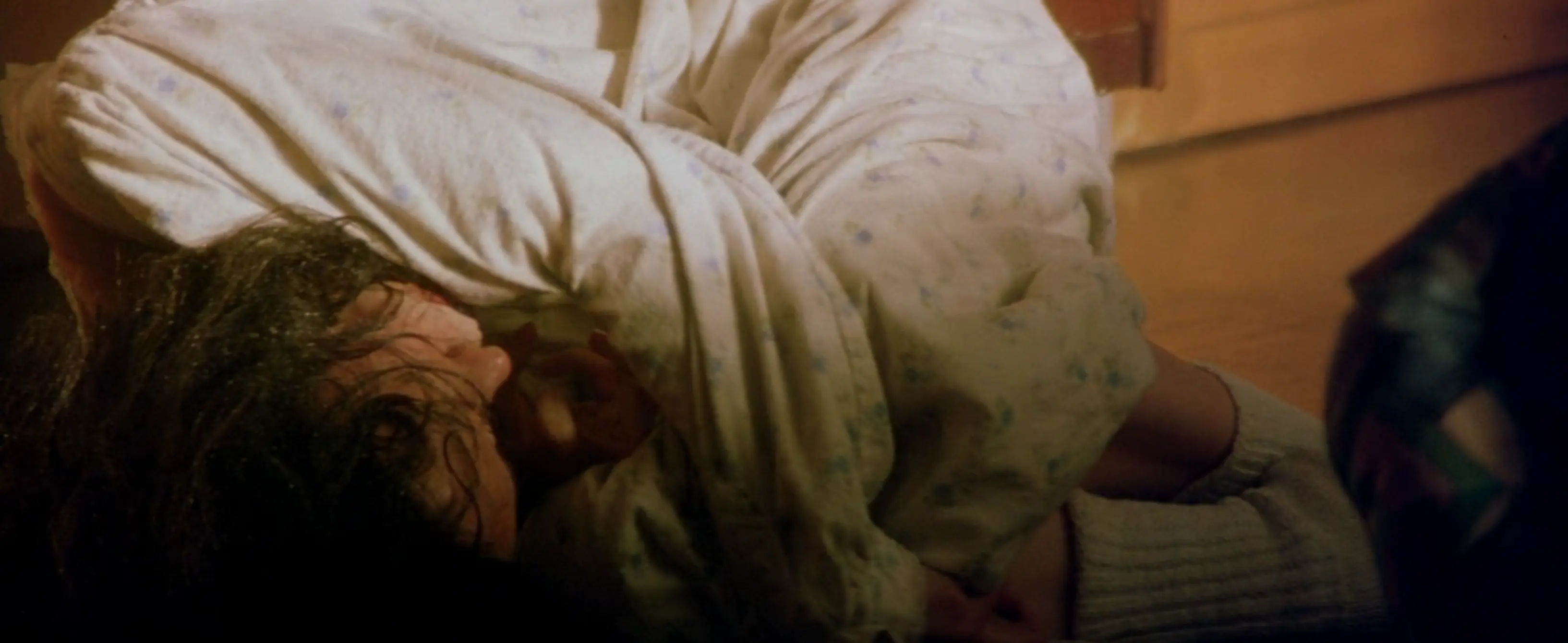
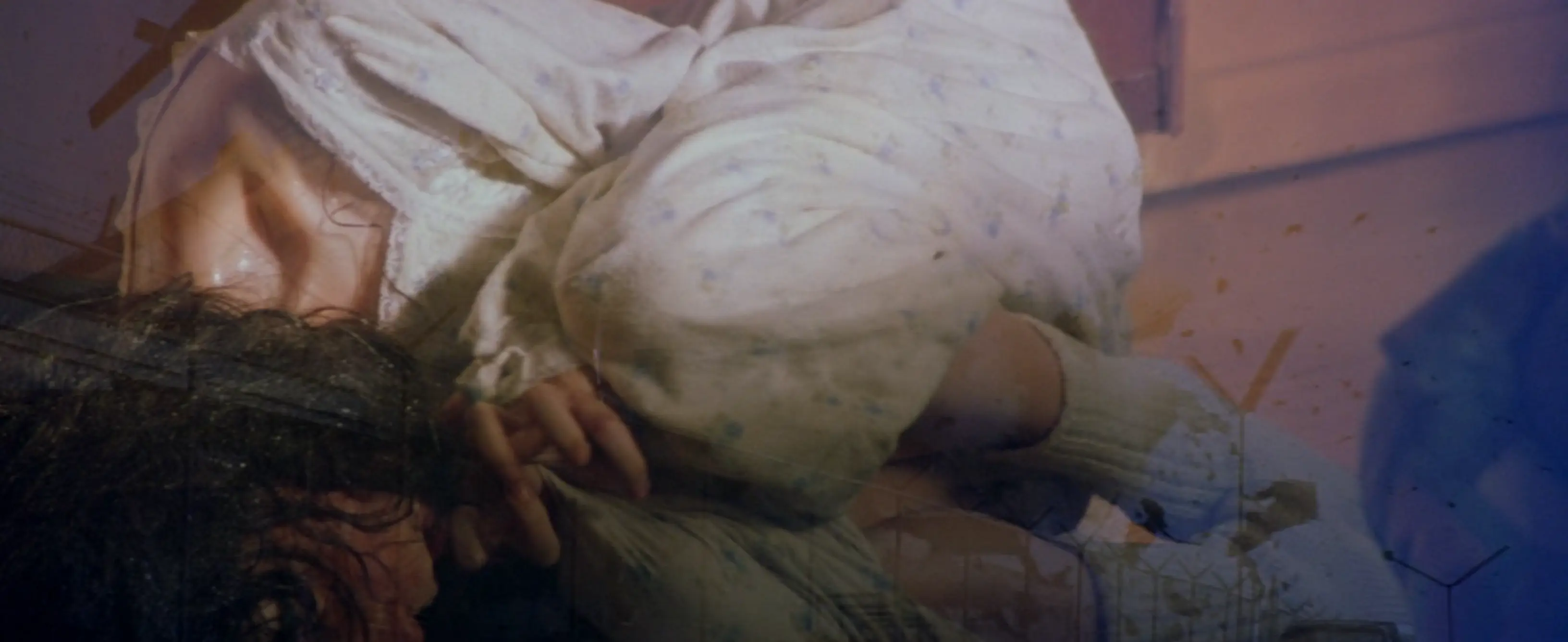
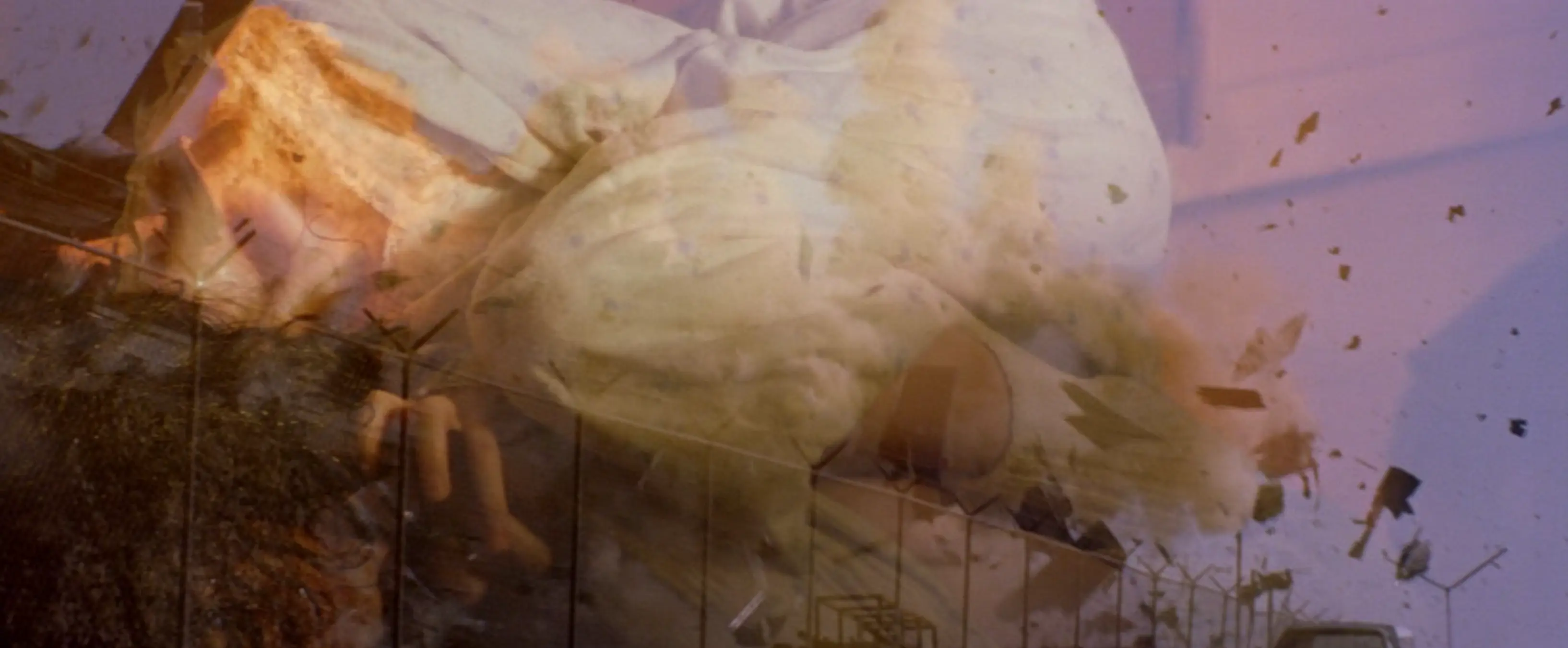
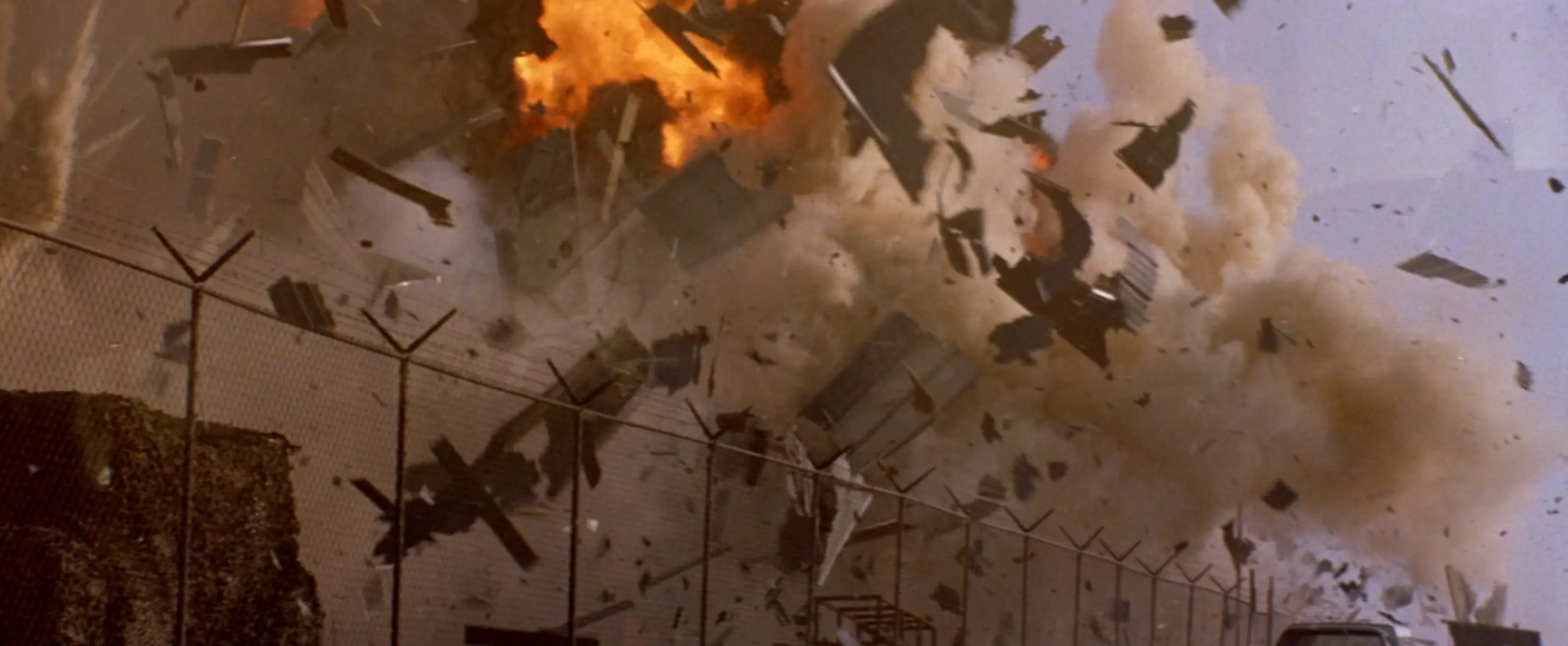
This absolutism is of particular interest in how it extends sympathy towards those already turned. As Mrs. Malone tosses a bag of trash — presumably the dirt of her former self — the truck pulls away behind her, opening into a massive blackness that swallows the frame. Similarly, when soldiers first arrive to implant the pods within the Malone home, we see the face of one of them framed by the tiny window of the door, the rest of her figure and the space she wishes to enter lost entirely to the dark. Those who carry out the goals of empire find themselves subsumed by it, formally and thematically — a terror Ferrara returns to throughout his work. In New Rose Hotel, Dafoe’s X ends the film high above the ground in fetal position, stricken by heartbreak and unmet expectation, his belief in his own mastery finally collapsing. The destructive ideals his men cling to in the name of dominance obscure the fact that they are casualties of the very systems that taught them to mistake control for power. When that scaffolding collapses, when the body comes tumbling down the stairs, little can save them from the gap between the performed identity and the real. Body Snatchers shares this terror of failed approximation, extending it towards those who reject individuality. Mrs. Malone, the architect of the destruction of her family, is also shown in fetal position as the military base explodes atop her via a cross dissolve. These are not images of monsters but of figures caught within the same totalizing structures as the humans they replaced, which is perhaps why this vague idea of ‘structure’ is so difficult to locate and so difficult to refuse.
Even the pods resist being reduced to any clean analogue to either mass production or intrinsic humanity. They are extracted by gentle hands one by one, then ushered into the domestic space in lopsided, cracked boxes, scrawled over in Sharpie. No evidence of the gleaming infrastructure of invasion or machinery commensurate with the scale of the threat. It arrives looking like something dug out of a garage. This unglamorous, provisional quality finds its echo in the pods themselves — fleshy, veined, wet, void of any hallmarks of conventional sci-fi alien design. When they burst open, the sound design mingles the expected squelching, organic rupture with an almost industrial hydraulic hiss. The film constantly undermines any clean distinction between the natural and the constructed, the human and the alien — an assertion which clarifies the pod-people as mere extrapolations. There is nothing within their design or behavior not already present within the organic vernacular of humanity. Which is where I inevitably contradict myself in starting out by treating the porous versus the sealed as a dichotomy.
* * *
Everything in the film emerges from this same ether of conflict without resolution. Every image can be understood in two ways. Take, again, the shots of Jenn’s alcoholic mother: first we see her passed out on the couch in the middle of the day, her body slack, vulnerable, the television flickering over her unconscious form. Later, after she’s been snatched, we see her upright, groomed, ready to play bridge with the other officers’ wives. Her posture is perfect, her makeup carefully applied, her cardigan buttoned to the collar. The question the film poses is: which version is more sober, more self-controlled? The passed-out woman at least has the honesty of visible suffering. The pod mother has achieved total self-control at the cost of her entire self.
Throughout the film, any behavior conventionally assumed typical of social types — mother, wife, father, husband, teenage girl — is exposed in all its implications when assumed by the pods, though the film seems to add a particular vulnerability to mothers, for it is their bodies which are most accustomed to penetration and supplantation of another life form, and the site of the film’s first snatchings. It is worth discussing how well reproduction without mother facilitates the goals of empire. We watch the fetus develop in utero, the formation of a placenta and umbilical cord — all without a mother and inside yellowed walls of an unfeeling sac tucked away in a vent or under a bed. During a brief sequence where Mrs. Malone looks through the window and meets the gaze of another mother holding her screaming child, we watch as they share a greater communion than between the woman and her own child. Therefore, with its screams and tears as proof of life without mother as moral or physical guide, here is the first child of a future America.
The horror of the film comes largely from the anti-social decisions we see the pod people making — these performances of social roles stripped of their emotional content. In this scene, our expectation writhes as we fail to see her actualize the performance of motherhood we desire. We see ourselves reflected in both the inattentive mother and the wailing infant, and the future being projected is ever more conformity and the further burial of these unrealized, suffering infantilized selves. You’re neither snatched conformist nor bold individualist, but this screaming child exposed to the world. The film ultimately poses the snatchers as externalizations of forces already present within us.
The pro-social and human element that we do see in the film is manifest in Marti and her helicopter pilot boyfriend Tim’s relationship. Capping off their eventful first date, the two venture down to the swamp for a bout of ‘never have I ever’, a game particularly well-suited to revealing the chinks in the armor of an iconoclastic outsider and a highly attuned insider. It’s painful to watch Tim’s self-awareness as he ticks down a finger to Marti’s inquiry of ‘never do I hide my feelings’. As he kisses Marti following this admission, I find it hard not to see this moment suspended between performance and sincerity, as if this kiss is a cover, a way of proving he is capable of extrapolating feeling despite history, less an expression of feeling than proof of it, as though trauma — he is a veteran of the Gulf War — has made emotion something that must be legibly performed rather than simply lived. In trying to show he can still feel, he begins to resemble those who cannot, and it is from within this ambiguity where we may discover the pod people to dispose themselves in ways which again resemble both the addict and the reformed.
The subsequent crane away from their kiss connects the organic and the pod people in a single shot, reeling away from their kiss to the marshland not far away, where soldiers are extracting pods from the water. The shot is bookended on one end by a kiss, and on the other end a birth, binding the two in a perverse causality that seems to imply a certain sameness between the pod people and organic people, or that the ends of one coital ritual might not be so dissimilar from the inhuman reproductions of another. The sympathetic moorings that are apparently provided by Marti and Tim’s romance seem to drift downstream, leaving the viewer again without the ability to orient themselves toward the characters. The fundamental uncertainty of any Body Snatchers adaptation — is that a person or non-person? — has infected the film form, challenging the viewer to understand, somehow, these characters as not either/or, but both. Brad Stevens writes that, in Ferrara’s films, ‘the constant state of moral and emotional flux is a prerequisite for the achievement of full humanity’. [6] Humanity as a virtue is so broad, but it also feels like the only term capable of Ferrara’s boundlessness at this point in his career.
* * *
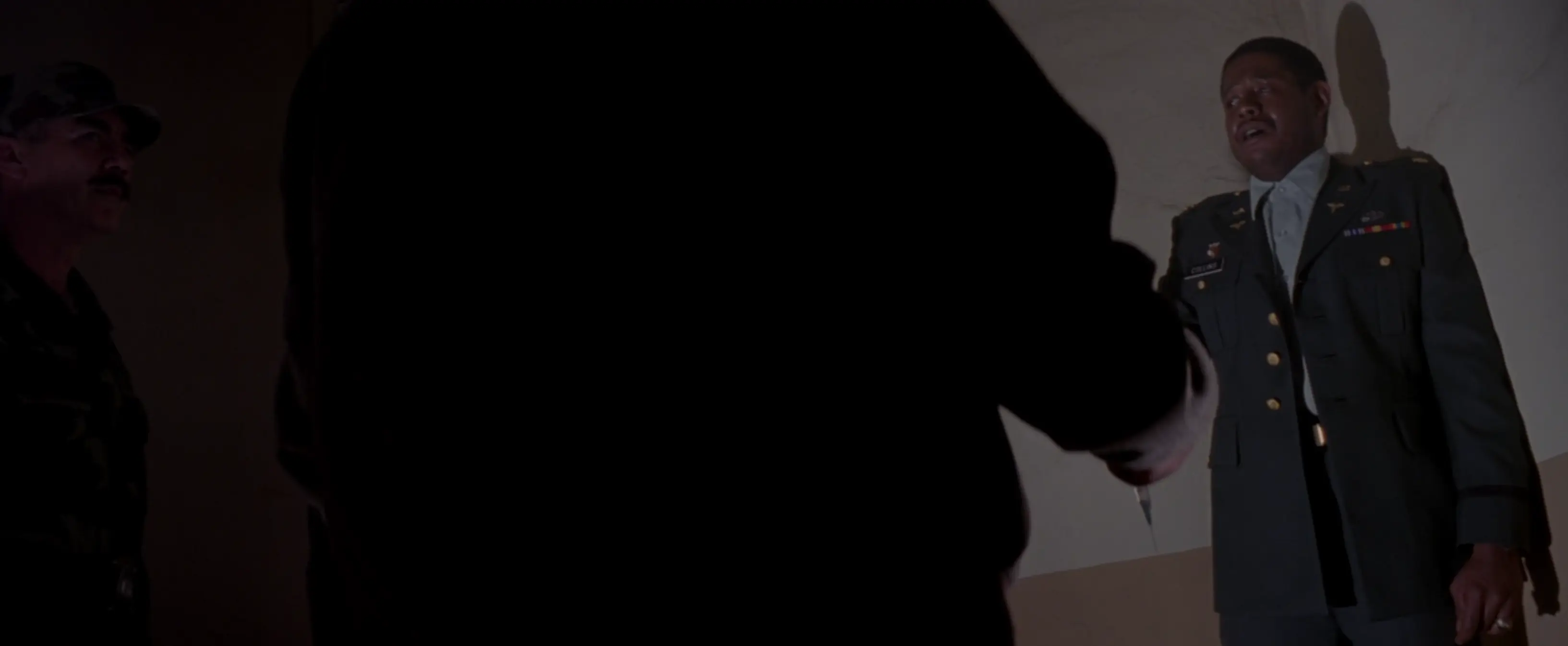
It’s the only thing this film is willing to die for, this ideal of humanity, however compromised or vague that is. In the final moments of Forest Whitaker’s character, as he’s being surrounded by Major Platt and a dozen other pod-people, his penultimate words are, ‘the individual is always important’. It is a sci-fi hallmark of course, the grounded and defiant self-sacrifice in the face of supernatural evil, but there is something particularly beautiful about allowing a character to share this insistence that humanity cannot be stolen or made reducible just before they blow their brains across a wall. When asked about the important ‘thing’ in The Addiction, Ferrara’s reply was that ‘no matter where you’re at, or how far down you think you are, your life force, your basic human spirit can overcome any situation’. [7] And yet, so much of his cinema is demonstrative of the reverse, its deployment of tragedy classical in the Greek sense rather than redemptive in the Hollywood one — an Oedipal failure to close the gap between one’s various contradictory roles. His cinema, and his life at this point, was so haunted by the unreachable, this negation of fantasy. Brenez frames this as his ‘optimistic conception’: [8] his characters exist in a state of revolt and torment precisely in order to delay inevitable tragedy. We, as the breathing viewer, live to resist Brenez’s later assertion that ‘the only story is the story of evil’, [9] and it is this which makes Ferrara’s doomed figures so moving. Unlike us, they cannot sustain resistance. In life we are afforded the possibility of revision — we reassert ourselves, recommit, begin again. Ferrara’s characters strain toward this same autonomy, hoping to exceed the logic of their own narratives and defy what this negative space of fiction demands.
* * *
It’s remarkable that he made these films grappling with the miserable facts of his life at this point when he was so far from sobriety, still so deep in denial and self-negation. The category of a real person — a fully formed person, uncompromised by lingering traumatic past or nebulous future — simply doesn’t exist. There’s no such thing as a self that isn’t in transition or in formation or deformation.
* * *
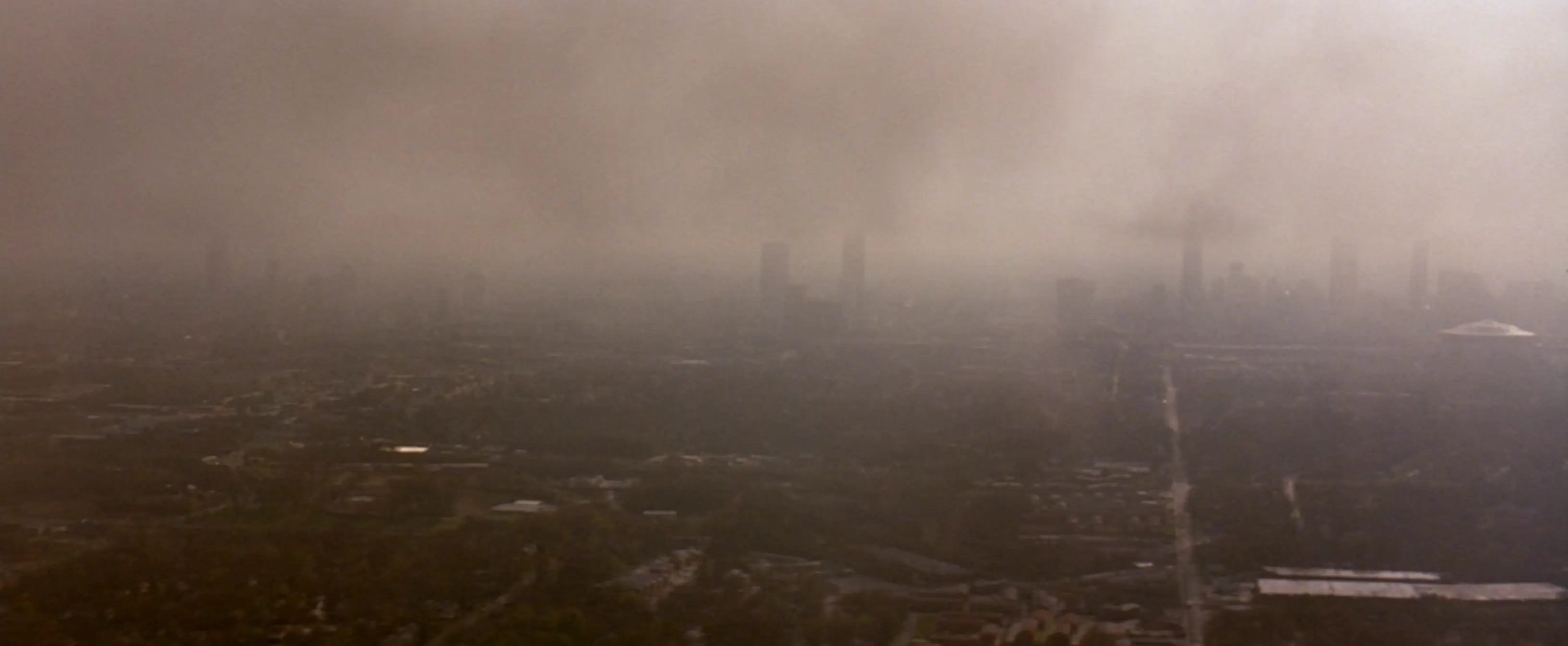
I keep thinking about that moment in the bathtub, with Marti wrestling with this older version of herself that’s also somehow an infant, waking up to the confrontation of a mirror, a supposed you who is anything but that image of time collapsing. The only way of resolving that pain of misrecognition the film can imagine is through conformity to this image, displacement from the realized self, or violence. Marti has to physically resist this version of herself while her hands slip off the predatory membrane she tries to tear away from her own face. Likewise, the Apache helicopter hovering over burning trucks at the end is just a scale-up of the same gesture. And then there’s the final image: another man in uniform. It’s funny how much we’ve discussed the film’s resistance to clarity, because my first association with Body Snatchers was totally clear. It brought me to the first time I climbed a mountain. As a child, you expect some transfiguration of the self in relation to space, and as a deeply evangelical child, I was certain the world would open itself to me somehow — that if I conquered the clouds where the angels lived, I’d meet some kind of truth. But I remember looking down on my town and thinking only of how grey it looked from up here.
Notes
For more on how Cohen’s films give form to his preoccupation with family dynamics, refer to ‘Cohen’s Families’ by Joshua Peinado, published in this issue.
Roel Haanen, ‘Do the Picture My Way: Larry Cohen’, The Flashback Files, 2018, <https://www.flashbackfiles.com/larry-cohen-interview\>.
See her introduction to On the Figure in General, and the Body in Particular: Figurative Invention in Cinema, trans. By Ted Fendt (Anthem Press, 2023), pp. ix–xxx.
Alexandre Astruc, ‘Fire and Ice’, trans. by Rose Kaplin, G. Hersberger & John K. E. Hitchcock, Cahiers du cinéma in English, 1, January 1966, 69–73 (p. 71).
George Kouvaros, ‘A Strange Sun: The Killing of a Chinese Bookie and Opening Night’, in Where Does it Happen?: John Cassavetes and Cinema at the Breaking Point (University of Minnesota Press, 2004), 117–57 (p. 149).
Brad Stevens, ‘15. Bad Lieutenant’, in Abel Ferrara: The Moral Vision (FAB Press, 2004), 156–69 (p. 162).
Liza Bear, ‘Interview: Abel Ferrara’, BOMB Magazine, 53, October 1995, <https://bombmagazine.org/articles/1995/10/01/abel-ferrara/>.
Brenez, Abel Ferrara, trans. by Adrian Martin (University of Illinois Press, 2006), p. 6.
Ibid.