The enactment of Godard’s proposed alternation of Made in U.S.A (1966) and 2 ou 3 choses que je sais d’elle (1967), The Wild Palms received its world premiere at London’s Institute of Contemporary Arts on 25 November 2025. The project was realized by Michael Witt in connection with the publication of his latest book, Jean-Luc Godard’s Unmade and Abandoned Projects (Bloomsbury, 2025).
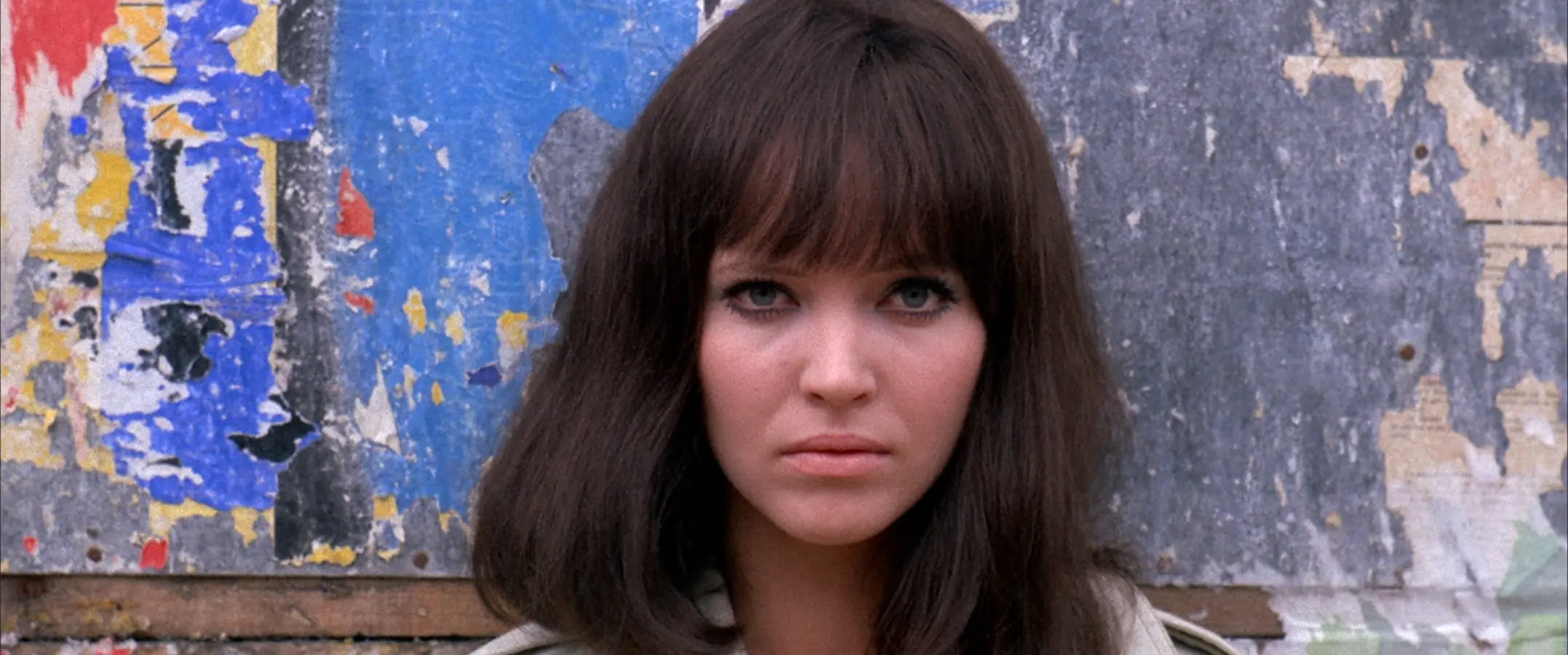
Made in U.S.A. (Jean-Luc Godard, 1966)
The Wild Palms is less a film than a procedure. Two films — Made in U.S.A and 2 ou 3 choses que je sais d’elle — are projected not sequentially but in alternation, reel by reel. The result is neither one film nor two, but a shifting composite: a collage of spaces, voices, actors, ideas, and images. It’s composed of two films, Made in U.S.A and 2 ou 3 choses que je sais d’elle, shot simultaneously between 1966–7 and now woven together through alternating reels. The changing reels also form a palimpsest, in which Dickens leads to Griffith, to Eisenstein, to Faulkner, to Godard, as a lineage of form: the passage from narrative to montage, from story to structure.
The procedure is simple in principle. What Godard originally conceived as a speculative programming idea becomes here a concrete viewing mechanism. The spectator is repeatedly displaced from one film to the other, carrying the memory of the previous reel into the next. Narrative continuity gives way to interruption; meaning accumulates not within each film alone but in the interval between them.
What Faulkner’s novel offers is not content but a model: two narrative strands advancing in counterpoint, illuminating one another without merging. Godard’s ‘adaptation’ takes this principle literally. Instead of alternating chapters on the page, the alternation happens on the screen, reel by reel. The Wild Palms is not an adaptation of Faulkner’s story so much as an adaptation of its structure. Godard’s ‘adaptation’ consists of taking this principle literally, transposing it from literature to projection. The Wild Palms is not an adaptation of a book so much as an adaptation of a method.
To begin with, one may keep count of the reels as they alternate. Each film retains its identity, its tone, its register. The switching is perceptible, even jarring.
The alternation may happen mechanically, but it does not feel mechanical. The reel lengths are uneven; the rhythm is irregular. The films interrupt, encroach, and overstay. The procedure produces not balance but drift: each return arrives slightly displaced by what has intervened. As it unfolds, the switches seem to accelerate until the effort of keeping track feels futile. Somewhere toward the middle, you realize that you have not only stopped counting, but forgotten there were two films to begin with. What remains is a single entity, constituted through division. This is not synthesis: the films do not reconcile, nor is anything resolved — rather, they transmute. The reel change stops announcing itself. What matters is not what follows what, but what takes shape between.
This accelerating metamorphosis seeps into character, tone, and space, as the films begin to bleed into one another. The comic-strip Paris of Anna Karina’s pulp detective, borrowed from American genre cinema and saturated with quotation and artifice, collides with the austere Paris inhabited by Marina Vlady, where philosophical and sociological observations unfold in the voice-over, whether through glimpsing the universe in a coffee cup or recasting the city as a vast brothel.
As the reels interlace, the worlds interfere. Karina’s detective wanders into a city that is no longer playful surface but economic diagram. While Vlady’s existential ruminations on a postwar Paris reconstructed through the circulation of American capital find their ideological double in the circulation of American culture itself. What began as tonal contrast becomes political friction.
The Wild Palms articulates Godard’s love–hate relation with the United States. Made in U.S.A stages his fascination with American culture — its genres, its art, its energy — while 2 ou 3 choses que je sais d’elle confronts the social and spatial consequences of its dominance. Their intertwining exposes both attraction and critique. America appears not as a distant elsewhere but as a force already reorganising Paris itself — imaginatively, culturally, and economically. By dissolving story, character, and narrative logic, The Wild Palms sheds the shell Godard was still discarding in the mid-1960s. What emerges in their place is a mammoth montage of propositions, references, gestures: high and pop art, reality and fiction, archive and present, signifier and signification, all held together without hierarchy.
The Wild Palms does not so much anticipate Histoire(s) du cinéma as already performs it inside the narrative debris of the two films from which it is made. What later becomes explicit in Histoire(s) — the superimposition of fragments, voices, quotations, and historical echoes — here emerges through a simpler device. By forcing two films from the same historical moment to occupy the same temporal field, the procedure exposes the cinema of the 1960s thinking itself in real time. Montage here is not an outcome but an operation: a way of thinking history through interruption, overlap, and coexistence.
The structure recalls Rivette’s Out 1: parallel entities advancing independently until, over time, they merge and speak as one throat. What begins as multiplicity only reveals itself as unity retrospectively, once the work has already passed beyond legibility.
At the centre of The Wild Palms sits a voice — drawn from 2 ou 3 choses que je sais d’elle — reflecting on language, images, objects, foliage. It offers a precise description of the project, not by explaining it, but by placing thought itself under strain.
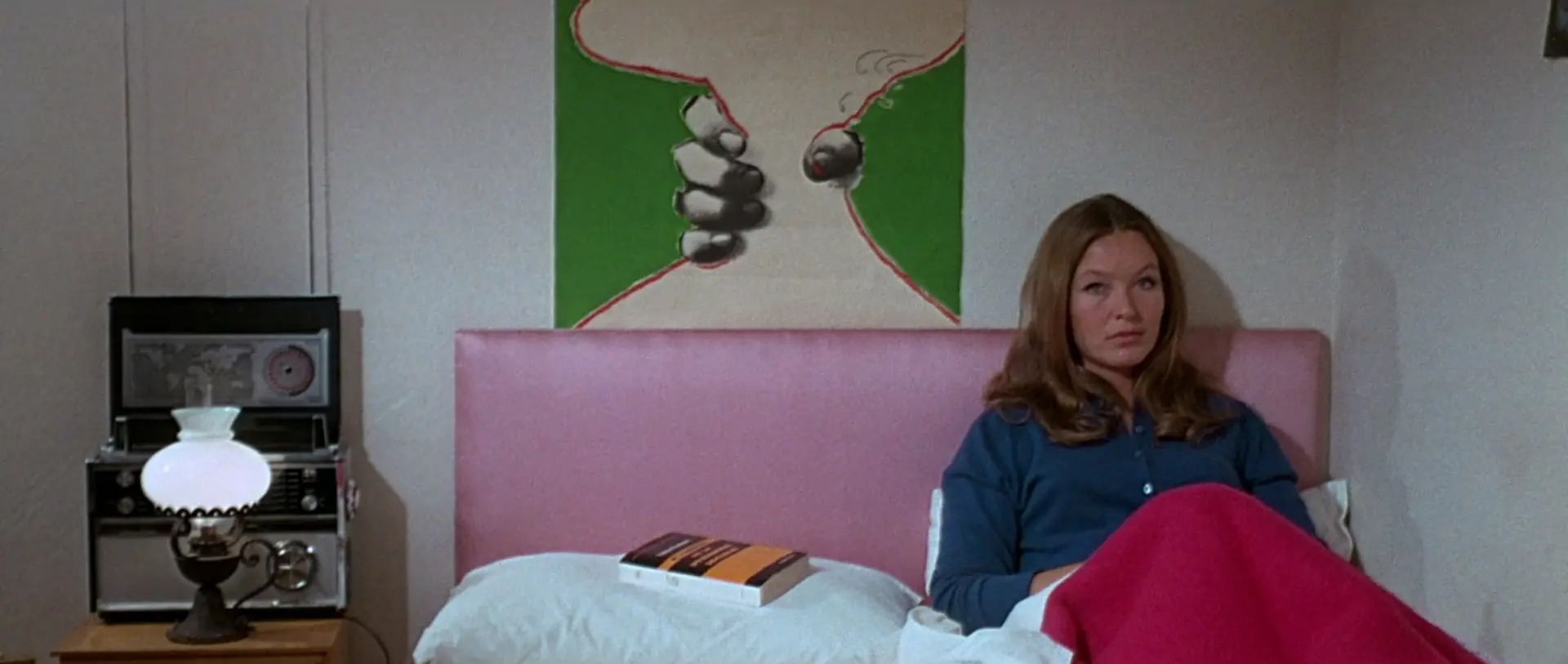
2 ou 3 choses que je sais d'elle (Jean-Luc Godard, 1967)
(voice-over from 2 ou 3 choses que je sais d’elle )
There is increasing interaction between images and language.
You might say that living in modern society
is virtually like living in a giant comic strip.
Still, language in itself
cannot accurately define the image.
For instance: how do you describe an event?
For example,
there’s foliage.
And though Juliette is no Faulkner heroine,
couldn’t it be as dramatically valid
as the foliage in Wild Palms?
The voice hesitates. It doubts its distance, its volume, its authority. It wavers between Juliette and foliage, between subject and object, between meaning and presence. Words circle what images expose without mastering them.
Here, montage is not the linking of images but the opening of an interval in which thought becomes possible. Objects insist. Language falters. History does not unfold as sequence but condenses into moments of contact and friction.
Objects exist.
Dead objects are still alive.
Living persons are often already dead.
What The Wild Palms stages is not a theory of montage but its practice. The procedure itself becomes the argument. Past, present, and future are no longer arranged but held together, briefly, precariously, in the same field.
The film does not resolve its materials. It lets them remain in tension. What it offers is not understanding, but a form of attention — one that emerges in the gap between reels, between films, between ways of seeing and being seen.
Describe Juliette or foliage?
In any case, talking about both is impossible.
Let’s just say that both trembled gently
on this late October afternoon.