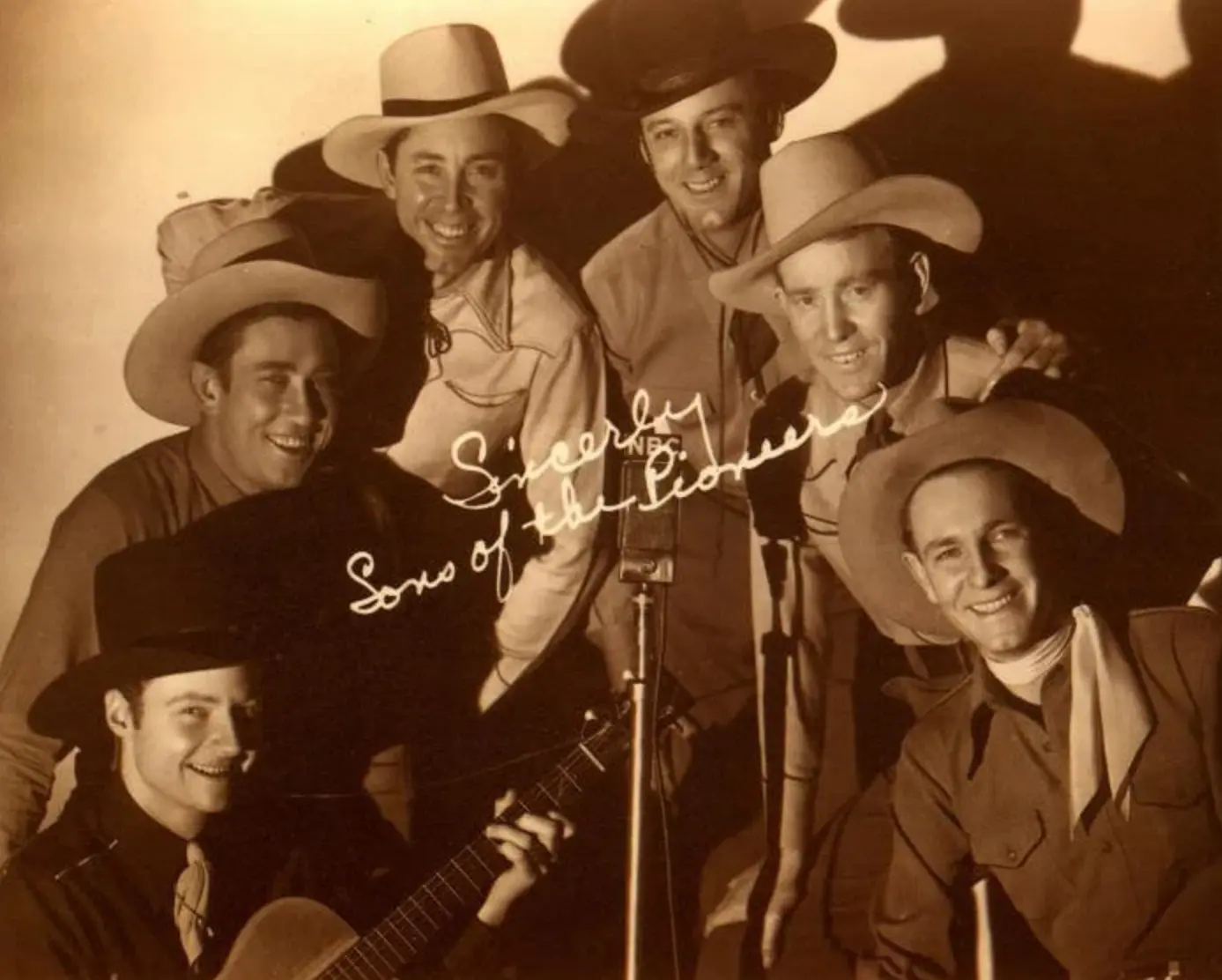
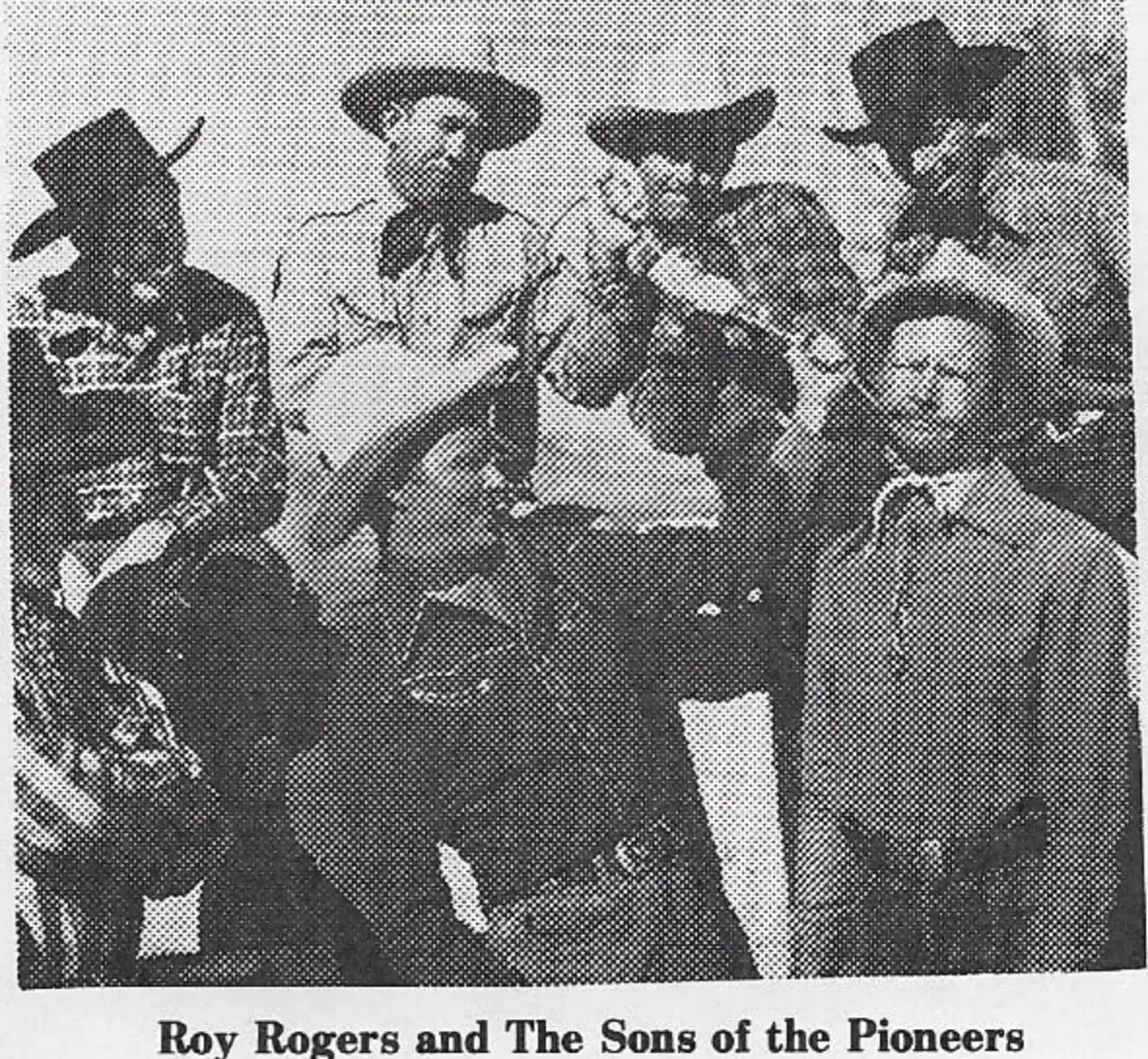
What’s left of the Sons of the Pioneers? In the 1930s, when the group was founded by vocalists Bob Nolan, Tim Spencer, and Leonard Slye (who would soon change his name to Roy Rogers), they were the most famous western singing group in the country, known for lending their warbling multipart harmony vocals to classics like ‘Tumbling Tumbleweeds’ and ‘Cool Water’. By the end of the B western trail in the 1950s, they’d shown up in over ninety films, from Mack Sennett two-reelers to John Ford’s Rio Grande. In the sixties, you could catch their various members fanning out across the channels of a television set on programs like Gunsmoke, The Beverly Hillbillies, Ripcord, and The Roy Rogers Show. In the nineties, you still might have hummed along with them blowing into Los Angeles accompanying Sam Elliott’s cowboy stranger in The Big Lebowski.
Today, though, they seem like so many tumbleweeds drifting along in the desert of the past, so far removed from their original heyday and its decades of cultural reverberations as to risk falling into anonymity. The group’s 78s sit untouched in record store dollar bins; they aren’t the rare kinds coveted by collectors or reissue labels. You’re not likely to catch one of their films on the Criterion Channel or in repertory cinemas. Roy Rogers is no longer primarily known as a great western star, but instead as the name attached to an ever-dwindling chain of roast beef sandwich restaurants located primarily in the greater Maryland area, where a neon ‘Roy’s Fixin’s Bar’ sign grimly beckons with the promise of unlimited cowboy sauce.
At the height of their powers, the band seemed to reflect all that was beautiful and terrible in the project of mythologizing the American West. ‘Perhaps more than any group,’ write country music historians Bill C. Malone and Jocelyn R. Neal, ‘they preserved a Western repertory and exploited the romantic cowboy image.’ [1] Even as their music frequently veered into the cliché and cornball, pitched to the children who’d frequent Saturday double features at the local moviehouse, the specter of violence was never far off; it doesn’t take much interpretive effort to excavate the outlines of the white settler colonial project in songs with titles like ‘Out in Pioneertown’ and ‘Westward Ho!’. Indeed, the group were frequently cast as homesteaders, ranchers, cavalry soldiers, and sheriff’s deputies — imperial henchmen just as ready to sling their guns as their guitars and fiddles. As a 1943 Life magazine profile of Roy Rogers put it: ‘He is the protagonist in the American morality play. He is purity rampant.’ [2] The Sons of the Pioneers — Rogers’s bandmates and later, after his rise to fame as a leading man, his backup players — were that purity’s enforcers.
The sonic repertoire of western music the group preserved and exploited was, however, also one they helped invent, and it was just as modern as it was old-fashioned — a rich amalgamation of blues, hillbilly, gospel, jazz, and even pop music. [3] Hugh Farr’s fiddle playing was one of the era’s most textured and creatively inventive; his brother Karl’s acoustic guitar work was jazzy, restrained, and wonderfully open — he seemed to always find a surprising way to swing the movement from one chord to the next, while still filling his playing with air and space, as if evoking the landscape of the brothers’ Texas upbringing.
The centerpiece of their sound, though, lay in the intricate close harmony singing developed by Rogers, Spencer, and Nolan, a vocal style that had already fallen out of fashion by the early fifties but which was once ubiquitous across a wider variety of popular American musical genres. The three singers, along with Hugh sometimes adding his bassy baritone, melded their voices together so closely as for it to be indistinguishable where one man’s singing bled into another. To pull it off, the singers developed an astonishing level of harmonic control, coordinating their breathing and syncing their voices to precisely pronounce and articulate every vowel of each word in unison. At times, as in the wild, cascading melodic lines in ‘Tumbling Tumbleweeds’, the effect could produce something surreal and sublime. On other songs, it could manifest a strange blankness, an ocean of uniformity wherein singers and songs flowed into each other without distinction. It is perhaps this undifferentiated quality that allowed for the group’s longevity as it cycled through an ever-changing array of members throughout the thirties, forties, and fifties — each new vocalist mimicking the earlier one to slip in without too much notice, faithfully recreating a sound that owed both its familiarity and strangeness to the fact it never belonged to one single person.
All of that close harmony, crisp diction, and singing in unison suggested a summative and retrospective sound, the idea that their music had tapped into an august and uncontested tradition of singing cowboys that had existed long before the invention of recording technology. It’s telling that the group originally branded themselves ‘The Pioneer Trio’ until a radio promoter announced them as ‘The Sons of the Pioneers’, advising them that they looked ‘too young to be pioneers’. [4] While in some respects this backward-looking approach was not dissimilar to other country and blues musicians of the twenties and thirties, who skillfully resurrected vernacular songs from the nineteenth century, the Sons of the Pioneers also frequently wrote brand-new songs intended to sound like old ones — a practice that responded to the rapidly expanding commercial markets for both western music and films. Studios such as Republic Pictures might require at least three new songs across a ten-day shooting period; to meet this demand, the Sons of the Pioneers developed a vocabulary of stock symbols to mine as subject matter: there were those dusty boots and saddles, the wranglin’ and rustlin’ and punchin’ of the cattle, the campfire by the bunkhouse when the working day was done and, more than anything, there were the rangers yippie-ki-yaying their little doggies down the trail and the wagon masters hitching up the reins of their stagecoaches, all of them proceeding in constant westward motion on songs like ‘Ride, Ranger, Ride’, ‘Roll, Wagon, Roll’, and ‘Wagons West!’.
Yet even amidst all this relentless motion, the music often sounded haunted. Songs drifted, unsettled and stuck in time as they went zig-zagging around discordant rhythms and spectral harmonies. When those close harmony voices affix themselves to a series of intricate yodels on ‘We’ll Rest at the End of The Trail’, they seem to produce slight ghostly traces as they glide up and down into the spaces where one note meets another. Bob Nolan, the Pioneers’ most prolific songwriter, frequently turned to images inspired by the emptied-out desert landscapes he grew up around near Tucson, Arizona. In ‘Cool Water’, a lost cowboy who searches ‘the barren waste for a taste of water’ begins to hallucinate in the flat dry expanse, yelling out to his horse: ‘Keep a-moving, Dan! Don’t you listen to him, Dan! It’s a devil not a man!’ Songs like ‘There’s a Roundup in the Sky’, ‘He’s Gone up the Trail’, and ‘Empty Saddles in the Old Corral’, some of which were written by Nolan or arranged from earlier sources, center around the absences of the cowboys of yore, whose earthly departures the singers can’t ever quite straightforwardly acknowledge. Instead, they skirt around death: an eerie breeze blows through the corral and dark shadows cast themselves on the lone prairie; the emptiness of the landscape reveals a set of props without an actor to use them. ‘Empty boots covered in dust,’ the Pioneers lament, ‘where do you walk tonight?’
This constant tension between clean, orderly surfaces and the haunted, unsettled terrains beneath them in the Pioneers’ music also resonates with how the B western appears to us today. After all, how could something that was once so popular now feel so impossibly marginal? What is in them for us to salvage, if anything, or is it material simply better left undisturbed? According to the counting done by Chuck Anderson, the indefatigable webmaster of the Old Corral online database, and his steadfast associate Les Adams, there were approximately 2,700 westerns made between 1930 and 1954 across dozens of studios. Approaching this lost terrain today is a bit like confronting that endless, anonymous expanse evoked by the spectral voices of the Sons of the Pioneers.
* * *
The films that feature the Sons of the Pioneers can be hard to track down — they mostly circulate now in hazy, poor-quality rips that can be found on YouTube, Tubi, or cable TV channels with names like GRIT and Family Movie Classics. In their time, they were made cheaply and serially; not only would a production line of actors, stuntmen, sets, props, or horses be endlessly revisited and recycled, but so too would character names, plot devices, jokes, songs, even the names of the films themselves. The dozens of films the Pioneers appeared in for Columbia Pictures between 1937 and 1941 all begin and end with ‘Tumbling Tumbleweeds’ playing over the titles and credits, creating a sense of recursion across the films — a closed loop as the same song runs over title cards with repetitious and musical names that sound like tunes themselves: The Old Wyoming Trail, Call of the Rockies, West of the Santa Fe, The Stranger From Texas. Sometimes, the print has degraded, or the digital transfer has been sourced from a recopied VHS rip — and the song will slow down, its notes pitched down as it sleepwalks along.
The films themselves tend to be loosely structured compendiums of comic skits, spectacles that don’t worry themselves with narrative, psychology or sometimes even blocking, mise en scène or camera movement, but instead drift, unprompted and in an almost dreamlike and amnesiac way, from horse riding to gunshots, to broad comedy sketches, to songs, and back again. Many of the actors and musicians most associated with the B western moved through vaudeville, circuses, church tent revivals, rodeos, radio revues (and eventually television, too). The country they depict sometimes feels close to that of the nineteenth-century stage shows studied by Constance Rourke in her 1931 book American Humor: A Study of the National Character, an excavation of comic archetypes that slowly emerged out of the American vernacular past. For Rourke, these generic characters carried their ‘blank countenances’ [5] as a kind of mask which hid beneath it all kinds of irreverent and unstable energies.
As emblematic examples of these kinds of stock characters, the Sons of the Pioneers are ideal companions (‘saddle pals’, in the somewhat cursed words of Roy Rogers) to ride along with through the B western’s endless series of main streets and deserts. Background players of films that are at times merely a collection of backgrounds, workaday musicians cranking out songs from production to production, pop culture figures who went from obscurity to fame back to obscurity again, they travel through these films collectively as a kind of clandestine unit, an assemblage of voices and bodies whose roles could shift drastically from film to film. Compared to the singing cowboy stars like Rogers and Gene Autry they frequently supported, who endlessly rehashed the same archetypical heroic character across their films, the Pioneers present an alternate trail through the vast expanse of the genre, one able to pull out resonances and variations from all that seems rote and formulaic.
In a film like Joseph H. Lewis’s Texas Stagecoach (1939), their music seems to create the air that the film breathes, with Lewis finding a cinematic rhythm, tone, and atmosphere attuned to the songs. ‘Funny how there’s rhythm in the things we do,’ Bob Nolan speak-sings, kicking off the film’s most inspired sequence, where the sounds of roadside workers chopping wood and hammering rocks cohere into a musical backbeat, a song spontaneously forming out of the hustle and bustle of men at work in the mountains. The clanging and sawing seamlessly flows into guitar strumming, and all of a sudden the Pioneers are off into a rousing rendition of a song called ‘Hill Country’ which seems to emanate from the very landscape it describes. In other films, the connection between sound and image is more sketch-like, unplanned, or even incomprehensible. The Pioneers might not appear at all for most of a film until they pop in to sing one song and then vanish. Or the opposite may be true: they might be present most of the time, lazing away at the edge of the frame without lines or action.
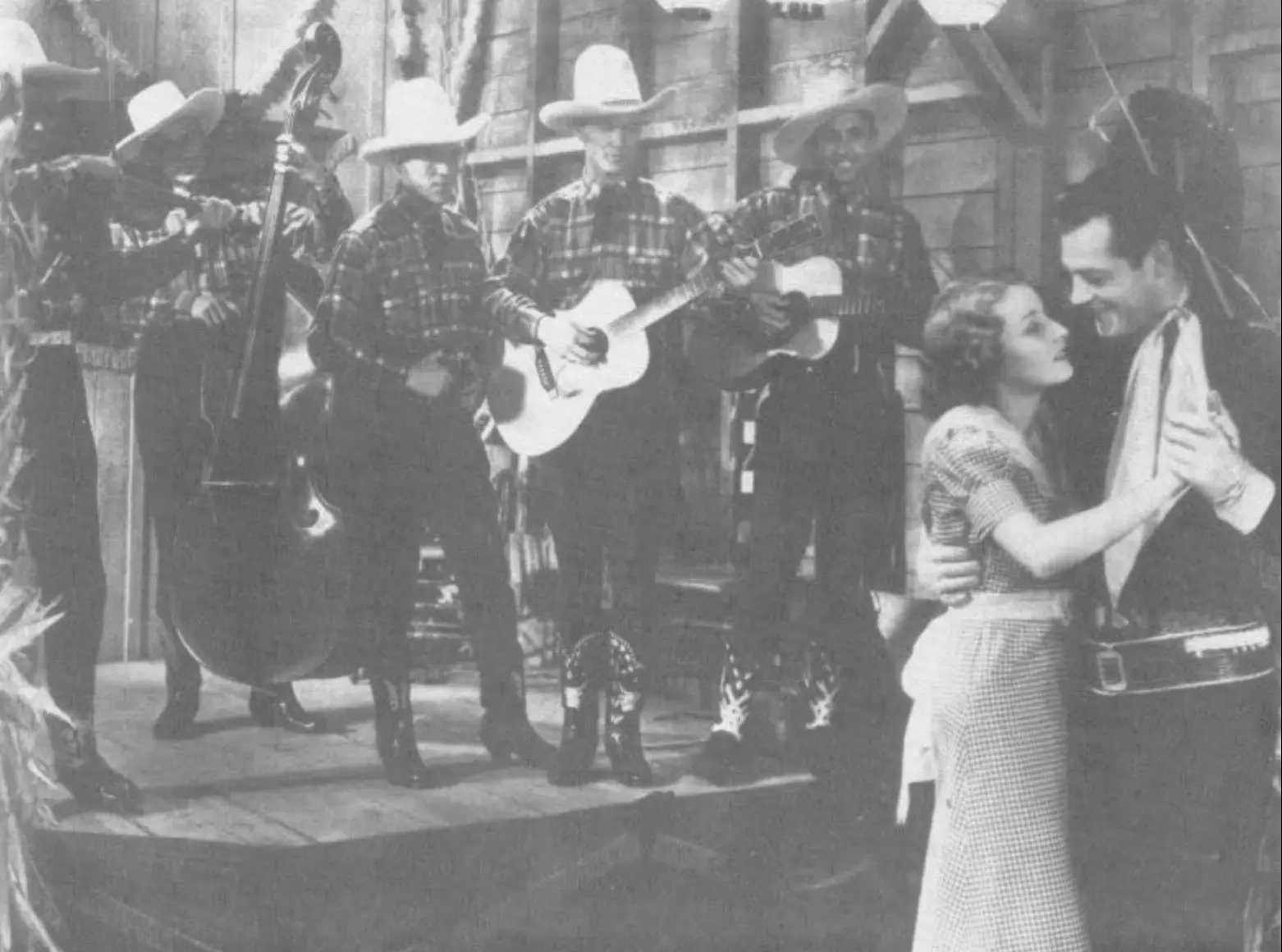
Gallant Defender (David Selman, 1935)
Many of their films exist in an uncertain and even surreal time and place, a movie set on the range comprising of a grab-bag of western symbols plucked from various historical moments. Things will often begin in what appears to be the Old West, with the Sons of the Pioneers riding their horses down the main street of an Old Western town — with swinging-door saloon, sheriff’s office, and all — until a character offhandedly mentions listening to the radio or watching television, or a car or bus pulls into a parking spot next to all the hitched-up horses. In Call of the Canyon (1942), the Pioneers are small-time singing cowhands squaring off against a greedy meatpacking salesman who hires airplane pilots to stampede their cattle. In The Old Corral (1936), they appear at first to be playing classic Old West bandits holding up trains and stagecoaches, until we learn that they are actually a group of down-on-their-luck western musicians attempting to gain enough notoriety to get booked for radio performances. The real danger in the film comes from a group of Chicago mobsters who drive into town in a station wagon, searching for a missing nightclub singer who witnessed a murder and went on the run — a device ripped from gangster or noir films more than westerns. Indeed, in the same way that these films often present a hodgepodge of historical reference points (and just as western music was actually a broad collection of other popular styles), the films are also an amalgamation of various genres and conventions of the era too: westerns, sure, but also crime films, musicals, science fictions, and screwball comedies.
While many films, songs, and dime novels tended to mythologize a folkloric cowboy tradition — the fantasy that singing cowboys had always been someplace ‘way out there’ (to quote the title of the Sons of the Pioneers’ 1934 record) — western music as a commercial genre emerged at the same time as the sound film and B western, flourishing in the advent of new electrical recording technology that sparked a sonic revolution in the late 1920s. Something of this historical process is depicted in Mack V. Wright’s The Big Show (1936), a B western about people making B westerns, dramatizing the emergence of the singing cowboy with a climax that involves an accidental broadcast of Gene Autry’s singing (backed by the Sons of the Pioneers) to the nation over radio. This new western music — drawing on earlier vernacular traditions while consciously differentiating itself from the previously dominant racialized divide between ‘hillbilly’ music and ‘race records’ — catered to the tastes of listeners in a rapidly industrializing America in the early twentieth century, a people marked by mass migration out of the rural South due to the railroad, automobile, and defense manufacturing industries, oil booms in Texas and Oklahoma, and the twin disasters of the Dust Bowl and the Great Depression. [6]
These historical developments are registered and negotiated in several films. Two movies both called Red River Valley — one from 1936 starring Gene Autry and the other from 1941 starring Roy Rogers backed by the Sons of the Pioneers — have different plots but both revolve around the constructions of reservoirs and dams, playing on contemporary anxieties around the industrialization of formerly rural areas, resource extraction from the Western landscape, and climate-induced drought and water scarcity. Others center around land and labor disputes, like Tumbling Tumbleweeds (1935), which, while featuring several renditions of the Pioneers’ signature song, strings its narrative around a clash between disgruntled settlers who demand ‘water and a plot of land’ and the ‘landlords’ who refuse their demands. Often, the villains in these films are not gun-toting bandits but rather bland corporate middlemen, who sow discord in communities by pitting workers against benevolent ranchers. The Pioneers frequently play sheriff’s deputies who work to uncover these behind-the-scenes machinations and broker a truce between laborers and small businessmen. While it might be a bit of a stretch to read too much left-wing populism into these plots, it’s still remarkable how the spirit of the times shifted just what kind of order the Pioneers were called upon to enforce. The group found themselves defending tight-knit rural communities and small enterprise against the consolidation of corporate capital: the banks foreclosing on the family farms, the big companies monopolizing the cattle trade.
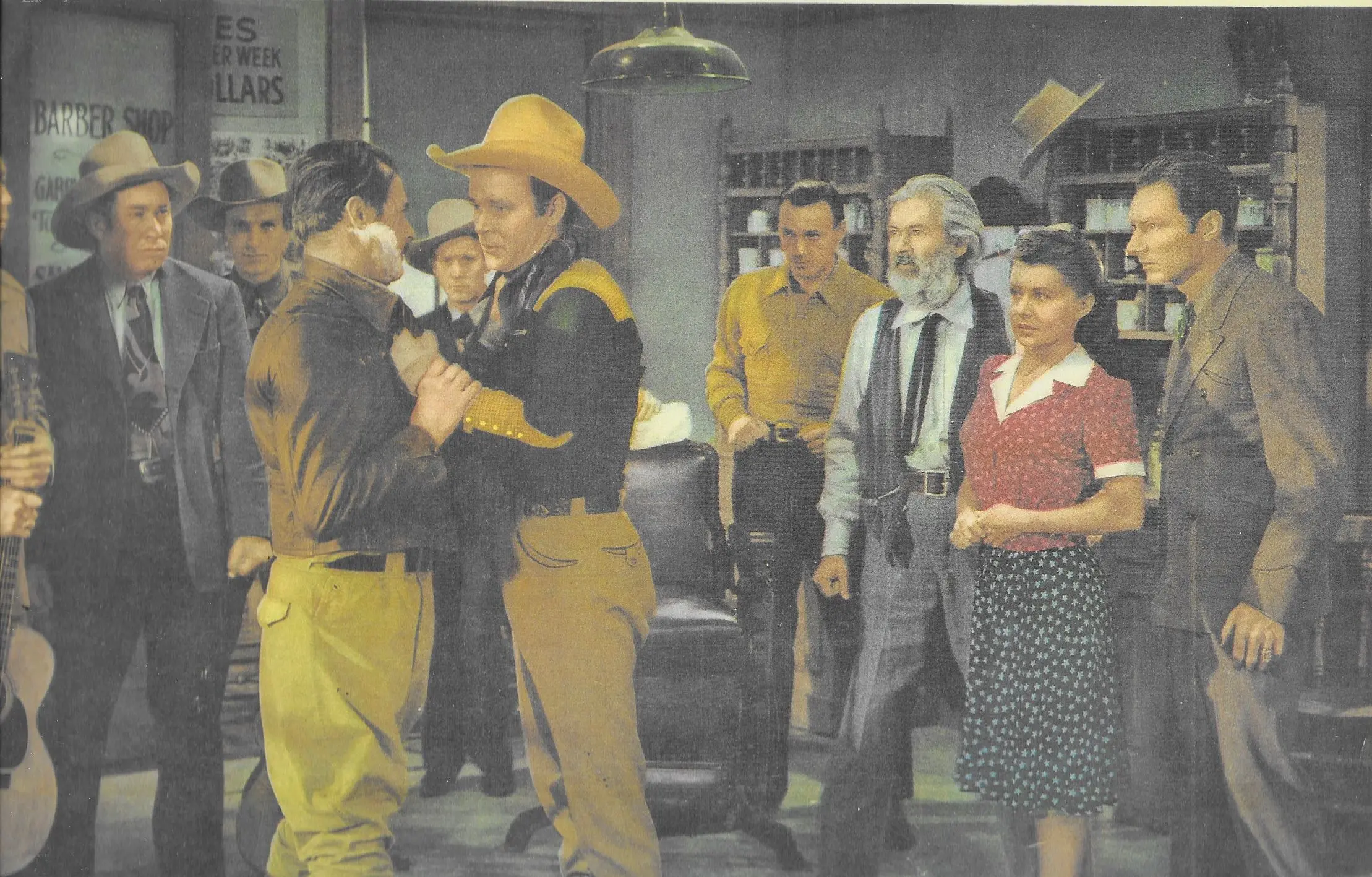
Red River Valley (Joseph Kane, 1941)
By the mid-forties, though, the Pioneers’ films shifted to reflect the economic boom of the postwar era. They had been released from their contract at Columbia with Charles Starrett and moved back to Republic to back up Roy Rogers, who had emerged as the new ‘King of the Singing Cowboys’. The studio lavished greater budgets on these new Rogers westerns, packing them with theatrically choreographed Busby Berkeley-esque song and dance revues and placing the Pioneers alongside tap dancers, big band orchestras with conductors in tuxes, and whatever up-and-coming crooners the studio was trying to make the next big thing — a far cry from their more ersatz and democratic musical interludes in the westerns of the thirties. This more buttoned-up context mostly worked to the detriment of the music — but it was also in these films that the group began to perform a selection of songs in Spanish, designed to cater to a growing Mexican audience that Republic hoped to appease. This led to surreal renditions of the Mexican songs ‘Cielito Lindo’ in Hands Across the Border (1943) and ‘Allá en El Rancho Grande’ in My Pal Trigger (1946). Interestingly, the group sang some of their most richly sourced material in what were otherwise the most milquetoast and conservative-minded of their films. In an era when Rogers broke free of the Pioneers, cementing his star status as the All-American golden boy who ‘never drinks, never smokes, never shoots pool, never spits’, and who ‘always wins the girl but never kisses her’, the other musicians were relegated even more to the margins of the films. Were the Pioneers singing Mexican folksongs, then, letting out in the corners of the film all that repressed ‘rampant purity’ held bottled within its center?
As the forties wore on and the popularity of the B western began to decline, these questions only seemed to fold in on themselves as the films became even zanier. Bells of San Angelo (1947), one of a group of films pairing Rogers and the Sons of the Pioneers with director William Witney, makes novel use of Republic’s newly invented Trucolor process, painting its desert landscape in luridly exposed hues of orange, brown, and red. The action ensues in a kind of fever dream from this hazy, almost psychedelic colorfield, as a bumbling Andy Devine leashes a raccoon and takes it for a stroll around the desert, a posh British detective with a red tailcoat and a stockpile of hunting rifles arrives without explanation, and a dead-eyed Rogers punches mining company henchmen on top of a mountain, calling out maniacally, ‘Get up, the picnic’s just started.’ Rogers plays a ‘border inspector’ in the film, investigating a smuggling ring ferrying silver between Mexico and Texas, and aiding him are a benevolent Catholic missionary and the Pioneers as Sheriff Devine’s deputies. The film is packed with violent fight scenes and shootouts — yet while it spends much of its runtime moving between borders, it’s strangely devoid of any Mexican characters. Its villains are all white men, who seem to have no difficulties taking over an abandoned Mexican mine and only run into troubles when they want to rip off the American market by smuggling across the border. Just as earlier films featuring the Sons of the Pioneers imagined a West that was already ‘settled’, devoid of any indigenous communities and culture, Bells of San Angelo also imagines a Mexico without Mexicans, registering an absence it can never outright name.
The film also includes one of the Pioneers’ most captivating performances, when Witney pauses the fight-scene-packed plot to slowly push in on the band as they lie about under a shady veranda, singing a slow, sleepy number to an audience of townspeople and their shaggy pet dogs. ‘Lazy days a-loping, having fun’, they harmonize, elongating their vowels as they slide down a wonderfully relaxed and breezy melody line, petting the terriers and poodles that surround them. Hugh Farr untucks his eyes out from under the brim of his cowboy hat to deliver a bassy couplet, and Bob Nolan leans slowly back on the body of a shepherd dog, using it as a pillow. ‘Got no work to do,’ they sing, ‘because my work’s all done.’
Watching the scene today, you might hear in the band’s laconic delivery and see in Witney’s whacked-out visuals a metaphor for the sleepy, shaggy petering out of the Pioneers’ film career and the B western in general. Rather than end guns a-blazing in a big shootout, in reality the B western died a slow and uneventful death, due to factors as diverse as rising production costs, aging actors, shifting postwar cultural tastes favoring B noirs and sci-fi films, changes in antitrust law affecting the jerry-rigged distribution deals struck by Poverty Row studios, and a new generation of suburban kids more likely to gather around the television set than head to the town or city for a Saturday double feature. Seeing the writing on the wall, Republic severed their contract with the Pioneers in 1948, and by the start of the fifties, the group had drastically changed as well: Rogers struck out on his own, following the exodus out of the movies and launching his own TV show; Tim Spencer’s poor health led him to leave performing behind to become the group’s manager; and Nolan, who had never felt comfortable in the limelight, quit the band unexpectedly after a 1949 show in Helena, Montana, fed up with his new role as the group’s frontman and with two grueling decades of life on the road and on location.
It was fitting, then, that one of the group’s last memorable film performances, in Disney’s omnibus Melody Time (1948), came in the form of a lullaby. ‘Shades of night are falling, as the wind begins to sigh,’ Rogers croons, ‘and the world is silhouetted against the sky.’ A pair of animated tumbleweeds float through a desert cloaked in blue and purple, moving past a cactus bending in the wind, a family of chickadees waddling through the sand, and coyotes howling beneath the moon. In many ways, the narrative section about ‘Pecos Bill’ that follows this opening prelude, ‘the rootinist, tootinist, shootinist cowpoke of them all’, extends Witney’s Trucolor mania into an even more surreal and disturbing fantasia: what’s set up to be a harmless children’s bedtime story soon presents a slew of repressed sexuality and colonial violence popping out of the film’s exaggeratedly trippy animations. But at the start, there is just the simplicity of guitars strumming and voices harmonizing, of music drifting along into the hand-drawn desert night. ‘Until the darkness sheds its veil,’ the voices promise the listener, ‘there’ll be blue shadows on the trail.’
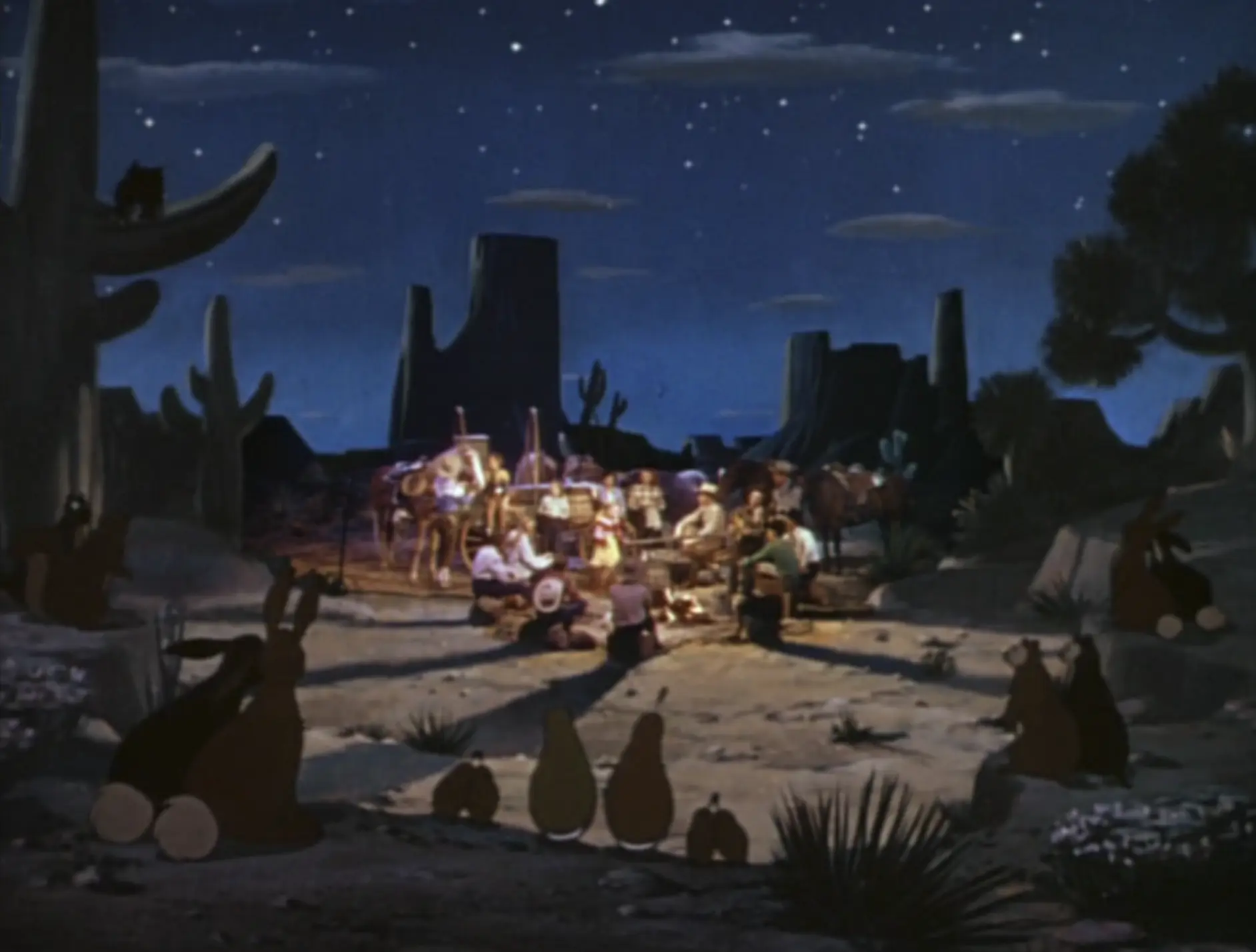
Melody Time (Clyde Geronimi, 1948)
* * *
Like those blue shadows haunting the trail, the Sons of the Pioneers never quite vanished, even if they became harder to recognize. In John Ford’s Rio Grande (1950), they come marching back in as the ‘Regimental Singers’, a band of singing cavalry men in John Wayne’s army unit in the post-Civil War American West. It was their first film appearance in nearly two years, and it would also be nearly their last — they would be featured as actors in just one more film, released the following year. And they had returned reconstituted, too, with three new singers in Ken Curtis, Lloyd Perriman, and Tommy Doss. The Farr brothers, the only remaining original members of the band, were visibly aging, their faces leathery and weathered, and they seemed to stand even more in the background of shots, ceding ground to the younger replacements. At the same time, though, these new singers had fully devoted themselves to replicating the close harmony singing sound of the original group — in some cases they had been chosen explicitly because of their vocal similarity to the departing members — so they slipped in almost unnoticed. They were already summoning ghosts.
The Pioneers’ biographers Bill O’Neal and Fred Goodwin called Rio Grande ‘the most important movie the Sons of the Pioneers had ever helped to film’. [7] Yet what did it mean that their most important film was also practically their last, with few of the architects of their original sound still present? Were the Pioneers, at the twilight of their film career, suddenly being elevated to A status after decades of toiling in the margins of the B picture? Or did the group present a musical motif for Ford to invoke, a way to explore the B western and its strange and receding cultural meaning? Just as the director often recast forgotten or passed-over actors like Victor McLaglen and Ben Johnson in his late films — what the critic Robin Wood eloquently calls ‘Fordian resurrections’ [8] — perhaps he was also bringing the Sons of the Pioneers back to life, placing their voices, already associated with a fading pop culture of the thirties and forties, in a period film set in the late nineteenth century and alongside actors whose careers in the Ford ‘stock company’ stretched all the way back to the silent era — an accretion of overlapping historical times, faces, and sounds.
Rio Grande, made quickly and cheaply under the aegis of the Pioneers’ old house studio Republic, is suffused with music, from military marches to work songs about the Erie Canal to novelty tunes like the Dale Evans-penned ‘Aha! San Antone’. The presence of the Pioneers as actual characters in the film allows the music to emerge naturalistically, as they not only sing the soldiers off to war but also hang out in their tents, trading verses about the Alamo or chowing down on corn pone and mustard greens. Unlike in Ford’s previous film Wagon Master, where the Pioneers’ voices narrate the film’s sweeping narrative of westward migration, in Rio Grande, their music always seems to be coming from somewhere off to the side of the action — just over yonder on the other side of camp, fading in and out with the noises of life in the desert. In one scene, they lounge around a campfire strumming and singing — an image ripped straight out of the B western stock vocabulary — before Ford cuts to a haggard and unkempt Wayne strolling alone on the shores of the film’s titular river, twilight shadows reflecting off his eyes as he listens to the Pioneers sing a forlorn tune called ‘My Gal is Purple’ off in the distance. In another, Ford mixes in the nighttime sounds of crickets chirping with the far-off yodeling of the cowboy tune ‘The Cattle Call’, as Wayne and O’Hara, once lovers long ago, now scurry off to their separate beds.
That ‘The Cattle Call’ had been a massive hit for western singer Eddy Arnold just a few years prior to the film’s release wouldn’t have been lost to viewers in 1950. What was it doing in a movie supposedly set in the 1870s? What might have appeared to be a simple anachronism was doubly refracted by the performance of the Sons of the Pioneers, anachronisms themselves who appeared as vestiges of the 1930s, an era already distant and passé to a postwar society. Perhaps this is what Ford’s son Patrick was getting at when he claimed his father initially thought the group ‘cheapened the picture artistically’ [9] — that they somehow broke the spell of the film’s historicity. But these anachronisms also bring forth all that was potent and strange about the Sons of the Pioneers and their music in the first place — that it was both of the past and the present, direct yet ornamented, intimate yet blustery, stuck in time yet floating free of it, hokey and ghostlike. Moreover, it’s what Ford seems most fascinated with generating in Rio Grande: a dislodging or dislocating of time, recursions and repetitions of the past happening all at once in the frame. [10]
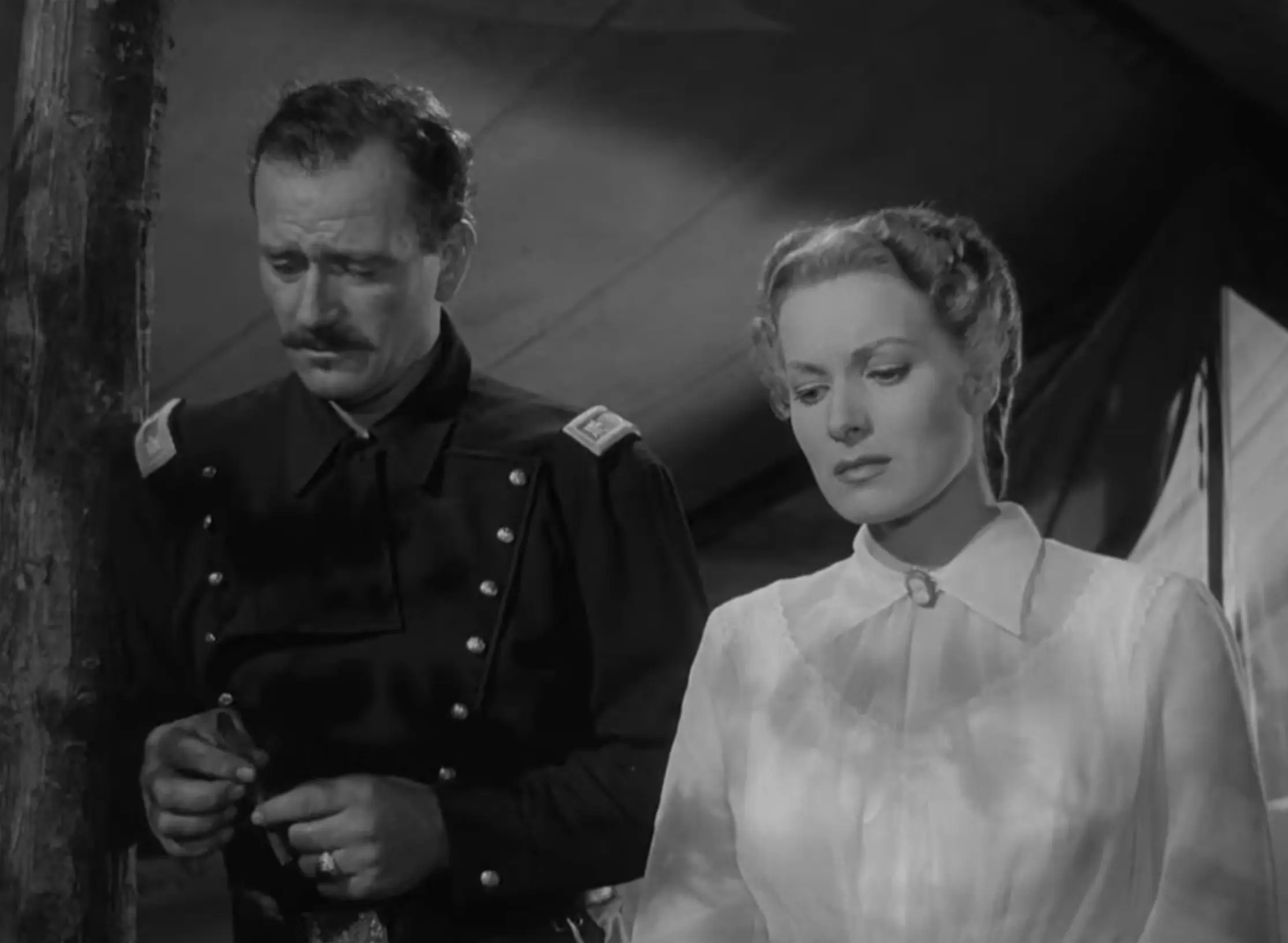
John Wayne & Maureen O'Hara in Rio Grande (John Ford, 1950), serenaded by the Sons of the Pioneers
Ford structures his film around two full performances of songs by the ‘Regimental Singers’. Both songs are anachronisms and both are concerned with looking back at the past. The first, ‘I’ll Take You Home Again, Kathleen’, was first recorded in the 1910s and would have been popular when Ford himself was a young man; the song’s reflection on reclaiming lost love creates a sentiment so on-the-nose for the narrative of the film — where O’Hara’s character is also named Kathleen — that Wayne’s Sergeant York, otherwise incapable of articulating his own emotions, must embarrassedly confess to Kathleen that ‘this music was not of my choosing’. The second, ‘Down by the Glenside’, is an Irish ballad written by Peadar Kearney around the time of the 1916 Easter Rising, which reflects upon the legacy of the earlier 1867 Fenian Rebellion against British colonial rule. What was an Irish Republican song about freeing oneself from the shackles of colonization doing in a film that dramatizes the US Army’s genocide of indigenous peoples? Originally a rousing cry to arms, celebrating the ‘Bold Fenian Men’ of yore, the Pioneers perform the song as a dirge, a moment of final reprieve and reflection for the soldiers before they embark on what appears to be a suicide mission and who perhaps suspect their cause of fighting the ‘Indian Wars’ may not be totally just. In both musical performance scenes, what Ford dramatizes is not so much the music but the experience of listening to it, as the songs project emotions onto the faces of characters who aren’t able to express themselves directly. These moments of listening present not just a nostalgia for a bygone romantic past or a propping up of manifest destiny, but something much more unsettled, ambivalent, and melancholic. What appears on the surface to simply mythologize the West and the music of its settlers and brave army soldiers reveals itself to harbor the shifting, anachronistic, and contradictory textures of the past — that same heterogenous hodgepodge of historical and generic references found in the songs and cinema of the Sons of the Pioneers. By pausing to give itself over to their music, all that the film’s narrative can’t quite reckon with directly comes to the fore. In the same way that these musical interludes channel emotions the characters can’t name themselves, the Sons of the Pioneers’ performance opens a space in the film to reflect all the disturbances and ambiguities its other sections suggest but can’t quite explain away.
Perhaps no figure has been better able to excavate these resonances or to model this way of listening with the past than Willie Nelson, one of the few prominent musicians of a later generation to be seriously interested in the Sons of the Pioneers and the singing cowboy music of the thirties and forties. Nelson grew up in a small Texas farm town in the thirties, often reminiscing about his childhood days watching westerns at the local picturehouse, and he famously named his beloved and battered guitar ‘Trigger’, in tribute to Roy Rogers’s trusty sidekick of a horse. He’s recorded covers of countless tunes sourced from the B western back catalog, from ‘Tumbling Tumbleweeds’ to ‘Sioux City Sue’, and his own signature tune ‘On the Road Again’ might be heard as a direct homage to Rogers’s ‘Happy Trails’ and Gene Autry’s ‘Back in the Saddle Again’. Something of Nelson’s mythic childhood romance with the western and its real-life connection to the rural Texas of his Depression-era youth has always inflected his music and image — which potently combines a larger-than-life icon (the pigtails, the headband, the clouds of pot smoke wafting from the tour bus) with a plainspoken directness. In his best covers, he creates the sense that he’s living in the song as he performs it, slowing down behind the beat or racing past it as he evokes buried dimensions of depth and feeling.
Willie’s interest in pulling out these resonances and phantom traces of the past finds its fullest expression on his 1975 masterpiece Red Headed Stranger, a sparse, atmospheric concept album which builds its loose narrative from the 1954 western pop song ‘Red Headed Stranger’, which tells the tale of a drifter so ‘wild in his sorrow’ that he murders a woman just for touching his dead wife’s horse. Nelson recalled that he’d always imagined the song as ‘an old cowboy movie’ [11] of the kind he grew up watching, that he could see a film unfolding in the song’s imagistic lyrics and structural repetitions. He constructed the album as if sketching out the rest of the film, writing songs imagining the stranger’s life before he rides into town in the original song. Yet Nelson only doubles down on the violence and desperation of his source material, turning the Red Headed Stranger into a crazed preacher on a seemingly endless killing spree. [12] As the album unfolds, too, he adds in other songs culled from the past, in the process creating a kind of atmospheric, polyvocal connection across time periods and musical idioms. When the preacher discovers his wife has left him, Nelson imagined ‘he’d relate an old Eddy Arnold tune’, ‘I Couldn’t Believe It Was True’. [13] Later, he cycles through Juventino Rosas’s nineteenth century Mexican carnival music classic ‘O’er the Waves’, the Baptist hymnal ‘Just As I Am’, and the centerpiece of the album, ‘Blue Eyes Crying in the Rain’, a country standard written by Fred Rose in 1947 that had been previously covered by Hank Williams, Gene Autry, and the Sons of the Pioneers themselves.
What might we be able to glean by taking Nelson at his word and imagining the album as its own kind of cinema? Might that provide a way back into understanding all that seems opaque about the Sons of the Pioneers and the films they appear in, the cinema that they also constitute? Nelson creates a chorus by stringing one song into another, and out of that comes a film that is sketch-like, filled with gaps and marked by absence and emptiness. In one sense, Nelson’s album seems to make explicit all the hidden violence and ghostly traces that had always lived underneath the Pioneers’ records and cinematic performances. However, bringing these undercurrents to the surface makes them no less haunted or suggestive. Instead, Nelson’s covers keep pushing meaning and resolution outward, somewhere off in the distance, as he follows one song into the next one and back again.
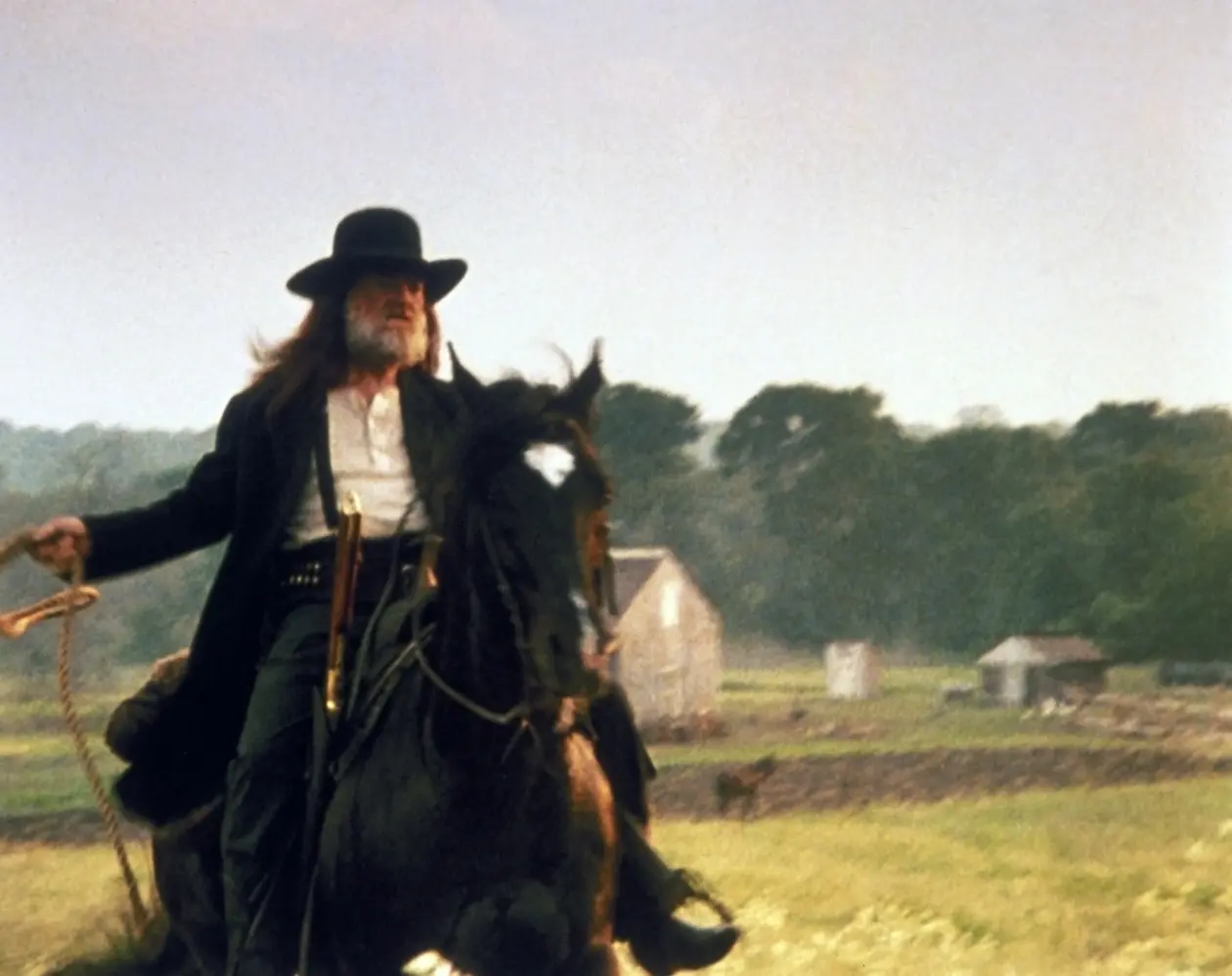
Red Headed Stranger (William D. Wittliff, 1986)
With the western music and cinema of the Sons of the Pioneers, then, it’s hard to make many assumptions. Whenever a landscape appears too clear, the ground tends to shift. Take the Pioneers’ 1941 song ‘Tumbleweed Trail’, which at first sounds like a generic retread of ‘Tumbling Tumbleweeds’, a way of cashing in on that song’s immense popularity. Yet as the song unfolds, it shifts its tune away from its predecessor. Rather than depicting a romantic drift through the desert (‘Lonely but free I’ll be found’), it imagines a Western landscape that’s been totally emptied out, its wide-open country wiped away into barren oblivion, perhaps by the Dust Bowl or perhaps by something more mysterious. Stopped in their tracks, the singers can do nothing but grieve: ‘This ain’t the West I knew.’ They call out to a tumbleweed rolling along through the expanse, but it leaves them in the dust. ‘Gone are the plains where cattle were lowing, gone are the fields where clover was growing,’ the singers lament in cascading and falling melodic lines. ‘Nothing is left and soon I’ll be going’, they sing, ‘down the Tumbleweed Trail.’
Notes
Bill C. Malone and Jocelyn R. Neal, Country Music, U.S.A. (University of Texas Press, 2010), p. 148.
H. Allen Smith, ‘King of the Cowboys’, Life, 12 July 1943.
It’s not for nothing that Bing Crosby crooned alongside the Pioneers in the film Rhythm on the Range (1938), and longtime Pioneer singer Ken Curtis once replaced Frank Sinatra in Tommy Dorsey’s big band.
Bill O’Neal and Fred Goodwin, The Sons of the Pioneers (Eakin Press, 2001), p. 15.
Constance Rourke, American Humor: A Study of the National Character (Harcourt, 1931; repr. New York Review of Books Classics, 2004), p. 44.
Even the singing cowboy is not as monolithic of a figure as we might think: Herb Jeffries starred in The Bronze Buckaroo (1939), an independently produced B western featuring an all-Black cast, and there were also singing cowgirls like Dorothy Page, Patsy Montana, and Dale Evans.
O’Neal and Goodwin, p. 167.
Robin Wood, ‘Shall We Gather at the River? The Late Films of John Ford’, Film Comment, 7:3 (Fall 1971), 8–17 (p. 9).
Scott Eyman, Print the Legend: The Life and Times of John Ford (Simon and Schuster, 1999), p. 392.
Or as scholar and filmmaker John Winn writes of Ford’s use of the Pioneers’ music in the soundtrack for Wagon Master (1950), ‘history and myth made manifest in the passing now’. In ‘The Landscape View: Survey Photography and John Ford’s Wagon Master’, Discourse, 47 (3) (forthcoming).
Willie Nelson with David Ritz, It’s a Long Story: My Life (Little, Brown and Company, 2015), p. 127.
A decade after the album’s release, Nelson finally realized his dream, collaborating with director William D. Wittliff to independently produce a film out of his album, casting himself as the titular Stranger.
Nelson with Ritz, p. 127.