A notion of the abstractness of films crosses my mind, only to be swallowed up in a morass of Hollywood garbage. A pure film of lights and darks slips into a dim landscape of countless westerns. [1]
—Robert Smithson
To face the western today is to consider cinema in its purest form — that is, in its impurity. Since its inception, film has been a medium compromised by power and exploitation, by the greed of patentholders, executives, and financiers; the abuse of workers and talents on and off the set; the poisoned waterways of Eastman and DuPont. Any introductory history of cinema will acquaint the reader with the imperial horizons that defined this medium’s early days: exotic travelogues of Egypt and China, a colonial gaze upon indigenous subjects domestic and abroad. Cinema is movement, montage, and light; it is equally conquest, capital, and the everyday misery of a fallen gesture. As Narrow Margin looks back on its first year, we return to the ‘only genre whose origins are almost identical with those of the cinema itself’. [2]
This issue is dedicated to westerns made at the margins, produced with little means and made from the scraps of the studio system: cheap programmers of Poverty Row, seventy-minute features of cowboys with guns ablaze on the backlot. These were films that exploited leftover sets, recycled plotlines ad nauseam, and made use of filmmakers and actors idling between major projects or exiled from the studios proper. At once popular and peripheral, they were the morass upon which American cinema was built, the crude oil that fueled an empire. However, they also exist in another lineage, one that includes the films of Luc Moullet, Paul Vecchiali, Larry Cohen, and any other filmmaker who made art with a poverty of means. Embodying all that is criminal and beautiful in the history of cinema, the B western tells the story of its medium. What did cinema once promise and what promises has it consistently betrayed? Where did it belong and where might it travel today? Our hope is that, in returning to a few of these scrappy films, we might begin to outline an answer.
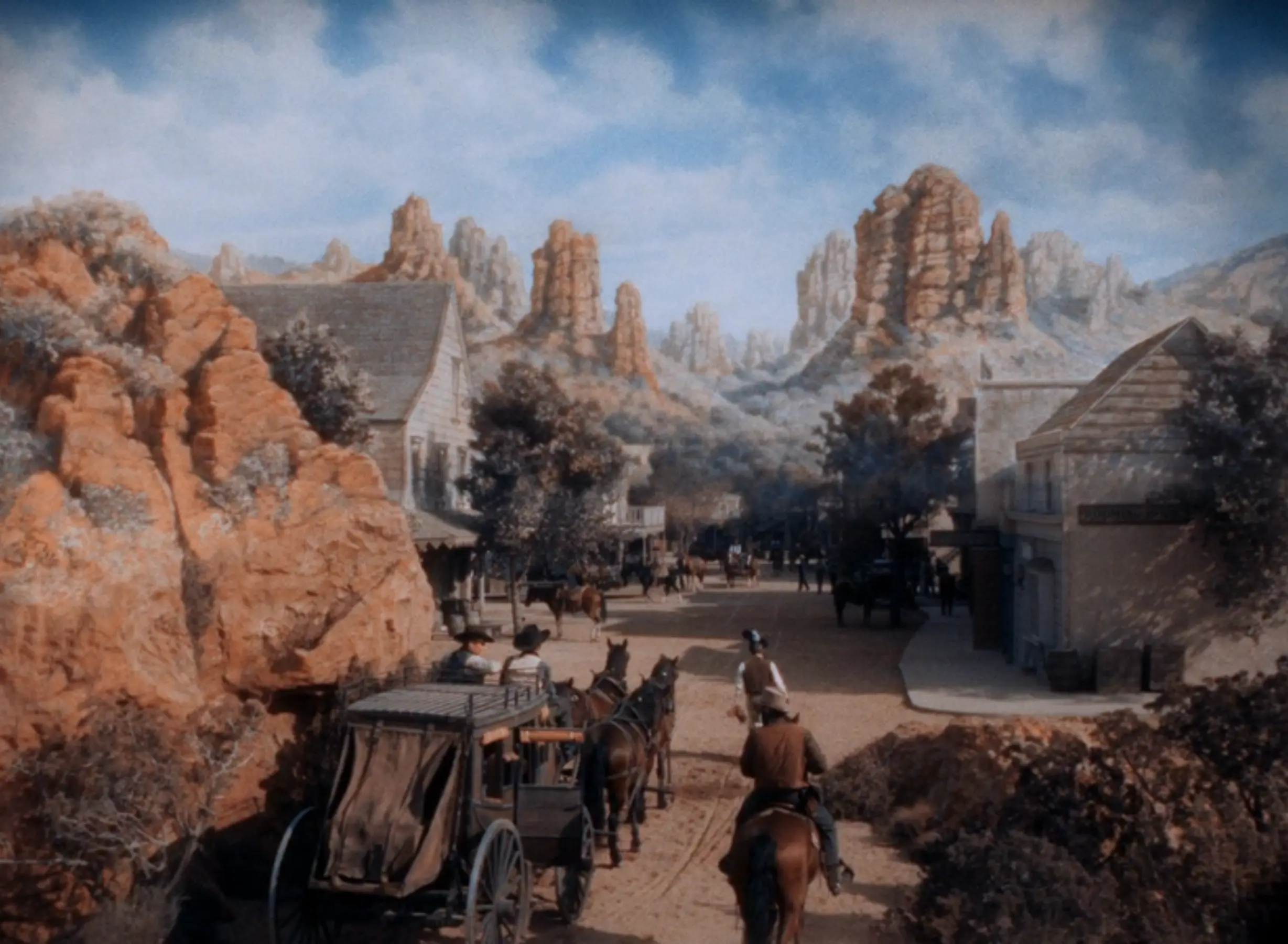
Singing Guns (R.G. Springsteen, 1950)
With meager resources at their disposal, the filmmakers of these minor movies were compelled to approach their medium pragmatically. In doing so, they discovered some important things about cinema: that forms could not be isolated from matter, thoughts must realize themselves in movement, and images bear the responsibility of conceiving a world. The genre was a diagram tweaked a hundred times over, continually modifying and rearranging its prepackaged stories, familiar settings, and companies of actors. Each film sought not to know itself, but to put this diagram to work in the world. If the B western thinks — about the history of the United States and its accumulated myths and forms — it simultaneously acts: it ‘does some things’, dissolving spirit into the motility of the image and contingency of the world. [3]
Many of these filmmakers exploited the natural beauty of the American West, shooting on location — how much cheaper to film en plein air — on the outskirts of what was only a few decades prior the so-called ‘frontier’. Already in the early 1900s, boosters were proselytizing the new myth of the West that would become Hollywood: California was a region ready-made for cinema, as though God had graced the nation with an open-air studio. As Budd Boetticher remarked, ‘The Good Lord really made this place for movies.’ [4] Of course, what made the region appealing to early film producers had little to do with the Good Lord and a lot to do with money and politics. Like the national parks that appeared in westerns with increasing frequency throughout the 1950s, the prospect of spectacular and uninhabited real estate was the product of hundreds of years of genocide and forced displacement.
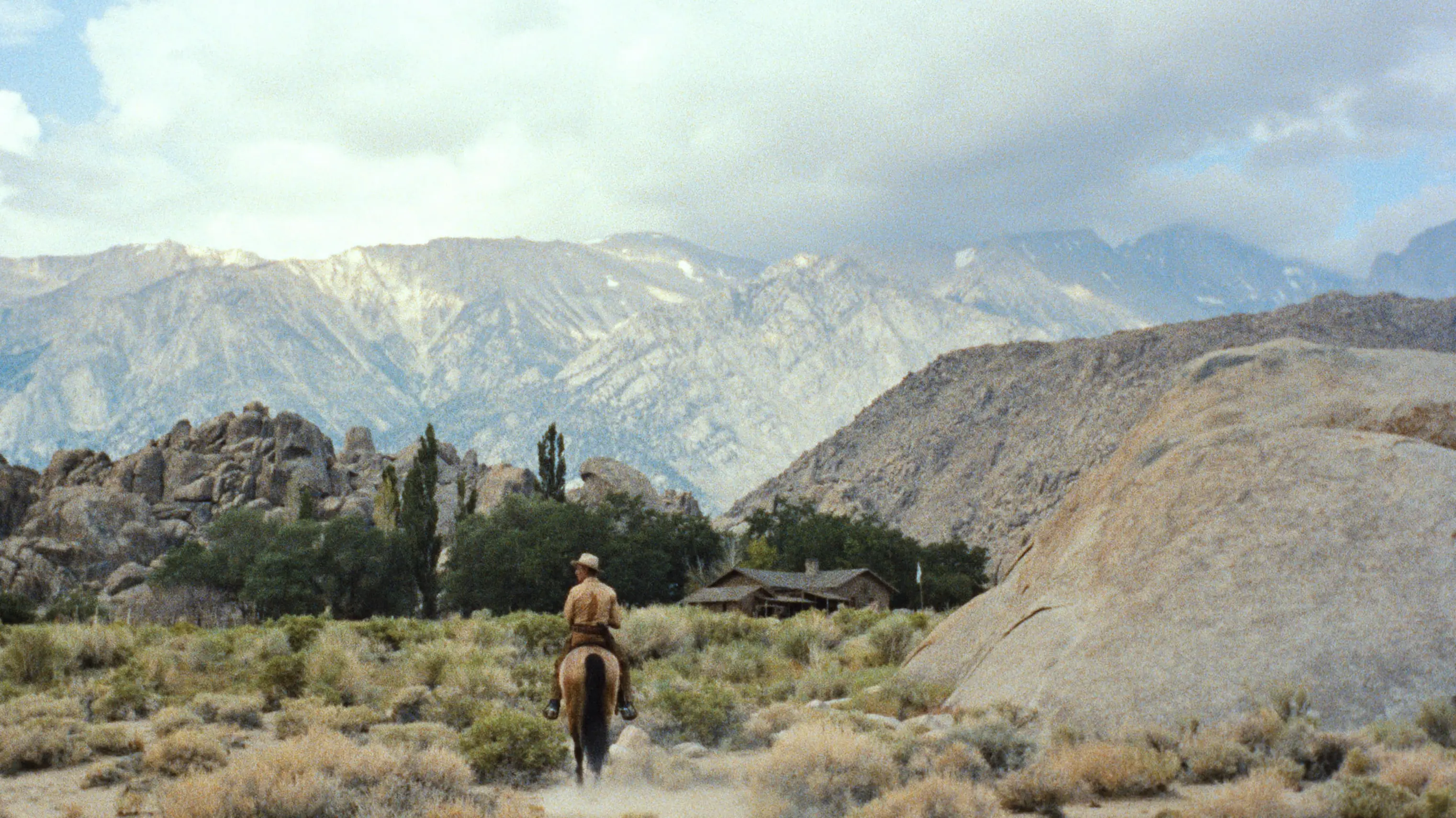
The Tall T (Budd Boetticher, 1957)
Of this long history of colonial settlement, the western often privileges one period: westward expansion in the years immediately following the Civil War, an origin story for the modern empire to come. Whether of open plains, barren canyonlands, or rugged mountains, the on-location photography of the western often reproduced that period’s visual vernacular, recalling the imperial imaginaries of nineteenth-century American landscape painters like Albert Bierstadt and Thomas Moran. ‘Landscape might be seen [...] as the “dreamwork” of imperialism,’ writes W.J.T. Mitchell, ‘unfolding its own movement in time and space from a central point of origin and folding back on itself to disclose both utopian fantasies of the perfected imperial prospect and fractured images of unresolved ambivalence and unsuppressed resistance.’ [5] There is perhaps no better description of the unreconciled terrains that populate the western film. However, unlike the landscape painters of an earlier era, the directors of the western film could never entirely escape into the realm of the imagination. These films were there, physically present, chemically and existentially bound to the profilmic terrains, habitats, and cultures fundamentally shaped by empire.
Then and now, this landscape is haunted by violence. Often just beyond the frame, it has pervaded the western since the time of Allan Dwan, which is to say since the genre’s genesis. While working at the American Film Manufacturing Company, Dwan shot one-reelers of cowboys and robbers in the traditional homelands of the Kumeyaay, who had been dispossessed of their land over the course of centuries. John Ford and others shot on location in Navajo Nation, especially Monument Valley (where uranium mining commenced in the 1940s with toxic consequences persisting to the present day). Situated just a few miles from Lone Pine, the shooting location for hundreds of westerns, is the Manzanar Relocation Center, a concentration camp that held captive Japanese immigrants and Americans during World War II. The western rarely tells these stories, but they are present in every square foot of the places it traversed.
To return to the Wild West today is not to nostalgically wish for the resurrection of an obsolescent genre, for the revitalization of these empty towns, overgrown trails, and abandoned tracks. They should remain as ruins. So often, the hero of the western looks upon these artifacts of ‘civilization’ with unease before riding out, destined to remain a wanderer passing through so many flimsy sets, matte paintings, and rear-projected skies. The essays included in this issue begin where our hero left off, drifting through the seemingly endless landscapes that were once the domain of the B western, reading its relics to divine what cinema was (the good and the bad) and perhaps alert us to what it still might become. If cinema has a future, it will likely have more in common with the half-forgotten scraps of its history than the sheen and false spectacle to which modern spectators are accustomed.
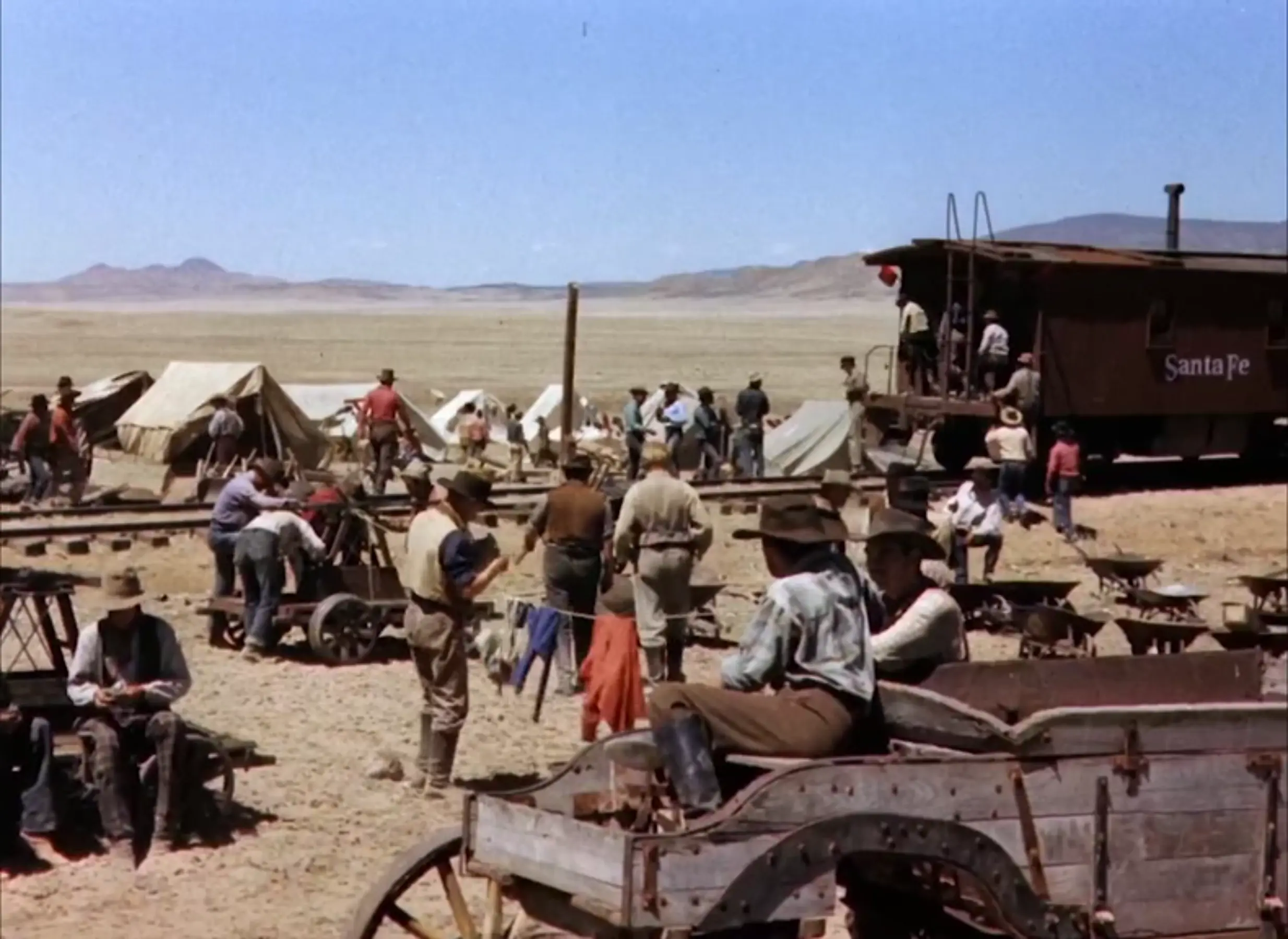
Santa Fe (Irving Pichel, 1951)
A comment on the structure of this issue. The table of contents is organized as a train: the editorial a locomotive, each of the main sections a boxcar, and the final miscellaneous section a caboose. Though each boxcar does not fit neatly with a theme (emphasized by the decision to name them arbitrarily with serial numbers), they have been curated to showcase the variety of approaches to the B western as well as to generate implied conversations between essays. The caboose warrants explanation: why include a section on films that are not B westerns? We included these pieces because they provide peripheral approaches to other kinds of westerns. They approach A westerns from their edges, gleaning productive fragments and prospects that might otherwise go unnoticed. They draw our attention to other traditions beyond the Hollywood system: westerns of the Eastern Bloc (Osterns) and a western from the heart of San Francisco’s avant-garde. The caboose invites the reader to approach the B western not so much as an object but as a method, a horizon for thinking cinema.
Notes
Robert Smithson, ‘A Cinematic Atopia’, Artforum, 10 (1), September 1971, 53–55 (p. 53).
André Bazin, ‘The Western, or the American Film par excellence’, in André Bazin, the Critic as Thinker: American Cinema from Early Chaplin to the Late 1950s, trans. and ed. by R.J. Cardullo (Sense Publishers, 2018), 11–18 (p. 11).
To quote Jacques Rancière in his discussion of Jimmy Stewart in the westerns of Anthony Mann. See ‘Some Things to Do: The Poetics of Anthony Mann’, Film Fables (Berg Publishers, 2006), trans. by Emiliano Battista, 73–93 (p. 78).
Budd Boetticher, ‘A Man Can Do That’, The Films of Budd Boetticher (Sony Pictures Home Entertainment, 2008).
W.J.T. Mitchell, ‘Imperial Landscape’, in Landscape and Power (University of Chicago Press, 2002), 5–34 (p. 10).