Here is a film that will surprise the audience and that ought to mark a renewal of French cinema. With Le Théâtre des matières Jean-Claude Biette suddenly reactivates the pleasure of spectacle, made up of gratuitousness and surprises, overseen by an implacable humor, with eruptions of elements of reality so subversive that one cannot help but think of what Chaplin, or American comedy, in a few powerful moments, has produced at their most virulent. At last, we laugh. It’s high time a little bit of life reanimated our screens.
The film is programmed at Action République and La Clef, with Straub’s Mallarmé (a ten-minute short film) projected before it.
Marie-Claude Treilhou: The title of your film, Le Théâtre des matières, has some strong avant-gardist connotations — it’s a very ‘theoretical’ title…
Jean-Claude Biette: All the theory expounded by the character of Hermann on matters is in fact the key to the film: when he talks of objects that can be exchanged, bought, discarded, adored or hated, that is what happens to the diamond in the film. Thus, the theory of matters has to do with Hermann’s theatrical mise en scène presented in a form both serious and ironic in relation to itself.
I wanted to mark the very recuperated side of a certain avant-garde, since the director obtains a state subsidy from the moment he stages Bataille, and stops directing his historical plays. I wasn’t thinking of anyone in particular. I wanted to show instead the extent of an academism in store for a certain milieu. The young terrorists of artistic creation are often by middle age the most fervent defenders of the order that they hated in their youth. In art too, revolts are quick to be smothered. I believe it’s a process which threatens all those who work in a sort of revolt against the fathers. Maybe true progress can be made without going through that. It makes me think of a little advice that was written on the harpsichords in the eighteenth century: ‘gentleness works better than violence’ … But I have to clarify that my film doesn’t situate itself in a moral climate. By telling the story of this troupe, it’s instead a satire of cultural mores that I wanted to make.
Marie-Claude Treilhou: Why the leitmotif of food, suddenly assimilated to a plate of gruel, in the restaurant scene?
Jean-Claude Biette: Grub, that is the most material term in the life of the characters. Knowing how they are going to find money to eat and to find somewhere to live appears to me the very ABC of realism. Afterwards, they can fly high if they want to or if they are capable. But I need to know that about the characters before making them act or have feelings.
As for the gruel, I found it funny to suddenly show a luxury restaurant where, by a sort of snobbism, they call an exquisite plate gruel. It was a comical element which accentuated the tragic in relation to people who had nothing to eat. If I have the tendency to orient a film towards quite a harrowing theme, I like to counterbalance it with impertinence, so as to not embalm the film with seriousness. This obsession with nutrition has struck me a lot in Chaplin’s work. It’s very anchored in reality.
Marie-Claude Treilhou: Your film appears to be a break from, let’s say, the Nouvelle Vague tradition. In many cases, we witness a reduction of the filmic perspective to a flattening, almost an execution. In your work, fiction comes back in force, and commitment gives way to the surprise of acting and mise en scène…
Jean-Claude Biette: I tried to act as if the last twenty years didn’t exist, and to reconnect with the tradition of fiction. And most of all, to say clearly that it is a film, and not slices of life. I did this by starting with arbitrary elements embraced to the maximum, without looking to justify them, or to seek psychological reasons. I constructed the film like a musical piece, it’s a sort of round dance, a conversation between themes. I chose these themes on the grounds of heterogeneous preferences, such as music and theater, and I put them in relation with much more directly material elements, such as food. And from there, I tried to create a harmony, in the most musical and philosophical sense of the term: that these elements of conflict be directed towards a point of harmony, though undefinable: that’s the film, there is no last word of harmony. Finally, when I look for my sources, I think of a multitude which borders on anonymity. I try to be traditional, in the strong sense: to rediscover the terms of a discourse that was always maintained by my predecessors when they were themselves the heart of the present. I have a huge reverence for what filmmakers have done before me. I don’t try to be innovative, because the historical perspective of utility and progress seems to me very partial. Cinema does not advance; it changes places, but it doesn't progress and doesn’t need to be progressed. The principal quality of a work is the ingenuity with which it is made.
Art Press, no. 14, January 1978, p. 28.
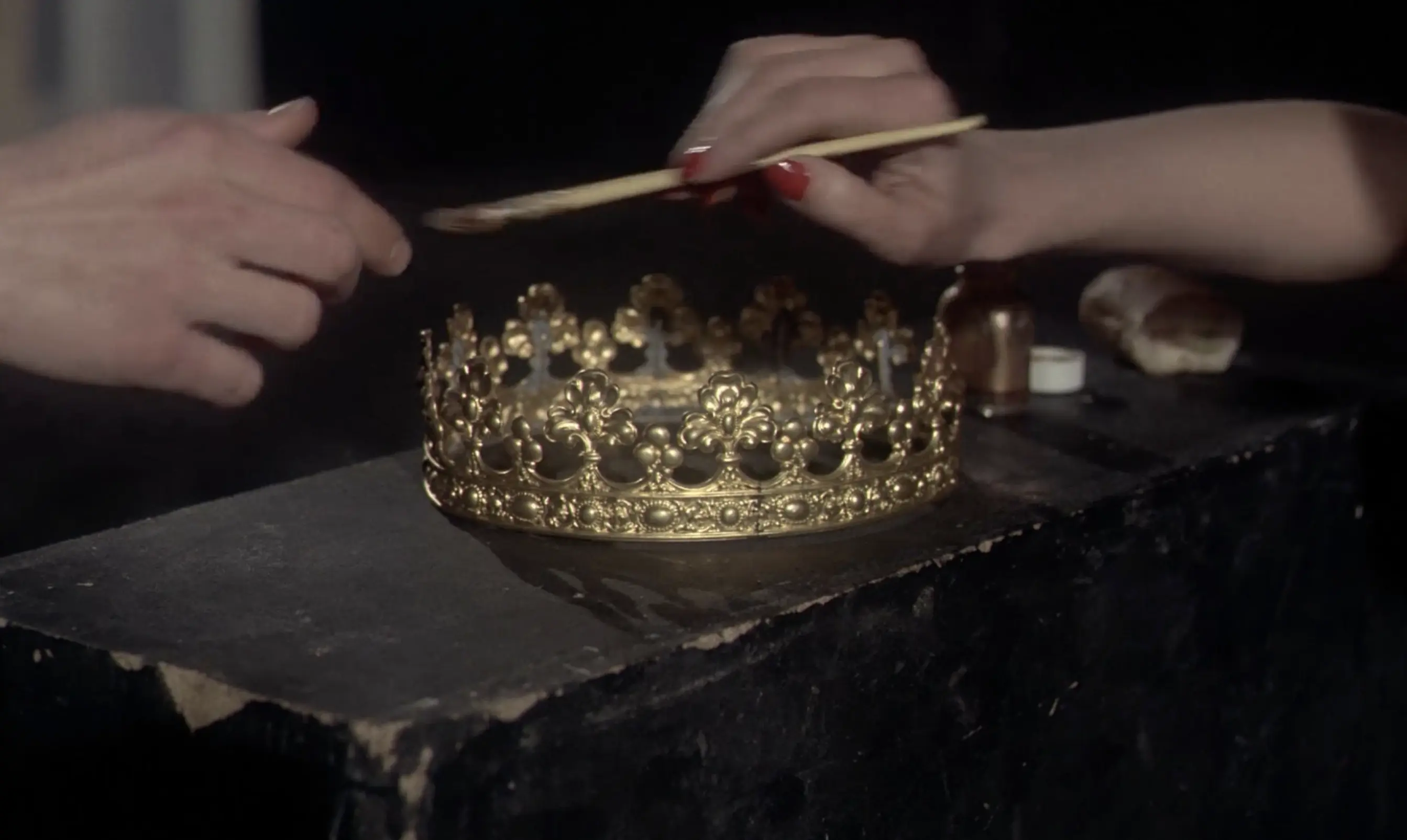
Le Théâtre des matières (Jean-Claude Biette, 1977)