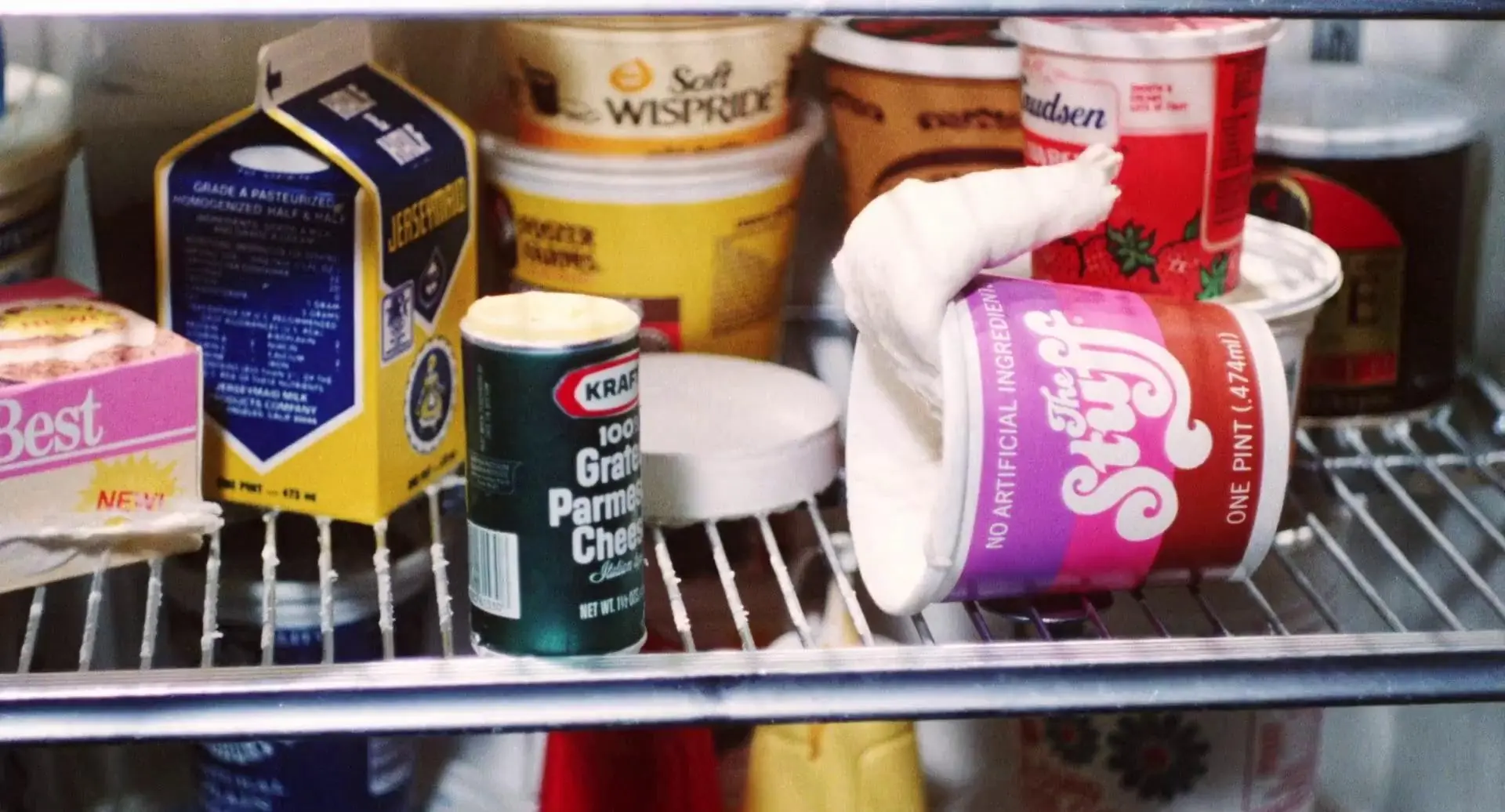
The Stuff (Larry Cohen, 1985)
Tellingly, ‘the stuff’ in Larry Cohen’s The Stuff (1985) is not made manifest as the result of an awe-inspiring volcanic explosion, nor as the consequence of an intergalactic intrusion; rather, the stuff debuts in the form of a placidly gathered goo, the effect of an ongoing accretion immanent to our own planet. Not exactly designed to induce a sense of sublime wonderment — either of Earth’s ever-shifting substratum, or of its star-filled firmament — the film’s beginning simultaneously evokes and upends — via its antagonist, the still-unnamed, featureless ‘stuff’ — various narrative and visual conventions which long-subtended the disaster, science-fiction and horror genres of the Cold War era. The cold open sequence, in which a mineworker in Georgia haphazardly tastes a white substance oozing from the snow-encrusted ground — ‘Smooth, tastes good!’ — thus constitutes an inaugural caprice necessitated, as I will argue, by the politics animating the film’s allegorical logic. The outward appearance of this logic (either lauded or dismissed, depending upon how one feels about B movies) is regarded as exemplary of so-called ‘B’ cinema aesthetics, on the one hand, or considered as merely symptomatic of Cohen’s filmic sensibilities, on the other. Although Cohen is at once a standard-bearer and an outlier within the history of B cinema, I want to insist that his achievement in The Stuff amounts to much more than the defiance of budgetary constraints or the indulgence of its auteur’s eccentricities.
As Tony Williams argues in the introduction to his comprehensive monograph on Cohen’s film and television career, Cohen was often able to insert political commentary by subverting well-worn genre conventions. [1] However, as Bertolt Brecht is said to have quipped: ‘Lenin did not just say different things from Bismarck, he also said them differently.’ [2] It is thus the particular form of Cohen’s intervention — narratively and visually — in the context of the Reagan era to which this essay is addressed. Does the efficacy of The Stuff as political satire rest solely in the authorial interplay between its narrative structure and visual style? Surely not. (The comedic miracle of the movie, to my mind, emanates from the performances of Michael Moriarty, Garrett Morris and Paul Sorvino.) However, by tending to how the script and mise en scène of The Stuff stage its own discrepancy, we can understand the film as much more subtly engaged with the politics of cinematic form than typical critical assessments (which usually focus on its blatant anti-consumerist satire) have thus far allowed. As is evidenced by the film’s homages to predecessors from which it draws inspiration, Cohen is ever-conscious of the formal and narrative aspects of film genre. In a kind of inverse relation to his own Q: The Winged Serpent (1982), which appropriates the conventions of the creature feature in order to shed light on political corruption and urban decay — ‘I want a Nixon-like pardon!’ — The Stuff instead takes aim at neoliberalization writ-large by centering its plot around a featureless, blank goop whose indeterminate nature allows Cohen greater flexibility in his critique. (All of this should in turn disclose more than a few insights into contemporary American cinema’s estrangement — as Hollywood’s algorithmic implementation of the ‘remake’ demonstrates — from the primal and, yes, restorative quality essential to Cohen’s filmmaking.)
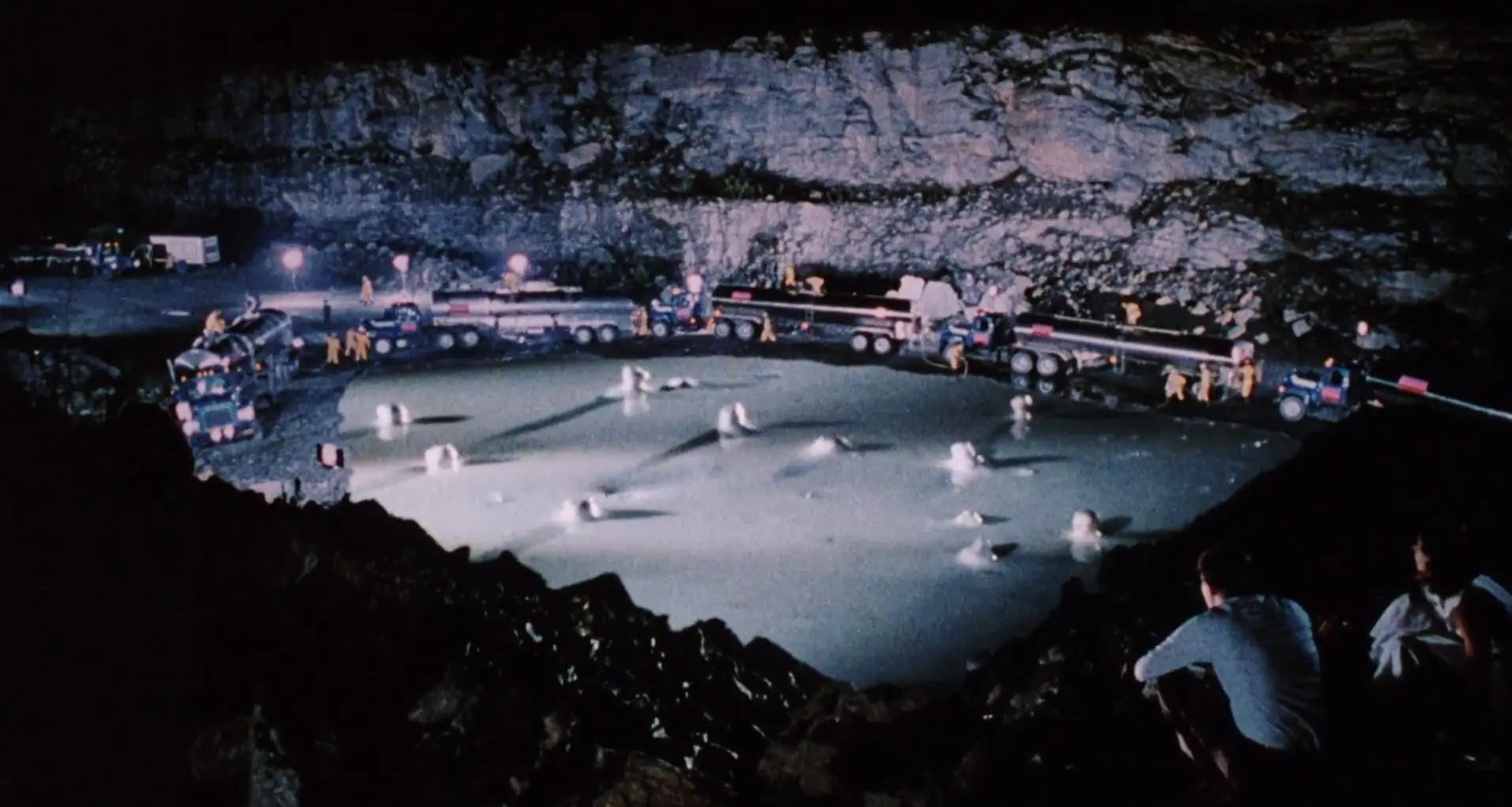
Although certainly not the first B movie to hybridize genres, The Stuff is nonetheless distinguished by its self-conscious incorporation of Cold War era disaster film thematics — particularly their concern for the ecological and not just societal effects of a potential nuclear war — into a science-fiction-inflected narrative framework. A cursory overview of English-language disaster movies from the 1980s alone demonstrates the extent of the period’s fascination with civilizational collapse: lesser-known films such as When Time Ran Out (1980), St. Helens (1981), The Day After (1983), Night of the Comet (1984), Threads (1984), and Impulse (1984) each precede The Stuff (1985). With the waning of the Cold War, the subject matter of disaster films noticeably shifts from man-made disasters to ‘natural disasters’: Outbreak (1995), Twister (1996) White Squall (1996), Dante’s Peak (1997), Volcano (1997), Deep Impact (1998), Hard Rain (1998), and — lest we forget — Armageddon (1998), each indicative of the era’s big-budget representation of the End Times. Historically, The Stuff therefore straddles two distinct eras of Cold War filmmaking. Cohen’s intervention, which falls firmly within the era of Reaganite post-détente nuclear buildup, acknowledges prior apocalyptic fantasies of atomic annihilation, yet gestures past them towards an emergent unipolar world order in which the primacy of so-called natural rather than nuclear disaster has been ‘restored’ via decisive Soviet rollback. Hence the significance of the stuff’s unknown origins: rather than an alien substance — the only mention of ‘aliens’ occurs in reference to ‘commies’ during Colonel Malcolm Grommett Spears’s scene-stealing exchanges with Mo Rutherford — the stuff simply percolates, unaccountably, up from within the earth itself. Rather than an intrusive parasite, it is inherent to our ecosystem. Well, what if what you don’t like is INSIDE you.
Which brings us to the (figurative) substance of the stuff, to what I argue is its purposely ambiguous function as a metaphor. While often understandably compared to Invasion of the Body Snatchers (1956) and The Blob (1958), the film’s objective — if we take its use of mise en scène as an indicator, a claim to which I shall return — is certainly not to induce terror. Instead, the ambiguous status of the stuff as a physical substance allows for an ever-broadening signification that perplexes rather than frightens, eliciting protestations of confusion rather than horror. Both ‘natural resource’ and a commodity manufactured for the free market — as its journey from ‘The Stuff’ to ‘The Taste’ through the course of the film attests — the stuff is at once always-already present and an emergent novelty of the capitalist system, a kind of ontologically meta-stable object/process that Gilbert Simondon himself would have cherished. It is via this choice of concept on Cohen’s behalf, rather than a haphazard script, that the crisscrossing of seemingly disparate set pieces ultimately fulfills its purpose. As the stuff, like oil, is a raw material that requires extraction and refinement, we find ourselves at the site of a mine. However, unlike a barrel of sumptuous Venezuelan sour crude, the stuff can be found pre-packaged on grocery store shelves near you; it somehow requires refrigeration and yet subsists at room temp. As the narrative progresses from mine (the site of extraction) to grocery store (the site of distribution) to ad agency (the commercial sector) to factory (the hidden abode of production) and back again — as Tony Williams notes, the film cuts immediately from the Georgia mine to Jason’s suburban household, thus indicating the rapid pace of the stuff’s absorption into the market — the viewer careens unsteadily between the spheres of circulation and production, until the consumer/laborer distinction begins to collapse.
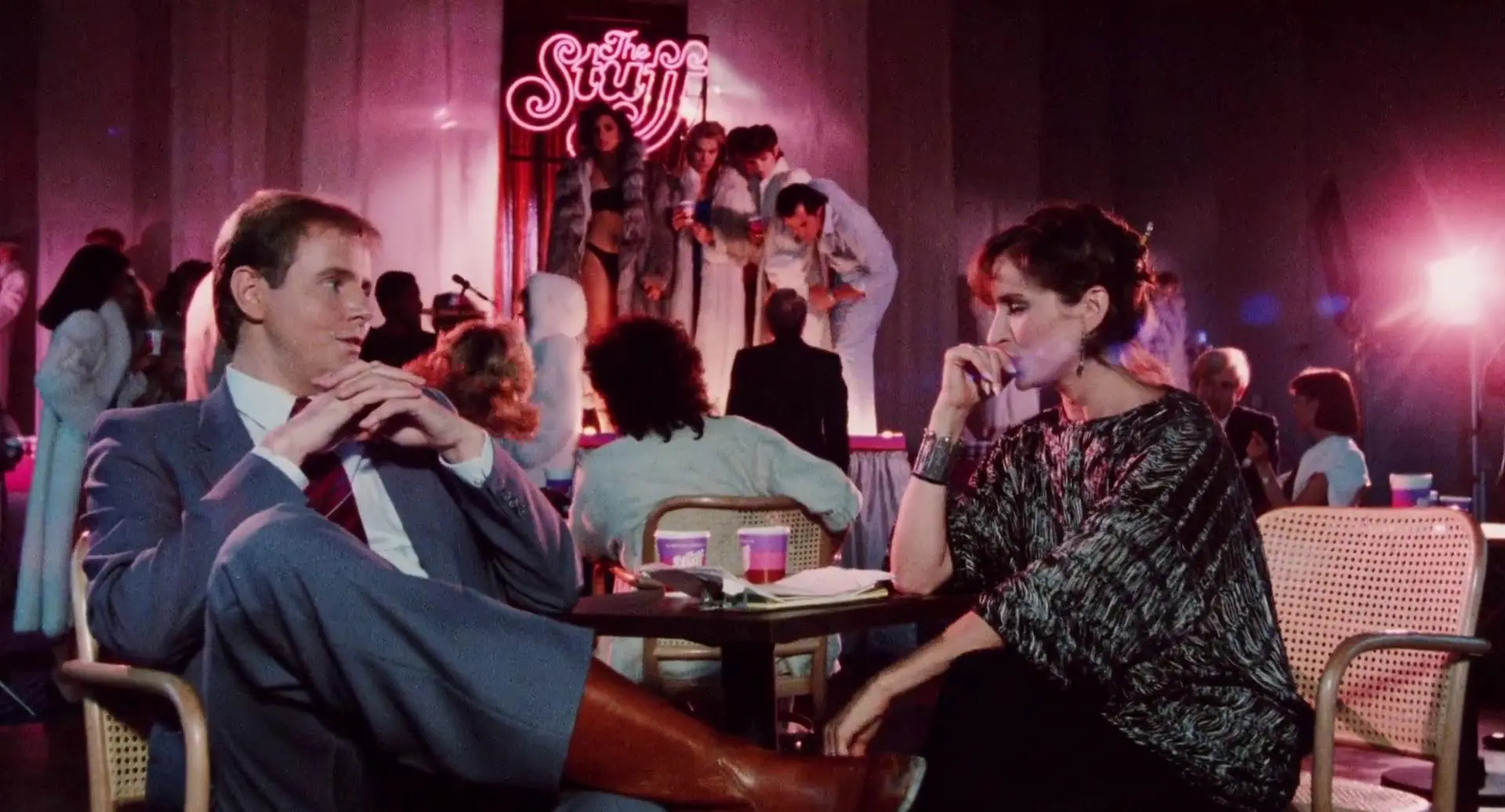
Fundamental to the visual depiction of this imminent collapse are the narrative structures of the films The Stuff is premised upon and pays homage to, namely The Blob and The Invasion of the Body Snatchers. If these key cinematic influences referenced by the film are considered within the political context which shapes Cohen’s narrative into one which addresses the ground below our feet — rather than seeds from outer space, or an alien-harboring meteorite — then its intervention becomes less transparent, particularly insofar as its central prop is fittingly ‘blank’. In this sense Cohen’s homages should not be regarded as mere pastiche, symptomatic of a slapdash and unmotivated form of signification, but can instead be understood as a method of addressing the fragmentation of social life under the revanchist phase of neoliberal capitalism that gave rise to the very need for what Fredric Jameson would refer to as ‘cognitive mapping’. One need not reduce Cohen’s aesthetic choices to Jameson’s account of postmodernity, however, in order to appreciate how The Stuff revolves around a totalizing, amorphous force which threatens to undermine the nuclear family, the workplace, and even the state. (One of the great satirical splendors of the film is that its protagonists consist of grotesque mirror-images of Reagan-era conservatism: an ex-FBI agent for-hire, a decommissioned Cold War military colonel, an ad agency executive, and a CEO usurped from the board by his own family members.)
Cohen’s feat in this regard is thus one of proverbial addition-by-subtraction: conceptually, the stuff becomes more by virtue of being less. This is achieved visually by Cohen’s deft use of mise en scène, which often alludes to its filmic predecessors. This is especially evident by comparison to The Blob. The Blob’s gelatinous creature — which unlike The Stuff, remains unnamed within the film itself — manages to dominate the narrative despite its sparse appearances in front of the camera. In relation to the overall scenery, the blob is either entirely absent or constitutes the scene’s focal point. (As director Irvin Yeaworth notes in the commentary to the Criterion Collection edition of The Blob, the pacing of the film is reflective of its budgetary constraints, a point well-worth keeping in mind for those committed to materialist readings of cinema.) When the blob does appear, it inches towards the camera; or, as in the iconic scene in Dr. T. Hallen’s office in which the blob lurches at a beguiled Nurse Kate, comprises the shot’s foreground. The evolution of the blob’s coloration, moreover, serves to draw attention to its voracity: first appearing as a semen-like substance when attached to Olin Ross Howland’s stick — suitable given the courtship ritual between Steve and Jane which opens the movie — the blob gradually darkens until it resembles blood red. Fittingly, the stuff retains its ‘neutral’ hue throughout and infiltrates all despite their color; neither The Blob nor Body Snatchers include non-white cast members.
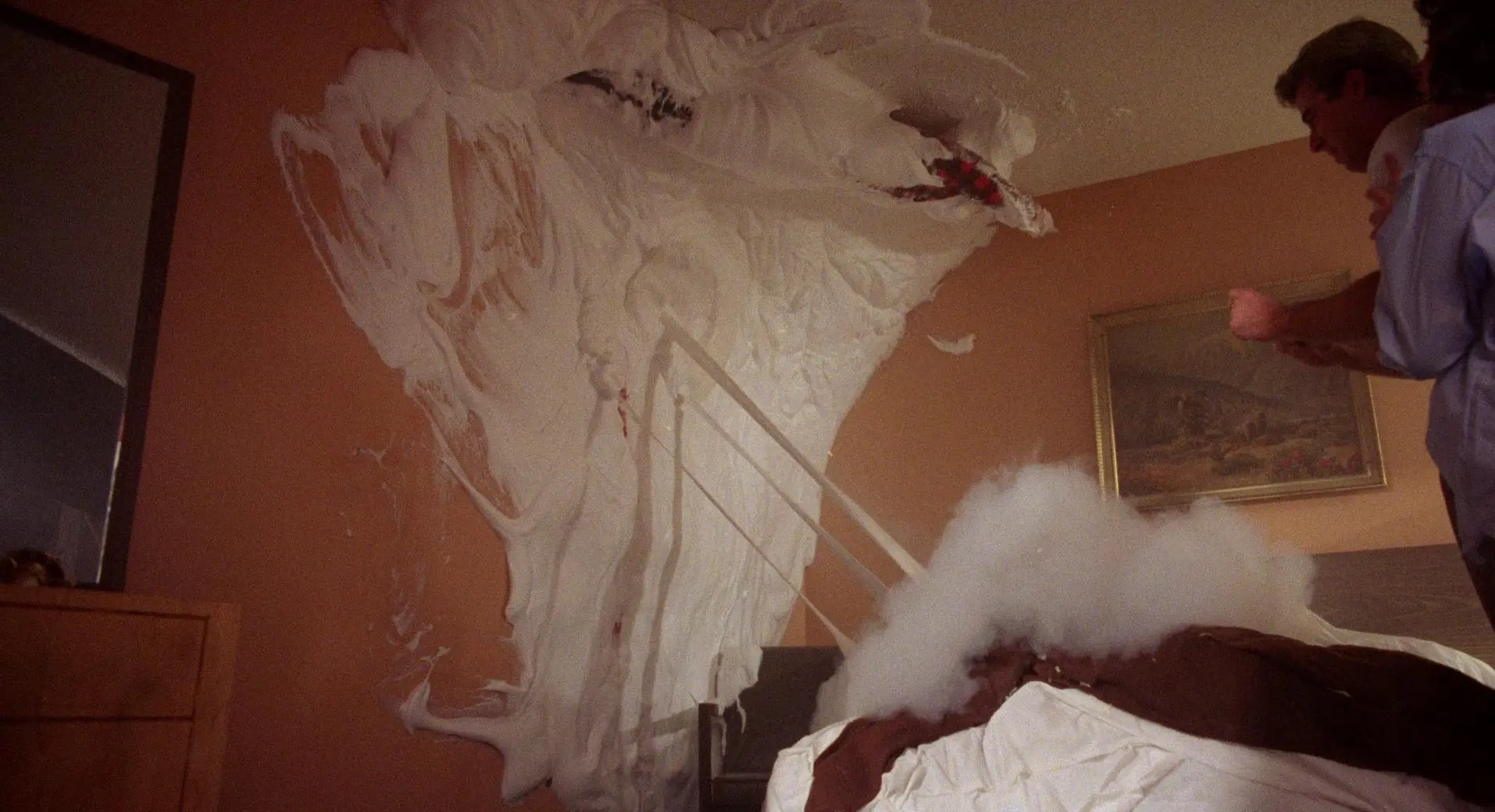
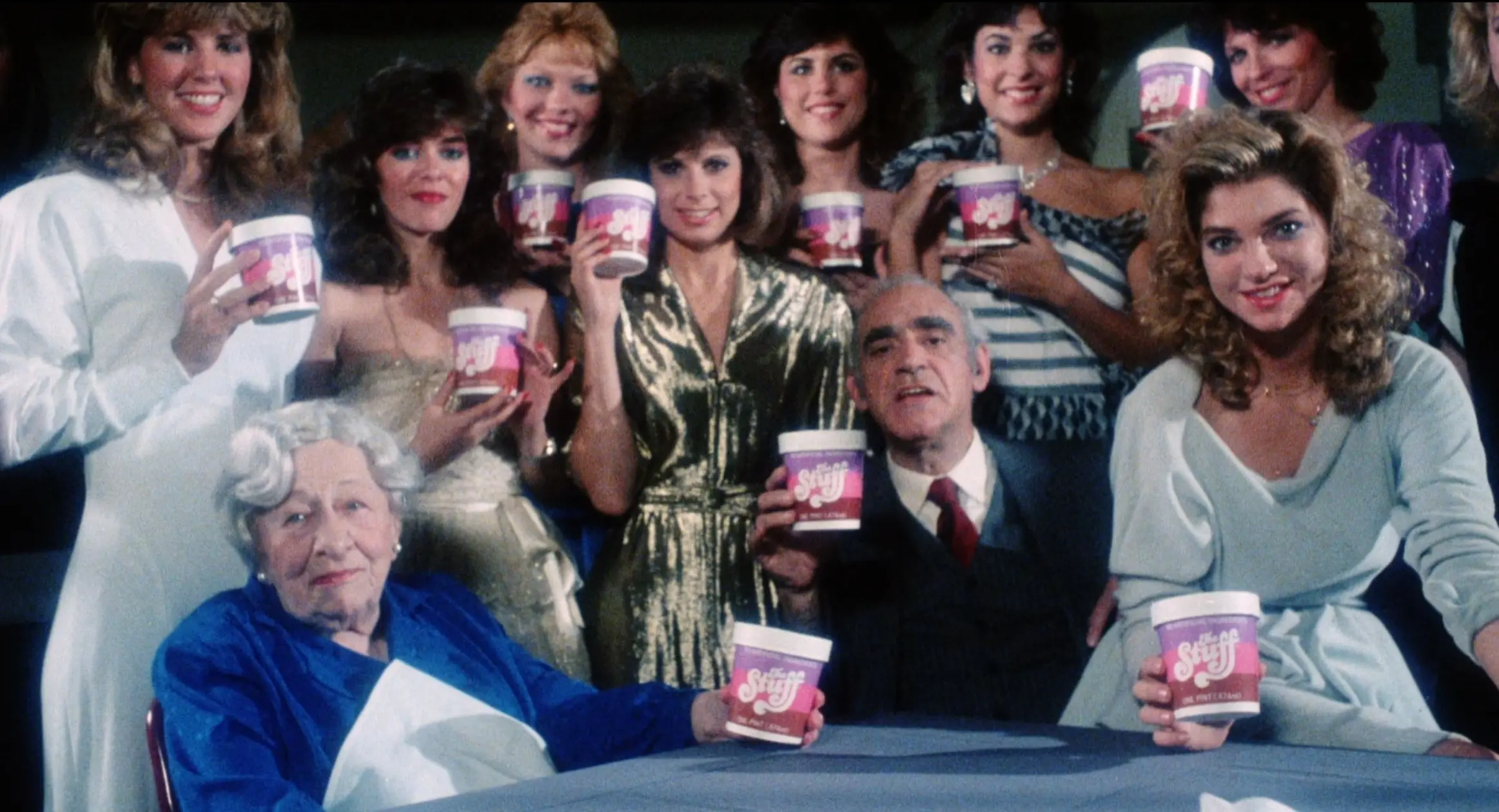
By contrast, Cohen’s creature (if we can label it as such) is so Protean that its ‘name’ merely designates its indeterminate status: stuff. This is key to the commercial-within-the-movie gimmick — a shared feature of eighties satires such as De Palma’s Body Double (1984) and Verhoeven’s Robocop (1987) — that interrupts and is subsequently incorporated into the film’s overall visual style. A physical and linguistic entity able to shape-shift across bodies and territories, minds and markets, the stuff does not gradually accumulate. Although often depicted at rest (in the fridge, in a bowl) it also spews outward like a massive discharge of Victorian spirit photography ectoplasm, threatening to overtake the entire frame with its deluge of fluff. This is most comically evident in the motel scene, in which Mo Rutherford and Nicole, who view a commercial for The Stuff before falling asleep, barely escape before the Stuff engulfs the entire room. In this sense the particular features of the set itself become a mere occasion for their own negation, as the stuff submerges — with great panache, seemingly fighting gravity as it climbs the motel room walls — what we as viewers have passively accepted as mere background fillers. Finally, while the blob occasions quick close-ups in order to create a sense of anxious foreboding — much as Body Snatchers employs close-ups in order to evoke an atmosphere of claustrophobic paranoia — The Stuff uses a variety of long-takes and close-ups to great (and often comical) effect. As the stuff entails a double threat of absorption and of internal occupation, Cohen sometimes zooms in on the stuff then cuts to a distanced, static view. In the motel scene this has the startling effect of providing an immersive yet detached experience for the viewer, who is nearly plunged into the surface torpor of the stuff only to be yanked back and forced to view the stuff as a roiling whole.
While I have accentuated the stuff’s all-encompassing aspect — both as concept and as visual prop — one should not lose sight of its dual ability to enhance our sense of particularity. As Louis Althusser states, ‘A word of caution: an abstraction is always, like a negation, determinate.’ [3] When pressed in an interview to confirm the overall subtext of The Stuff as one of a generalized anti-consumerism, Cohen instead pointedly responded with a concrete example: ‘You know what they were doing [the cigarette companies], they were addicting an entire generation of young American men, and those cigarette companies actually killed more American boys than the Japanese and the Germans combined… I mean the total casualties of American lives in World War II was under a million, those cigarette companies killed tens of millions of young American boys by addicting them to cigarettes, by giving them free cigarettes [during the war].’ [4] This response, while perhaps an off-hand remark, is also indicative of the structural quality of the film. It can be understood both as a criticism of consumerism as a whole and of its products (from trendy health foods to addictive substances); of the rhetorical façade of neoliberal ideology and its underlying motives (‘I suppose we do have to keep the world safe for ice-cream’).
Thus the stuff is not an anamorphic object, a calculated intrusion which presumes pictorial placidity and a stationary stance: as smear, it does not conceal a single message, let alone a memento mori. The Stuff proceeds with the assumption that exposition, while crucial to movie-making which seeks to illuminate the world-system, does not in itself suffice to make art stick. Given the dismal, formulaic, IP-driven drivel now characteristic of mass movie culture, any film which offers politically cogent exposition should not be dismissed. And at a moment in which nostalgia for military Keynesianism passes for resistance to fascistic, nativist politics, perhaps art itself does not suffice. Or perhaps the role of art is more significant than we are currently able to grasp. Proceeding as if this is so, such that we must prove it to have been true, is likely necessary. Insofar as it is the case that ‘[to] find a form that accommodates the mess, that is the task of the artist now’, we can find no better exemplar of restless politically-informed aesthetic inventiveness than Larry Cohen. [5]
Notes
Tony Williams, Larry Cohen: The Radical Allegories of an Independent Filmmaker, 2nd ed. (McFarland and Company, 2014).
Daniel Fairfax, ‘Marxism and Cinema: A Reading Guide’, Historical Materialism, <https://www.historicalmaterialism.org/marxism-cinema-daniel-fairfax/>.
Louis Althusser, ‘Further Remarks on Law and Its Reality, the Legal Ideological State Apparatus’, On the Reproduction of Capitalism, trans. by G. M. Goshgarian (Verso, 2014), 164–170 (p. 166).
‘Larry Cohen attacks consumerism with The Stuff’, This Week in Horror, 23 March 2011, <https://www.youtube.com/watch?v=TpfCmf_y8gc>.
Clark Coolidge, ‘Arrangement: a lecture by Clark Coolidge. Talking Poetics from Naropa Institute (1978)’, Coolidge and Cherkovski in Conversation (Lithic Press, 2020), p. 98. This quotation is purportedly from Samuel Beckett, whom Coolidge cites roughly midway through his talk.