This article appeared as part of a feature in the September–October 1975 issue of Cinéma entitled ‘Inquiry into porn cinema: beneath all suspicion’, which consisted of a number of articles on pornographic cinema, which had recently experienced a surge in popularity in France. Gaston Haustrate introduced this feature as follows:
‘We could not remain indifferent to this phenomenon, its importance, and its repercussions. In a few words, we will address the issue of pornographic films and their success. The news of the summer holidays preceded us. In mid-August, a colleague discovered that more than half of Parisian theaters were showing this type of film. This was followed by a wave of surveys and opinion polls, which are still being reported on by daily and weekly newspapers.’
Marie-Claude Treilhou’s contribution was one of a series of articles described by Haustrate as ‘proposals that reveal our common positions, even if the obvious personalization of these remarks points to differences in detail.’
* * *
And then I imagine (but this is only an imagination) that sexuality, as we speak it, and insofar as we speak it, is a product of social oppression, of men’s wicked history: an effect of civilization, in other words. Whence it might be that sexuality, our sexuality, would be exempted, dismissed, annulled, without repression, by social liberation: the Phallus done away with! It is we who, in the manner of the ancient pagans, make it into a little god. Might not materialism pass through a certain sexual distancing, the matte fall of sexuality outside discourse, outside science? [1]
—Roland Barthes, ‘Sexuality’s Happy Ending?’
Molded from within by its own contradictions, bourgeois society gradually frees itself from Judeo-Christian morality. What constituted an alibi suddenly becomes a curb. Praise for poverty and deprivation could not serve forever as a watchword for a society whose logic is that of enrichment and greater pleasure.
The bourgeoisie cannot even tolerate this sizable ideological cover anymore, particularly since it was losing its narcotic effects on the people. The domain of sexuality, which suffered the most from this long period of restriction, is rising to the surface and, as that which has long been held back, is overflowing from all sides.
The bourgeoisie, in this sense, is fundamentally immoral. This is what makes the bourgeois phase, along with the accumulation of wealth, a decisive step forward in History. This is certainly not what we have to complain about.
Everything would be perfect if this wealth did not come from gigantic theft, the condition of its existence, and if this ever-increasing wealth did not have as its corollary an ever-greater — albeit relative — impoverishment of those who produce it.
Rich sex, Poor sex
In matters of sexuality, class difference becomes particularly scandalous, especially now that it is no longer hidden.
On the one hand: time, money, imagination, the critical and therapeutic support of psychoanalysis and knowledge in general.
On the other: the total misery of body and mind, the hostility of medicine.
In this way, ‘the multiplication of needs and means breeds the absence of needs and of means’. [2] However, to a certain extent, this dazzling wealth must be shared, or at least the illusion of sharing must be provided. To channel murder, rape, the immense conspiracy that could be brewing at any moment in order to get a piece of the pie: that is to say, ultimately, the revolution that signifies the disappearance of class privilege — such is, at its own level, the function of the vast majority of commercial cinema, and of pornographic cinema in particular.
We can easily understand the treasures of imagination deployed to this effect: the body, sex, being the stronghold of human relationships, their greatest strengths, their greatest fragility. We also understand that this paradigm of human relationships is erupting precisely at a time when capitalism is gasping for air, when the intimate nature of its body (class division) can no longer be hidden, when it is important to pay attention to what people are shown.
Also, the pornographic product aimed at a popular market is very well thought-out. The bourgeois public is not mistaken: these spectacles are not meant for them, they do not recognize themselves in them, they find them vulgar; yet it is indeed the bourgeoisie who produce them. This is why phenomena of the Exhibition [3] sort, which have the intelligence (very marketing [4] -y) to pass themselves off as sociological, almost militant cinéma vérité — and which succeeded in attracting even the sympathy of the intellectual petite bourgeoisie through this subterfuge — will fizzle out very quickly. The industry has bitten off more than it can chew. And what’s more, Exhibition was a very clever way of naturalizing porn, with good intentions serving to justify its existence as a shameful disease: it is the real porno, that of Grands Boulevards… The one Criticism neglects, as if it weren’t cinema. But an institution, nonetheless, a cheap brothel where, for eight francs, you can be sure to get at least one orgasm.
A magical universe, the space of the rich
A true fairyland: first and foremost, a space of fiction, a private and enclosed place, a manor, a castle, a high-class second home, carefully isolated from any social context. It requires the extraordinary, and debauchery must be accessible only by breaking and entering: we enter a magical, forbidden universe of the fairytale: the space of the rich. It’s already understood that pleasure is a luxurious privilege. Breaking and entering moreover multiplies enjoyment, all while reinforcing forbiddenness. This possession of places is immediately accompanied by possession of all the bodies lying around: one uses them, one abuses them.
The pivot, the center of proceedings, is the triumphant Phallus, around which a ballet of commodified women is organized. Few words, except for the repetitive dialogue between master and slave. The cherry on top is that the slave is consenting: she likes it, ‘the slut, the bitch, the whore’, and she gets off on hearing it said.
Added to the debauchery of period furniture is the quantity of possessed bodies: a lot of women — and the quantity of what each woman gives of herself, namely as much as possible (cf. the advertisement for Histoire d’O [5] : ‘…paroxysm of love… extreme form of submission… offers everything… any woman will agree that the chains you don’t want to break are those that a woman herself puts on her wrists, when total love makes her consent to everything’).
Are we so afraid of the breakdown of the family, the foundation of private property, that we have to reassure its male head to this extent? Dispossession is against nature: it’s implicit that she who does not submit is sick… We can see from here the result of this brainwashing inside thatched cottages.
Everything is therefore in place, the order of private property is the very order of things, since, you see, nature — which can be made to say what we want — confirms it.
What does this mean to a panting and needy public?
That one day they will be able to have all this, if they become wealthy. If they work hard, if they save up, if they stay in their place in the meantime. It’s about imposing the narrow point of view of appropriation (of assets), not that of a relationship of reciprocity with the desired object. For being better, we substitute the idea of having more. For the quality of relationships, we substitute the quantity of the relationship. To the totality of desire, we give only part of the answer: the body, the body alone. The tree hides the forest. Only one solution is possible throughout: ‘Get rich’. [6]
This is all the more powerful because it gives the impression of fully transgressing the established order, at a time when true bourgeois morality, that which there is no question of transgressing, is flaunted onscreen.
The inimitale model
At the same time that the model encourages imitation, it is also a strong deterrent. The space of the movie theater is one of hiding, shame, humiliation: if you’re not rich, it is because you’re not capable, because you don’t deserve it. Slowly, insidiously, you come to cast doubt on the virtues of your poor man’s phallus. You have to be content with what you have.
What must be forgotten at all costs is the totality acutely demanded by the dispossessed.
On this point, it is infinitely touching and reassuring to hear the testimony of one of the prostitutes of the Lyon movement: [7] the more loaded ‘clients’ are, the more they demand feats of vocabulary, the more they insult the girls and treat them like commodities. The workers — apart from purely functional sexual relations — come above all to talk, to seek a presence, comfort, or even advice.
Naturally, this is not about seeking purity, a sexual truth to which the proletariat would have exclusive access. But it’s about the indication of the totality of the lack, to which pornographic cinema responds with fantasies that in reality are fantasies of the bourgeoisie, which they do not dare to put into practice themselves, and of which they go to relieve themselves in brothels.
The headlong rush
We also recall the remarkable analyses by Frantz Fanon [8] of the almost instinctive, poorly formulated distrust of the Algerian people towards real progress such as medicine or the abandonment of the veil for women, which colonialism wanted to impose from the outside — as if to shatter, by putting a veneer on it, a process of clean development, which furthermore took place of its own accord at the time of the liberation struggle.
Faced with danger, the bourgeoisie’s tactic is to rush headlong into it and propose to share its benefits, at the expense of additional mutilation; the same thing, in different hands, changes its nature.
There is perhaps in the very conservative morality of working-class families a tension of the same sort. Perhaps.
Power gives birth to monsters, which it exhibits in order to hide its own monstrosity. It favors the hyperdevelopment of points of protest (women, sex, prostitutes, homosexuality…) on the condition that it vertically obsesses over them, so to speak, like so many towers of Babel exhausting themselves as derisory utopias.
In the meantime, the machinery is running at full blast. On this point also, we desperately wait for cinema to indicate the steps to follow in order to disrupt it.
Cinéma, 201–202, September–October 1975, pp. 105–108.
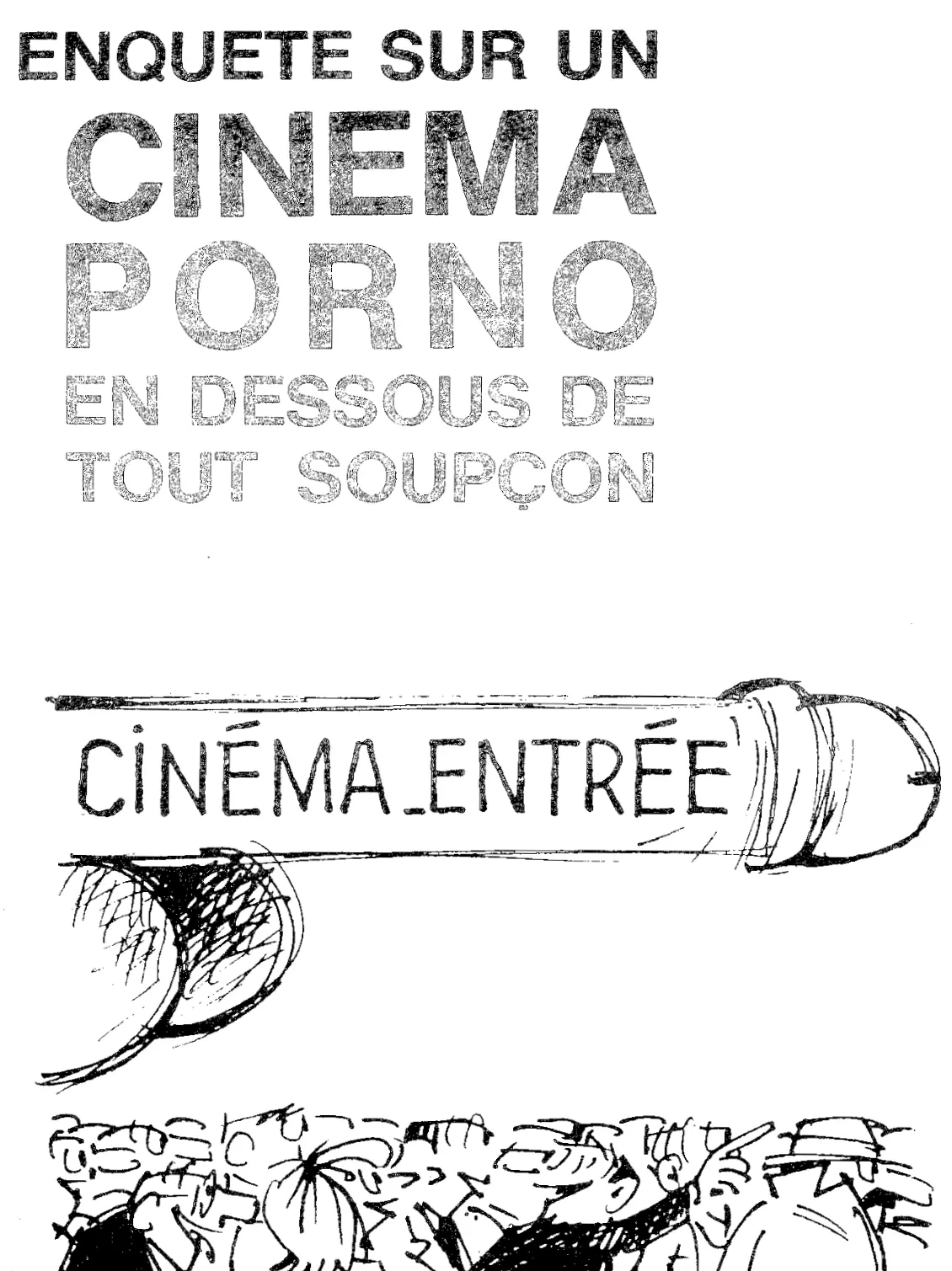
Illustration from original article.
Notes
Translator’s note: English translation by Richard Howard. Roland Barthes by Roland Barthes (University of California Press, 1977), p. 165. Emphasis by Barthes.
Translator’s note: English translation by Martin Milligan. Karl Marx, Economic and Philosophic Manuscripts of 1844 (Progress Publishers, 1977), p. 111.
Translator’s note: Jean-François Davy’s film which came out in the same year as Treilhou’s article. The film contains excerpts from another contemporary film, Change pas de main, produced by Davy himself. Treilhou wrote director Vecchiali a letter of appreciation after seeing this film, which led to their first meeting.
Translator’s note: in English in the original.
Translator’s note: Just Jaeckin’s film which came out in the same year as Treilhou’s article.
On the categories of assets, quantity, totality, cf. the chapters ‘Private Property and Communism’ and ‘Human Requirements and Division of Labour Under the Rule of Private Property’ in Marx, Economic and Philosophic Manuscripts of 1844 (1977). [Categories and titles cited by Treilhou have been replaced by what is published in English. - Trans.]
The video montage about prostitutes of Lyon in their struggle, produced by Vidéo Out, 21 rue Hippolyte Maindron, Paris 14e. [Referring to Les Prostituées de Lyon parlent, directed in 1975 by Carole Roussopoulos in the wake of the occupation of the Saint-Nizier church in Lyon earlier that year by prostitutes protesting police violence and working conditions. - Trans.]
Sociologie d’une Révolution, published by Maspero, notably in the chapter titled ‘L’Algérie se dévoile’ (‘Specialists in basic education for underdeveloped countries or technicians for the advancement of retarded societies would do well to understand the sterile and harmful character of any endeavor which illuminates preferentially a given element of the colonized society… More precisely, the phenomena of counter-acculturation must be understood as the organic impossibility of a culture to modify any one of its customs without at the same time re-evaluating its deepest values, its most stable models…’). [English translation by Haakon Chevalier. In Frantz Fanon, ‘Algeria Unveiled’, A Dying Colonialism (Grove Press, 1965), pp. 41–42. The ellipses indicate Treilhou’s omission. - Trans.]