In 1974, at Giacomo Gambetti’s initiative, the Venice Biennale programmed a retrospective of Paul Vecchiali’s films. The cycle concluded with the screening on October 24 of Femmes femmes, which Vecchiali had just completed. Per Laura Betti’s recommendation, Pasolini saw this film and was instantly excited by it, expressing his enthusiasm several times during the roundtable that followed the screening, in the presence of Hélène Surgère and Sonia Saviange, who we would see again next year in the credits of Salò.
We publish here essential parts of Pasolini’s ‘heat of the moment’ interventions during this roundtable as well as a text he would later write on the same film, a text in which he revisits the same themes, but in which his admiration for the film, as lively as ever, was ‘cooled’ by the mere fact of transitioning to writing.
Pasolini’s interventions in the roundtable are extracted from Bruno De Marchi’s book Vecchiali o dell’anfibologia, published by Biennale di Venezia.
The ‘written’ text was published in issue 276 of La Nouvelle Revue française in December 1975.
I
I admit I find it difficult to introduce this debate; first, I’d like to say I’m happy about this extraordinary chance to have been, almost by accident, a kind of cogwheel in the gear that allowed this film to be shown here. It’s the first time I’ve seen it, I was able to see it at the same time as you all a few minutes ago, and I am still moved and overwhelmed. I find it difficult to speak… I must say that in the last few years, it has rarely happened that I get to see a film so beautiful and so moving.
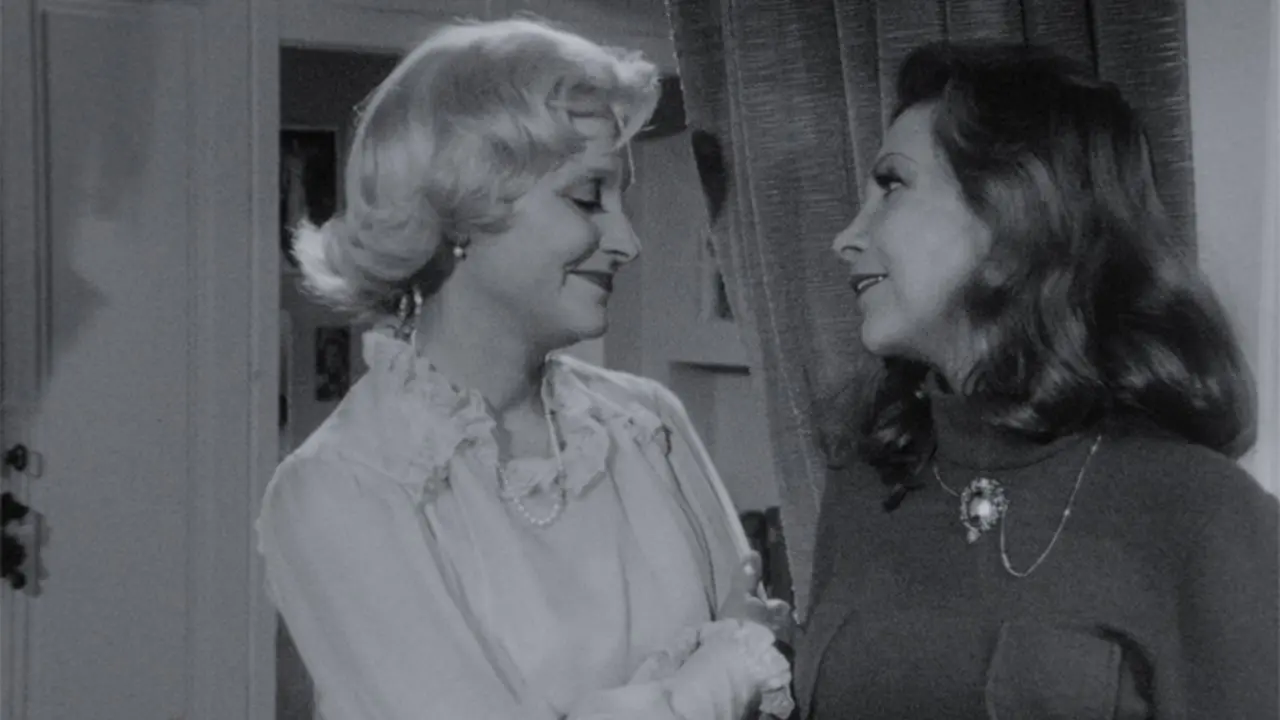
Femmes femmes (Paul Vecchiali, 1974)
When I read a book, I usually claim that, after ten or fifteen pages, I understand whether it’s a work by an author or not, because it suffices to read fifteen pages to immediately sense the author’s quality, whether it’s a writer’s page or just like that. And I’ve also said that, on the contrary, it is almost impossible to do the same for a film. For a film, I thought you had to see at least fifteen minutes — a quarter of an hour — to understand whether or not you’re in the presence of an author. Whereas tonight, barely seated, seeing the first images — the first three shots were enough for me to grasp this miracle: we are faced with the work of an author, an absolutely exceptional author. As I do not know how to improvise, let this whistling blackbird come here to the mic and learn to whistle while saying things that are a little more comprehensible, more rational — at least I hope so. I can tell you this: I’m taking a risk, no use hiding this, I’m taking a risk — with a lot of emotion, and, incapable as I am of improvising, because I need to think and meditate on things… I am taking a risk, so if anyone has an objection and doesn’t agree with me that this film is exceptionally beautiful, let him come and say it; this is a debate. I don’t understand… truly, I don’t understand (...)
* * *
What strikes me in this film is its extraordinary stylistic purity. While watching, I was saying — just like that, in a friendly and emotional way — that I was thinking of Dreyer, I was thinking of certain classical directors, perhaps forgotten ones like Machatý. Perhaps some historian of cinema will be able to say something precise; but at one point there’s a musical motif that recalls an old film by Machatý. Or, simply, I was thinking of Murnau: perhaps it’s the charm of black and white.
But it really is the great cinematographic style; it’s surprising. Another astonishing thing about the film is an incredible blend of theatre and cinema. I don’t know if I saw theatre or cinema tonight, and what could have been a flaw in another context and another situation is here, on the contrary, what gives this work we saw all its charm, since this blend is a magic blend. Perhaps it wasn’t even intended by the author, perhaps it appeared in part unconsciously, even though the object of this film is theatre. But, this spectacle, as a finished object, as a thing we saw, shows a blend of the two that is truly magical (...)
* * *
As far as I can remember, there is no example of a film of this kind in Italy; nor do I believe there could be, because it belongs to another culture, a completely different culture.
I don’t believe we can make a film like this in Italy, with two protagonists, even with two great Italian actresses cast in a play using the same text, because behind this play — besides the cemetery as a visible symbol of death awaiting the two women — there is all of France, there is a type of culture that makes this eternal duo of theirs — their relationship — not simply a representation of a lyrical, intimate and neorealist kind, nor a sort of motionless picaresque, but, in fact, a drama that has behind it an enormous background. [1]
It’s impossible to make a similar film in Italy; moreover, the director’s type of culture is different from that of a contemporary Italian who might direct such a film.
At one point in the film, other directors are ironically named; among them Demy, and Demy made a film called Les Parapluies de Cherbourg. In a sense, this Demy is a spy: there is this whole ironic vein of an extremely cultural character, which has behind it not only a certain cinema and a certain literary culture, but also a certain type of spectacle. Even French cabaret is different from Italian cabaret. Now, all these things together mean that this film could not have been conceived anywhere other than in France; even if, perhaps, there is originally a purely formal and schematic reflection on a certain Italian realism (...)
* * *
You find this film influenced by older films that resemble it, and you thought you saw in it a rather excessive meditation by the artist on his own language, by the artist on his own work. That is, you saw in this film an important aspect that the critics call ‘metalinguistic’, as if it were a meditation by the artist on his own language. When it is not that — there is no meditation by him, the author, on his own language, as a director, as an author in general. No, there is a meditation on reality as a reflection of theatre, and on theatre as a reflection of reality; these two things are then confronted with cinema. That is to say, in terms of style, there is a sort of ménage à trois [2] in the film: reality, theatre and cinema, hence something much more enigmatic and difficult. It’s not the habitual meditation by the artist on what he is doing, but something more absolute (...)
The fact that Vecchiali, by meditating on these stylistic and critical problems, has created this curious enigma which he himself would not be able to resolve before us — since it cannot be resolved — allows him to invent two marvelous characters, that is, by rethinking Racine as Racine, and as Racine experienced by two failed actresses unable to perform his work how they would have wanted to, and as both of them in front of the camera: on these three levels, he succeeds precisely in creating characters worthy of Racine. These two women you saw onscreen are two Racinian characters, two great characters of classical cinema, and it’s in this sense that earlier I mentioned, confusedly, the names of Murnau, Machatý, or, above all, Dreyer. We saw two figures who have the complexity, the absolute and accomplished character of two great tragic figures and, in this sense, Vecchiali has done precisely what he thinks he has not done: he has sought cinema as myth, as total and pure representation. That’s why I love the film, because, as you said, this is what I seek to do. In Il fiore delle mille e una notte, there is something similar, a story in which Aziz poses as a sort of editorial center among different modes of communication: communication through mimicry and communication (this one magical) through speech between two women; here, too, there is a certain reflection on ways of expressing oneself and of speaking. Nonetheless, one does not sense this in my film, because I wanted to transfer and reproject everything onto the mythical representation. Perhaps it’s because I find myself in the same situation as Vecchiali that I loved his film so much, aside from its intrinsic qualities that moved me in themselves, as a work of art (...)
* * *
I would like to come back to one point: I’ve already mentioned that I am quite close to Vecchiali’s position, and I can explain this in two words: on the one hand, we are coming from an era when cinema has been torn apart by the priority given to content, where it is demanded in a savage, superficial and terrorist way, by a sort of blackmail, that a director be a pedagogue, that he teach the ABCs to workers and schoolchildren, etc. For cinema, this is a ridiculous and heartbreaking pretension.
On the other hand, there is a similar crisis within cinema; that is, authors have rethought their own means of expression, a rift that has Godard as its personified protagonist, in all this production of a metalinguistic character which surrounded Godard and Cahiers du cinéma, and from which Vecchiali himself probably emerged.
Now, he as well as I find ourselves on this side of a historical situation that confronts us in totally different ways, even if, in the end, they are fundamentally identical, because we belong to two totally different cultures; because the moods, the psychology, the way of choosing characters and the specific references are different. Both of us are seeking to reconstruct a cinema that does not forget the demands of content, and we — he and I — are also perfectly conscious of the social framework in which the characters evolve, and we, as he puts it, fix them onscreen, and offer them to the spectator’s contemplation. We are quite close to each other in this way of fixing characters in their social situation, their way of being humans within a society; at the same time, we are trying not to forget metalinguistic problems, problems of reconstructing a new plasticity. Since some people perhaps did not hear me well, I’ll say it again: for me, Vecchiali’s two characters in this film are two characters by Racine. I repeat that it’s a true minor masterpiece — minor or great, I don’t know — but it’s a masterpiece in the sense that, despite all these demands that threaten to dismantle it, he has succeeded in creating an extremely coherent work, thanks to this marvelous intuition of the relationship between these two women and their relationship to their art. This intuition is made entirely of real things: there is not a single false gesture, not a false or discordant expression, everything that happens onscreen is true, even if it’s not in the realm of banal reality; even if someone suddenly begins to sing, she sings in a way that is so real, so true, it’s so right that she sings at that moment that there is no need to even ask the question.
What we have in common is the attempt to reconstruct a certain classicism of style, following the anguish and the crises of the last few years. We will fall into new crises, that’s for sure; but, at the moment, that’s what we’re trying to do.
II
Femmes femmes is the first ‘finished’ product of a cinematographic research which has lasted about ten years, and which has coincided above all with the ‘metalinguistic’ parable of Godard and his young terrorist disciples. Since it is a ‘finished’ product, Femmes femmes proposes — objectively — perhaps beyond its author’s intentions — to restore a classical cinema in which ‘metalinguistic’ research is, at least in large part, reabsorbed. When viewing Femmes femmes, we do not constantly think that its author is in the process of making cinema, not even that he is in the process of thinking about it. In Vecchiali, the ‘retreat’ from the work has been reduced to nothing more than a diffuse sentiment without either pressure or violence on the spectator and, above all, without exhibitionism. The ‘lesson’ — it was fatal — has sunk into the codes, even if it remains visible. Once the intentions have disappeared, and along with them the discussion of the work as it is being made, the work remains, bare and simple. Regarding a ‘restoration’, which is ideological not on the level of ideology but on that of expressivity, what Vecchiali ultimately accomplishes (in an otherwise very specific historical context: Paris at the start of the seventies) is a rediscovery of cinema.
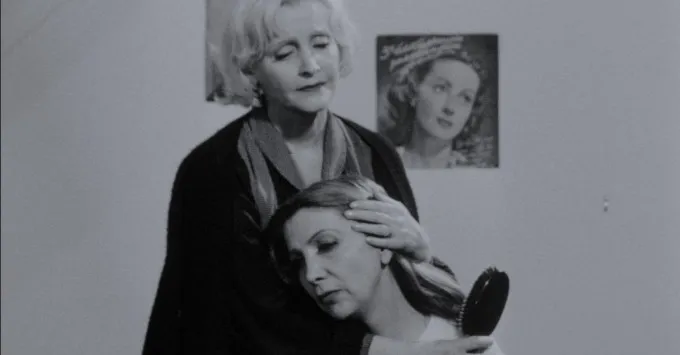
From the black and white of Femmes femmes, we can surmise its great and moving original models: I thought of Murnau (Der letzte Mann), Dreyer (Gertrud) or a less great director, Machatý. Femmes femmes is, however — and this is extraordinary — a film precisely about cinema! Or, to be even more precise, about audiovisual expressivity in general. Indeed, the two protagonists are two actresses: two theatre actresses whose myth is cinematographic (as evidenced in the photos pasted on the walls of their small Rossellinian apartment). They play Racine or a naive clown act but would like to be Hollywood ‘stars’. A ménage à trois is thus established between ‘reality’, ‘cinema’, and ‘theatre’. The actresses are failed actresses descending on the slope of social degradation. They are, then, as much abandoned by the ‘fullness’ of their profession (theatre) as they are by the fullness of their myth (cinema). Only the void of reality remains for them. But it’s when ‘reality’ seems most empty, insignificant, purely tragic because it is without reasons, that it is once again filled by this ‘self-consciousness’ that is representation: on the one hand, cinema, because its linguistic code coincides precisely with that of ‘reality’ as natural representation, and it is furthermore a universal model (as she begins to die, one of the two actresses, though suffering terribly, ‘imitates’ the desperate pose of one of the revered Hollywood stars); on the other hand, theatre, because the characters that are interpreted contaminate, once and for all, whoever interprets them — once an actress has been a Racine heroine, she will never cease to be one. A character by a great author is always greater than her interpreter (who is often mediocre, lacking in talent or downright hammy), but she generously lends her greatness to the latter. In short, the two poor failures, adrift — on the verge of becoming tramps — are semantically dilated in their reality, through what they are in cinema–theatre. They could, of course, like every human being, achieve a ‘grandeur’ of their own — an even imposing grandeur — using their poor means: the fact is, in this film by Vecchiali, they achieve their ‘greatness’ — an imposing greatness — through the linguistic dilation I spoke of. These two unfortunate women, madly excluded, reduced to human waste, appear to us at the end of the film as two characters that are — I’ll say it again — worthy of Murnau’s Jennings or Dreyer’s Gertrud (to take two purely paradigmatic examples). Their love — which is sensual without being lesbian, which is spiritual without any spiritualist rhetoric, which is moving without any sentimentalism — has the firmness and madness of great poetic inventions of petit-maîtres, because, by avoiding precisely the dangers of a clinical psychologism, a culturally degrading spiritualism, and above all mawkishness, it appeals only to an extreme, light and profound elegance (so far from formalist that it risks being clumsy), and this — an Italian witness may be allowed to say it — was possible only within a culture like the French culture. Never has a cultural establishment [3] been presented with so much innocence and absoluteness as by Vecchiali’s two failed actresses (the extraordinary Hélène Surgère and Sonia Saviange).
Cahiers du cinéma, Hors-série, 9, March 1981, pp. 29–32.
Translated from Italian by Bernard Mangiante (first
part) and Jean-Claude Biette (second part).