Your script received an ‘advance on receipts’[^1]...
My script was accepted by the committee of advances on receipts, in November ’78. Before that, it had been rejected once. Contrary to what I’d thought, it was for very good reasons, and the comments given to me were all justified. I took them into account. Once it was revised, I presented it again, and it was accepted. I didn’t have any difficulty producing this film, since I had already worked with Paul Vecchiali (for La Machine and Corps à coeur) and he immediately agreed to produce it.
In ’67, I was lucky to meet Gérard Frot-Coutaz, who not only infected me with his fervor for cinema but also introduced me to people impassioned, possessed by cinema.
It’s by working on others’ films (as production manager, second assistant, errand girl…) that I’ve acquired a taste for cinema and the audacity to make it. Simone Barbès ou la vertu is my first film, but also my first project.
I brought my emotional universe into the ‘Vecchiali production unit’, which I knew and without which this film probably wouldn’t have been made. The camera operator was a first timer, and it was the main actress’s first role. I worked very ‘emotionally’, very much ‘by affinity’; it’s quite difficult for me to do otherwise.
In the case of Simone Barbès, the bulk of my work was done at the level of the direction of actors who, for the most part (and starting with Ingrid Bourgoin), weren’t professionals. That played a part even in the dialogue; since it was more necessary to suggest a tone to people who were above all ‘characters’ in my life and who could only speak in a certain way: their own.
I’m not great with imagination. I’m above all an observer. I work from what I hear, from what I see. I borrow from real life; I’m happy to arrange it (or stage it). Initially, these two girls are somewhat like parts of my own story. I was an usherette with Ingrid at this cinema, for that matter. Yet it seems to me I didn’t take the approach of psychological autobiography.
We have the impression of a very orderly, very musical crescendo…
The structure was not entirely premeditated. It came as the work progressed, and, by becoming aware of it, I perfected and deepened it. The meaning still eludes me in part. I wanted to film things lived, whose analogies, passing through different environments, struck me more than ideas. In the end, imagination is maximally reduced: two individuals in a car — it can’t be any more basic.
Or it can’t be any more wise… For there is the strangeness of the moment, your perception of this strangeness, and how you render it perceptible to the spectator…
It’s rather the miraculous and mysterious side of cinema. In my film, this played out visibly at least twice. In the very last scene. We were shooting at night, and lights go out in the morning, at six o’clock sharp. On the first night, we didn’t know this and were interrupted. On the second night, I asked the camera operator to look out for this moment and film the last lights going out; we had a few meters of film left, and the result was fantastic.
For the third part of the film, one detail helped us a lot. Michel Delahaye had problems with driving. Ingrid had the idea, almost as a joke, to offer to drive herself; we hurried to rework the dialogue in this sense, and the scene is what’s become of it.
This confirms my feeling that my cinema is not a cinema of ideas, of intellectual elaboration, but rather the laying out of elements borrowed from lived experience.
I am always afraid of ‘weighing’ kilos or imposing my own meaning. I went to great pains to avoid that in the central part of the film, which unfolds at the nightclub. I didn’t know what I wanted to show exactly. Rather, I sought a dispersal of significance, telling myself that, of all the elements that were there, some would necessarily get through to the spectators.
There is a great degree of spontaneity to my way of representing a world I know. The cinema hall, for example, the very place where I worked as an usherette, I know it like the back of my hand. So organizing the space, playing on light sources didn’t demand too much conceptualization on my part. It must also be said that Jean-Yves Escoffier, the chief camera operator, helped me out a lot with structuring the découpage, which caused me terrible allergies, all sorts of discomfort.
Have you discovered correlations between the cinema you admire the most and your own self-expression?
Not really. Except regarding Ozu or Tati. But then that’s very pretentious! I discovered this — completely rapt with wonder — after having written the script. But Ozu must have more or less consciously instructed my way of filming. I like his rigor, his starkness, his stasis, his unique setting, his extreme attention to the human person.
His dramaturgy springs from a sort of triviality of the human being and the deployment of this triviality in repetition.
The film is built upon three huis-clos:[^2] (1) the foyer of a porn cinema, a three-screen theater: the usherettes as spectators of the clients, who themselves are spectators of a phantasmatic universe, and ourselves who are confronted with the spectacle of the former two, in addition to the street, suggested or shown twice. 2) The nightclub: a huis-clos in which the entire space is inhabited, filmed in close-ups, the main character thereby reduces herself to the role of spectator. 3) The car: there is practically no more representation: everything is centered upon the human relationship between two persons.
Yes and no… In the car, the two characters put on quite a bit of ‘cinema’. Apart from this detail, I agree with your analysis. For the foyer in the first part, I designed my lighting like that of a theater; I deliberately left the screening rooms off screen, underlining the opposition between the world of erotic phantasms (the rooms) and the world in which we live (the street, the love scene, the bridal shop we see in the background). The world of the street is treated like another magical space, that of marriage and passionate love (the sequence with the legionary). In the second part it’s even clearer: it’s a place of designated spectacle. Finally, in the car, there is nothing but the spectacle that two humans put on — or give up — to try to understand each other. This last scene, which doesn’t use rear projection and was shot in two nights, is a small technical feat. Ingrid drove, we crouched behind with the sound engineer, and all the tack needed for the shot was on the hood, with Escoffier on top of it! I don’t know how we managed it…
What runs underneath the film throughout is this freedom inside Simone. A freedom which is more lived than claimed. That she explains herself is out of the question. She’s a ‘take it or leave it’ character.
Yes, absolutely, and that has a lot to do with Ingrid, with our personal relationships. She helped me, ‘freed’ me from a great number of social phantasms. It’s difficult for me to say more about this without paraphrasing the film: she’s a bit like that. She hasn’t had other experiences in film since, but she would like to.
It is her in particular who gives the film this tone of freedom without banners. So much so that the song bothered me somewhat, since it’s such a ‘profession of faith’. I try, for that matter, to avoid the trap a little, by having it ironically announced by the ‘conductor’, Matha (12°5, rock on the counter). [3] They’re a rock band who perform basically anywhere you want them, with a very clear, very accessible, almost traditional number.
Simone Barbès gives off somewhat the impression of being a ‘limit-film’[^4]...
So much so that I won’t start again anytime soon. The crew was great and the experience heartwarming, but very hard.
I’m currently working on a script, but, in order to ‘take a break’, I’m planning it behind closed doors, with seven or eight characters.
If you want to master a large-scale deployment of places, of characters, it requires a lot of strength and a lot of money.
On that point, when you say in your review — published in the January issue [5] — that the nightclub sequence looks ‘poor’, I’m surprised! In reality, there’s almost a debaucherous indulgence in kilowatts! Escoffier wanted to create a ‘great burst of light’ and Vecchiali went along with it, even though at the level of production the risks were significant.
It seems to me that one of the film’s great strengths lies in its moral as well as spatial boundaries: it thereby avoids shamelessness, ostentatiousness, protest, etc.
What I like about the cinema of the years ’35–’45 is not the dramaturgy; it’s the dialogue, its youthfulness, this no-nonsense side to the characters.
Of course, I tried to find this in a modernity that is our own.
I am for a cinema of insistence, of detail, of accumulation. That’s what I like about comedy. What I admire in Tati.
The comedy in your film is rather painful…
Well, there are different moments: the comedy at the beginning, which borrows from caricature but, in so doing, creates a balance. The usherettes’ caricatural side corresponds to the outrageous nature of their situation. Then there is the frankly serious middle part of the film. Finally, we resorted to deliberate humor, which stings a little.
For me, cinema (and I’ve verified this) is wonderful because you can express, through human bodies, through human relationships, just about anything you want. It’s a question of the relationship within a crew. It’s crazy what Michel Delahaye was able to help me with, by taking me seriously, by behaving like a true teacher, by agreeing to give everything he had. It was he who chose to play the male character in the third part. We never did more than two or three takes. During the last scenes, I had the impression of working ‘by ear’. I could hear if it was working, if the silences were right! What I wanted was to create characters strong enough, true enough for them to exist and for the spectators to be able to love them, understand them.
Cinéma, 255, March 1980, pp. 54–57.
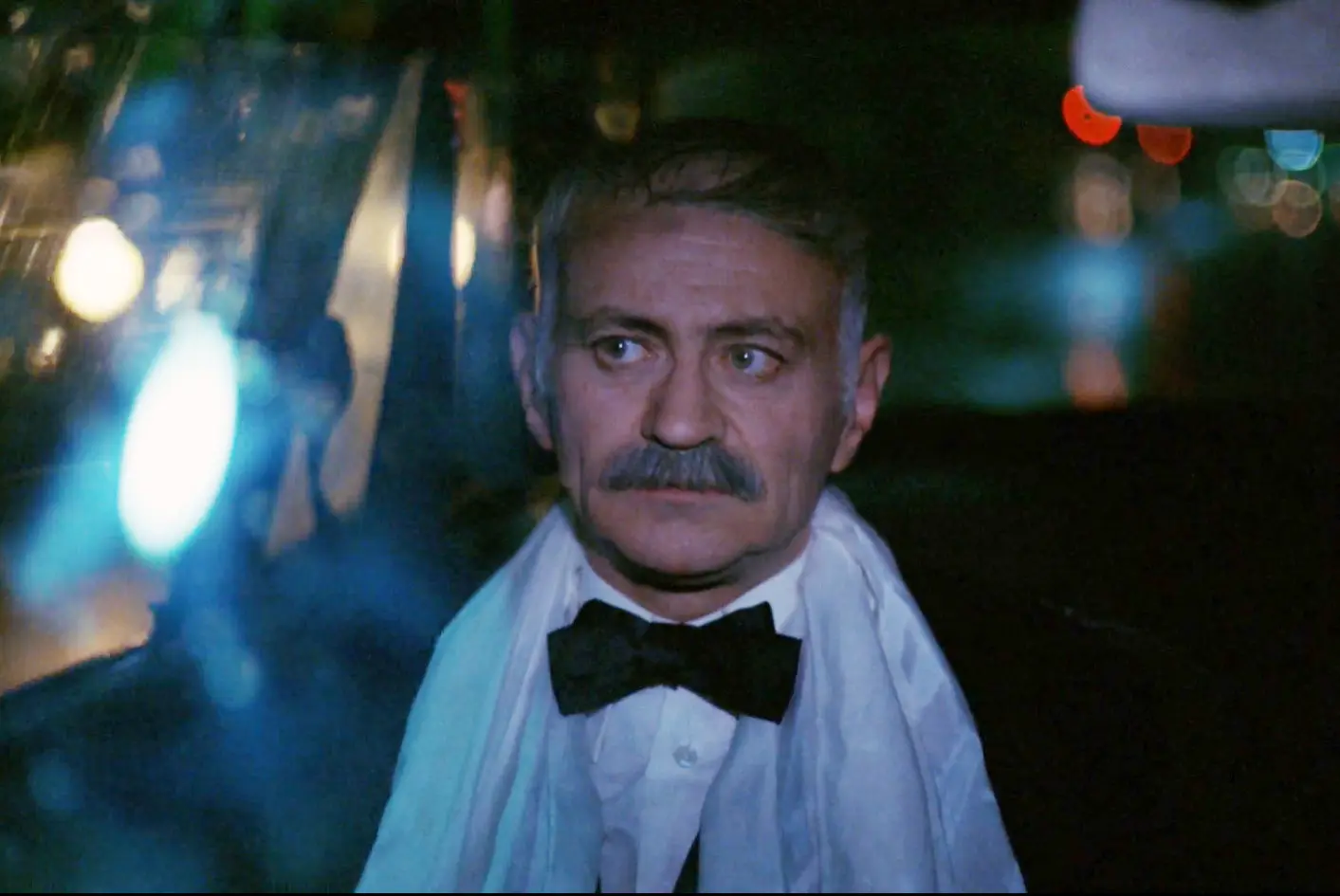
Simone Barbès ou la vertu (Marie-Claude Treilhou, 1980)
Notes
Translator’s note: avance sur recettes.
Translator’s note: literally ‘closed doors’, the term refers to closed spaces.
Translator’s note: Referring to the scene in the night club where ‘Nana-mec’ is performed by Josse from the rock band 12°5. The clarification between parentheses in the original interview may be faulty: ‘Matha’ seems to be a misspelling of ‘Matho’, which refers not to a member of 12°5, but to the androgynous, senior band whose singer — likely its namesake — introduces Josse’s song.
Translator’s note: film-limite, likely playing on the concept of ‘expérience-limite’ known to French philosophy.
Translator’s note: It seems Treilhou is referring to the February issue. See Mireille Amiel, ‘Simone Barbès ou la vertu’, Cinéma, 254, February 1980, p. 76.