En haut des marches (1983) first presents a disclaimer that would be taken for granted in any other film: ‘Any similarity with previously existing people or events would be purely coincidental.’ Over time, such legal notices have become meaningless, with films advertising themselves as based on the life of a real person, yet still opening with the notice just the same. The title fades and reveals a shot of the bay in Toulon. Then, a cut to a photograph of someone — Vecchiali’s mother, Françoise — though nothing in the film tells us this. Danielle Darrieux’s character in the film will also be called Françoise. Vecchiali’s mother had the Corsican maiden name of Raffalli, which is also the name of a military camp in Haute-Corse, in the north of the island. Darrieux’s character has the surname Canavaggia, also Corsican, also a place in Haute-Corse. What does that disclaimer mean?
Vecchiali was six years old when he saw Anatole Litvak’s Mayerling (1936), and it was here that he first encountered Darrieux. She plays the seventeen-year-old Mary Vetsera; she attends the opera, she plays music, she dances. The film climaxes with her dying at the hands of Charles Boyer in a murder–suicide. After Boyer shoots the sleeping Darrieux, he looks over her body, caresses her hand. The image cuts from her in bed to Boyer observing blood rolling down her forehead. He grabs her hand, the film ends. Vecchiali’s framing of Darrieux in En haut des marches carries the childhood shock of first seeing someone die, only to see the same dead actress revived for the next film. The child loses their sensitivity as they grow, learning to distinguish between actors and characters, between real events and things that happen in films. For adults to be shocked in this way, the aesthetics that distinguish the real and the filmic need to be more robust. Vecchiali achieves this by cutting to a spatially or temporally displaced image before a scene can find its resolution.
When Litvak remade Mayerling in 1957 for American television, this sequence was consolidated into a single shot/reverse shot sequence, from Mel Ferrer to Audrey Hepburn, then back to Ferrer. Vecchiali once mentioned being asked to shoot systematic shot/reverse shot for television. He refused: ‘I am not saying that the reverse shot should be forbidden, but reverse shot means a confrontation.’ [1] Early in En haut des marches, there is an overhead shot of Françoise walking in the Place de la Liberté, which cuts to a reverse shot now looking upwards at the statue in centre of the square, then cuts back to Françoise walking, which, by the conventions of shot/reverse shot, we now understand as the statue’s own point of view. Now the film cuts to a final third composition containing both Françoise and the statue, which can be understood as an ‘objective’ shot, not beholden to either party’s perspective. In this third shot, Darrieux turns her head to the right, and the camera repositions itself, thus leaving the statue’s head offscreen. Rather than following a conversation, these shot/reverse shots establish a confrontation between Darrieux and the statue, one that would be unclear if the subjects were shown within a single image. The statue’s facts and Françoise’s facts are different, and the third shot fulfills the same purpose as the opening notice, positioning both sides of the contradiction in the same frame.
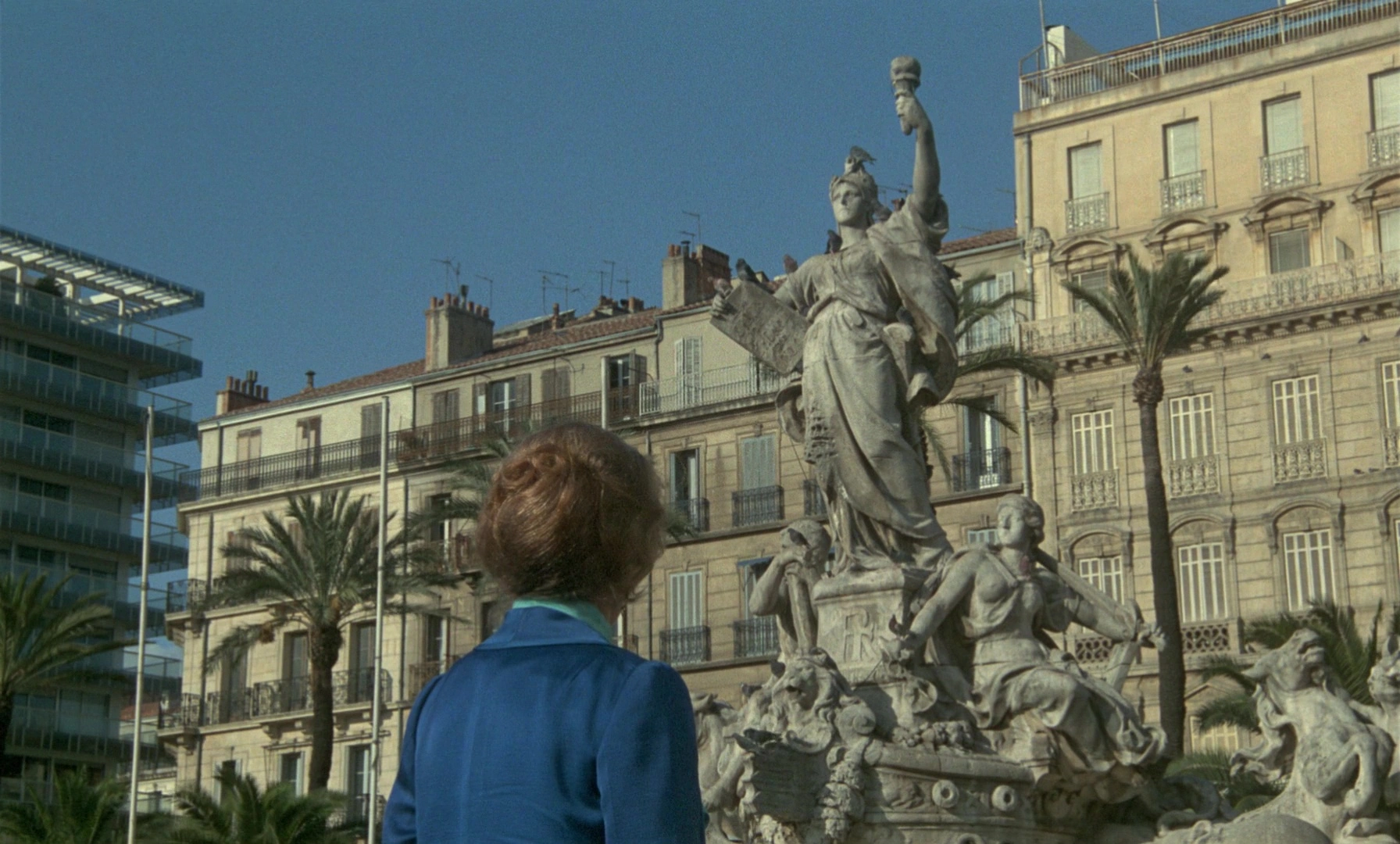
En haut des marches (Paul Vecchiali, 1983)
Vecchiali speaks of Jean Grémillon’s Le Ciel est à vous (1944), a film made during the war, a film he adores: ‘When Vanel is waiting for his wife, he’s all worked up, he doesn’t know if she’s dead, and then the film rehabilitates him in extremis. He’s there, he hears noises, the crowd arrives, we feel that he’s going to be lynched, and then he’s told that his wife has returned.’ Process has given way to gesture. This, Vecchiali says, is ‘a typical example of what I call dialectic’. [2] When, in the middle of En haut des marches, Françoise, standing in front of the sea, turns to align with a superimposed shot of her face, the spatial and temporal relationship between the two images is not known; the disruption has moved from the cuts, the edges of the images, to the centre of the frame. Moved inward, this disruption becomes less concrete than the clear separation typically situated between shots. To avoid confronting this ambiguity, it would be easy to jump to half-truths; spatial and temporal relationships can be rationalised, but cannot be resolved. It is through the ambiguity of its assembly that the film enacts its rehabilitation of the subject.
Looking directly at the film without diverting to half-truths is uncomfortable; it requires that we learn how to see it again. By the end of the film, our sight has adjusted. To return to these scenes, whether by rewatching the film or recalling moments from it, is to return to the discomfort, to reopen the film and confront the images as they first appeared to us. Our old mistakes cloud our vision again. There is a struggle in trying to piece together the truth of scenes and events; the dramatic structure is simple, yet it is the process the film undertakes, looking at facts that contradict each other, only to force us back into the perspective of Françoise, without coming to a conclusion about what is true or false, that causes this difficulty. The same is true of our struggle to piece together the person named Françoise — it is impossible to know her as well as we know Darrieux; our familiarity with Darrieux does not equate to a familiarity with Françoise. There is no resolution, only the clarity Vecchiali affords us to see the complications of history intersecting with life, compounded by themselves.
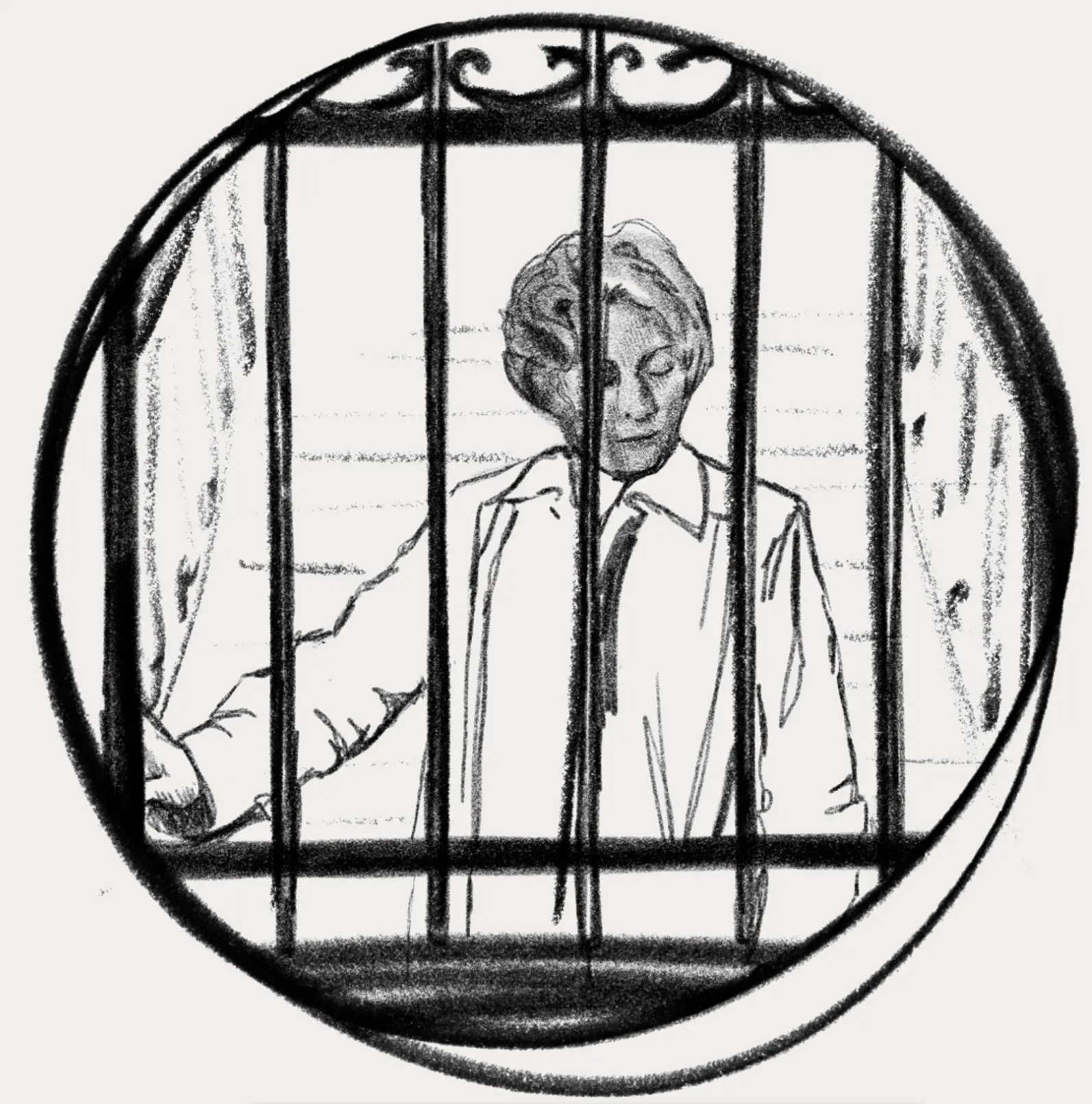
Original illustration by Kate Sianos
Notes
Murielle Joudet, ‘Paul Vecchiali: “Les sentiments, c’est dans les jambes”’, Chronicart, 23 February 2015 https://www.chronicart.com/cinema/paul-vecchiali-les-sentiments-cest-dans-les-jambes. Available in English at https://festivalcinesevilla.eu/en/news/paul-vecchiali-feelings-are-legs.
Ibid. (translation modified).