What justifies calling Marie-Claude Treilhou’s Simone Barbès ou la vertu — one of the most beautiful debut films in the history of cinema — a film that exists in the tracks of 1968? Perhaps we can begin with the fact that Treilhou identifies herself as a ‘survivor’ of the period. [1] Her essays for the French magazine Cinéma suggest the influence of politicized theories of cinema developed in the wake of the student–worker protests. One of her first pieces is among the earliest theoretical analyses of pornography as a genre, developed out of her experience working, like the titular heroine of her film, as a ticket-taker at a porn cinema. Published in September 1975, the essay is an almost exact contemporary of Laura Mulvey’s essay on visual pleasure. Both women arrive at similar conclusions about the psychical function of the theater space for the spectator. Treilhou decries the faux-subversiveness of pornography, which ‘gives the impression of fully transgressing the established order, at a time when true bourgeois morality, that which there is no question of transgressing, is flaunted onscreen’. [2] Rather than undermine bourgeois morality, she argues, pornography sells its fantasies. This same question, how mass media shapes bourgeois desire, is taken up again by Treilhou ten years later in Il était une fois la télé, a documentary about the influence of television in the French provinces.
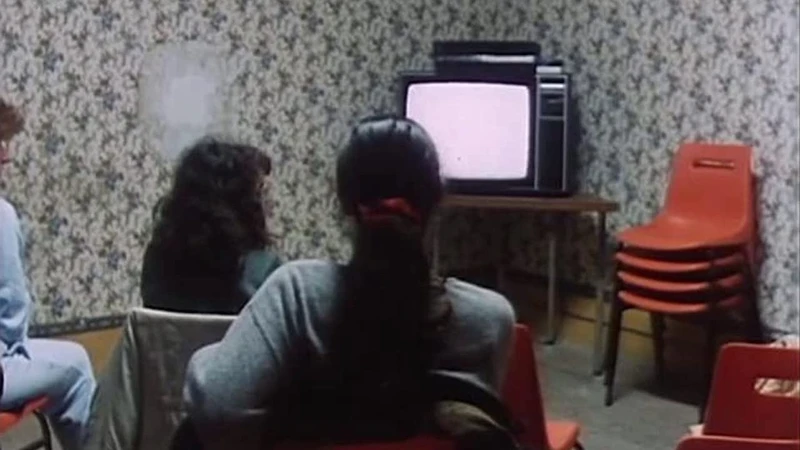
Il était une fois la télé (Marie-Claude Treilhou, 1986)
Then there is the fact that Simone Barbès is about pleasure, specifically in connection to various forms of spectacle. Each of the film’s three scenes is composed around different kinds of media: in the first, cinema; the second, cabaret; the third, (recorded) music. None seem to hold the attention of the titular protagonist, who passes through these vignettes for the most part with little interest from night till dawn. For those who are most concerned with cinema, the first of these scenes — also the longest, by a small margin — naturally holds the greatest interest. It’s in this section that her admiration as a critic for the great modernists of the seventies like Jean-Luc Godard and Straub–Huillet is most apparent, particularly their rigorous handling of space. (Likewise, the influence of Pascal Bonitzer’s analysis of offscreen space is suggested by his brief appearance in the film as one of the well-dressed dandies in the nightclub sequence.) In his novels, Alberto Moravia showed how sexual satisfaction and boredom, far from being opposed, are complementary factors in the structure of bourgeois desire. Does one not come away from the first sequence of Simone Barbès with the same realization? Stuck with Simone in the theater lobby, we experience her boredom waiting during shifts and her dealings with patrons and creeps. The films themselves are excluded from view; Treilhou limits our knowledge to the faint grunting and moaning heard through the walls. In one of the scene’s most memorable exchanges, an indignant Belgian pornographer (played by the film historian Noël Simsolo, later a collaborator on Treilhou’s 1991 film Le Jour des rois) complains to Simone about the poor projection in the salle. The cries of ecstasy lose their allure and become something mechanical, sapped of the excitement they’re meant to inspire. Françoise Aude criticized Simone Barbès in Positif for ‘the absence of mise en scène’. [3] But is that not exactly the point? This is a film that says more through what it withholds from us, and how it withholds it, than through what it shows us.
In L’Automne, the last entry in his ‘Four Seasons’ cycle, Marcel Hanoun mocks as ‘pornolitical’ a certain kind of radical documentary popular after ’68 that is more concerned with showing action in the streets than with engaging the politics of form. Treilhou makes a similar sort of point by using pornography as a metaphor to say something about cinema. (In her essay on porn theaters, she already described pornography as a ‘particular example’ of tendencies within commercial cinema more generally.) What is defective, perhaps even fundamentally unsatisfying, about the kind of pleasure traditional cinema can provide? This is one of the questions Serge Daney asks in the essays bookending his first collection, La rampe, the goal of which was, in part, to trace the period of its decline. Simone Barbès is, in its own way, dedicated to the same line of questioning, one that brings it into proximity of one of the most famous slogans of the ’68ers, jouir sans entrave, ‘enjoy without obstacle’ — originally a quote from the Tunisian situationist Mustapha Khayati, but more often misattributed to the Marquis de Sade. In her debut film, Une vraie jeune fille (1976), Catherine Breillat carries this slogan to one self-destructive extreme, placing maximal pressure on the erotic figure of the woman in bourgeois cinema. Treilhou approaches the problem from another extreme. Like Hanoun, her answer takes the form of a displacement. Setting aside these older images, Treilhou sets out to find new ones — one of the reasons the film takes the shape of a search.
It is surprising how few critics have remarked on the allusion in the film’s full title to Sade’s most famous novel, Justine, or the Misfortunes of Virtue. Simone Barbès is no Justine, but she does encounter a similarly colorful cavalcade of characters on her journey through the underground clubs in Montparnasse: petty-bourgeois perverts, marquises, dandies, stylish lesbians, drunks, and many other kinds of night owls. This kind of scenario, in which characters parade in and out of scenes, will go on to be Treilhou’s forte, an approach carried forward into her next films. Un sale histoire des sardines (1983) — her contribution to the French television series ‘Télévision de chambre’, which also produced films by Robert Kramer, Jean-Claude Brisseau, and Chantal Akerman — remains interested in oddball caricature. Her final two fiction features, Le Jour des rois and Un petit cas de conscience, will trade such milieus to center more conventionally petty-bourgeois situations (family reunions in the former, and disputes with neighbors in the latter). Yet this shift in focus remains attentive to social outcasts, mocking the hypocrisy of middle-class virtue.
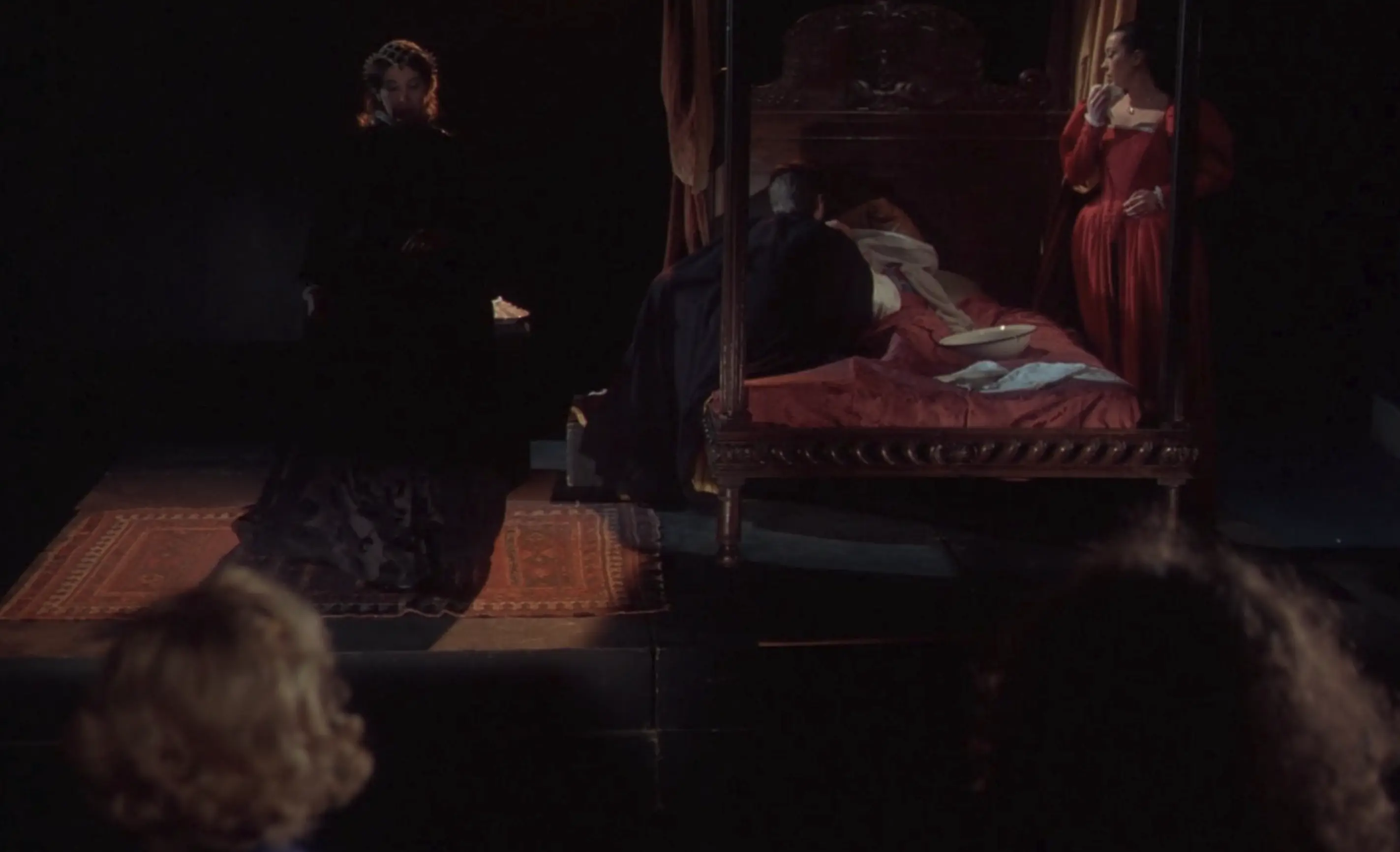
On the other hand, what we remember from these films are less the characters than the spaces they pass through. One of Treilhou’s greatest skills is her handling of space. Like the best of her contemporaries, she bucks the strategies of traditional découpage. There is something reminiscent of Renoir in the way she uses every corner of the frame in Simone Barbès, with characters sneaking around corners to slip from one room to the next. Her adoption of direct sound, from at least L’Âne qui a bu la lune (1988) onward, likewise places her in this legacy alongside other French descendants as varied as Straub–Huillet and Éric Rohmer. But, in another sense, her style is Renoir’s inverse — it turns his ideas inside out. Renoir gives the impression of a total freedom of space that continues on well past the frame. Even the prison-like villa of La Règle du jeu (1939) seems to extend infinitely. The world is in his films; it’s shut out of Treilhou’s film, appearing only in the transition between scenes. Treilhou’s cinema seems to suggest that the only things that matter are what take place ‘in the wings’ — a sentiment close to the essence of the Diagonale company. (I’m thinking in particular of the ‘backstage’ elements of Biette’s marvelous 1977 debut, Le Théâtre des matières, as well as the films by their Spanish fellow traveler, Adolfo Arrieta, and even Vecchiali’s gorgeous, underrated late features.)
Perhaps one could say that Le Théâtre des matières and Simone Barbès form two halves of a manifesto for a cinema still committed to the best ideas of the nouvelle vague long after its subversive attitude — the same one that will define the generation of ’68 as a whole — had been recuperated by the mainstream.
Le Théâtre des matières (Jean-Claude Biette, 1977)
Notes
Éric Biagi and Andrea Inzerillo, ‘Interview with Marie-Claude Treilhou’, Another Screen, 2021, https://www.another-screen.com/simone-barbes-or-virtue.
Marie-Claude Treilhou, ‘La machinerie fonctionne à fond’, Cinéma, 201–202, September–October 1975, 105–108 (p. 107); translated in this issue as ‘The machinery is running at full blast’. Élisabeth Lebovici, in her remembrance of Simone Barbès’s production, similarly connects this essay to Jean-Louis Baudry’s critique of the cinematic apparatus, developed at the short-lived avant-garde magazine Cinéthique. See ‘On Simone Barbès ou la vertu’, trans. by Daniella Shreir and ed. by Missouri Williams, Another Screen, 2021, available at the link in footnote 1.
Françoise Aude, ‘Inertie (Simone Barbès ou la vertu)’, Positif, 229, April 1980, 69–70 (p. 69).