Left hook. Another left hook. Maurice winds up his right hook — camera at eye-level. He lets it fly. We cut to a new shot just before the punch connects: camera at a high angle pointed at the top of his opponent’s head. Slow motion. The punch lands, and the body arcs towards the ground — the camera’s high angle primed to capture the fall.
If that punch hadn’t knocked his opponent out, the shot wouldn’t have worked: it would’ve just shown the top of his head. We would have lost the energy of the scene. The high angle only works because he falls. The camera was in that exact spot because it knew he would lose. The fight was fixed.
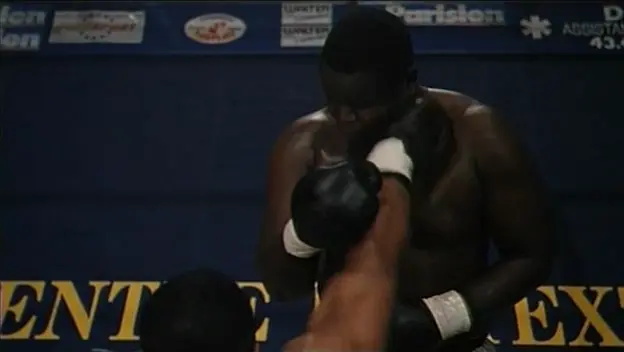
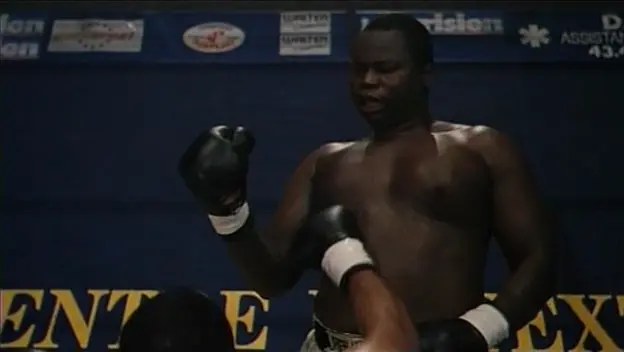
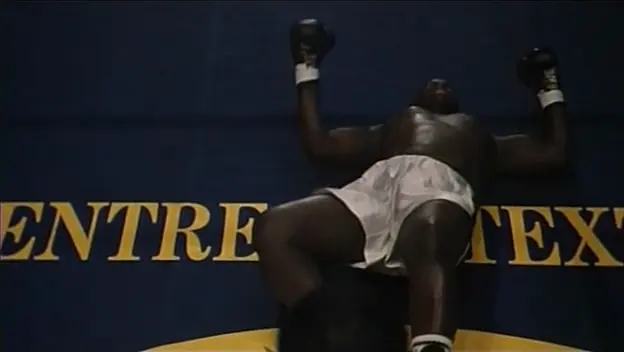
Wonderboy – De sueur et de sang (Paul Vecchiali, 1994)
I used to hate this type of shot. I called them ‘fatalistic’ shots because, right from the first frame, they were doomed to a single ending. In other words, shots where the blocking was predetermined by the camera angle, completely restricting the actor in the moment. To me, cinema was the art of potential energy: the longer, more neutral the shot, the more possibilities it contained, and the more exciting it was. Fatalistic shots have zero potential energy. They seem to relish that fact; they gaze solely on that fixed endpoint. These are shots that made me ask, ‘Why am I looking at this?’, until that question was answered by the actor’s slow, inevitable journey towards their mark. I first noticed a fatalistic shot at the end of Fritz Lang’s Spione (1928). The clown shoots himself, and we cut to an empty patch of floor — a cut that makes no sense until its end, when we see the clown’s body land just so in a perfect patch of light, center frame. To my younger self, this was a betrayal of the rules of a fair film, a card cheat peeking at the next card before anteing up.
* * *
Wonderboy is — very blatantly — a movie about freedom. Our boxer hero Maurice wonders again and again whether this next fight will be the one to grant him his freedom: from contracts, from his father, from his training regimen, from the murder he committed, from the constraints of being Black in Europe — free enough to learn to play the violin, which is all he longs for. Finally, he lands in jail, where he exchanges his boxing knowledge for violin lessons and tells us that, for the first time in his life, he feels free.
Vecchiali’s film most explicitly concerned with freedom is also the one where he appears, at the level of form, least free. The script revolves around a protagonist’s psychological quest in a rather ‘Hollywood’ style. Scenes are filmed using much more typical coverage, rather than Vecchiali’s signature long takes. Wonderboy has all the feeling of a work for hire, phoned in for a paycheck. Could it be the bounds of convention that led him to film that fatalistic shot, right in the middle of a movie about freedom?
* * *
Years passed from my dogmatic days watching Spione, and I started making films. I learned the truth, perhaps already obvious to anyone more cynical than me: every shot is fatalistic. Every shot is doomed before it begins. Even a simple pan must be rehearsed many times to hit the framing and focus. If the actor steps off the narrow path allotted to them, they won’t catch the light — they’ll be erased from the shot. I can’t imagine the careful planning required by such ‘free’ films as Le Crime de Monsieur Lange (1936) or Germania anno zero (1948). The boy’s walk through the ruins in the latter film was no less inevitable than the boxer’s fall in Wonderboy — dolly track was laid, marks were measured — but Rossellini chooses to frame the action as if growing organically, whereas Vecchiali tips his hand from the first frame. The angle of Rossellini’s shot emphasizes the peculiarities of his actor’s performance more than Vecchiali’s does, perhaps in order to establish some humanity beneath mere action, but both shots prescribe a similar journey from Point A to Point B. It’s a difference not of kind, but of degree: Vecchiali’s shot sheds every veneer of self-justification.
Furthermore, I learned that the difference between a fatalistic shot and a spontaneous one isn’t in how they’re constructed; it’s in how they’re edited. Take a seemingly spontaneous moment — an actor bursting into frame, the camera panning passionately with them — and roll the footage back two seconds: the camera would be stationary, lying like a hunter in wait for the prey to hit their mark. Early in Wonderboy, there is a simple moment where Vecchiali cuts to a close-up of Maurice as he takes a seat — perfectly ordinary, because the cut occurs partway through the sitting motion. But had he cut to that shot a few seconds earlier, we would have seen an entirely unmotivated shot of Maurice’s legs, simply because the camera had been placed there to capture his exact landing spot. In Spione, the fatalistic shot would have felt entirely natural if Lang had cut halfway through the clown’s fall, rather than before the motion started. In fact, in these fatalistic shots, we see more of the world that was filmed. We have a better idea of the truth behind filmmaking, unobscured by the after-the-fact imposition of clever editing. That ‘potential energy’ of a long, neutral take was just a critic’s fairytale. Truth and freedom are at odds.
By the time of Wonderboy, Vecchiali valued truth over freedom. After all, what good is freedom? Freedom is Maurice’s consolation prize for landing in jail; freedom is the rallying cry before a massacre. Freedom is Apocalypse Now; truth is C’est la vie !. [1] There is a land where freedom fears to tread: the land of convention, the path well-traveled. As time goes on, you realize that your truths — your heartbreaks, your ecstasies, your imprisonments — have been felt before, and expressed better than you could ever hope to. Isn’t Maurice’s fate cribbed straight from Camus’s L’Étranger, and likely a thousand myths before that? Borges, as quoted by Godard, found himself clinging to these simple truths late in his life: ‘I use the most worn-out metaphors because they are eternal.’ The truth is often trite, and Wonderboy is trite. I find it fitting — call it fatalistic — that Wonderboy brought Diagonale, this wonderful experiment in freedom, to its end.
Notes
Vecchiali shot C’est la vie ! in four days after hearing of the excesses of Apocalypse Now’s production.