For a long time, I had the memory that each of Jean-Claude Biette’s films contained within itself a stretch of silence, which was both the film’s center of gravity and the heart of the gravity of things. On checking, it is nothing of the sort, which comes as no surprise to me since, like everybody, I describe shots that only exist in my memory or recite dialogues that no actor has ever uttered. The sleights of hand of memory in these matters act more like mischief, reassuring us of our capacity to weave narratives, emotions and details in the interstices left vacant by the unconscious. However, this true-false memory does not come from nowhere. It is nourished over time by these sequences which, in each of Biette’s films, serve the role of silence and thereby contaminate the memory. For if I can remember them in these terms, it is necessarily because they offer me the possibility, because they contain the promise — that my memory, afterwards, holds onto.
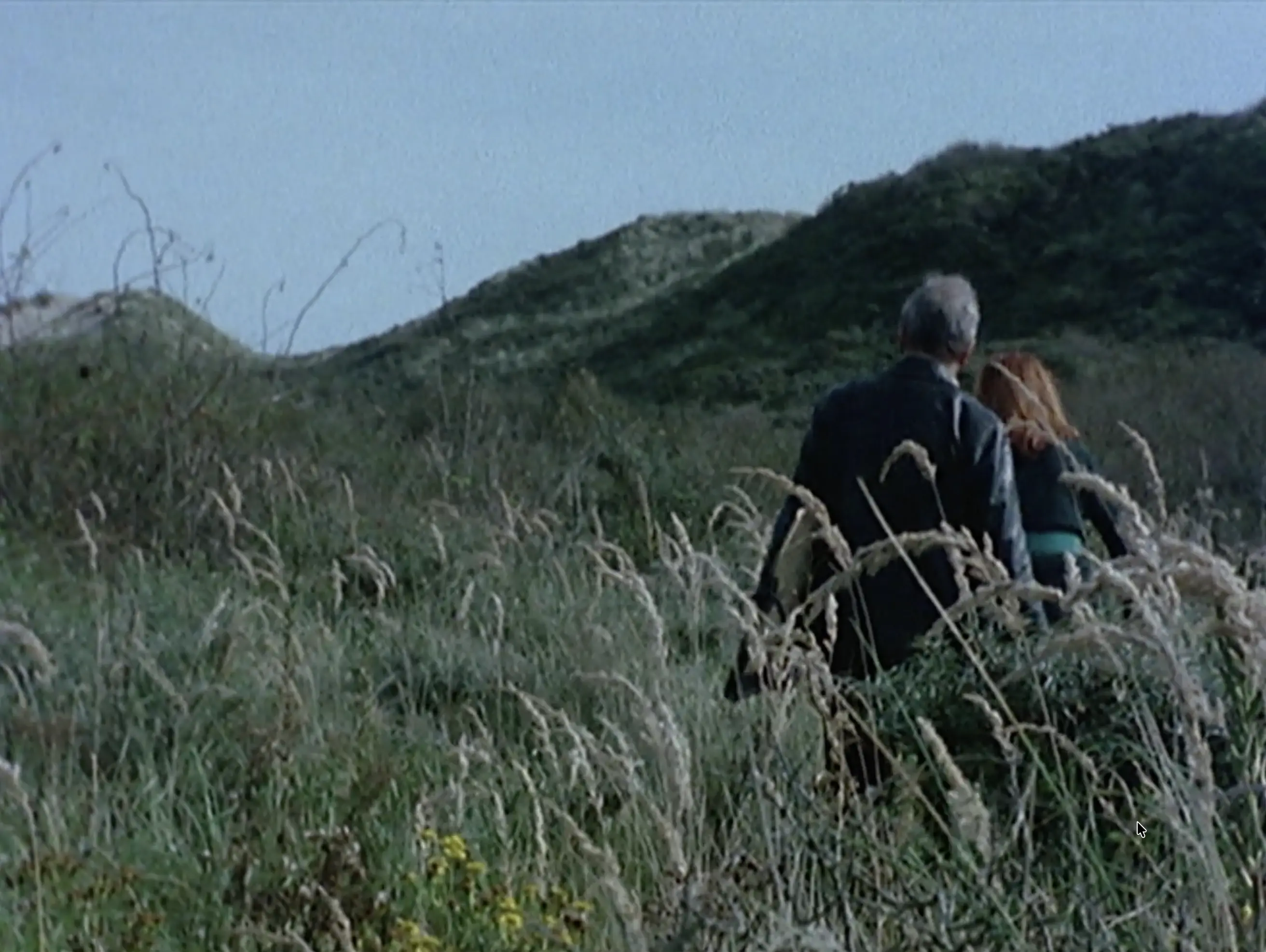
Loin de Manhattan (Jean-Claude Biette, 1982)
We may recall that almost all of Biette’s films are a way of slowly approaching the great art, theatre, whose radiance reach us, having left the stars some centuries ago (the stages in the films are always bathed in a splendid and mysterious light conducive to the hatching of meaning: it is not in the world that words take on their meaning, but on the stage). Moreover, almost all of them also offer a voyage: the beaches of the North in Loin de Manhattan, Le Champignon des Carpathes and Chasse gardée, London in Le Complexe de Toulon, Porto in Trois ponts sur la rivière, Berlin in Saltimbank. These two movements (the stage, the voyage) are like lapses in the very flexible narrative patiently developed from film to film. My view today clearly identifies them as the officiants of silence whose trace my memory held and quite cleverly presented to me as reality. For how can one account for silence by making an appearance, by talking nevertheless? By creating conditions for its emergence, by being there to film what then occurs, or doesn’t occur. There’s nothing better for this than a lapses in the narrative. There, one can speak, move, and nothing can prevent it from fulfilling its office, from being silence.
There is nonetheless one film, Loin de Manhattan, which well and truly addresses this question of silence, going so far as to stage it, in the dunes of Pas-de-Calais, with a delicacy that truly reveals the indeterminacy of things — no small matter. The film presents a gallery of characters in the Parisian world of painting: an enthusiastic yet atypical assistant of a high-profile gallery owner, an intractable theorist of art and sly critics of the Shapes and Colors magazine dance a semi-socialite, semi-serious ballet, which little by little sketches implicitly the figure of René Dimanche, a painter famous for several major series exhibited around the world (the Montagne period, the Broussailles, Fauvettes, and Sylvies periods — here painting is as silent as its subjects), who abruptly stopped painting for eight years, leaving everyone to question the reasons for his silence without coming up with any genuinely convincing answers. The theory of disappointment in love is put forward, in the full knowledge that it doesn’t hold water, that it’s a little thin, the mystery is revived anew, but does the silence necessarily conceal a secret? René Dimanche is without doubt the most beautiful example of these untalkative characters entirely devoted to the search for a spark, which can only appear from the friction of reflection upon silence, something Biette constantly returned to interrogate through the hesitant silhouette and the detached diction of Howard Vernon. Before René Dimanche, there has been Hermann in Le Théâtre des matières, afterwards there will be Jeremy Fairfax in Le Champignon des Carpathes (in which his daughter says that he wraps himself in a ‘wonderful coat, silence’), Charles Toulon in Le Complexe de Toulon (who ‘does not want to hear about any of this’), and all the way up to Fortunato Almeida in Trois ponts sur la rivière who for his part is completely silent (but Howard Vernon was no longer there to play him).
To bring some new elements to the critical study he is preparing on the painter, specifically a satisfactory explanation for those eight years of silence, theorist Ernie Noad (Michael Graham) sends a journalist, Christian (Jean-Christophe Bouvet), to track him down and get him to talk. The interview scene, which ends with the dismissal of the journalist, carefully leaves René Dimanche off-screen; he only appears at the end to chase the journalist out of the frame when he realizes the latter’s real intentions (no reverse shot is possible, in these conditions, to the shot of the speech). Eager to provide the theorist with an answer at all costs, Christian then asks his friend Ingrid (Sonia Saviange), assistant of a renowned gallery owner who is exhibiting one of René Dimanche’s Fauvettes, to approach the painter and to obtain the much-coveted information. Thanks to a fainting spell, Ingrid manages to make contact with him, but when, a little later, at the end of a walk by the shores of the Channel, she obtains the much-awaited answer, she’s long since passed, bag and baggage, to René Dimanche’s side. Of this episode, the film only retains the inexpressible; turning its back on the spectacular, it registers only a few signs that give it the appearance of a revelation (and which Sonia Saviange takes on, not hesitating for one moment to reveal the overwhelming fragility upon which the life of actors is founded). Ingrid will therefore not deliver to Christian the magic word he’s awaiting (but he’ll get over it, having already found the answer to the question by himself), and will flee to the painter’s side, disappearing literally into a trompe l’oeil — the last image of the film, where the final pan (an essential stylistic figure in Biette’s work, a tool of contemplation) gently comes to a halt, returning the questions to a spatial and temporal dissolution of confounding simplicity.
These three figures of disappearance (dismissal, fainting, dissolution) are staged here like pathways to silence the characters successively take to enter into contact with the mysterious heart of what they are interrogating. It’s clear to see that entry cannot be gained by force, but only through listening, or even through grace. This is what happens to Ingrid, who only fully understands the scope of the affair during this walk in the dunes in the footsteps of the painter tracking down scrub. This ten-minute sequence needs no empty words: two-thirds of the way into an otherwise extremely talkative film, it is only punctuated with two or three sentences. Captivated by Ingrid’s tender exaltation, like her we are suddenly won over by the simplicity of the world, invited by the filmmaker to enter his frame and to offer ourselves up to contemplation. Like her, we can then look at the things cleansed of words through the painter’s gaze, and rejoice in his silence.
The essence of what is discussed here (painting) and of what resists discussion (the painter), is thus off-screen, that is, left unspoken. There is no paintbrush, palette, or canvas in this film that is nevertheless entirely centered around painting, which is undoubtedly why it’s forgotten every time the question ‘how do you film a painting?’ is asked — yet what an answer! For Biette always takes the greatest care to question representation rather than spectacle, in theatre as well as in painting, preferring to film the bystanders, to look at things indirectly, to meditate endlessly on the lesson of Femmes, femmes, Paul Vecchiali’s inexhaustible film: ‘People who are delusional […] are not tense, they don’t seem real because they don’t exaggerate, they don’t make crazy gestures’. (Incidentally, the spectacle made no mistake in taking revenge by passing over Biette’s films in silence.) What’s on-screen in the film, meanwhile, is invaded by words, sharpened and charming, deadly and bizarre, in which everyone indulges as part of the enjoyment of everyday life. This is where the critics frolic, trying at all times to evaluate the degree of equilibrium between ‘shapes’ and ‘colors’ achieved, or not, by the artists, and where Christian understands intuitively that René Dimanche’s silent period comes from a disequilibrium between the two ends of the spectrum. ‘Beaubourg, Beaubourg, Beaubourg’, concludes the gallery owner (Laura Betti) with a disenchanted rolling of her r’s as if she were saying ‘Words, words, words’ [1] (Shakespeare is never far away in Biette’s work). But there is no secret: the price to pay for certain things is the silence of words. So we turn our backs, we faint, we enter a painting, and suddenly warblers, sylvies, and shrubs come to life; behind us, furtively, an animal has stopped in its tracks, and in this vast digression we suddenly have the leisure to see what is left to be accomplished: for René Dimanche, ‘to link lines and colors more closely’. Eight years is barely too long to understand that.
Vertigo, no. 28, 2006, pp. 28-9.
Notes
Translator’s note: in English in the original.