Where Brecht might have meant historical materialism, Biette seems to mean materialism as such, materials as in ‘materials science’. The latter obviously never played a substantial role in the history of theatre until Le Théâtre des matières, Biette’s debut feature; and certainly there are fewer prospects for a theatre informed by it than one of the film’s two protagonists, Hermann (Howard Vernon), might think. During a doomed sales pitch to a potential investor, the titular troupe leader and ex-musician suddenly launches into a lengthy spiel on his preoccupation with the materials of the world — ‘all the “matters” of the cosmos’ that exist, he says — and their influence on his practice. This is part of a grandiose methodology involving such precepts as being ‘carried away’ by a text rather than performing one and the key contribution on the part of bodily secretions when actors forget their lines. But crucially, it is the interference of the ‘matters’ that seems to be the main stimulus of Hermann’s theatre (and the primary selling point). Unlike the dutiful dramaturg Repetos, seated at a nearby table and reciting all of Hermann’s words at the very moment he speaks them, Biette’s film is less interested in mocking these strange preoccupations than in testing them as hypotheses. For instance, we never see, on stage or onscreen, bodily secretions, neither anyone being ‘carried away’ by a text, nor do we see objects from the cosmos entering the theatre on their own accord. Conveniently for us, the ‘matters’ appear on a continuum (instead of stacked up in piles), precisely where the theatrical register gives way to the filmic state of flux, of metonymy and succession. Hermann says, and Biette would likely say, that the stage (and the camera) provide a natural limitation to this infinite series of objects; their specificities are the crucial factor in whatever vastness art shares with the universe. There can be only so much room on the stage or in the shot.
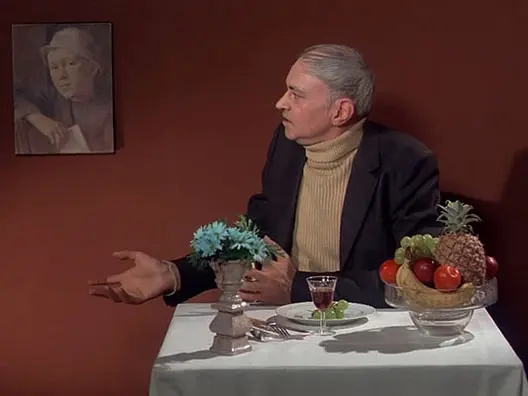
Le Théâtre des matières (Jean-Claude Biette, 1977)
Theatre and cinema form a kind of chiasmus in Biette’s work, though it would be difficult to say what place each occupies in the sequence. He himself writes, in a 1982 Cahiers piece on Welles’s Shakespearean adaptations, how the insistence of Welles’s camera (what the latter called the ‘vile machine’) cannot elide the feeling of strings being pulled on puppets. [1] Le Théâtre des matières could be said to turn this formula around, where the precision of what is arranged, with its exacting frames and narrative discretion, is complicated by exactly how the camera might correspond and converge with what is conferred by the scene. A form that moves out from one space into another is often made of a material completely immune from the constraints of the new space. Regardless of his stated methodology, for Hermann it is precisely the fluidity between forms he cannot account for. We watch near the beginning of the film as he examines various sounds of Furtwängler rehearsing Beethoven with the Stockholm Philharmonic Orchestra in 1948. Turning to Dorothée (Sonia Saviange), the complete stranger he has just found sleeping on the steps of the theatre, Hermann switches off the recording and immediately relates to her ‘what happens next’. But instead of what we maybe expect to hear, in a cut followed by a slow push-in, the ex-violinist recounts a random experience he had rehearsing Bruckner’s 4th in the Berlin Philharmonic, in particular being instructed by the conductor to (impossibly) imagine how ‘Furt’ would have approached the scherzo. There is an unbridgeable distance constructed here between Furtwängler and Hermann because we have suddenly withdrawn from the hallowed milieu of the famed conductor whose off-hand utterances are preserved on an LP. In its place we find traces of the interlocutor’s past, all the reserve and bitterness of a failed musician. Biette posits here that this is not only a sensible description of ‘what happened next’ in the Furtwängler rehearsal but the most accurate one and the one that is verified by the film. Of course, one can easily distinguish Furtwängler from Hermann, or from Désormière, for example — Dorothée approvingly notes the latter’s scrupulosity with respect to scores — but the sound of the rehearsal alone cannot account for this. Biette’s cut from the suspense of ‘what happened next’ to Hermann’s story is a demonstration of this continuum, a moment where sight and sound are an inextricable puzzle that ‘carries away’ the listener. It would seem that being able to see what is heard and hear what is seen would be somewhat useful, Biette says. That and being on speaking terms with the dead.
The act of listening in this scene is revealed not to be a form of observation but a small and covert act of participation in a culture and history. There are rarely passive observers that aren’t obliged to participate in Biette’s mise en scène. Take the sequence where Dorothée is on a date in a restaurant, and a stranger at an adjacent table (Michel Delahaye) suddenly interrupts the conversation to explicate the etymology of a word from the menu mentioned in passing by the waiter. Biette frames Delahaye all by himself in the static medium shot, never once depicting him in the same room as the others; of course he will never reappear. And in an earlier sequence shot near the beginning, Dorothée’s slumber on the staircase is framed in a well-lit doorway in the midst of the blacks and reds of the theatre closing up for the night. Biette moves his camera forward into the light of the doorway and of course, this will be a very fortuitous nap that brings her into the fold. As she says, she is almost immediately hired by Hermann, tout de suite, to play Catherine de’ Medici ‘for free’ in their production of Schiller’s Mary Stuart. An inauspicious debut role, indeed, given that this character is completely absent from Schiller’s text. This is of course an unspoken alteration in the formal reality of the frame text and just as with Hermann’s recollection of Bruckner, we are ‘carried’ elsewhere by the discrepancy. Then again we have seen how the shadows of the theatre summon ghosts out of their slumber; there’s a reason it made for a great place to sleep in the first place. So it’s Catherine, the ghost that presides sternly over the tragic proceedings of the imprisoned Queen of Scots, played by Dorothée, the ghost who materializes out of thin air to haunt Le Théâtre des matières.
The ‘matters’ at hand might as well be the ashes of dead monarchs, or some kind of residue left over where ideas and practices converge and become indistinguishable from the artist. There is virtuosity in the way that Biette’s cloistered characters happen to cross paths and obtain access to spaces. They are excellent interlopers. Dorothée, for instance, is taken on as the house financier of sorts, despite her modest income at the travel agency. Sooner or later, her travel agency co-worker Christophe (Jean-Christophe Bouvet) finds himself as lighting technician at Le Théâtre des Matières, a tenure cut short once he sees Dorothée is a member of the group. There is a movement in Biette, like that of the chiasmus, whereby any momentum gained by an impulse to make art must by necessity lead back with the same momentum to the initial state. One begins there and enters the artistic space only to leap back into the place of confinement: the world of employment, drudgery and precarity. Still, there is no state of equilibrium for these forces to return to. So perhaps it is the more complex constructions of matter — the difficulty of obtaining money, the collective practices of a group, the abandonment of a prior career — that constitute the ‘matters’ that Hermann (and Biette) are concerned with. The density of such materials, the variety of means by which Biette tinkers with them, means that the process of change is always undergone stochastically, such that every element plays an intensive part in the circuit of flow and resistance.
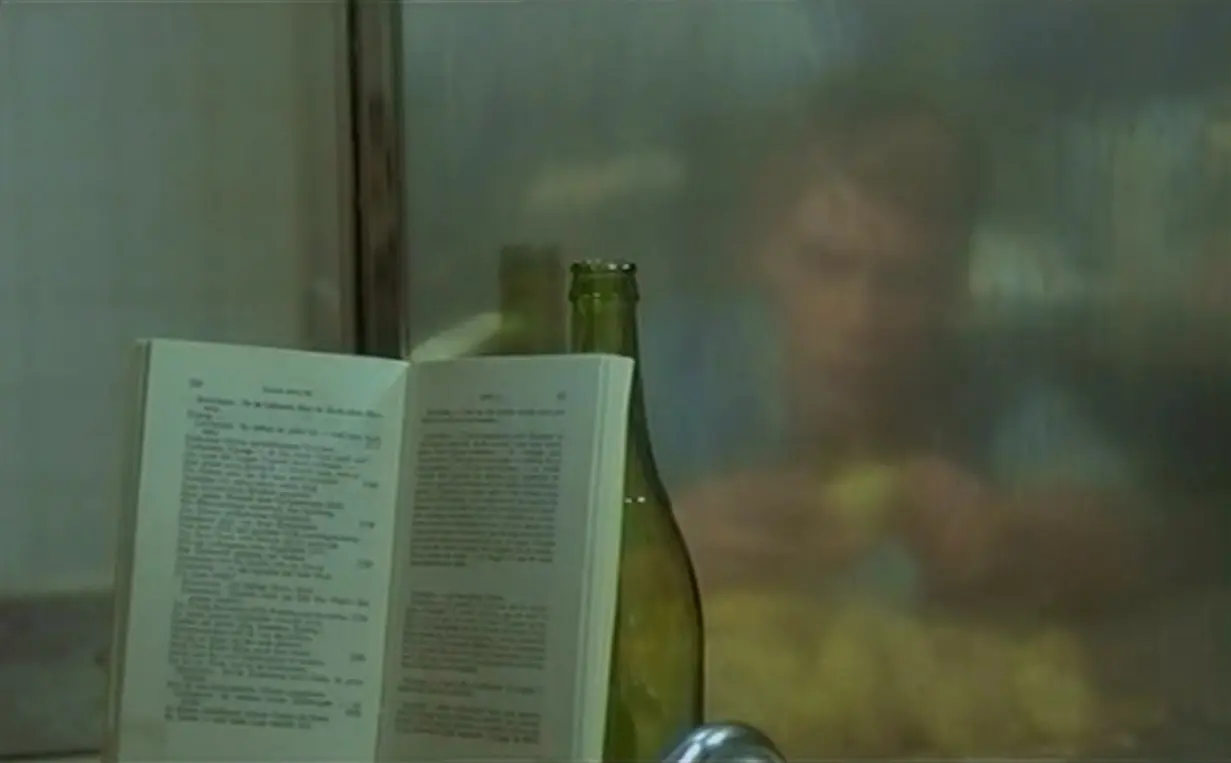
As we near the film’s conclusion, Biette’s use of chiasmus falls away and is substituted for that of assonance, one that threatens to efface the characters. This is most apparent in the conflict between Dorothée and Martine over the role of ‘Dirty’ in Bataille’s Le Bleu du ciel. We can neither unhear the name ‘Dorothée’ in the nickname ‘Dirty’; nor can we consider the fact, without being ‘carried away’ from the theatre into Bataille’s text, that the actress and the character herself share the same proper name. Biette resolves this conundrum in a brilliant jump cut, one of his finest, depicting the two actors saying the same line of dialogue, ‘Troppmann’, at the same time, and in different places. Somehow, without hearing anything, Dorothée is able to feel Martine take this word out of her mouth. This is the pivotal moment that culminates in the climactic scene where Dorothée recites lines from Racine’s Athalie while staring into a mirror. What occurs in this extended scene — the first time Dorothée has recited any lines of a play — calls back to an earlier scene where the troupe listens to Hermann recite lines from De rerum natura in the midst of an abandoned industrial wasteland. Here, the theatre itself has been ‘carried away’ outside of itself by the camera and we find ourselves alone again with Lucretius. Hermann certainly isn’t being carried off by the text; in fact, he hasn’t memorized his lines. The world outside the theatre may well be as empty and unsurvivable as the Ivry wasteland site would purport. But Biette’s camera is more interested in the ‘matters’ of the world than invoking the confinement of the theatrical space. Rather, he might simply be telling us that the theatre is already colder than the world, cold enough for winter jackets, and may itself be a kind of tomb.
Original illustration by Kate Sianos
Notes
See Jean-Claude Biette, ‘Cinéma = Théâtre’, Cahiers du cinéma, Hors-série, 12 (1982), pp. 84–87.