Jean-Claude Guiguet’s La Visiteuse (1981) opens on a woman (Françoise Fabian) in repose on her couch, placid except for the rise and fall of her diaphragm. Her eyes are closed; they open a beat before the ring of the doorbell. When the film comes to an end eight minutes later, these eyes will be on the verge of tears. A visitor will have entered and exited the woman’s chamber, arriving seeking solace and leaving with new resolve. We will know more of this home — the paintings that hang from the walls, the deep red hallway leading to the front door — and we will sense the presence of something anterior and secret. In a 1997 text on melodrama, Guiguet recalls the manner in which a companion’s sorrow affected him, writing of the sadness of a ‘young man who had no idea to what inner region, what melancholy, intimate and secret space, his emotion had brutally thrown me’. [1] With the simplest of means (two women in an apartment, découpage, a song), La Visiteuse sounds this depth. A little sonogram of a film, it makes this hidden interior present in the visible just as tears may indicate the torsion of the soul.
What transpires in this chamber drama? The doorbell signals the arrival of a woman draped in white (Héloïse Mignot) who stings from heartbreak. The visitor’s movements are impulsive and sharp, led by a too-present emotion. The visited woman maintains the composure conveyed by her initial pose. Facing her wounded friend, she comports herself as one who has long since completed her sentimental education: just wait, she advises, the passage of time will soon irretrievably strand your emotion in the past. The visitor gains some resolve from this counsel and departs. The visited puts on an Edith Piaf record and stares out the window, now in the grips of an obscure emotion.
The idiom of La Visiteuse is theatrical, but the chamber is not rendered as a stage. Guiguet gives us no establishing shot, only delicately modulated articulations of presence and absence. His découpage volumetrically discloses the space and, in tangent, the visited woman’s hidden interiority. Woven of glances, touches, and strides, the encounter gradually reveals the room: the visitor’s turn away from her friend shows the window, we glimpse a cabinet from the latter’s pensive steps towards the door. Rarely do the women share the same frame for long; the encounter ebbs and flows between contact and the irremediable privacy of emotional life. Although the friends somewhat exchange states — the visitor departs consoled, the visited is shaken — the film demonstrates less the transfer of emotion, the possibility of communion, than a resonance in the visited woman’s solitude. [2] A simple camera movement accentuates this seclusion and alerts us to the stirring of something hidden. When she begins to recall how she once recovered from heartbreak — ‘It’s like a distraction. One day, without knowing why, you forget your pain as if you never felt it’ — Guiguet dollies to a close-up of her face, its expression bearing the knowledge of time accumulated and lost.
The tracking shot that brings La Visiteuse to a close reiterates this movement towards portraiture but begins from the far side of the chamber, still for nearly two minutes before tenderly approaching to find her face illuminated by a cold light from outdoors. Here, for the first and last time, Guiguet gives us an expanded view of the room as she puts on a record and handles a photograph or postcard we are too distant to make out. To reassure the visitor, she predicted that they would soon lose the ability to mourn their lost love and would instead ‘feel a great emptiness’. With this last shot, we see it is this emptiness that Guiguet’s découpage has been articulating: the chamber of a solitary woman, artifacts of a life that is perhaps no longer lived.
A sound from beyond the chamber begins the film, another brings it to a close: the faint honk of a car horn from an off-screen street. Like the footsteps so prominent on the soundtrack and the song by Piaf, these sounds reverberate through the volume of the room, sounding the hidden interior evinced by Fabian’s visage. We don’t know what exactly brings the visited woman to the edge of tears — from the door to the window, the film carries us to thresholds we don’t cross, indicates privacy without exposing it. As we hear the horn, Fabian glances away from the window and towards the only region of the chamber that Guiguet’s découpage has left out of frame — a glance with no object, a secret movement of the soul. Jean-Louis Schefer once wrote of a solitary, hidden experience of cinema that touches ‘an unexpressed part of ourselves: the part given over to silence and to a relative aphasia as if it were the ultimate secret of our lives’. [3] There are few films that limn this region so well.
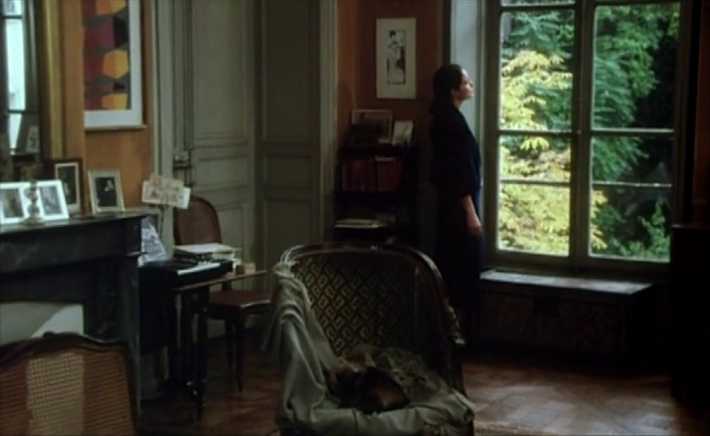
La Visiteuse (Jean-Claude Guiguet, 1981)
Notes
Jean-Claude Guiguet, ‘The Gift of Tears’, trans. by Jhon Hernandez, https://theluckystarfilm.net/2024/10/28/translation-corner-the-gift-of-tears
In his text on La Visiteuse, Joachim Lepastier gives a lovely account of the ‘ineffable vibration’ that resonates through the film. ‘La Visiteuse’, Foco, 2 October–November 2010, https://www.focorevistadecinema.com.br/FOCO2/lepastier-visiteuse.html.
Jean Louis Schefer, The Ordinary Man of Cinema, trans. by Max Cavitch, Paul Grant, and Noura Wedell (Semiotext(e), 2016), pp. 11–12.