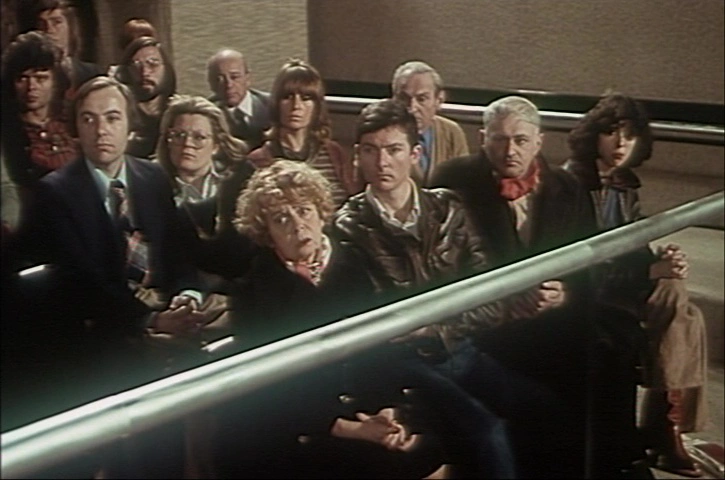
A freedom-promoting, discordant film culture necessitates the dissemination of illicit material. Movies that can only be found on private servers, with low resolution and crunchy sound. After losing its status as the primary mass medium, cinema is now the discrete interest of those who want direct access to difficulty and confusion. Meanwhile, the reasonable majority enjoys things that conform to common sense. Between the two groups forms a feud of interdependence. After all, there would be no potential for freedom without some pre-built abstractions. And the generation of useful abstractions in the first place requires a lot of surplus, failed remarks that don’t quite map to any commonly agreed-upon thing.
So those who prefer unproductive confusion make noise, some of that noise turns out to accomplish things, the accomplishable-noise creates structure, and the confusion-lovers once again undo that structure. It’s this undoing of structure that interests me. That negative reason of film and art, which always depends upon the inversion of some pre-existing just-so story. Film culture is no longer about fusing things into a whole but about furthering the splintering of understanding. We seek out movies like La Machine that take on the series of spectating, interviewing, and broadcasting we all go through to understand an event that breaks up the familiar flow. Vecchiali does not just film this series; he refilms and refilms and continues along the chain of all possible images. Because we are not trying to get back to any original reality or authentic event, we’re circling it, getting as close as we can without ever claiming finality.
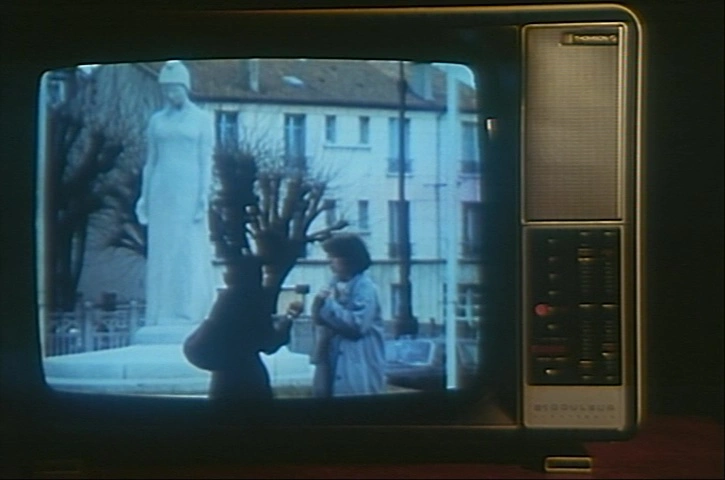
La Machine (Paul Vecchiali, 1977)
The movie presents us with a classic breakage of the familiar: a child’s murder, its discovery, and the execution of the murderer. But this presentation is not accomplished via common narrative logic. It uses an inverted apparatus. Every standalone shot showcases a whole moment, and these moments do not link in an arc that satisfies. We peek at a bar through its storefront panels, surveying the action at a cold remove. Series of interrogations, interviews, and visits to the crime scene all proceed deliberately, but not necessarily. Everything is clearly purposeful, but without a clear final purpose. There is a verticality to these images. Rather than serving as pieces of one continuous horizontal melody, shots serve as counterpoints. Some shots even provide a counterpoint within the image itself, like those of a television that take up much of the film’s center. These television news segments in particular get at the possible sociological reasoning for Vecchiali’s formal choices. Just as much today as in 1977, we parse the ostensible pattern of our world through video. And in a world still reeling from the invention of color television, filmmaking requires filmmakers willing to cut conventional montage’s continuously refreshed flow into discrete images.
How to read a film made correctly, discontinuously? By constantly pitting what is photographed against its framing. What ought to be filmed always resists figuration. And none of the consciously durational, lingering moments in La Machine provide us with any insight into the character of our murderer, Pierre. Because you don’t get reality for free. No clear, understandable arrangement emerges simply from the onscreen presentation of something. In fact, the film promotes the view that the only way to evoke what is true and real is to generate distance. Distance from a shot to its referent and distance from one shot to the next. La Machine does not just criticize and complicate things through this distance; it does have positive qualities. The film generates freedom, and it occasions disinterested thought.
La Machine possesses the prime characteristic a movie should have: it’s heterogeneous. And every shot is autonomous; they run up against each other. At every moment, Vecchiali furthers discontinuity and thereby critiques conventional reason. In the end, we do not feel that we have experienced the culmination of anything. It’s all a set of attempts at action. And these attempts result in a frightening feeling of uncertainty, one that is necessary. A good film plays with the most extreme limits of our understanding. And it’s only at the threshold of common sense that shot selection and the arrangement of actors in the frame can start to become worth watching.