Anna Tümmler’s painting is never shown. She is the daughter of Maria Tümmler and a painter of landscapes in Jean-Claude Guiguet’s pastoral, Le Mirage (1992). Standing at her easel, she interacts with her visitor at the stairs. There are drawings and etchings on the wall behind her. Forgoing convention in their mother-daughter relationship, Anna tries to show her painting to Maria, ‘It’s Trees in the Wind,’ Anna says, giving a title to her painting, which we never see. ‘Ah, that should enlighten us as to your intentions!,’ remarks Maria. What is absolutely key is Maria’s deciphering: ‘So, the strokes with the green spots on the gray background are trees… and this swirl that rises and uncurls is the wind.’ Maria is confused. She stares carefully and lovingly to make sense of her daughter’s effort. Anna strives to make her mother see. Has she lost her sight? Did she see clearly to begin with? Similar questions will occur to Anna and her brother throughout the film.
Anna tries to elaborate on Maria’s emotional connection to the spring, telling her, after a jaunt to the meadows: ‘To me, nature is a pretext.’ Maria Tümmler seems to daydream about the romance of art and its illusory smells — ‘A bouquet of lilacs, for example, so real that we smell their scent.’ Anna is clearly well-studied and well-disciplined, an artist of the concrete. Guiguet ricochets between these two, but only in an image-discourse. He never sides with either character. In this discourse, the viewer is pushed to further emotional heights until Maria’s fraught romance with her son’s English teacher, Ken Keaton, is clarified by the film’s ultimate miracle. Until then, things like the scents that Maria speaks of seem to be all that is on her mind.
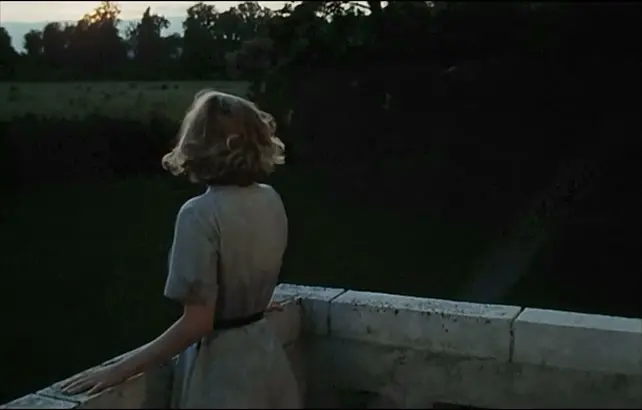
Le Mirage (Jean-Claude Guiguet, 1992)
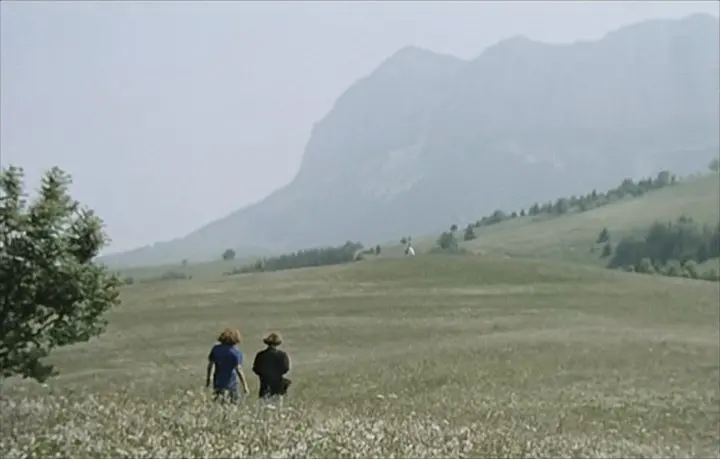
If music is the supreme voice, Guiguet’s camera movements remain simple — cuts are scarce, the montage is legato. The mise en scène is either well-cultured or well-horticultured. Anna’s studio is made vibrant by fades to the meadow where thistledowns fall like heavy snow. Many corners in the Tümmlers’ house are adorned with expensive musical instruments and artworks. Guiguet’s cinematographic language is carefully considered, but unimposing in the camera’s framing of the characters, who are taking part in his scenario–exercise in opposing social standards. Edouard, Anna’s brother, is left lonesome, but the siblings do intermittently work together to oppose Maria’s romance. Edouard tries to fire Ken from his tutoring: ‘A total fiasco!’ Then, after a walk in the meadow, the Tümmler family encounters him at an upscale party. Maria’s fate is sealed — her run-in with Ken becomes too much and she goes home with Anna. Unable to contain herself, she smirks with glee and speaks in riddles about the spring, which she alluded to in the film’s first dialogue: ‘I really belong to the spring. Every spring, the season smiles just at me.’ Guiguet stages the scene to both exhibit the quiet of the Tümmlers’ French countryside existence and the grand expectations that Maria holds for the season. The Tümmlers do not know of her endometrial hyperplasia, or the love she will experience, the history lesson–dinners with Ken, who sets Maria’s heart forth. Maria is presented in this scene through a tracking shot; when the camera stops at a moment where she seems to realize something, there is no rhetorical exaggeration through a cut or a charged movement. The silence is enough. To listen to one’s characters in one’s cinematography is always enough. But now there is a challenge for the découpage: how is Maria beckoned to love in her seemingly aimless state? Guiguet’s solution is to use music as a doorway when the space does not have one available. Someone beckons to the Tümmlers in the distance, and though the trees standing between the two parties might form a kind of passageway, merely using them like this is still too tenuous for Guiguet. The wafting entry of the second movement of R. Schumann’s Symphony no. 3 thus allows for a threshold which is not there.
Through Louise Marleau’s performance as Maria Tümmler, Guiguet establishes huge expectations via basic means. The actor has to make absolutely clear her character’s love for Ken Keaton — she has to make decisions in her performance that will enable her to exhibit devotion. In a pivotal scene where she announces her love, seemingly to nobody but herself, alone in a room, she turns from the stereo and laughs in terror. Drunk with infatuation, she has to recollect herself by taking refuge at the window. Her eyes do not search for anything. She braces herself — ‘I want to believe, believe in nature’s gifts of well-being, in this beautiful springtime, in this overdue awakening.’ Maria steps down from the window, but the framing obscures the fact that this is a door that leads to the balcony. Louise Marleau moves through this passageway with such emotionally drastic but physically ethereal composure, that we can be certain that Maria has found devotion, faith in love.
How can Maria’s devotion — to a much younger man — manifest at her age, with her children who are young adults? If she cannot know that Strauss and Guiguet have conjured the mountains of Burgundy for her, if she cannot be of sound enough mind to know of her failing endocrine system, and that her children plot against her, how can she hope to come to terms with her ecstatic state? In a more conventional film, the love between Maria and Ken Keaton would break apart the bond of the family. Instead, Guiguet stages a battle of interiority that can only be expressed in nature and song. The Tümmler family has only the weapon of faith to combat the unknown.
Turning from Le Mirage to Guiguet’s first film, Les Belles Manières (1978), produced by Diagonale — notably, Le Mirage is not a Diagonale film — one finds the same emotional charge in Guiguet’s soundtrack and mise en scène. Here, Emmanuel Lemoine, playing a young, working-class boy named Camille Maillard, is a blank character. He expresses no dismay or ecstasy either for Hélène Courtray, the bourgeois mother who houses him with a vague kindness, or for Pierre Courtray, Hélène’s hermit son, who is the occasional object of Camille’s curiosity. Both Courtrays are oddities to Camille, who, despite his age, has travelled, worked, toiled. In this, he is not dissimilar to Le Mirage’s Edouard, who has experienced the brunt of the loneliness caused by his family’s move from Germany to France, a loneliness which extends to his own academic pursuits. This pairing of a motherly figure who is sent careening through a dreamland and a young, shy, lost boy forming a balance between life and death forms a thread through Guiguet’s films, including Faubourg St. Martin (1986), his first work outside of Diagonale.
Guiguet was a filmmaker who worked with better and more original scripts as the years passed and, as he moved on from Diagonale, his experience and resourcefulness eventually allowed him to make a film like Les Passagers (1999), which abandons the linear narrative structure. The film uses long observational scenes to great effect. Véronique Silver plays ‘La Narratrice’, breaking the fourth wall by speaking to the camera about the Saint-Denis–Bobigny streetcar, and engaging the viewer’s attention in a way that is new to Guiguet’s filmography. This film frequently tries new approaches to scene structure, such as when a young girl (Isabelle Gruault) attends her neighbor’s funeral at St. Joseph’s church. This scene stands out in Guiguet’s oeuvre, using a long, distant, observational take to follow the funeral, with the camera taking in the event more patiently than the characters. Guiguet’s camera helps to establish Gruault’s reckoning with this irregular scene. ‘I never saw anything like it. And I almost stayed in bed!’, she says with admiration. Guiguet always seeks to learn more about his character’s interpersonal interactions, moments that define a normal life. In one of the film’s most memorable scenes, the great Jean-Christophe Bouvet, riding the tram, blabbers on (and on) about all sorts of sexual experiences — he calls his discourse ‘sexology’. A neighboring passenger listens and looks about for an escape, while another one sits at Bouvet’s back, seemingly uncomfortable. In a sequence of shot/reverse shot between the listener, who sits across from Bouvet, and the uncomfortable man, the latter, after much shifting, cedes this seat of cursed conversation to a businesswoman, thus escaping the tram. In scenes like this, Guiguet finds comfort in elaborate but elementally simple personal dramas, fashioning small creative solutions to questions of mise en scène, and so resisting the technical and budgetary inflation that overtook French cinema in the wake of Leos Carax’s Les Amants du Pont-Neuf (1991). [1]
Before Les Passagers, Guiguet made a short film for an anthology called L’@mour est à réinventer (1996), titled Une nuit ordinaire, in which a gay man rides his bike to see his lover, sick in the hospital with HIV/AIDS. On his bike ride, he sings ‘J’ai rendez-vous avec vous’, which is overlaid with Patachou’s rendition, also an actress who features in multiple Diagonale-adjacent films. Again, through a strong performance — Philippe Garziano is completely delightful — framed in a long shot, played against highly emotional music, Guiguet is able to build a distinctly yearning, romantic scene with only one actor, without being garish or obnoxious. Again, just like in Le Mirage, we are faced with a lover on the edge of life and death. Guiguet is an artist who depicts death with the highest reverence. Philippe Jaccottet describes the marvel of moments like this in his book on the poet Francis Ponge, Ponge, Pastures, Prairies: ‘There was a great simplicity and a great force, both of which were integral parts of words, as each also was present in sculptures and monuments. There is no doubt about this when one sees them, in museums, and even more convincingly if they have remained in their original location, bound by iron to the place where they stand… Today, perhaps death has remained as immense, as ungraspable as back then, but no monument, no word, can put itself against it anymore. Perhaps death is, today, the last thing that looks like the gods of ancient times.’ [2] Through the lens of Guiguet, it is death which makes love feel truly grand, amid the mountains of Burgundy, on the streets of Paris, aboard the tram connecting Saint-Denis to Bobigny, in the titular Faubourg St. Martin, at the hotel’s finest and also darkest hour, in the violence of Guiguet’s Les Belles Manières, a mysterious blueprint for a remarkable, underseen oeuvre.
Notes
See Luc Moullet, ‘The Maoists of the Centre Du Cinéma’, translated on The Seventh Art, 29 August 2019 https://theseventhart.info/2019/08/29/the-maoists-of-the-centre-du-cinema/ [accessed October 1, 2025]. Original version in French published in Piges Choisies (Capricci, 2009).
Philippe Jaccottet, Ponge, Pastures, Prairies, trans. by John Taylor (Black Square Editions, 2020), pp. 51–52.