Of course, it’s easier to imagine a lion speaking than a poppy: one has a mouth, whereas the other doesn’t. Still, even if ‘a lion could speak, we could not understand him’ (Philosophical Investigations, trans. Anscombe), because we would have to imagine a lion speaking without being able to picture to ourselves what our language would become in the mouth of a lion: it would be the first thing the lion devoured.
—Roberto Diogini, La fatica di discrivere: Itinerario di Wittgenstein nel linguaggio della filosofia
Danièle Huillet and Jean-Marie Straub’s En rachâchant was filmed during the 1982 summer holidays and first shown in France a year later as a pre-feature short paired with Rohmer’s Pauline à la plage. The seven-minute film consists of twenty-five shots; twenty-three show the interior of a classroom from which the black and white film stock does nothing to dispel the August heat, inhabited in different ways by the four human players: Olivier Straub as Ernesto, Nadette and Bernard Thinus as his mother and father, and Raymond Gérard as his schoolteacher.
The opening credits state that the text is by Marguerite Duras. Huillet and Straub lifted the dialogue for the film from Duras’s book for children, Ah ! Ernesto, and rewrote parts of it. Vecchiali, who produced En rachâchant for Diagonale, claimed at one point that the filmmakers had neglected everything in the book that made it funny. [1] On another occasion, he described the film as ‘very funny’. [2] One could polemically set against this Straub’s denunciation of the separation between tragedy and comedy, which distorts recognition of their simultaneity (one valency of the ‘concrete situation’), and attempt a reflection on an overdetermined difference in humor between Huillet and Straub with their attack on formal hierarchies and Diagonale with its, a reflection that would have to include the register of camp, and could peripherally make use of a comparative reading of Othon and Lionel Soukaz and Guy Hocquenghem’s Tino, but here it is enough to state unequivocally that En rachâchant is ‘violently comic’, to borrow Deleuze’s description, a few years later, of a text that it can only be said Ernesto announced for the French public in the eighties: Michèle Causse’s inimitable translation of Melville’s ‘Bartleby, The Scrivener: A Story of Wall Street’. The comic, as Deleuze writes in this text, ‘is always literal’, and it is Huillet and Straub’s Brechtian literalism that is responsible for the effects that will be gestured at here. [3]
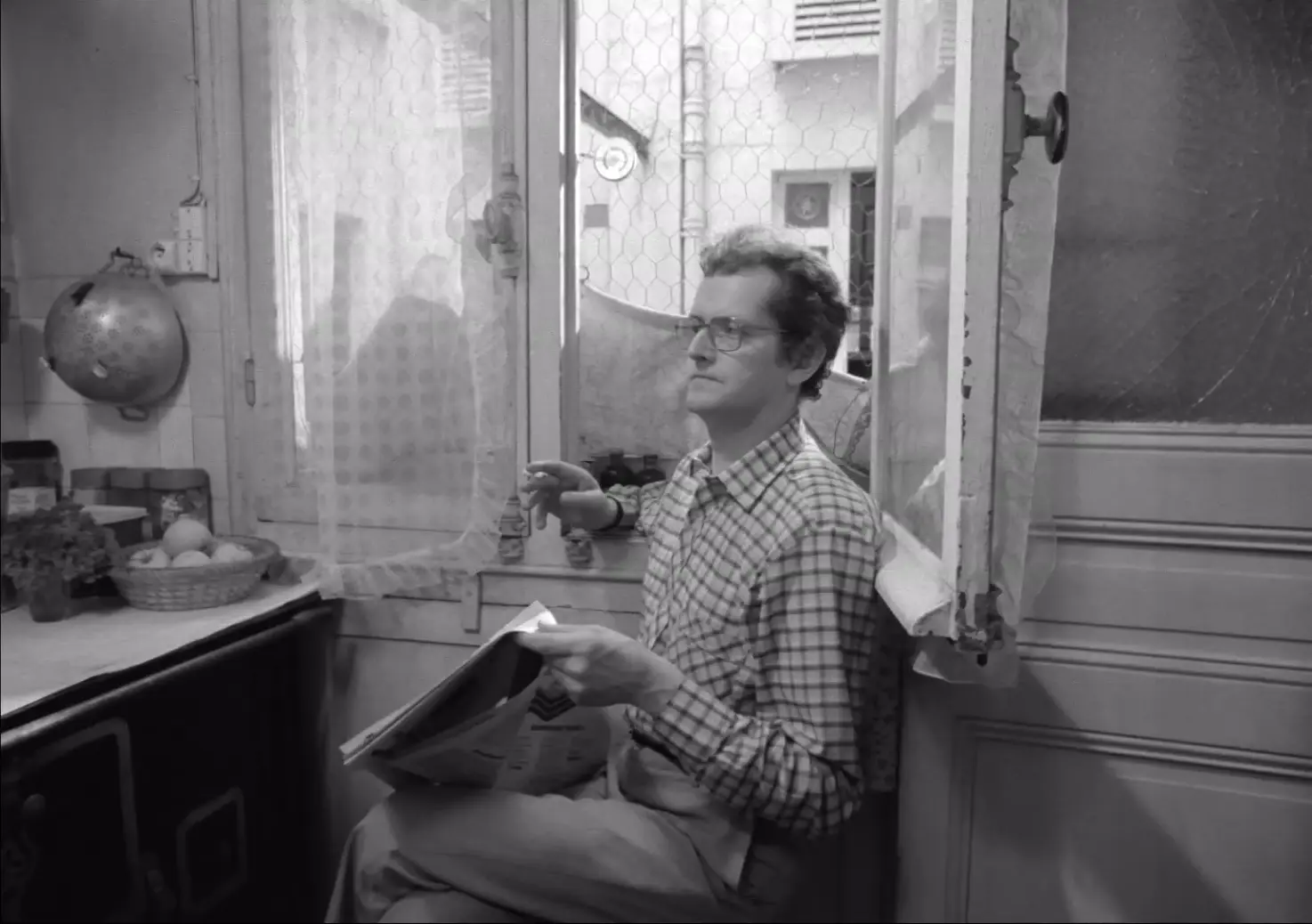
En Rachâchant (Straub - Huillet, 1982)
The first shot of the film shows Ernesto’s mother at the kitchen sink peeling potatoes (a datum from the book); we hear the door to the kitchen open and the camera pans right, including Ernesto in its movement, who has come in to inform his parents that he won’t be going back to school anymore because at school they teach him things he doesn’t know. The pan continues until the camera comes to rest before a courtyard-facing window covered by chicken wire and various other elements, where Ernesto’s father is sitting; he expresses his surprise at his son’s stated motivation by retracting his head until his body forms a sort of question mark. Ernesto sings his text in this scene unaccompanied, as he does once again in the last scene, a hapax in Huillet and Straub’s body of work. The delivery throughout the film is unlike in any of their others, at least the similarities are not what is being emphasized: the severe Luftpausen notated against the grain of the text’s syntax are absent, and the citational relationship to the sources that the filmmakers explicitly began with has taken on a different value here. Ernesto’s sung lines, the 3/4 rhythm with which he makes the statement that gives the film its title, and the two unison lines pronounced by the parents after turning to look at one another clearly identify this film as a musical (the intro/outro music, from the moment in Moses and Aaron when Moses returns from the mountain with the Tablets of the Law, is not the only other element that anticipates their 1996 film of Schoenberg’s one-act comic opera, Von heute auf morgen).
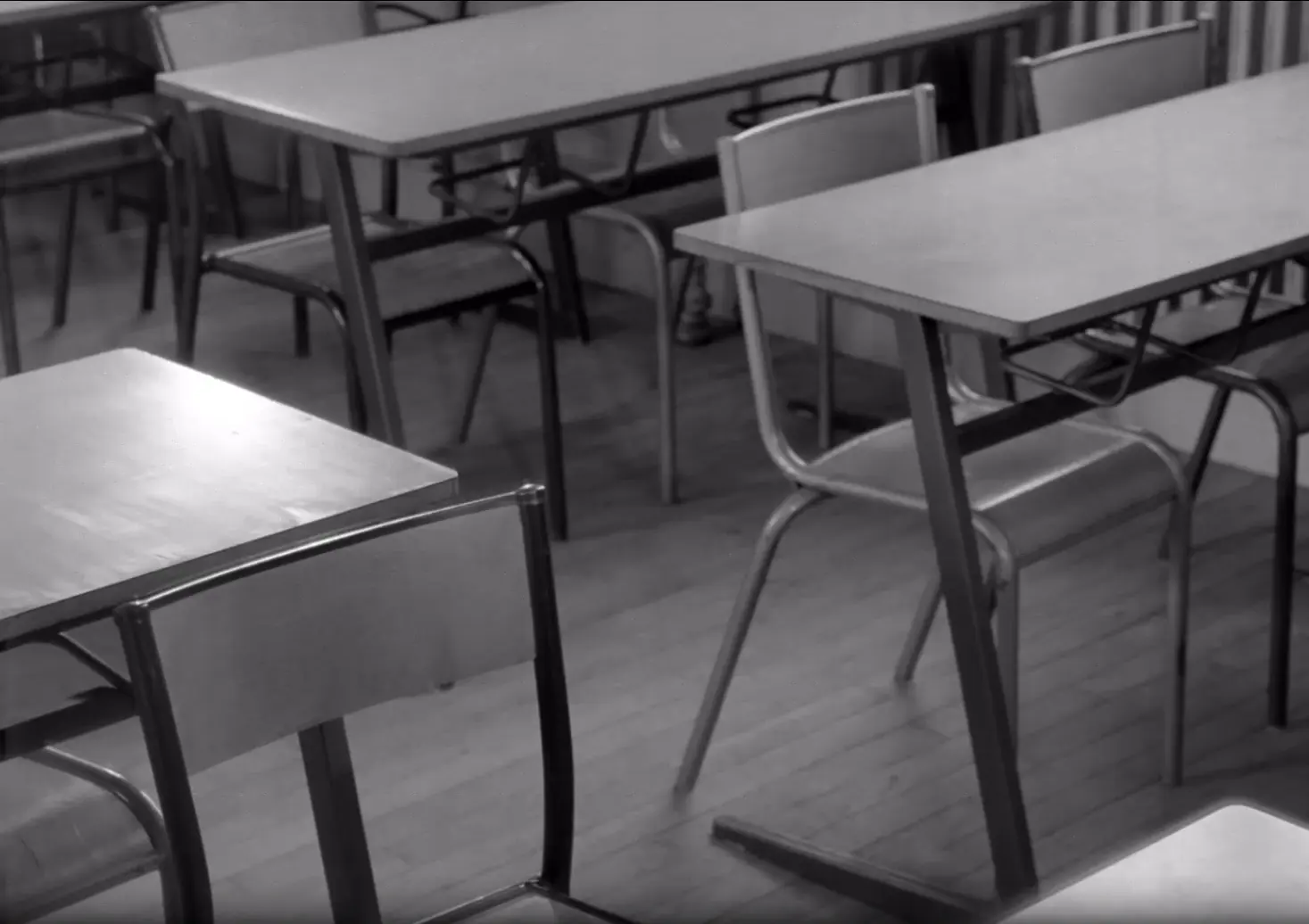
The following shot introduces Ernesto’s teacher at a door to the school, his body posturally superimposed on that of the father (neither will get further than this quizzical attitude), and the remainder of the film unfolds inside a classroom, where Ernesto is interviewed by the teacher in the company of his parents. The camera is placed here according to Huillet and Straub’s signature gesture: in one spot from which all the shots of the given space will be taken. Changes in lenses allow re-framings along the same axis, and like in Moses and Aaron, the height of the camera also shifts (but not inhumanly this time). One influential object remains outside of the frame: the teacher’s desk sits on a raised platform such as these classrooms used to have; its presence is felt only in the sound and the drop in height of the teacher as he steps off it, and perhaps also in the last, high angle from which we see Ernesto, which appears just before the teacher stands up behind his desk, and corresponds to the two characters’ increasingly frontal antagonism (the interposed surface of the empty desk is itself shot on the filmmakers’ preferred diagonal, and would reappear as such in the scene in Class Relations in which Karl Rossmann is sent away by his uncle). Ernesto’s departure towards the end of the film, by removing one of the two poles of this relationship, causes this angle to dramatically vanish: the tension literally leaves the frame like air from a balloon, and the remainder of the scene is shot on a low angle from the camera’s initial, lower height, so that, as the parents stand up from the school desks where they have been sitting with the other ex-student, we look up at them from the height of Ernesto’s ‘ghost’.
An introductory set of remarks sets the tone of the interview, beginning with the confirmation that Ernesto enjoys the property of being invisible, ‘unremarkable’ in his father’s language (the teacher doesn’t recognize him, Ernesto recognizes the teacher: if we are being supplied with the only point of view from which Machiavelli claimed authority can be correctly apprehended, i.e. from below, here this remains the privileged one; the teacher has been ‘clocked’ like the young Lacan by his companions on the lake, or Roger Dumas’s rabbit hunter; in spite of telling Ernesto to be careful with his expressions, he will say it himself: he is braqué). The teacher first loses patience with Ernesto after the latter points out that school attendance is not obligatory everywhere, shouting, ‘We are here, we are not everywhere!’ Huillet and Straub modify Ernesto’s response to this by one word, turning ‘Moi, si’ [‘I am’] into ‘Si’ [‘We are’], already redistributing his empty, negative power of the ‘quelconque’ — to use the teacher’s word when he admits to the parents that the name Ernesto doesn’t bring any student of his to mind, and against his later opinion that this is a ‘unique case’, when Huillet and Straub telescope Duras’s text again to produce the funniest quid pro quo in the film.
After this begins a language game full of ostensive definitions. The teacher first points to the photograph on the wall of the President of the Republic and asks Ernesto to identify him. Huillet and Straub have availed themselves of the ‘blindness’ of ostensive definitions to elide the reference provided by the descriptive text in Duras’s book (unlike the mother’s potatoes, for instance), where Ernesto, because of his shortsightedness, doesn’t see where the finger is pointing and names another image instead. One thing that happens here is that the figure — as one might say, ‘rhetorical figure’ — of ‘le Nègre/le Noir’ in Ernesto’s still colonial textbook, with the inscribed difference between its language and the language of its ‘frame narrative’, is rendered unto language: the textbook image is refused entry to this film only for its caption to appear in the next, in the name Karl Rossmann gives himself, finally escaping the primal scene represented by his first exchange with the uncle on the boat, where he encountered the truth of the patronym as expropriation — one of numerous indicators that Karl is one of Ernesto’s ‘brothers and sisters’. Locally, the significance of this round of three-card monte with the source texts is that it gives full agency to Ernesto in his reply (‘Un bonhomme’ is arguably best translated in this context as ‘A fellow’): Ernesto-Olivier Straub has made this word his own when he offers it, and as the documentary image that is an integral part of Huillet and Straub’s cinematic production also, like the boy in the Hans Christian Andersen story, necessarily looks transparently through such functional references as ‘the President’, we can be sure in what sense he was using the word ‘recognize’ when he spoke to his teacher earlier. Duras made her own film based on Ah ! Ernesto, then wrote another book extending the fiction of the film, and the droll first paragraphs of La pluie d’été suggest that she in turn learned from and appropriated Huillet and Straub’s reading of this place in her text.
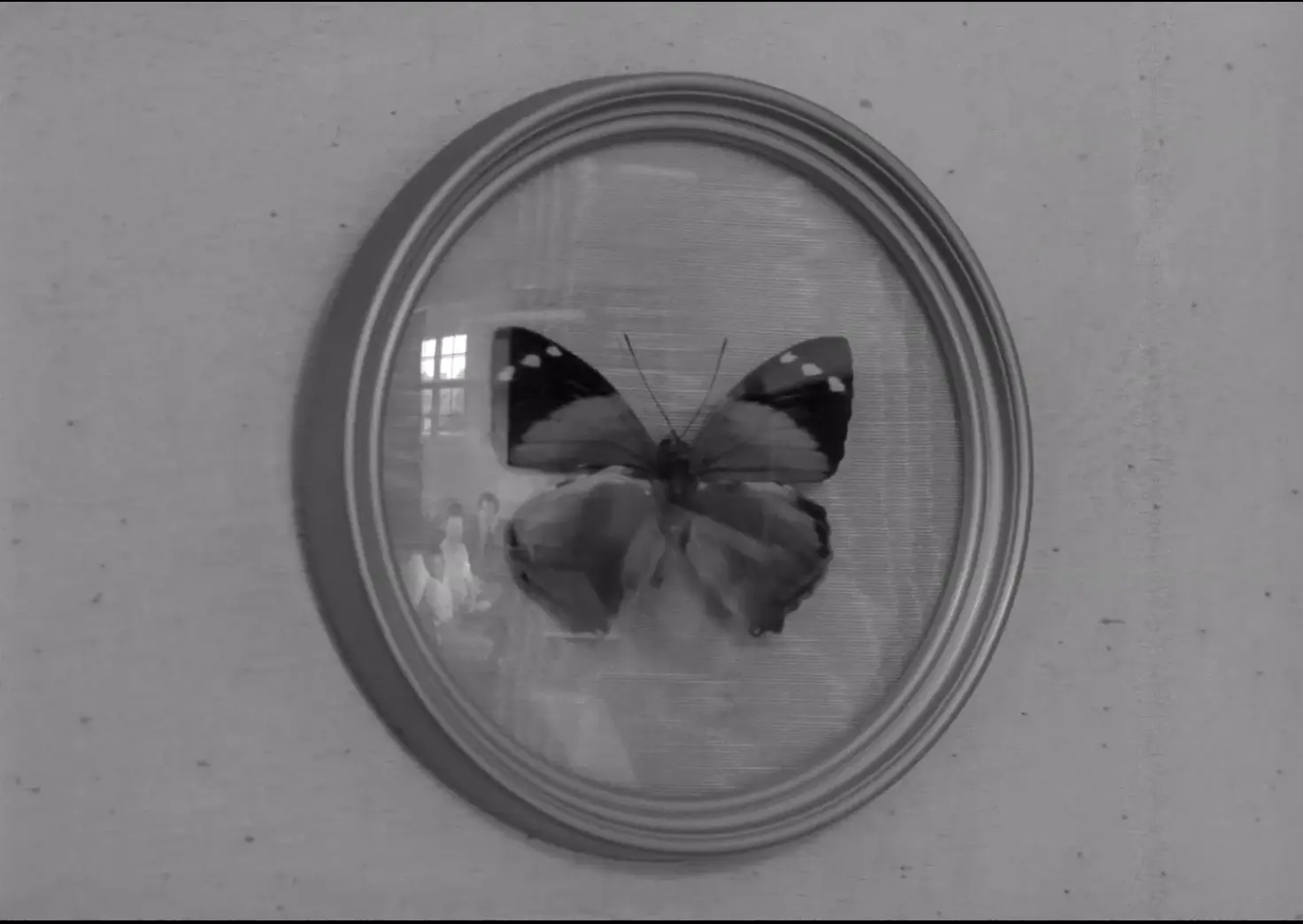
The mother joins in this interrogation of ‘the hydra of the empirical world’, asking Ernesto to identify a framed butterfly on the wall, to which Ernesto (in concert with Huillet and Straub’s Rosa Luxemburg) replies: ‘A crime.’ Finally, the teacher’s hands seize a desk globe as he asks: ‘And this, is it a football, a potato [une pomme de terre]?’ Ernesto replies: ‘It’s a football, a potato, and the Earth [la Terre].’ At this point, as with the harmonies that one hears spectrally in twelve-tone music, the viewer may start to perceive voices whispering like Fidelio’s chorus, ‘Un jour viendra couleur d’orange…’ The sense of mounting triumph within an imprisoned atmosphere is at once the air of that simultaneity that runs all the way through Huillet and Straub’s films and an effect of Ernesto’s relentless redefining of the rules of the game. His ‘case’ is further determined during the interview as that of a child who only wants to learn what he already knows, but where Duras has the teacher ask him how he proposes to do this, Huillet and Straub have him ask how Ernesto intends to learn what he does not already know. The answer in both cases is a chewed-up portmanteau word consisting of rabâcher and ressasser and partly homophonic with cracher, so that one could paraphrase: ‘by rehashing, chewing it over, and spitting it out’. If one can say here that, like Deleuze’s Bartleby, the result of Ernesto’s ‘treatment of language’, an ‘original language within language’, is to ‘[send] it into flight, pushing it to its very limit in order to discover its Outside, silence or music’, in the film, this ‘new method’ is adjacent but not itself the answer to the question of how he means to pursue an educational program that we recognize as that of Platonic anamnesis, which as Barton Byg has recalled, belongs equally to Adorno’s ambivalent temporality of the ‘not yet’ and the ambiguous status of Brecht’s ‘audience’. [4] It is the knowledge that must come into its own as practice.
This is not the place to attempt to follow the faultlines of the cinematic construction of this Outside. Suffice to say that what coincides in practice must find a double articulation in the artwork, as both external and internal limit. The incandescent power of Huillet and Straub’s films — their irrecuperability — lies in such an articulation, constructing both kinds of incompletion. Their extra-filmic statements and dedications, powerfully anti-hermeneutic, belong to one pole of this. But En rachâchant images forth both poles with concision. The external limit appears, as it does over and over again for them, in the image of the open window. When Ernesto stages his walkout, it is into the space indicated by the window left wide open at the back of the room, letting some air into this imaginary midterm with a real summer’s day in it. The ‘reveal’ of his shirt hanging out the back of his pants is as noble a joke as anything by Chaplin. We must imagine that he vanishes over this threshold into the blinding Eastman Kodak color of Empedocles’s ‘school of freedom’ (Straub) like Dorothy into Munchkin Land. [5] Meanwhile, the hysteria his poietic speech momentarily provoked in the teacher, like Bartleby’s in his boss, has gone the way of the chewing gum Ernesto took out of his pocket and effectively started chewing. The teacher can only admit that Ernesto is right that he will ‘inevitably’ learn everything the school is designed to inculcate in him because school, like the artwork, is only a monad — it is not the source of the authority it performs. Ernesto goes out into the world far more like Nina in Althusser’s famous reading of the Piccolo Teatro’s production of El Nost Milan, to ‘face the music’ as it were, than the strongly contrasting hero of Duras’s own film of her book, who provokes an evangelical stupor in his teacher: the immediate effect of his words is the suspension of the authority of the institution of the school, and his ‘news’ is spreading like wildfire by the time the film ends. If Huillet and Straub’s Ernesto, who is just as ‘inseparable’ as Bartleby from the world he effects, bequeaths the only subjective point of view in their filmography precisely by leaving it vacant for the viewer (Huillet would suggest calling the position of the camera over Karl Rossmann’s shoulder a ‘brotherly point of view’), and that after exiting via the window like Johannes in Ordet, so as to go where the viewer, as a viewer, cannot follow him, it is because he is ultimately, like his namesake in Oscar Wilde’s play, an alibi that no official record can render univocal. [6]
The other limit can be said to appear in the film metonymically in the shot of the dead butterfly under the convex glass, the omnipresent, unrepresentable center of the cinematographic image, which ‘doesn’t hold’, literally a point de fuite that is not one, a sort of event horizon where all movement, all cause and effect congeal: Byg is once again right to say that the place of the camera in their films is ‘taboo’, ‘sacred’ precisely in that it is included through its exclusion. [7] The glass reflects Ernesto and his two parents (we have not seen yet that the camera can see the father), as well as, with dialectical refinement, a sun-filled internal window. Straub may well have spoken about holding a ‘clean mirror’ up to reality; if we are to speak like Adorno and say that Stendhal’s metaphor of the mirror travelling along the road is already an image of the film camera, this would have to be supplemented with George Eliot’s metaphor of the light held up to the glass, a focal point selectively illuminating only concentric circles of scratches, bending reality around it (Cocteau, who Straub quoted in this connection, in fact once employed a similar image). The hole under the tree on the Palatine Hill where the Roman partisans hid their weapons during the day occupies the same place in the frame at the end of the first shot of Othon. One could borrow from the way Deleuze himself, in the same period as the text on Bartleby, graphed the movement of Huillet and Straub’s films, and say that such inert points mark a lower bound in the way the window marks an upper one. Between, say, history and its ‘lessons’.
Perhaps it is a historical question by which of these ends a film is imaginatively taken up. Ernesto’s signal will always be for a general strike. He withdraws invisibly from a catastrophic spiral whose last rotation on their first home territory Huillet and Straub recorded in the gray tones presided over by the effigy of the tournant de la rigueur, and which is now predictably turning into something even worse. The ‘phantom percept’ [8] of his capacity to effect is indexed in the film by the ephemeral, bifurcating itinerary of a smile that had gone notoriously underground by the time they filmed Von heute auf morgen fourteen years later. Its simplicity indicates the massive proximity of unlived true life to any historical impasse. Meanwhile, on skid row of what used to be called US imperialism, beggars also choose. A cinema in the right hands could program En rachâchant before Scream 5, The Batman, or Jurassic World: Rebirth. On the internet, it could be paired with AJ and the Queen. The filmic, Straub said Renoir said, is ‘a tiny dialectic between film, theater and life’. [9] If one were to transpose Ernesto’s speech into the language of the republic for a comment box, and if more than one person hadn’t taken more than one half of the idea already, one might write beneath the film the following dedication: Au grand jour des sourires de chats enfouis.
Notes
Josiane Scoleri and Vincent Jourdain, ‘Entretien avec Paul Vecchiali’, Zoom Arrière, 6 (2022), 140–172 (p. 153).
Paul Vecchiali, Le cinéma français: Émois et moi — Tome 2: Accomplissements (Éditions Libre & Solidaire, 2022), p. 105.
Gilles Deleuze, ‘Bartleby; or, the Formula’, in Essays Clinical and Critical, trans. by Daniel Smith and Michael Greco (University of Minneapolis Press, 1997), 68–90 (p. 68).
Deleuze, p. 72; Barton Byg, Landscapes of Resistance: The German Films of Danièle Huillet and Jean-Marie Straub (University of California Press, 1995), pp. 239–240.
Incidentally, Brecht and Straub both qualified Hölderlin’s translation as ‘amusing’. Quoted in Byg, Landscapes, pp. 211, 219.
This could be framed as competing interpretations of the mother’s prognosis for her son as a ‘cretin’, which sense of the word one chooses, or the horizon one ascribes to the way he dé-rai-sonne (as Françoise Dolto’s Dominique says, breaking the word into ‘three strongly accented syllables’ [Le cas Dominique (Seuil, 1985), p. 33]). If Huillet and Straub’s tragicomic hero ‘takes himself out’ like Empedocles — it is Causse who evokes Bartleby’s ‘Hölderlinian nature’ — on this point the two filmic Ernestos, one ‘Mosaic’, the other linked by Duras to Ecclesiastes, reflect the distinct values their respective versions of the story ascribe to its neologism: having (and retaining, in Duras’s account) vs. lacking the word (‘O Wort, du Wort, das mir fehlt!’). See Marguerite Duras, My Cinema, trans. by Daniella Shreir (Another Gaze Editions, 2023), p. 328.
Byg, Landscapes, p. 227.
Ibid., p. 177.
See ibid., p. 20.