Once More has just been released, and is just as striking for the power of its subject as it is for the originality of its form: the decision to shoot the entire film in sequence shots. Already Paul Vecchiali has completed two new films: Le Café des Jules, screened last May at Cannes, and Le Front dans les nuages, a television adaptation of a Troyat novel. One comes to think, in the face of this abundance, that only French cinema could offer such a cheerful paradox: at the very moment when the word ‘crisis’ is on everyone’s lips, a tenacious filmmaker is managing to fully exercise his craft as an author–artisan, alternating between commissions and personal films. His high wire act fully justifies this long interview.
Commissioned films
When it comes to commissioned films, I have two very simple criteria: do I want to do it or not? Do I feel capable or not? If I answer yes to these two questions, I go ahead. The only thing that matters to me is the writing. What is writing? It’s someone who speaks to me in a certain way, and who has asked themselves the question: how am I going to tell the viewer this story? In what form? Am I going to get rid of the flashback? The lateral tracking shot which has been so fashionable since the Nouvelle Vague? Or am I going to get rid of, as Eustache said, the backwards tracking shot? There are so many people who fail to realize that a static shot has just as much effect as a tracking shot. As a director, that’s what I think about: systematically in cinema and wherever possible in television. For the sake of honesty, when I commit to making a film, I do it on time and within budget. And anyone who does otherwise is a bastard, as far as I’m concerned. I’ve always said this: there’s a certain amount of money available for cinema, or for a certain channel, and anyone who goes over by three weeks — well, they’re taking money from a friend.
I had just finished En haut des marches and my assistant asked me what I want to do next. I told him: a crime film, a real one. The telephone rang, it was Pierre Grimblat, who said to me: ‘Do you want to make a crime film?’ I burst out laughing, explained it to him, and off we went. I had Cœur de hareng, a crime novel that I’d wanted to make a film of ten years ago with Delon and Nicole Courcel. It’s great to be able to do on television what you can’t do in cinema, or to work in a genre you’re not used to. I always thought I could make good crime films, but people laughed in my face: ‘Oh no, you’re a romantic.’ Now I’m being offered crime films when all I want to do is make a comedy. ‘But you’re not cut out for comedy.’ Pierre Grimblat came up with this magnificent idea of Série noire. And it’s wonderful that someone like Manoubi Larif, for Cinema 16 on FR3, wants to give authors work. Why hadn’t we thought of it before? This idea of giving work to people who love cinema, who have something inside them, while giving them an opportunity to earn a little money, which is not insignificant.
Television requires speed
In television, if you don’t go twice as fast as the people in charge, you’re screwed, the film won’t get made. As soon as you have the opportunity to do so, you have to take control of everything. It’s absurd, because it should be the opposite with a commission, the director should just have to sit in his chair and say ‘action’ and ‘cut’. It actually takes twice as much energy as when you’re your own producer. At a certain point, they start questioning one thing, then another.
When I made Cœur de hareng for television, I arrived talking like a producer. I said: the bar scenes have to be shot in a studio. They laughed in my face. Later, they called me to say the film wasn’t going ahead: too expensive. I asked to look at the budget, took a red pencil, and crossed out the unnecessary expenses, then next to bar’ I wrote ‘studio’. They told me: ‘You’re being stubborn’, so I explained to them that in a bar you can only shoot at night, and that this film would have about ten women who would need to be made up at two in the morning, so I couldn’t guarantee that all the bar scenes could be shot in five days. They asked me: ‘Could you do it in a studio in five days?’ Of course: by shooting in the daytime, in no hurry, which would get rid of the night hours for the crew and actors and save us around four days of shooting. They did the math, it worked out. Strangely, it’s my experience as a producer that helps me when I work in television.
Advance on receipts
I was refused the advance on receipts for En haut des marches, which made me furious. The reader’s reports were rapturous, but the committee wanted to see what I had done. I replied that it was strange that they didn’t know my films, and that in any case I refused to show my previous films, since I had always wanted to break new ground in a different style each time. To avoid being unpleasant, I sent them the first reel of one film for the direction of actors, the third of another for the politics, and the fifth of Corps à cœur for the use of tracking shots. Nobody watched them and I didn’t get the grant. So I wrote to Jack Lang to tell him that the committee was incompetent for two reasons: 1) they didn’t know my films; 2) they declared me unfit to direct even though they thought the script was good. And I added a list of the festivals where my films had been selected, the prizes they had won… He replied: you have the right to apply again. The second time, I got the advance unanimously. Once the film was made, on the day we screened the combined print, I got a call from TF1 telling me: ‘We’ve just read the script of En haut des marches, and we definitely want to produce it.’ I said to them: ‘If you like it so much, come and see the film tomorrow, there’s a screening.’ That’s how it was with television, though it’s changed since. But there’s still this sort of latency: when a project appeals to them, all the staff get together and start talking to you about the first fifteen minutes (it’s an obsession: people mustn’t change the channel at the start), then they get into the details of the budget, and you don’t know anything about it, you just fall asleep. In the end, they tell you it’s too expensive, that the film won’t be made, even though you’ve plugged away at it. On the other hand, if you come armed, you can speak on their level and clarify everything. They’re not dishonest people, but they don’t have hands-on experience.
Production: the necessity of a Method
I know producers who have no method at all; in fact, that becomes the method: drawing up sixty budgets, a new one each day because you’ve forgotten something. So you make progress on the budget but downgrade the project. And the film is bad. Not because it was bad at the start, or because the producer is stupid, but because he doesn’t know how to fit the original project into an appropriate budget. Or because he’s too greedy and wants to take advantage of the overheads. So you start with project X and budget Y: instead of making Y become X, the opposite happens, and it’s the project that suffers. That’s the fatal error. You end up saying: ‘we don’t need this…’ That isn’t for the producer to say, because it belongs to the artistic domain. The role of the producer consists of saying how X will equal Y, and as far as I’m concerned, I’m going to make sure the product sold is the original one. When you downgrade a project, it’s always the spectacular element that suffers: you lie to your financiers, you lose their confidence and you fall on your face.
'Once More': A question of ellipsis
When I wrote Once More, I knew in advance what kind of money I needed to do it. Rightly or wrongly, I think of a change of shot as an ellipsis: the director says ‘cut’, the actors rest, the technicians smoke a cigarette, the next shot is set up and the director says ‘action’ again. Later on, all the production work consists in making people believe that there is no ellipsis: if there’s a break in sound, mixing and post-synchronization will ensure sonic unity. But it’s a cheat, a more or less pleasant, camouflaged lie: the actor has broken his stride and taken up another. For a long time now, I’ve had the idea of playing with ellipses in a different way: in Once More, we go from one year to the next at the rate of one shot per year. So my ellipsis is marked, it’s real. The other problem was: am I in real time or not? The answer is no, and the procedure for marking the change of day is simple: the lights go out and then come back on, just like in the theater. At the same time, I’m either stretching or shortening time. For example, in the wedding scene, I create an ellipsis in the shot: when the doctor goes to fetch the wife, she enters the frame immediately, without having to walk the eighty meters that separate her from her husband. There’s a dramaturgical intent here, which is to say: I don’t care about the wife’s journey.
Economy of shooting
For each sequence shot, I had roughly six hours of preparation and two hours of shooting. So it wasn’t crazy to consider making Once More in ten days. At no point was it a performance; we made this film in no hurry. When people are focused and motivated, you immediately get what you want from them, more quickly than on a ‘normal’ shoot. My budget was fixed, and we kept to it without going over. Everything else came down to technical issues. For the sequence shot to have its emotional impact, we needed two booms, two Nagras [audio recorders], one for playback since the music was played live. So four sound people. Doing sequence shots meant having an assistant to reload the film magazines. And so on, and so on, until we came up with a budget, which we couldn’t circumvent. It was precise and clear: this is how much money we need to make the film.
If I feel comfortable with the sequence shot, it’s because I don’t like masterly discourses and I can’t help but have a will to discourse: two contradictory things within me. My job as director is to make this discourse as unmasterly as possible. Of course, the sequence shot holds the greatest risk for the director, the actors and the technicians. All these fears fight against discourse, and there’s chance and error... That’s sort of my moral code, and the danger of discourse recedes. In La Machine I myself played the role of the lawyer, who had to say what I wanted to say; I took the risk of seeming ridiculous, since I’m not an actor. I’m not saying that I’m a saint because I have these morals, I’m saying that it’s indispensable to me, otherwise I’d be ashamed to hear a discourse that wasn’t put into a dialectic by the style, the discourse of the other characters, etc…
Let’s sing: ‘Encore, encore’
Songs are used situationally in Once More. The wedding song’s function is to prolong, to cast doubt, even to entrap: it’s apparently ridiculous, voluntarist, when in fact it’s an alibi. Why does the camera rise up into the scene? Because I can’t show the ellipse of the figuration in any other way than by diving into it, with the two focal points of the ellipse being the two lovers, in the context of the bourgeois institution of marriage. This is where the film takes place: we see these two households, the camera descends, and suddenly the song becomes aggressive: ‘Encore, encore’. The whole family behind seems to be threatening the couple in front, and one of the two households splits off and goes off on its own. That’s how the shot is constructed, and the song is there to provide a façade; it’s doubly ambiguous, because of what it says. It presents a philosophy of life, which is certainly a lie on the part of the protagonist who is sheltering behind it to commit suicide, and it has the appearance of grandiloquent cinema, whereas it is, as with Demy, its reverse: the horror of the family, cruelty... For me song has always served to extend a universe, an opinion, an idea, or on the contrary, to stand back, take some distance, or even deny a universe. And that comes from the French cinema of the thirties. I’m thinking of Gabin, in Cœur de Lilas, a film by Anatole Litvak from 1931, where he plays the role of a murderous working-class man, in love with the French Dietrich of the time, Marcelle Romée, who committed suicide shortly afterwards. She’s being courted by André Luguet, and Gabin has a kind of anger in his face, as only he could convey, and he comes to the bar, orders a drink, then turns around, and instead of yelling at Luguet, he sings: ‘It’s that bendy brat…’ And all the anger goes into the song. I think it’s the pinnacle of cinema. Except in my work it’s more perverse...
'Le Café des Jules'
It’s a text by Jacques Nolot, although I changed it quite a bit: I added the black character, and there were things that struck me as heavy and repetitive; good for theater, but repetition doesn’t have the same function in cinema. I warned Nolot: ‘I’m going to film it as a love story between Christiane and Jeannot. I don’t want to know what’s going on inside, I’m going to treat it like they haven’t seen each other for a long time, he wants to make love to her, he can’t, and in the end he rapes her.’ Jacques was very happy and the film was made as agreed. If the mise en scène had just remained redundant in relation to the text, it would have been a disaster: the characters would have been unbearable for even a second. So we had to transform them a little and show that, after all, they are a little like us; that they aren’t like that every day, just tonight they’re abominable. This rather old-fashioned idea that the characters must be saved. We play God, after all: we’re the ones who write the dialogues and invent the characters, stupid or unpleasant, and then it’s easy to have our mise en scène go hard on them. In the end, we’re the ones who are stupid, because we’re the ones who created them. Putting this ‘stupidity’, this racism or fascism, into a dialectic is our responsibility, and this doesn’t prevent grandeur. In Le Café des Jules, I pushed the character played by Patrick Raynal towards a kind of childhood, a dream, and Nolot’s towards despair; I pushed each character in a direction that could allow them to discover a certain grandeur, without impairing the horror of the situation.
A question of economy, once more
I knew what I could get from SEPT: 1.2 million Fr. I had 400,000 in the form of shares or overheads from Diagonale Films. So Le Café des Jules had to be made for 1.6 million Fr. It was the opposite approach to Once More. So what to do? An ordinary producer would have said: there are seven characters, get rid of two. I said: we need two cameras, we’ll shoot the film in six nights. It was a challenge, but it excited me, and it gave me a lot of ideas about how to communicate with the people around me. And we did it.
A film isn’t made in the shooting; in my opinion, it’s made in the preparation. I’m perfectly happy for Bresson to do two hundred takes, for Demy to shoot with considerable means, but what the hell are the other filmmakers doing? They don’t prepare. My advantage over them is that I move forward at the same time as the crew. When I’m writing a script, I very often call Georges Strouvé, my cinematographer, to discuss technical problems, and I have the actors I’m writing for read it — I have this disease of writing for specific actors, and I want to know right away if they’re on board — so that when it comes time to shoot, everyone’s more or less on the same page, even if I’m the one making the decisions. I worry that directors waste their time explaining the film to the technicians and actors during the shooting, when this should be done beforehand. Maybe actors and technicians need to invest themselves in a project, even if it means taking the risk of starting work on a film that might not be made…
Sequence shot
Shooting with two cameras and in sequence shots poses problems, of course. First, there’s memory: you have to know your lines all the way through. Then, placement. So you need to remember two things: words and placement. With two cameras, there’s no room for screwing up — if an actor isn’t in the right place, they’ll block their fellow actor, either in one camera or the other. It’s ten times more precise than in the theater, where it doesn’t matter too much if an actor is a little in the shadows. In cinema, you cover up. Brigitte Roüan jumped into the shoot of Le Café des Jules with both feet. She said to me, ‘What if I forget my lines?’. I told her I didn’t care. And she used her anxieties very intelligently, because she has moments of pause, moments of reflection that she channels into the character, and it’s very powerful. I’d watch her during a take and think: shit, she’s forgotten her line, and then, bam, she’d deliver it, like the great actresses do.
I never did more than three takes, and when I did more than two it was because of a technical error. Usually, the first take is the right one, and often there’s no need to do a second one. I prepare a lot in advance, but without the actors, because that interferes with the sequence shot, with that marvelous kind of fishing for chance. Capturing the moment…’
Head and legs
My head’s in the thirties and my feet are in the Nouvelle Vague: I’m definitely somewhere in between. This was obvious as early as Les Ruses du Diable (1965): a totally imperfect film, because it was torn between cinephilic reflection and a popular drive. That’s why it was so misunderstood when it came out. It took Truffaut and Rivette to get it back on track. I remember that Eustache and Jean-André Fieschi, who were my best friends, wouldn’t speak to me, it was a disgrace. Then came the reversal, as often happens. I myself was coming to the conclusion that I’d made a mistake, and then I thought about it: we were in the middle of the New Wave and I was throwing a spanner in the works by being torn between my origins as a spectator, which pushed me towards the French cinema of the thirties, and the contemporary cinephilic reflection of the Nouvelle Vague.
The question of censorship
For Once More, I’m expecting the worst: there’s already been a problem with it being banned for under-18s. The reason? ‘A pernicious film’. I told the members of the censorship committee that they were ‘pernicious’ for approving what Depardieu does in Tenue de soirée for all audiences and banning what Jean-Louis Rolland does. I understand they had a reaction to the film, and in absolute terms I can’t dispute the committee’s decision, but in relative terms, I can’t help thinking of films like Prick Up Your Ears or Tenue de soirée: why ban one and not the others? The ban was lifted and now only applies to under-13s. That’s less of a problem, because the 15–18 age group is fantastic for this film.
The question of audiences
When we made La Machine, Jean-Christophe Bouvet said to me: ‘But 95% of people don’t behave like that.’ And I replied: but it’s precisely that 5% that interests me, on the screen and in the theater. Too bad if it’s only 5%. I’d rather have 1,000 truly passionate viewers, like those who write me letters (and I get a lot, a number disproportionate to my success, with poems, drawings) than… But I hope for more. When I made Trous de mémoire, I didn’t care if it only got 5,000 admissions: it’s not a spectacle that could appeal beyond a small circle. But why not make spectacles for 5,000 people in Paris, or 20,000 in the whole of France? All the same, Trous de mémoire has already made back three times its cost, with admissions, sales, SEPT. It can’t be called a commercial aberration. But obviously for Rosa la rose I expected — and had — more viewers. When I made Corps à cœur, I also expected a minimum number of viewers and I would have been disappointed only to get 5,000 admissions. I got 50,000 and I was unhappy, not for myself, but for the system’s failure: in Italy the film had 300,000 admissions, it found its audience, and I think it should have found one in France as well.
I don’t write for the greatest majority, but if what Once More has to say isn’t heard by as many as possible, what’s the point? UGC, who are distributing it, are fighting to make sure the film reaches viewers who perhaps wouldn’t go of their own accord, without this effort. It’s more important to communicate with those who aren’t already convinced. This film contains a discourse that isn’t heard very much, and that in a certain sense is never heard. And one that could help spur on communication between people.
Don’t live in fear
1978–1987: I think it was in this decade that everything happened: we went from the height of sexual liberation to the brick wall we face today. What scares the hell out of me is that ten years ago, close contact in the metro wasn’t a problem, and today everyone is afraid. Not of catching something by touching the clothes of the person next to them, but of having any kind of contact with them at all, even accidental. You used to be able to talk to someone without seeming aggressive, and now suspicion has returned. I want to hear myself say to them: ‘Don’t live in fear’, like in the song in the film. The consequences AIDS has had are disproportionate to the scale of the disease, however serious it is. I’m more afraid of the moral order that has come out of it than AIDS itself, which is no more of a threat than car or plane accidents. And who has stopped going on planes?
Cahiers du cinéma, 411, September 1988, pp. 19–21.
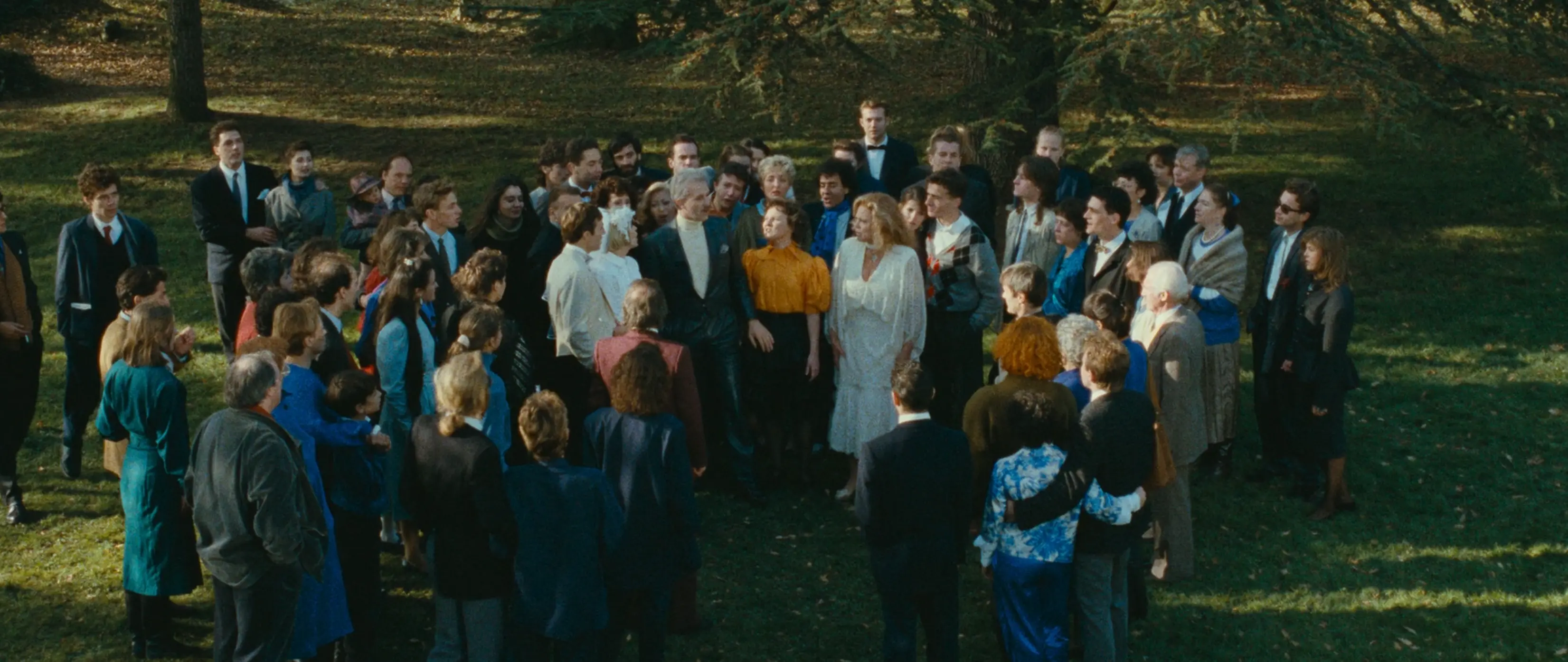
Once More (Paul Vecchiali, 1988)