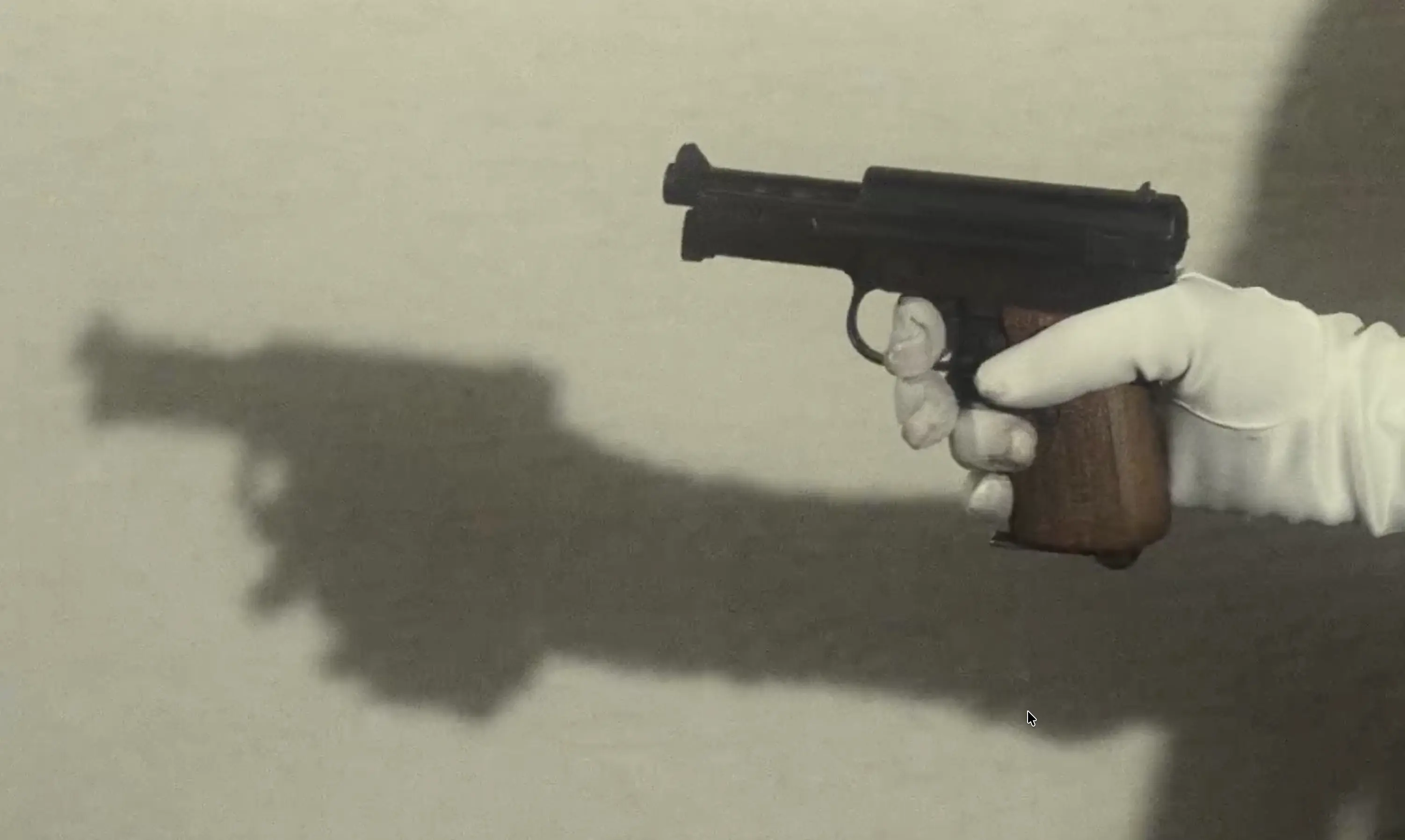
Change pas de main (Paul Vecchiali, 1975)
De rerum natura
It would be easy to arrange, out of the first few minutes of Change pas de main, one of the litanies of binary oppositions dear to academic film studies. The white of a gloved hand pulling a trigger, the red of the blood pouring out of the bullet wound. Faceless bodies and limbs, then a close-up of an anxious Hélène Surgère. The 35mm color stock of the film proper against the rough grain of the 16mm black and white film within the film. The profile of a mustachioed Jean-Christophe Bouvet, flipped to its mirror image in the next shot. Man/woman; body/head… even Roland Vincent’s score, which seems to be two pieces of music discordantly superimposed. And above all, the title itself, or rather the film’s two titles, since the title card shows the letters DE and MAIN thrusting towards each other, giving us, in alternation, Change pas de main (Don’t Change Hands) and Change pas demain (Don’t Change Tomorrow).
Much more important to Paul Vecchiali’s cinema than these analytic divisions, however, is the force of a unity that can encompass such heterogeneity. Whenever the subject of Change pas de main came up, Vecchiali trotted out one of his bon mots: ‘For me, a dick is like a nose or a finger, I have no problem with it’. [1] The general rule: ‘Films are like rivers that carry all kinds of elements. For me, the richness of a film is above all its vigor, regardless of whether it also carries dirt and filth.’ [2] What must have interested Vecchiali when Jean-François Davy approached him with the proposal to shoot a porn film was the prospect of charting a Vecchialian river that could carry the content the genre required. As he pointed out, change pas de main is what you say to someone giving you a handjob when you’re about to finish. [3] Meanwhile, change pas demain is what you say to a lover you fear will leave you in the morning. It is this double sense which, beyond historical anecdote, [4] gives the film the status of a final precursor to Diagonale: Diagonale films always remind you that the blood that pumps through the heart also pumps through the other organs.
Body to heart
Excepting the snatches of diegetic porno, Vecchiali and his cinematographer Georges Strouvé first depart from a more or less classical style of fixed and dolly shots when the failed mime Victor (real name Marcel, we’ll later learn) [5] does a Pierrot act from his youth, which is shot with a shoulder-mounted camera. As the background noise drops out and is replaced with the music in his head, Strouvé’s apparatus cedes its choreographic agency to the actor, who is no longer hitting his marks but must be followed on a terrain of memory that seems to have its own coordinates, overlaid on the scenography. To what extent is a body able to choreograph itself and to what extent must it follow a choreography laid down for it in advance? This is the question at the heart of Change pas de main, and in it is located, one is tempted to say, what will become the politics of Diagonale.
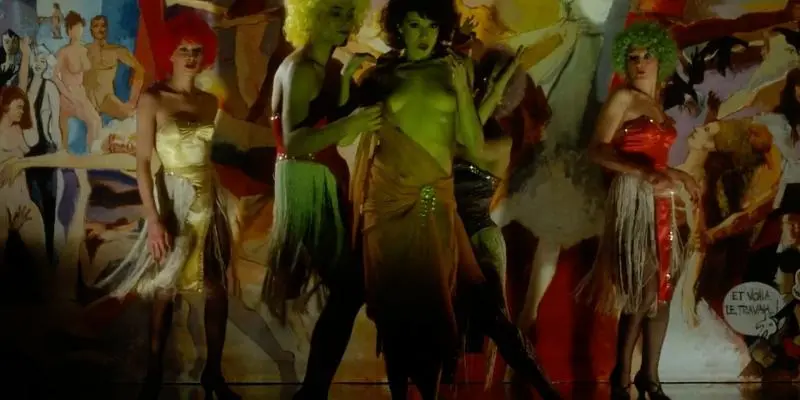
Vecchiali inherited from his hero Jean Grémillon a keen sense for the fragility and decay of things, which always inhabits the underside of his films’ overwhelming effect of red-blooded human presence. When, at the start of the second reel, we see the black and white photographs that gumshoe Mélinda’s partner Natacha has taken in the club, we’re also seeing the first reel as something already passed into the fixity of recorded images — frozen poses, an obituary for a scene. Change pas de main is full of photographs and film reels: well before Godard enters his melancholic-reflective mode, Vecchiali is already conflating the manifold processes of social entropy — the darkening of time — with the aging of images and the distortion of real events by permanent photochemical capture. That distortion seeps into reality itself and causes acts and their representations (visual, narrative, mental, sociological) to fold endlessly in on each other, a process Derrida (born three months after Vecchiali) would, interestingly, soon term invagination. [6] This is a kind of minor key cinephilia, manifested elsewhere in the naming of the seedy club at which Victor/Marcel’s murder takes place ‘Shanghai Lily’s’, and its decoration with a huge photograph of Marlene Dietrich. Here, cinephilia is transformed from a source of detournements, provocations and boyish homages — as it generally functioned in the films of the Nouvelle Vague — into a set of axioms or premises for far more troubled elaborations. And if it matters that the murder is timed to the end of a song and dance number, it’s because in this case another inheritance from earlier French cinema — the paradigm of life as performance, what we call in English the ‘All the world’s a stage’ topos — has been recast in a similar register. [7] So when Mélinda and Natacha, sitting below a clothes line on which some of the latter’s photographs are drying, and reeling from the violence they have just witnessed, melt into a ménage à trois with their companion Andrew, we might ask whether this is a release of tension or another act of obedience to heteronomic choreography. Vecchiali knows that we know that this scene fulfills part of the film’s pornographic quota. ‘Feeling better?’, asks Natacha. ‘Absolutely’, Mélinda replies. Natacha: ‘I love you.’ Vecchiali is constantly making a stereogram out of two flat images.
Sex in Change pas de main is always intensely mediated, whether we are watching someone watch a threesome, watching someone pleasure themselves while watching one of the pornographic films within the film, watching one of those films intercut with footage of its production, or just watching the way Vecchiali makes use of the mise en scène of the porno within that of the detective film, as the two forms watch each other. After all, what does it mean to find one has been ‘set up’, as the fictional private eye so often does, if not to realize one has been following someone else’s direction? With its convolutions, interruptions, and increasingly nightmarish plot, it’s impossible to imagine anyone enjoying Change pas de main in the straightforward way porn films are supposed to be consumed, through which all forms of mediation momentarily fall away in favor of immediate scopophilic satisfaction. Vecchiali is constantly changing hands on his audience. Yet he also recognizes, and asks us to recognize, the inextinguishability, even in the throes of all this mediation, of the mysterious effect that simply acting out the steps and singing the tunes seems to create, something sexologist Blaise Pascal described as follows:
We must combine outward and inward to obtain anything from God; in other words we must go down on our knees, pray with our lips, etc., so that the proud man who would not submit to God must now submit to his creature. If we expect help from this outward part we are being superstitious, if we refuse to combine it with the inward we are being arrogant. [8]
We must go down on our knees; the icy center of Change pas de main — ‘temporary actors’, as Mélinda puts it [acteurs de passage], forced into passionless sexual performances directed by powerful, secretive figures — could easily be taken as a loose metaphor for any given form of social coercion, even for that thing called ‘contemporary sexuality’ itself, but Vecchiali is too fleet-footed to dwell on that. His attitude towards subtext is probably indicated by his decision to give Bouvet’s demonic necrophiliac the name ‘Bourgeois’. Yet, as a work of psychosexual media analysis, the film already laps the epoch-making ‘Visual Pleasure and Narrative Cinema’, whose publication it preceded by four months. There, Laura Mulvey famously concludes by calling for filmmakers to ‘free the look of the camera into its materiality in time and space and the look of the audience into dialectics, passionate detachment’, arguing that this would ‘no doubt’ do away with ‘the satisfaction, pleasure and privilege’ of the voyeuristic viewer on which popular cinema had depended. [9] But Vecchiali knows that, for the true disciple of images and bodies, cinematic dialectics will always produce its own surplus scopophilic pleasure. The task is forever to do it all, to unite the distance of the dialectical eye with the proximity of the eyes of flesh, and Vecchiali’s entire oeuvre, wide-eyed and glowering, luxuriates and trembles in the face of the absurd ambition this implies, constantly reinvesting itself and constantly counting the costs. This, an erotics as much as a poetics, was a way to create a genuine post-Nouvelle Vague cinema (‘I wasn’t happy with French cinema’, Vecchiali later reflected [10] ) and it opened up a path for a set of filmmakers who were each deeply idiosyncratic but united in rejecting a radicalism that had already drained itself of life. [11]
Pas de change, changement de pas
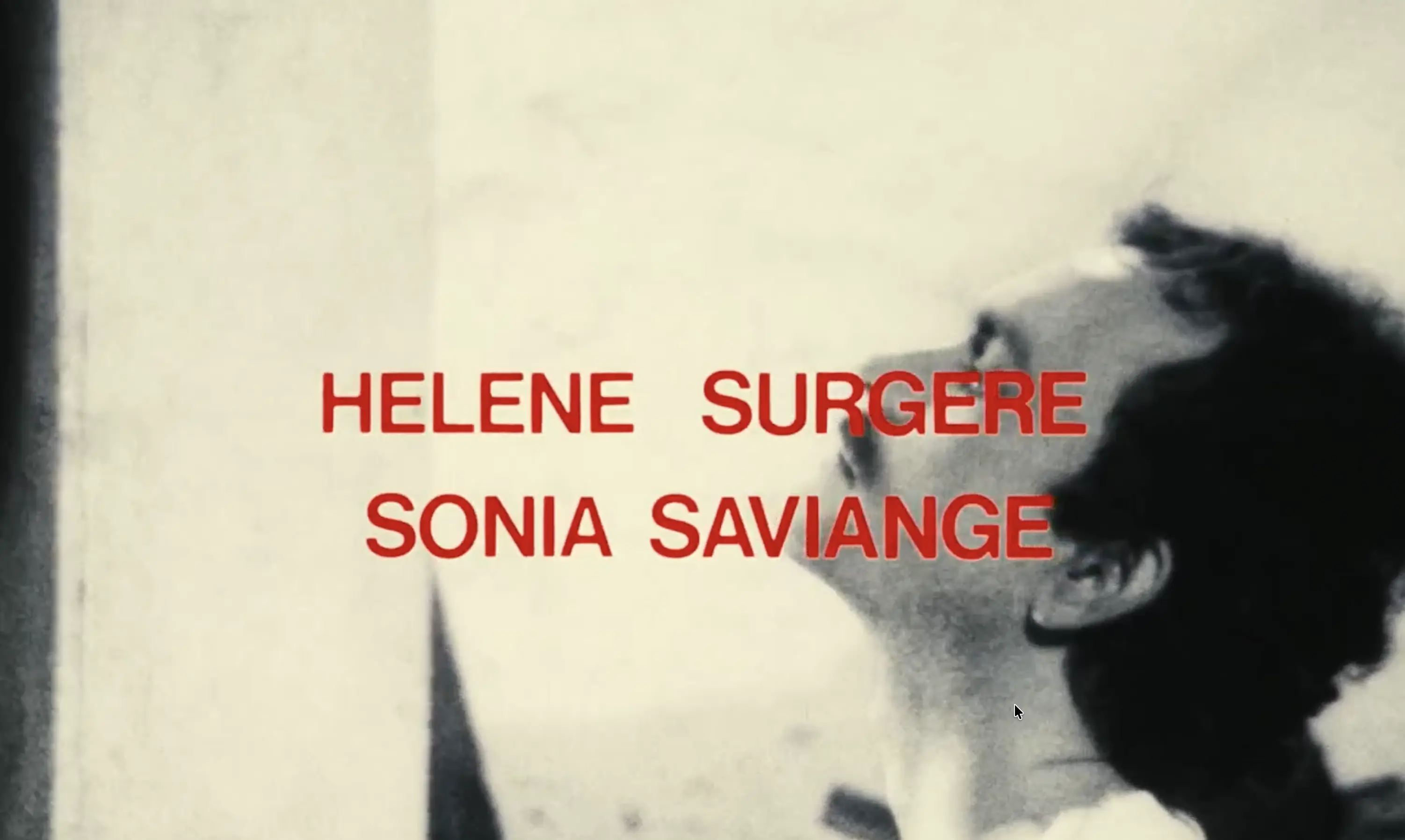
Back to anecdote: not only were both Jean-Claudes, Guiguet and Biette, assistant directors on Change pas de main, the latter also wrote several scenes in the film peppered with wordplay — homonymies like elle-même (‘herself’) and elle m’aime (‘she loves me’) — which certainly bear in nuce the hallmarks of the writing that would blossom in his own features. And here again we have the stars of Femmes femmes, Hélène Surgère and Sonia Savange, whom Guiguet and Biette would divide among themselves in their debut films. [12] Noël Simsolo, who had co-written Femmes femmes and would go on to direct the Diagonale feature Cauchemar, features in Change pas de main and was largely responsible for its script. Six other members of the film’s cast, in addition to those already named above, would appear in at least one more Diagonale production (Myriam Mézières, Liza Braconnier, Michel Delahaye, Howard Vernon, Dominique Erlanger, and Denise Farchy). When she saw the film, a young critic who herself worked in a pornographic theater sent Vecchiali a fan letter. They met, and Marie-Claude Treilhou joined the social circle that would become known as the Diagonaleux. If Femmes femmes is Diagonale #0, Change pas de main is Diagonale #0.5. Halfway through the film, Simsolo’s character says, ‘By tomorrow this whole affair will seem ridiculous’. This line could be spoken in any number of Diagonale productions, which prototypically take shelter in the freedom and cruelty of the night and fear the light of the morning. But by tomorrow, it will be too late to see what — and who — has changed, because it will be time to start another film.
And what of Politics with a capital P, the kind the film’s plot deals in, the kind that involves ministers, conspiracies, backroom deals, and documents changing hands? Vecchiali is no more interested than the great noir filmmakers and pulp novelists of the forties and fifties in patronizing his audience by professing to explain to them how things are. Capital-P Politics is a way of moving pieces horizontally and vertically on a board. The real politics is in everything else; in the diagonals.
Notes
Josiane Scoleri and Vincent Jourdain, ‘Entretien avec Paul Vecchiali’, Zoom Arrière, 6 (2022), 140–172 (p. 168). This line also appears in several other places.
Quoted in Mathieu Orléan, Paul Vecchiali, la maison cinéma (Éditions de l’œil, 2011), p. 98.
See Pascale Bodet et Emmanuel Levaufre, ‘Le branle des évidences’, La Lettre du cinéma, 18, Spring 2002, 31–57 (p. 55).
See footnote 12 in the editorial in this issue for the story behind the production of Change pas de main and its contribution to Vecchiali’s departure from Unité Trois, the production company he co-directed immediately prior to founding Diagonale.
Played by Marcel Gassouk, who had been in Vecchiali’s Femmes femmes and would turn up again in Jean-Claude Biette’s Le Théâtre des matières.
See Jacques Derrida, ‘Living On: Border Lines’, trans. by James Hulbert, in Deconstruction and Criticism, ed. by Harold Bloom et al. (The Seabury Press, 1979), pp. 75–176.
According to Vecchiali, on seeing Femmes femmes, Rivette, who was at the time working along similar lines, told him: ‘You’re really the craziest among us. Because you don’t pretend.’ See Paul Vecchiali, Le cinéma français: Émois et moi — Tome 2: Accomplissements (Éditions Libre & Solidaire, 2022), p. 28.
Blaise Pascal, Pensées, trans. by A. J. Krailsheimer (Penguin, 1995), §250.
Laura Mulvey, ‘Visual Pleasure and Narrative Cinema’, Screen, 16:3 (October 1975), 6–18 (p. 18).
Rien à voir [radio program by Hélène Frappat], 24 October 2005.
See for example Jean-Claude Biette on the making of Le Théâtre des matières: ‘I tried to act as if the last twenty years didn’t exist.’ ‘Jean-Claude Biette: Le Théâtre des matières — Interview par Marie-Claude Treilhou’, Art Press, no. 14, January 1978, p. 28.
See Pierre Eugène’s article ‘A start in life’ in this issue.