The final shot of Michael Cimino’s Year of the Dragon — composed of movements that come to a halt, restart, and alternate until the film’s definitive freeze frame — is a variant of a rhetorical figure typical of a new cinematic common language. In fact, every film that ends with a freeze frame unknowingly manifests a metaphysics of the image as a new, sacred value. In this common language, the image (cf. also the equally violent and arbitrary standpoints of those for whom cinema ‘is first and foremost the image’), postulating in principle an infinite combination of visual elements, now relies not merely on the possibility (which would have been a pleasant way to envisage cinema) but on the obligation of according credit and value no longer to the restitution of space and life as something lived, sensed, observed, or imagined, but to the compilation of all visual figures, emitted by genres all throughout the History of Cinema.
The cinema of advertisement has habituated us to perceiving every shot as a fetal bath of images and every advertising spot as a narrative highway that opens onto a word, name, phrase, or image. This idealization of the image as surface — signified, thus, most often by a freeze frame at the end of a film — is gradually leading to an archaeological reconstitution founded on an implicit principle: we know that the cinema of our predecessors was nothing more than the illusory reproduction of life. Today, every film that employs this full stop is cruelly reminding us that cinema is merely a succession of images condemned to the freeze frame. Television, followed by the video cassette recorder (VCR), and in ways more radical than all the cinematheques in the world, has transformed all filmmakers into potential or actual owners of all the cinematic treasures, from the Lumière brothers’ documentaries to pornography and filmed opera, from Griffith to Straub. What has now become common to films being made today, and to the Big Book of Cinema that everyone can read or flip through on a television screen, is the freeze frame. Freezing the instant, an operation unavailable twenty years ago, has become a temptation the spectator can’t resist.
Godard attributed the invention of the freeze frame to the ending of Truffaut’s Les 400 coups (Truffaut, who so loved books). In any case, this invention precedes Truffaut and can be traced to a film adaptation of a book: it is at the end of Madame Bovary that Vincente Minnelli freezes the image of James Mason-Flaubert. This freeze frame of a book, as imagined by Minnelli, has become a cinematographic rallying sign correlated to the fact that the image has become but a pure quantitative operation of copying (images are already being reproduced electronically). Today, anyone whose unconscious memory of films is insufficient can consciously recopy the effects they admire into the Big Book of Cinema, which they can read and reread at will on a VCR (thanks to the remote control). In both cases, it is the freeze frame that reigns.
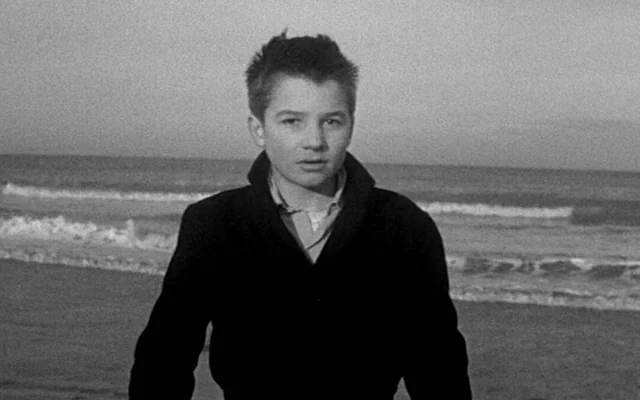
Les quatre cents coups (François Truffaut, 1959)
Mizoguchi, [1] who made sublime films rooted in the archaic illusion that cinema ought to capture life instead of composing images, would have never dreamed of ending a film by freezing life. He, who spared nothing in his quest to render life real on screen, would have never been tempted to reduce life to the confines of the image. Never has a shot by Mizoguchi been the sum of abstract recipes and effects but always an incalculable encounter between human, atmospheric, luminous, and technical vibrations generated by the certainty that life, which precedes and succeeds a film, never stops being there (from the first dream or intuition of a film to the production of its first print). At times insidiously and at others brutally, life interrogates Mizoguchi. Mizoguchi never forgot that he had to work on capturing on film what is essential in life. (The story of the steak, recalled by Claude-Jean Philippe, is a testament to the constant attention one finds in Mizoguchi, who heard in the voice of his actress, chewing her meat, intonations of wellbeing incongruent with her character.) This delightful illusion, which Mizoguchi and most of his colleagues had in common, found an equal counterpart only in the films of Murnau and Griffith, where space, along with the human face (and beginning with the sound film, the voice), are the only orders of magnitude that guarantee cinema, through the surpassing of its techniques, its sacred character as an art. Space, in Mizoguchi’s films, is a metaphor for life that radiates beyond people’s social and historical contingencies all the while avoiding being fixed in an indifferent beauty. Mizoguchi restores to the visible world its sacred character: with his sudden openings of spaces that cast out beings or pit them against each other (the most beautiful camera movements ever conceived by a filmmaker), he exalts depth of field to the point of making it express, with a sort of wave induction that extends the actors-characters, the immensity of life.
Today, with the combinatorial image, filmed space is no longer felt as a beam of vibrations. Had we still believed in that, we would not have felt the need to over-signify that the film has ended, as is done with the freeze frame. The vibrations of the shot, the dramatization of space, the distance between characters (or their proximity) would have sufficed (with a bit of music around it, sometimes). Even if someone decides to go back to this old way of doing things, the spectators, even before they consider the possible new metamorphoses, would read it as a figure of speech. The impasse is rather total. How to break the wall of the freeze frame? Some have managed to do so. Godard’s Détective ends on a recognizable image (a happy ending in a car) that is scorned by dialogue. At the end of Straub and Huillet’s Klassenverhältnisse, it is sound that tears the contemplative image and breaches the impasse.
In Abbott and Costello in Hollywood (programmed as part of Eddy Mitchell’s television show La Dernière Séance on FR 3), space is not tasked with expressing great things (Sylvan S. Simon is probably only an artisan unconcerned by creating), but, more conventionally, with allowing actors and their gags to unfold with great clarity and precision. Abbott’s comedic genius, not unrelated to the vulgarity of Benny Hill, [2] consists of pushing gags to absurdity without ever distracting spectators from the gags’ physical incarnation: Abbott’s dynamic head and stocky body, more three-dimensional than in W.C. Fields’ work (in which the voice does more than half of the work), offers a guarantee that the abstraction of a gag is merely a tool. Abbott had to await a director skillful enough to make all the ingredients that go into the composition of a film appear as their natural and logical extensions. This is precisely what takes shape in Abbott and Costello in Hollywood. Everyone in the film performs on the same wavelength as the titular actors, unlike in most serial American comedies and musicals where characters act as foils desperately signaling the remoteness of their era. In Abbott and Costello in Hollywood, all the characters are there in front of us in the unfolding time of the film — in the present. These actor-characters have the power to efface the heavy and outdated traces of the style of the era. (What the hell sent Woody Allen — who has no need to copy anyone — into the Hollywoodian pyramids?) This, for the time being, is the last fortress of resistance against the insidiously totalitarian regime of the archaeology of the image: that actors stop referring to the stars who preceded them and instead be themselves in the present. At least their light would be real.
Le Journal des Cahiers, 58, Cahiers du cinéma, 327, January 1986, pp. 10–11.
Published in Poétique des auteurs (Éditions de l’Etoile,
Cahiers du cinéma, 1988), pp. 128–130.
Notes
Thanks to a serendipitous change of programming on Antenne 2, we were able to rewatch Saikaku ichidai onna (The Life of Oharu).
Fortunately, Jean-Pierre Mocky drew attention to this major popular actor who deftly crossed the lines of taste à la française and who gives us a much better representation of Elizabethan theatre than the reconstitutions one finds in the films of the Sir Laurence Olivier tradition.