Cézanne – Dialogue avec Joachim Gasquet gathers together a bundle of texts which venerate the land across diverse geographies and centuries. Jean-Marie Straub and Danièle Huillet start with Gasquet’s book Cézanne, which offers Paul Cézanne’s method to the reader in dialogues between the poet and the painter. These conversations are both pedagogical and devotional. Huillet narrates Cézanne, her tone stern, musical, yet ecstatic, self-transcendent. Straub’s Gasquet is confined to his questions. Cézanne’s creed colors the film, built over twenty two blocks composed of: ten shots of Cézanne’s art, four shots of Mont Sainte-Victoire, three shots of photos of Cézanne near the end of his life, two sequences from Der Tod des Empedokles, one scene from Jean Renoir’s Madame Bovary, and a concluding shot at the gate of Cézanne’s studio in Paris. These too are structured by dialogue, an intimate architecture composed of rigid elements — Cézanne posits an understanding of the interconnectedness of all things which are bound together by light.
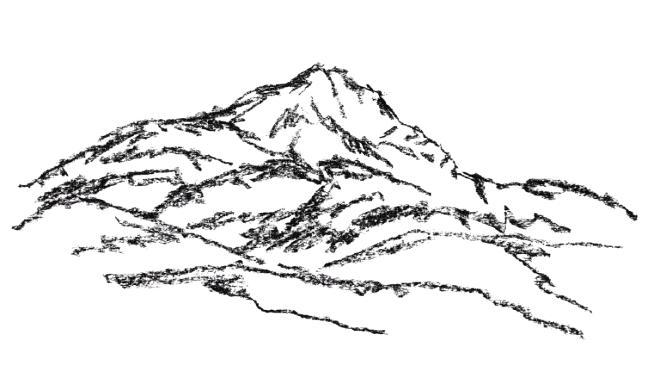
Original illustration by Syd Henry Lewis
Huillet was the first to know Cézanne; as a child she saw The Grand Bathers (c. 1900): ‘My first impression was, he can’t paint [...]; nevertheless there was something in it that made me think about it for a long time afterward, and that made me unable to look at the pictures by the other painters…’ [1] The first two shots manifest the difference between the filmmaker and the painter. Straub and Huillet can pan their camera and show objects across a radial plane. Though it is only scarcely visible in the background of the former, the first two shots both pivot to reveal Mont Sainte-Victoire, the sole subject of Cézanne’s painting that the filmmakers sought to restage. Cars dart across the frame in both directions, a truck seems to lead the camera’s gaze left. A column of trees, its leaves waving in the wind, decorate the shift in perspective, which ends trained on the tops of the buildings of a town in the distance, with a hill behind them, and only the faintest impression of a larger body behind that, something not quite distinct as the mountain but which disrupts the blue of the sky. It’s not dissimilar to the kind of view presented in Toute révolution est un coup de dés but its framing is at odds with Cézanne’s paintings — unlike his landscapes, the lower half is dominated by a close view of the immediate grass on the hill on which they stand. This large green object is cast half in dancing shadows cast by the leaves of the trees which adorn the upper left and right corners of the frame — the gaze must come to rest higher in the composition to see echoes of the painter’s own mannerisms. The wind still blows as the second pan begins its movement, following the arch of the bending trees in the foreground — tracking along an elevated roadway among scattered buildings. The view at the end of the second most closely resembles Cézanne’s Mont Sainte-Victoire and the Viaduct of the Arc River Valley (c. 1882–1885). The mountain is plainly visible beyond greenery and human architecture — the buildings have changed, taken over the topography in the hundred years since Cézanne painted the simple agricultural abodes, and cars have come to dominate the roads. Straub–Huillet are not interested in capturing the world as Cézanne did, because one cannot capture the world in the same way — the balance of the earth has changed; revolutions have been fought and won and lost; the topography, though familiar, has shifted — they can only set up their camera to record what they understand of Cézanne in the world as it is.
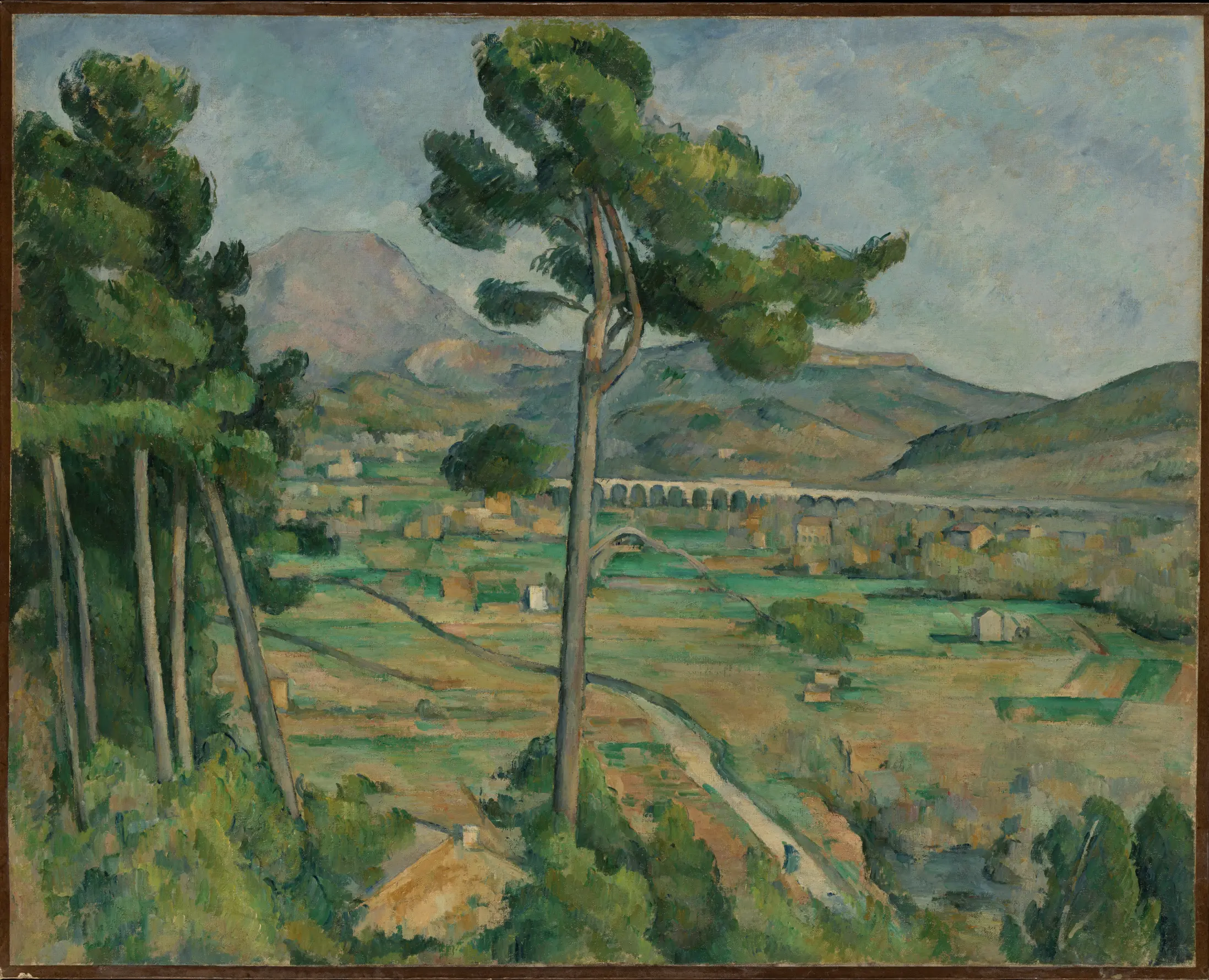
Mont Sainte-Victoire and the Viaduct of the Arc River Valley (Paul Cézanne, 1882–1885)
Narration arrives over a photograph of Cézanne, held patiently, sitting plainly on a red background. Cézanne is suspended in action, his arm outstretched with a brush. The canvas is positioned almost exactly vertically, and the artist looks alert, but marked by his craft — he is caked in stains. In Huillet’s voiceover, Cézanne speaks about the earth he sought to capture, the spiritual fervor that compelled him. A shot of Cézanne’s painting An Old Woman with a Rosary (c. 1896) introduces the segment from Madame Bovary’s episode from the history of the class struggle. Leroux, a peasant woman, has earned a silver medal worth 25 francs for fifty-four years of service on the same farm. She will donate it to her priest. For this, she is made the joke of the local bourgeois, the same beneficiaries of the religious fervor in the peasantry — the pacifying promise that though their labor had not been rewarded in this life, it would be in the ‘next’. Straub and Huillet cut to Mont Sainte-Victoire again, from a distance but much closer than before. Cézanne’s mission is stated in clearer terms: ‘All creatures and things, more or less, are only a bit of heat, stored up, organized… a memory of the sun […]. This sunshine… The chance fashion in which its rays fall, the way it moves, infiltrates things, becomes part of the earth’s fabric — who will ever paint that? Who will tell that story? The physical history of the earth, its psychology.’ [2] Huillet presents via Cézanne the unity which exists in the common spirit of things — a gesture of her ecological communism, which maintains that humanity is bound to nature, and governed by a system based on these principles. Jacques Rancière writes that ‘communism, for the Straubs, in this last part of their work, must necessarily be linked to a nature without rhyme or reason. There is also a dispositif that pronounces a rupture with the idea of nature that accompanied Marxism for a long time: nature as transformable material that man must model in his image and the idea of history as the humanization of nature’. [3] Cézanne does not form the earth in his image, nature impresses itself on him. He says earlier that ‘the artist is only a receptacle of sensations, a brain, a recording apparatus’. There is no better summary of Straub–Huillet’s project than these challenges posed by Cézanne: from Othon to Moses und Aron to Dalle nube alla resistenza to Trop tôt, trop tard, the filmmakers set up their camera and take in the world as it is. The earth expresses itself in slabs of rock, in mountains and volcanos, in peasants, prophets and painters. Straub–Huillet’s film of Hölderlin’s Der Tod des Empedokles, which we see excerpted, expresses this version of communism. Mont Sainte-Victoire is closer than ever now. It is closer than Cézanne painted it, though just as prominent in the frame as in his watercolor, Mont Sainte-Victoire (c. 1897). Standing between the intersection of two hills which occupy the bottom half of the frame, the peak soars into the sky, while greenery dots the land below. The wind doesn’t howl, the clouds don’t drift, the shadows on the mountain don’t transform. The painter explains that his strokes must illuminate the blue of the sea to the right, beyond the edge of the frame and the mountain. The camera makes a movement towards the sea beyond three trees, an enormous pan of 270 degrees. This is the last time the mountain is seen as it stood before Straub–Huillet, departed from by the motion that marked the separation of the mediums of film and painting at the start. Situated at almost the exact center of the film, it is the innermost expression of their proximity to and distance from Cézanne. This was the mountain he painted, but they could not paint it; the invisible light of the sea dictated that they must turn their gaze.
The film’s end is marked by the emergence of Cézanne’s paintings en masse, a parade of frames whose content marks major motifs in the artist’s career — still life, landscapes, portraiture. Rochers et branches à Bibémus (c. 1906) is the fourth painting presented, and the last section of the film that includes narration from the chapter ‘The Motif’, which is the source of the dialogue up to this point. The work presents a view of the small corner of a rockface — leaves and rocks and branches blend together, amid wonderful green shadows. Cézanne declares his will to die working in a corner. The last view of the mountain: Mont Sainte-Victoire (c. 1904), more than half of it left white. It is the first painting presented without commentary. A shot of the still life Apples, a Bottle and Chairback (c. 1902) transitions to the last chapter of the book, ‘The Studio’: ‘I paint my still lifes for my coach driver who does not want any. I paint them so that children on the knees of their grandfathers look at them while eating their soup and babbling.’ [4] This sentiment makes an appeal to the ‘modest’ people to whom both Straub–Huillet and Cézanne dedicated their craft. Les Grandes Baigneuses makes an appearance — the painting a country girl could not shake. There is no narration but Huillet doesn’t leave the painting hanging in silence. Instead, there is a profound disrupture of the gallery by the simplest of means — the wind blows through the trees, an element of rare nondiegetic sound in their oeuvre. The trees in the painting don’t move, but the dissonance has a gravity: this is ‘nature without rhyme or reason’. We hear her speaking again, over The Gardener Vallier (c. 1906), painted the year he died, which was at least in part a portrait of himself posing in place of his absent model. He wanted to die working. It is the last line of Gasquet’s book, ‘I want to die painting… to die painting…’ [5] Straub and Huillet do not end on this line, but the line before: ‘It is frightening, life!’ Their approach to the text has been chronological, but leapfrogging — their sequence of paintings has darted across his career. A sketch undated, Naked Woman, standing, right leg folded, arms raised, plays for four seconds in silence. The filmmakers cut to a view of the artist’s studio in Paris, seen in the distance from behind an ornate gate. His Paris is clean, tidy, and separated from the people. The geometries of the frame lead the eye down the street and around an unknowable corner — there is a threshold.
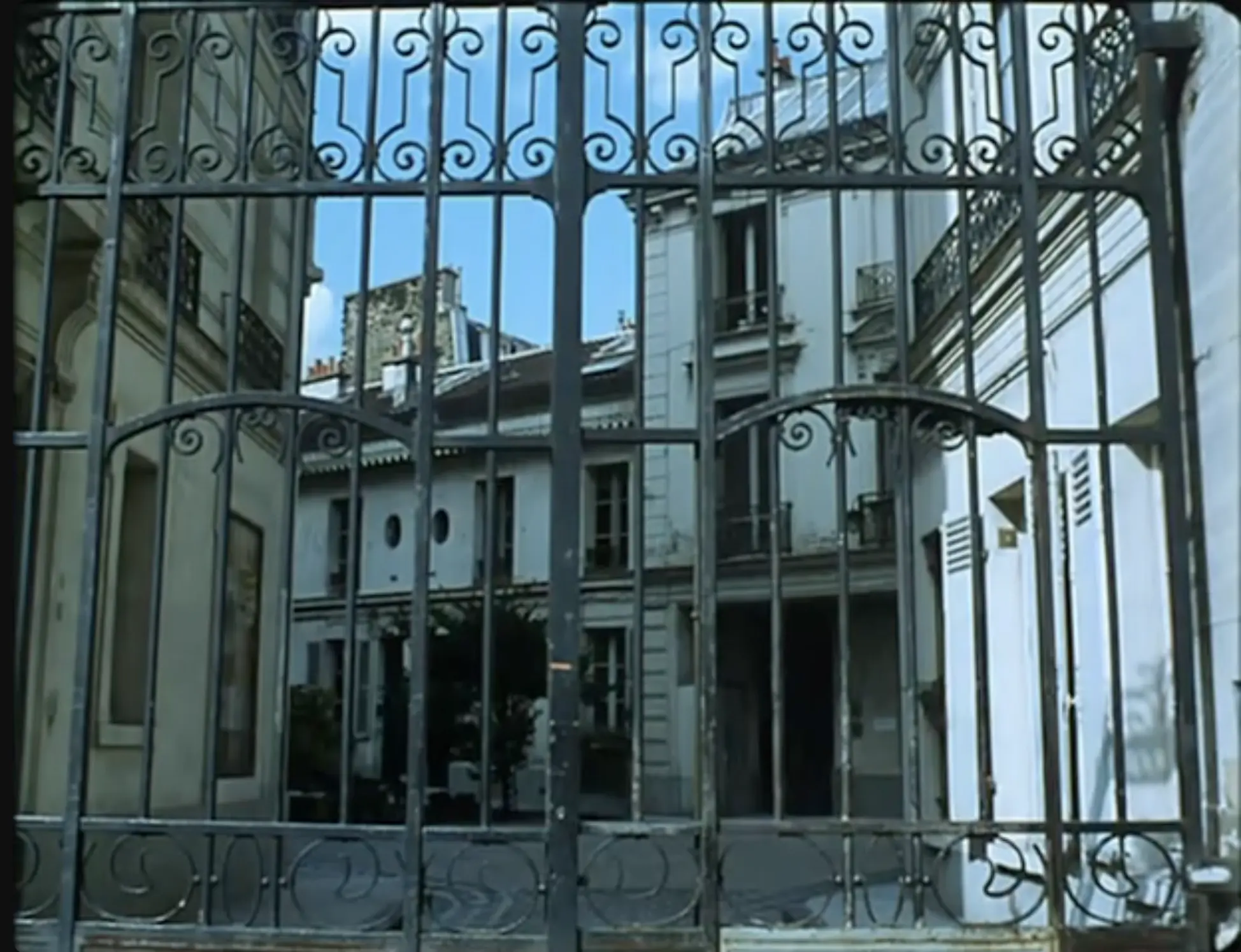
Cézanne – Dialogue avec Joachim Gasquet (Straub - Huillet, 1990)
Notes
Danièle Huillet, ‘Danièle Huillet at Work’, trans. by Ted Fendt, https://kinoslang.blogspot.com/2017/05/dan-iele-huillet-at-work.html. Originally published in German in Frauen und Film, 32, June 1982, pp. 4–12.
Joachim Gasquet, Cézanne, trans. by Christopher Pemberton (Thames and Hudson, 1991), p. 152.
Jacques Rancière, ‘Politics and Aesthetics in the Straubs’ Films’, trans. by Ted Fendt, MUBI Notebook, 7 November 2011, https://mubi.com/en/notebook/posts/politics-and-aesthetics-in-the-straubs-films. Originally delivered in French for a screening of Dalle nube alla resistenza and Operai, contadini, February 16, 2004, Jean Vigo Cinema, Nice, France.
Gasquet, Cézanne, p. 223.
Ibid., p. 224.